
Case File: What the Nvidia CEO Inquiry Means for Founder Control and Succession Risk | MyTechDailyNews General
By Sarah Chen, Tech Daily · MyTechDailyNews General desk
Direct answer: the independent inquiry opened by Nvidia’s board does not change who runs the company. Jensen Huang continues as founder and CEO, and the control question that actually matters is arithmetic rather than gossip — 870.6 million shares, 3.58% of Nvidia, with roughly 92% of that bloc parked in family trusts he administers jointly with his wife, Lori Huang. This case file reconstructs the timeline, the ownership stack, three reusable precedents and a checklist of what to watch next.
What happened on Nov. 8, and what the board is reviewing
Nvidia’s governance stress test started with an email. On Nov. 8, local time, Huang sent a note to Nvidia employees acknowledging an extramarital affair and apologizing to his family. The same day, the company’s board announced a committee of independent directors, assisted by outside independent counsel, to run an investigation.
The board’s own wording matters, because it reframes the issue from personal conduct to institutional exposure: “The NVIDIA Board is initiating an independent investigation in light of recent reporting that founder and CEO Jensen Huang has been the target of a foreign intelligence effort.” The statement added that the board “has confidence in Jensen and his leadership team.” A company spokesperson said Huang stays on as CEO with no break in his duties. He has led Nvidia for more than 30 years, and the company is the world’s largest AI chip maker.
Five dates anchor the case:
- March this year — Huang told a podcast audience he distrusts formal succession plans and would rather teach continuously than name an heir.
- March 23, 2026 — the measurement date for the share counts disclosed to regulators.
- May this year — Nvidia submitted its formal document to the U.S. Securities and Exchange Commission (SEC), putting the 3.58% figure on public record.
- June — at the annual meeting, every director listed in that filing was re-elected.
- Nov. 8 — the apology email, the board’s independent-investigation order, and the market’s control-and-succession questions.
What Nvidia’s control is actually built on
Conclusion first: the founder owns very little and controls a great deal, and the control comes from job design, not from a privileged share class. Nvidia has no AB dual-class structure; Huang’s shares are ordinary common stock.
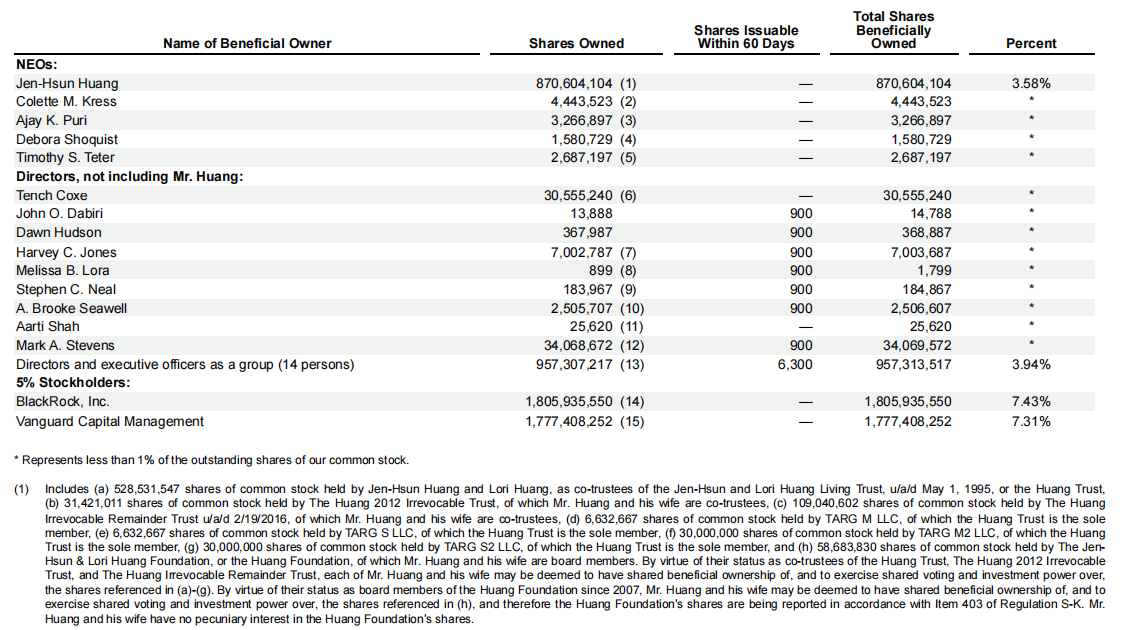
Per the May filing, Huang beneficially held 870.6 million shares of common stock as of March 23, 2026 — 3.58% of the company — spread across family trusts and holding vehicles in which he and Lori Huang are co-beneficiaries. The stack behind that percentage looks like this:
| Vehicle holding Nvidia shares | Shares | Position in the founder bloc |
|---|---|---|
| Jensen Huang and Lori Huang Living Trust (the Huang family trust) | 528.5 million shares of common stock | 60.7% of everything Huang controls; both spouses are co-trustees |
| Huang Irrevocable Remainder Trust, Huang 2012 Irrevocable Trust, TARG M LLC, TARG S LLC, TARG M2 LLC, TARG S2 LLC | 213.7 million shares of common stock | each names Huang and his wife as co-trustees or has the Huang family trust as its sole member |
| Jensen Huang and Lori Huang Foundation | 58.6838 million shares | Huang and his wife sit on the foundation board |
| Bloc with joint voting and investment power | 801 million shares | about 92% of the shares Huang controls |
| Residual held in his own name | up to 69.66 million shares | the gap between 870.6 million and 801 million at the filing date |
Huang and Lori Huang were married before Nvidia was founded in 1993, which is why investors keep re-running this arithmetic: nearly the whole founder bloc is co-trusteed, not individually held.
Why a private event becomes a public control question
Definition worth keeping: key-person risk is the exposure a company carries when its strategy, capital allocation and public credibility route through one individual rather than through an institution.
Nvidia’s version of that risk is unusually concentrated for a company with such a thin founder stake. Only two shareholders report stakes above 5%, and both are large asset managers rather than families: BlackRock, Inc. at 7.43% and Vanguard Capital Management — the manager behind the Vanguard group — at 7.31%. Of the five named executive officers listed in the filing, four hold less than 1% of outstanding common stock. The company has no chief operating officer, has more than 40,000 employees, and stays flat by design: dozens of direct business leads report to Huang personally.
At board level there is no chairman. Every director except Huang is independent, the independents designate one lead independent director, and Huang is the only management voice in the room. The board has 11 members today and had 10 when the May document was filed — the extra seat was added after that filing — and all sitting directors were re-elected in June. The nine directors other than Huang each own less than 1%; the largest independent holding belongs to Mark A. Stevens, at 34.0696 million shares.
| Layer | What Nvidia looks like | Why this episode makes it matter |
|---|---|---|
| Founder economics | 870.6 million shares, 3.58%; 801 million of it jointly beneficial with Lori Huang | a change in family status would be processed through trust deeds, not headlines |
| Other large holders | shareholdings above 5%: BlackRock, Inc. 7.43%; Vanguard Capital Management 7.31% | the register is institutional and dispersed, so a shifting bloc is proportionally significant |
| Management line | five named executive officers, four under 1%, no chief operating officer | there is no announced number two |
| Organization | more than 40,000 employees; dozens of direct reports to the CEO | decisions queue at one desk, which slows things if that desk is distracted |
| Board | 11 members, no chairman, one lead independent director, Huang the only management member | oversight of the investigation now sits with the independents |
Two limits on the speculation should be stated plainly. There is no public evidence that Lori Huang has ever independently influenced a Nvidia board election or split with Huang on a major shareholder decision, and no public evidence that this episode has changed the couple’s marriage, the family trusts or the voting arrangements. Everything that follows is analysis of how such structures behave elsewhere, not disclosure from either party.
Precedent 1 — Amazon, 2019: how quickly a divorce creates a major shareholder
Process and result: in the 2019 divorce settlement, MacKenzie Scott received roughly a 4% stake in Amazon, about 400 million shares then worth some $36 billion, making her one of the company’s largest individual shareholders overnight. By October 2025, Reuters reported, she had reduced that stake by about 42% through donations and sales.
Reusable lesson: the headline percentage is the least interesting number on the page; the interesting one is who is entitled to vote transferred shares. Amazon absorbed a newly created large holder without a control fight. Nvidia’s founder bloc is smaller in percentage terms but stitched into co-trusteeship, which is a different legal animal from stock held in one person’s name.
Precedent 2 — News Corp: when a trust written during a divorce outlives its author
Process and result: Rupert Murdoch created an irrevocable family trust after his 1999 divorce to hold the family stake in what later became News Corp and Fox Corp, a structure that reporting has described as carrying roughly 40% of the voting power in both companies, with each of his four older children holding one vote and Murdoch himself four. When he moved to amend that irrevocable trust to give one son sole control, a Nevada probate commissioner refused, as the Los Angeles Times reported on Dec. 9, 2024. On Sept. 8, 2025, News Corp announced that trustees and beneficiaries had settled and ended all litigation, with a new trust for the remaining beneficiaries and cash for departing ones, funded in part by a public sale of about 14.2 million Class B shares.
Reusable lesson: vehicles drafted in one crisis can hard-code control for a generation, and they are enforced by courts rather than by family intent. Applied to Nvidia, the same logic says the answer to “who votes the 801 million shares” sits inside the Huang family trust and the companion irrevocable vehicles — not inside an apology letter.
Precedent 3 — Nvidia, 2013: the outside-investor test it already passed
Nvidia has met the barbarians at the gate once before. In 2013, the activist hedge fund Starboard Value wrote to the board while Nvidia was spread across several markets and challenged whether Huang was leading the company to ruin. Huang listened to Starboard Value’s chief investment officer on one point — exiting the modem market — but then lobbied multiple institutional investors to keep funding CUDA rather than let an outside fund set direction. The strategy stayed with management.
Three lessons worth copying:
- Activist pressure is survivable when management can defend a multi-year platform bet to institutional holders.
- Concession discipline matters: give up the small position, defend the platform.
- The real buffer is the shareholder register, not the founder’s percentage — which is exactly why movement in that 3.58% bloc, or an open CEO seat, changes the math.
Is Nvidia’s next CEO ready, and what transitions cost
Conclusion first: no successor has been announced, and the founder has explained why he does not want one.
Huang, 63, said on a podcast in March this year that he had publicly stated he does not trust succession plans; rather than be anxious about it, he prefers to break the problem down and stay in the present — passing on knowledge, information, insight, skills and experience as frequently and continuously as he can, with the stated aim of working in his role until the last moment of his life.
The bill for improvising later is measurable. Christopher Fernández-Aráoz’s research published in Harvard Business Review estimated that badly managed CEO and C-suite transitions in S&P 1500 companies alone wipe out close to $1 trillion of market value a year. And real searches are slow: Steve Ballmer announced his retirement in August 2013, and Microsoft named Satya Nadella chief executive roughly five months later, on Feb. 4, 2014, as The Guardian reported.
A flat organization is routinely mistaken for a bench. Dozens of strong operators is not the same as a designated successor, and similar people-risk questions are surfacing elsewhere in big tech — see our report on the leadership shuffle around Apple’s Siri AI team. The competitive backdrop keeps moving too, as our breakdown of AMD’s data-center-first quarter shows, yet Nvidia remains the standard-bearer of AI infrastructure buildout and, in the U.S. technology ecosystem, still has no rival that matches it. That is why the succession question is a market issue rather than a celebrity item.
Five misconceptions readers keep repeating
- “The board is investigating a marriage problem.” Nvidia’s statement ties the review to reporting that its CEO was the target of a foreign intelligence effort.
- “Nvidia is protected by super-voting founder shares.” There is no AB structure; the founder holds 3.58% of common stock.
- “A divorce halves the founder’s stake immediately.” Most of it is co-trusteed, and nothing has been disclosed about the marriage, trusts or voting arrangements changing.
- “Activists can now force board seats.” Starboard Value tried pressure in 2013 and did not take over the roadmap; the largest disclosed holders today remain BlackRock, Inc. and Vanguard Capital Management.
- “A flat org chart is a succession plan.” There is no chief operating officer, and the board’s only management member is the CEO under scrutiny.
What to watch next: a checklist
- Nov. 17 — Nvidia’s conference call on third-quarter fiscal 2027 results, scheduled by the company, with the standing outlook of revenue of $108.0 billion, plus or minus 2%. Read the governance language as closely as the numbers.
- Board follow-up — whether the independent committee and its outside counsel report findings, and whether the one lead independent director’s remit widens.
- Ownership filings — any move in beneficial ownership appears in SEC documents, searchable through SEC EDGAR full-text search.
- Strategy signals — CUDA roadmap commitments and major AI infrastructure announcements, the areas where outside pressure has historically tried to bite.
- Confidence signals — buyback pace and guidance framing at the next results meeting are the clearest public read on how much key-person risk the board thinks is priced in.
Action advice, by reader
- Founders and executives: document the trigger, not just the name. Charter language on who convenes, who leads and who speaks during a board investigation is what keeps a flat company steady.
- Investors: separate economics from votes before drawing conclusions from a percentage. Ask how a founder bloc is held — trust, LLC, foundation — and what the deeds require.
- Everyday tech readers and buyers: Nvidia’s products and developer platform run through dozens of business leads, so the near-term customer risk is slower decision-making, not a shutdown.
FAQ: what readers are searching
Is Jensen Huang still Nvidia’s CEO?
Yes. The company said his duties continue without interruption, and the board’s Nov. 8 statement said it has confidence in him and his leadership team while the independent committee’s investigation runs.
How much of Nvidia does the founder own?
870.6 million shares of common stock, equal to 3.58%, as of March 23, 2026, according to the formal document Nvidia filed with the SEC in May this year. About 92% of that bloc — 801 million shares — carries joint beneficial ownership with Lori Huang, leaving a maximum of 69.66 million shares held personally.
Could a share split decide who controls Nvidia?
Not on its own. The largest disclosed holders are BlackRock, Inc. at 7.43% and Vanguard Capital Management at 7.31%; the board has no chairman, has one lead independent director, and Huang is its only management member, with 11 directors in total and 10 at the time of the May filing. Control runs through that board and the management line, so a split would matter mainly through how trust documents re-assign voting power.
Has Nvidia been under outside investor pressure before?
Yes. In 2013 Starboard Value wrote to the board and challenged the company’s direction across multiple markets. Huang conceded the modem market but defended CUDA, courted institutional investors, and kept strategic control with management.
What is the best single signal to follow?
Follow-up disclosure from the independent committee plus the Nov. 17 results call. Governance wording in either will tell readers more than any new detail about the founder’s private life.
Sources
- NVIDIA Board statement on the independent investigation — nvidianews.nvidia.com
- Nvidia conference-call schedule for third-quarter fiscal 2027 results — investor.nvidia.com
- Reuters on MacKenzie Scott’s Amazon stake reduction — reuters.com
- Los Angeles Times on the Murdoch family trust ruling — latimes.com
- The Guardian on Microsoft naming Satya Nadella CEO — theguardian.com
- Christopher Fernández-Aráoz, “The High Cost of Poor Succession Planning,” Harvard Business Review — harvardbusiness.org
- U.S. Securities and Exchange Commission EDGAR full-text search — sec.gov