
Jensen Huang's NVIDIA Stake Compared: Trusts, LLCs, Foundation, and Governance Trade-Offs
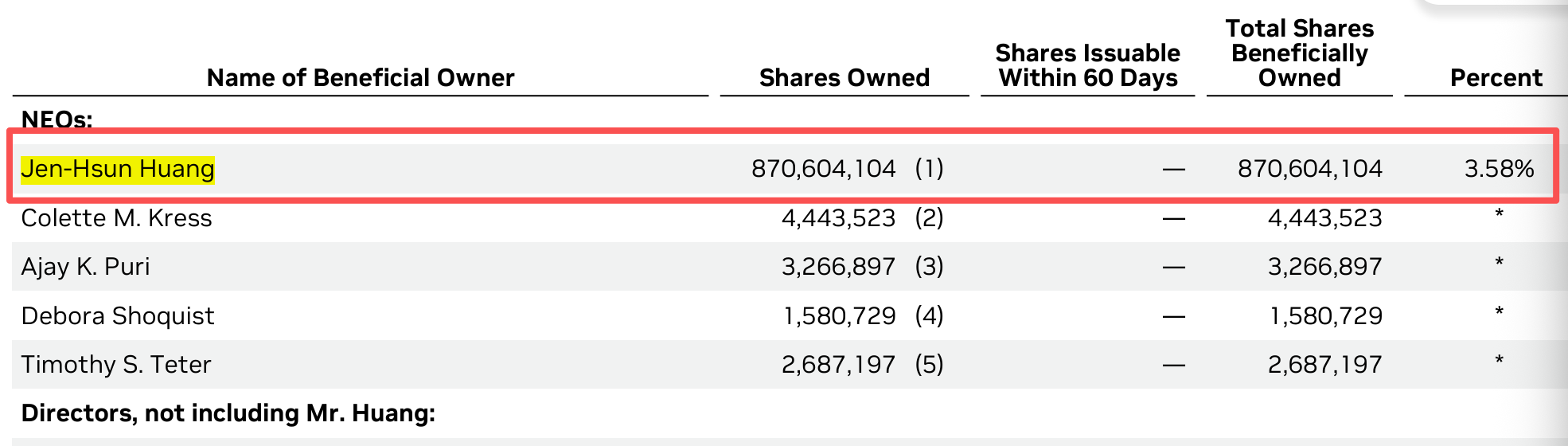
On November 8, 2026, NVIDIA's FY2026 disclosures show Jensen Huang beneficially owns about 871 million shares, roughly 3.58%; about 801 million shares are disclosed as jointly held with Lori, worth about $149.5 billion, while an independent committee has begun a review after his public apology.

What the numbers mean before the governance story begins
The disclosure is best read as a comparison between ownership size and decision power. NVIDIA's FY2026 filing attributes about 871 million shares to Jensen Huang, with about 801 million described as jointly held with Lori. That joint block is valued at about $149.5 billion. The gap to the total is about 69.66 million shares, and the filing does not explain that remainder. For a broader market reference, 36Kr reported that, based on the November 6, 2026 closing price of $186.64, Huang's approximately 871 million-share stake corresponded to about $162.5 billion.
| Comparison layer | Reported fact | Reader takeaway |
|---|---|---|
| Total attributed stake | About 871 million shares, about 3.58% | Large economically, but not majority control. |
| Jointly disclosed block | About 801 million shares, about $149.5 billion | The family-holding story is the core of the filing. |
| Undisclosed remainder | About 69.66 million shares | Readers should treat missing breakdown as unresolved. |
| Market-value reference | About $162.5 billion at the November 6, 2026 close | Price-sensitive figures should be dated. |
Which holding vehicle fits which purpose?
Conclusion: the 801 million-share joint block is not one simple account. It is a mix of trusts, limited liability companies, and a foundation, each carrying a different trade-off between family control, legal administration, and economic use.
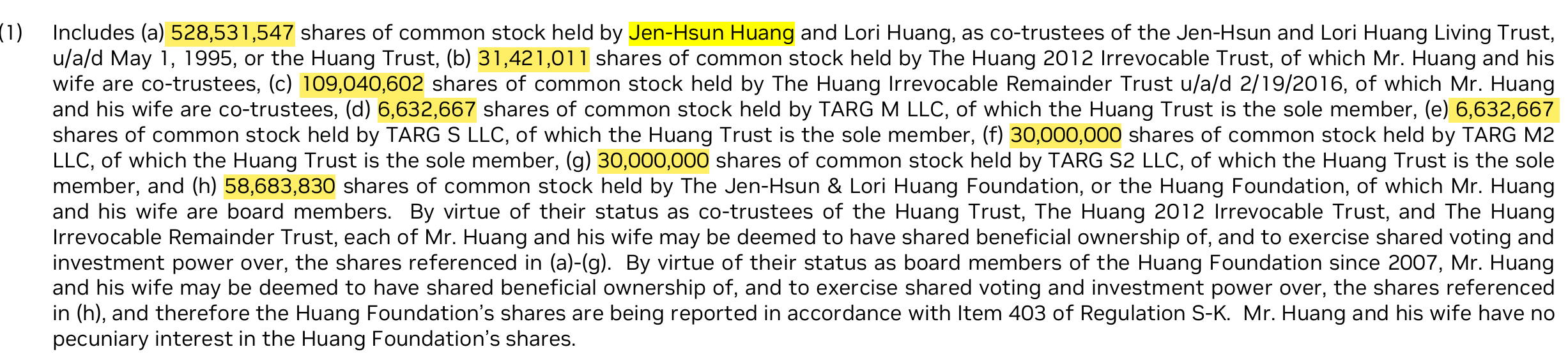
- Jen-Hsun and Lori Huang Living Trust, described as the Huang family living trust, was established on May 1, 1995 and is associated with about 529 million common shares. It is the largest single family-planning vehicle in the disclosed joint block.
- The Huang 2012 Irrevocable Trust, or the Huang 2012 irrevocable trust, holds about 31.42 million common shares, with Huang and Lori as co-trustees. Irrevocable structures usually signal longer-term family wealth planning rather than short-term flexibility.
- The Huang Irrevocable Remainder Trust, or the Huang irrevocable remainder trust, was established on February 19, 2016 and holds about 109 million common shares, again with Huang and Lori as co-trustees.
- Four limited liability companies, also described as four LLCs, hold about 73.27 million shares. The filing says the sole member of each entity is the Huang family living trust.
- Jen-Hsun & Lori Huang Foundation, the Huang couple foundation, holds about 58.68 million common shares. Huang and Lori have served as foundation directors since 2007, but the filing states that they do not have economic interest in those shares.
Because Huang and Lori serve as co-trustees of the three trusts, they may be attributed joint beneficial ownership of the related shares under the relevant rules, including voting rights and investment-disposal rights. The same reasoning is applied to the foundation shares for ownership attribution, but the no-economic-interest note changes how readers should interpret that holding.
Does a 3.58% stake equal control at NVIDIA?
Not by itself. Coverage of NVIDIA's ownership structure, including reporting by 36Kr and 21jingji, notes that NVIDIA uses a single-class common-share model with one vote per share and no super-voting founder structure. That makes a 3.58% stake significant for signaling, but not sufficient for unilateral control of a shareholder vote or board change.
The governance signal on November 8, 2026 was separation rather than concentration: NVIDIA's board said it would launch an investigation handled by a special committee of independent directors, with outside legal counsel reviewing all information. John Rizzo, NVIDIA's head of public-policy communications, confirmed that Huang would continue as CEO without interruption. Huang said he would remain fully committed to the company and work to regain the trust of colleagues and shareholders.
How the campus story reframes the family-asset design
In November 2024, Huang spoke about his years at Oregon State University, where he studied from 1980-1984. He said he entered the university at 16 and met the woman who later became his wife when he was 17; she was 19. He recalled, “I was the youngest student in school and in my class. There were 250 students and only 3 girls.” He added, “I was the only one who looked like a child; everyone else was still young.”
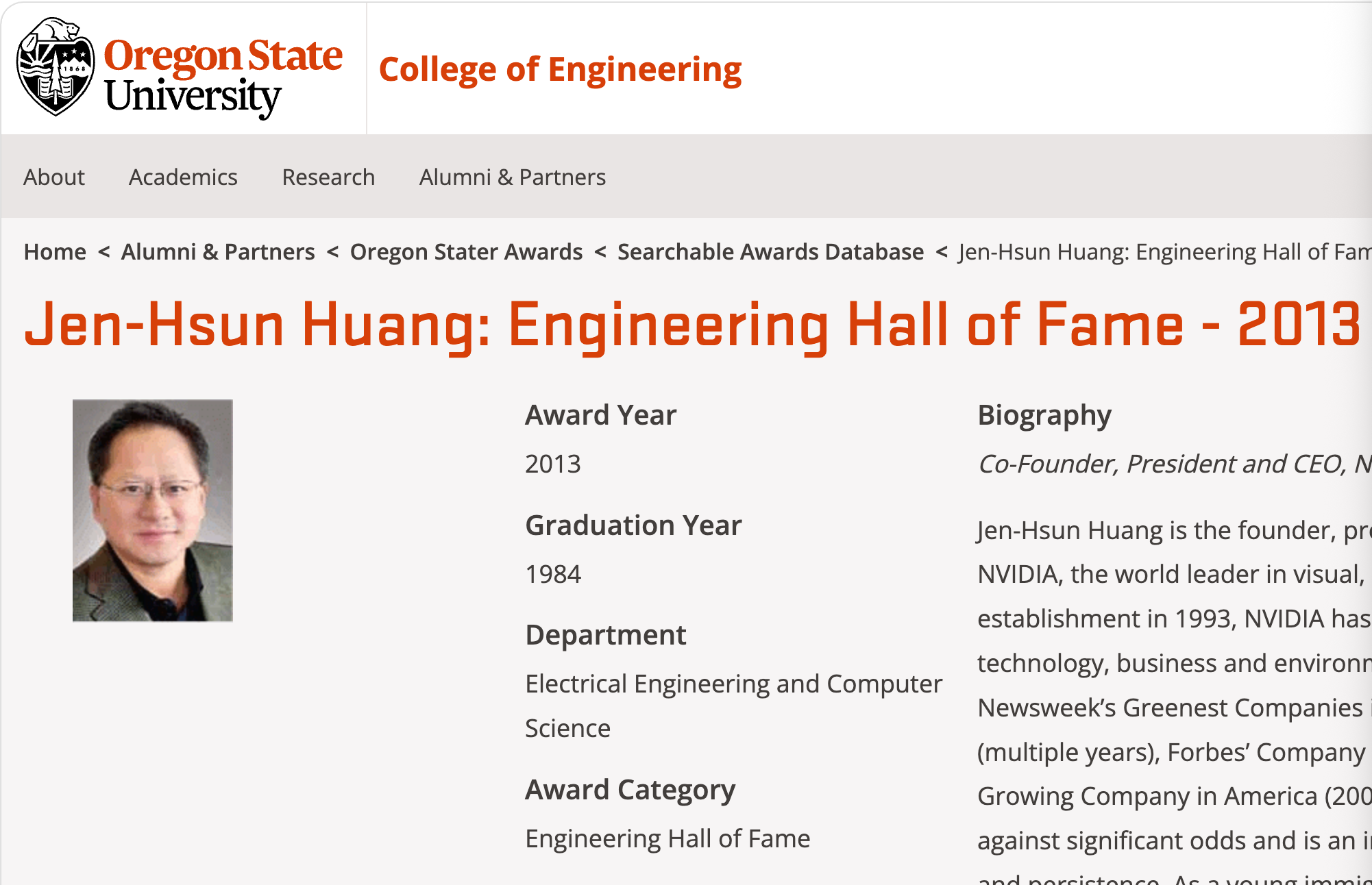
Oregon State University records describe Lori Mills as his lab partner in an electrical-engineering fundamentals course when he was a freshman. Huang understood that he looked young, so he believed her first impression would be that he must be smart. He went to her and asked, “Do you want to see my homework?”
He then promised that if she studied with him every Sunday, she would receive straight A grades. He said he prepared answers in advance, so when they checked homework he looked like a genius. The routine gave him what he called a “date”: every Sunday became a study session, each Sunday was used to stay together, and he kept her with him for the entire Sunday.
At 20, Huang said he set a target: before 30, he would become a CEO. Oregon State University material notes that the couple married after five years together. In 1993, at 30, Huang co-founded NVIDIA and became its CEO.
Common misconceptions
- “Jointly held” does not automatically mean a simple 50-50 personal account. It refers to attributed beneficial ownership, voting rights, and investment-disposal rights across trusts, LLCs, and a foundation.
- Foundation shares are not the same as personal family wealth. The filing states that Huang and Lori have no economic interest in the approximately 58.68 million common shares held by the foundation.
- A 3.58% stake is not a control switch. NVIDIA's one-share-one-vote structure and independent board committees limit what any single executive can decide alone.
- The missing about 69.66 million-share breakdown is a disclosure gap, not proof of wrongdoing. Readers should wait for filings or official explanation.
- A board investigation is not the same as removal. The confirmed public statement is that Huang continues as CEO while independent directors and outside counsel review the matter.
FAQ: what general readers should ask next
Why do the trust names matter to a regular tech reader?
They show how founder assets are separated from daily corporate control. A reader does not need to understand estate law to see the practical trade-off: long-term planning can create stability, but it can also make ownership stories harder to summarize in one headline.
Is the $149.5 billion figure a market value or a legal settlement estimate?
It is a market-value calculation tied to approximately 801 million jointly disclosed shares, not a ruling. Values change with share price, so the FY2026 disclosure date and any later closing price should be checked together.
Can the independent committee replace Jensen Huang?
Board governance provides that possible path, but public information at the time said Huang continued as CEO. The investigation was assigned to a special committee of independent directors with outside legal counsel, so the immediate signal was review, not removal.
What should investors and product watchers avoid in the first news cycle?
Avoid merging three separate questions: personal conduct, asset structure, and corporate control. The filing evidence supports only what is disclosed; speculation about the undisclosed about 69.66 million-share remainder should be labeled as unresolved.
Action checklist before drawing a conclusion
- Start with dated numbers: about 871 million shares, about 3.58%, about 801 million joint shares, and about $149.5 billion. Separate current market price from filing-period value.
- Read vehicle labels instead of single phrases: three trusts, four LLCs, one foundation. Each has a different legal and economic role.
- Check authoritative filings before accepting share-count claims, using sources such as NVIDIA's proxy statement and related SEC filings.
- Compare governance signals with product-cycle signals. For example, our guide to a $11.4 million NVIDIA hardware disappearance shows why hardware supply-chain headlines need separate evidence checks.
- Watch for Form 4 changes, board statements, and committee updates rather than assuming trust labels are fixed forever.
Bottom line
The clearest way to compare this story is to separate three layers: the family holding structure, the market value attached to it, and the governance response. The FY2026 numbers explain the asset map; the board statement and continued CEO confirmation explain the decision map. For general readers, the practical lesson is that a personal controversy can change headlines quickly, while a public company's control logic changes more slowly through disclosure and independent review.
Reference sources
- NVIDIA 2026 proxy statement and related filings, SEC EDGAR: https://www.sec.gov/cgi-bin/browse-edgar?action=getcompany&CIK=0001045810&type=DEF+14A&dateb=&owner=include&count=40
- 36Kr, governance and share-structure analysis: https://36kr.com/p/4062289322824839
- 21jingji, checks and balances analysis of Huang's stake: https://www.21jingji.com/article/20261109/herald/8762e8168bbf42e2111e794f0e911715.html
- TheStreet, CEO holding-size overview: https://www.thestreet.com/personalities/how-much-nvidia-stock-does-ceo-jensen-huang-own
- Tonghuashun Finance, joint-holding value breakdown: https://m.10jqka.com.cn/20261109/c681606659.shtml
This MyTechDailyNews General explainer is a media analysis based on public filings and reported figures, not legal, tax, or investment advice.