
AMD Data Center vs. Gaming: What Lisa Su’s Q3 Numbers Mean for PC Buyers
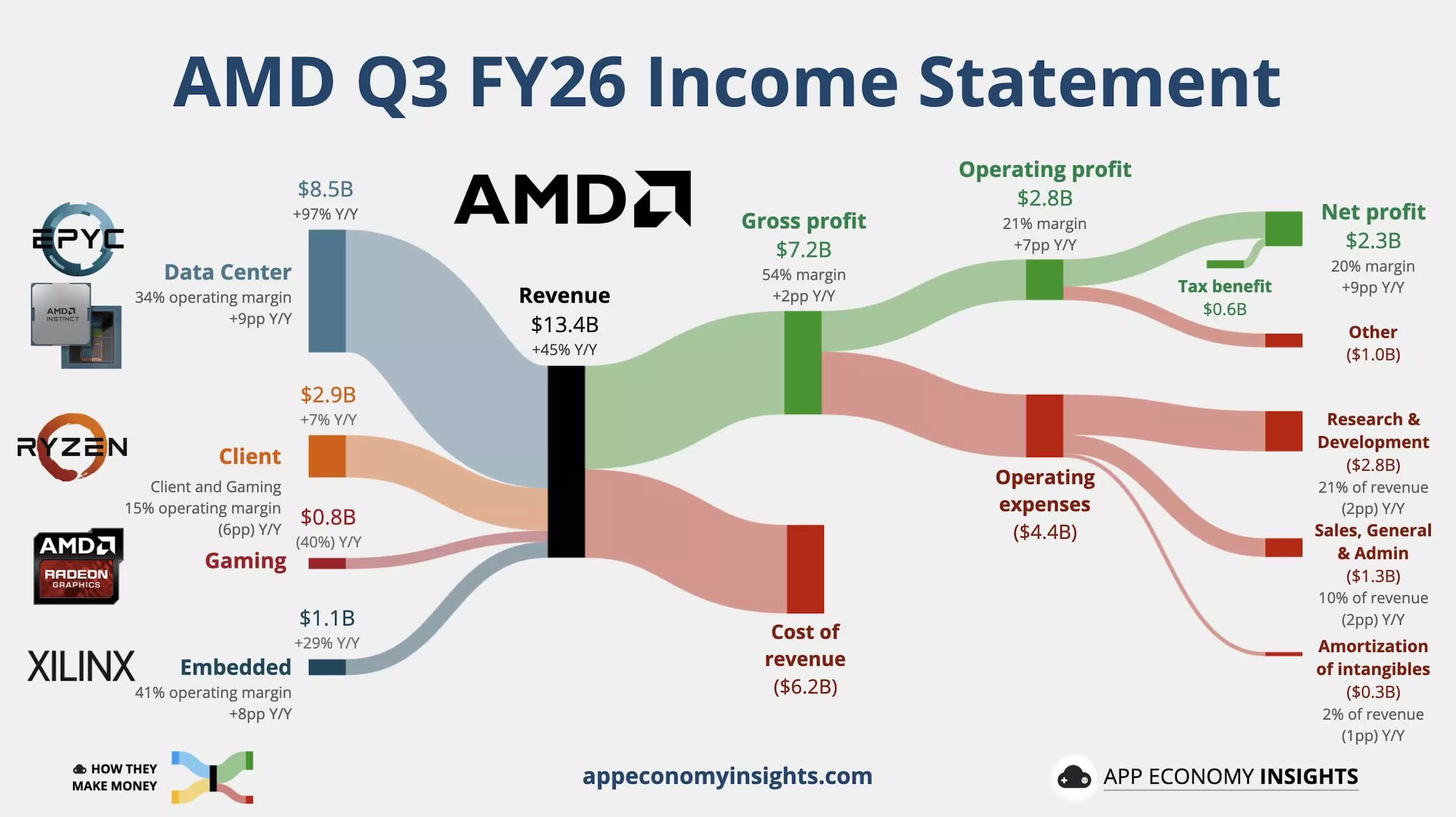
The short answer: AMD’s growth is now defined by server and AI demand, not by gaming hardware. In the third quarter of 2026, AMD reported $13.4 billion in revenue, up 97% year over year, while gaming revenue dropped 40% to $773 million. The contrast helps readers see where future investment, product priority and supply pressure are headed.
Why Lisa Su calls AMD a data-center-first company
Conclusion: AMD is moving resources toward the largest computing buyers — cloud providers, AI developers, enterprises and hyperscale operators. Lisa Su told Yahoo Finance, “We are a data-center-first company; this is our positioning. People need more computing power to support various applications.” The sentence is best read as a strategy statement, not a casual quote.
The growth was driven by AMD Instinct AI accelerators and EPYC server processors. Instinct handles AI training and inference workloads, while EPYC supports general-purpose cloud computing. The demand from data-center construction made AMD’s third-quarter result look more like a server company than a consumer-hardware company.
Data-center strength versus gaming weakness: what the segments show
The comparison is simple: one side is selling capacity into an infrastructure build-out, while the other is facing cost pressure and softer consumer buying. AMD's official results show data-center revenue at $8.5 billion. By contrast, the client and gaming segment totaled $3.7 billion and fell 8% year over year, with gaming alone at $773 million.
| Segment or unit | What it sells | Q3 signal | Decision takeaway |
|---|---|---|---|
| Data center | EPYC CPUs and Instinct GPUs for servers, cloud and AI | Record segment performance; central to the quarter | Best place to watch AMD’s future profit and supply priority |
| Client and gaming | Ryzen PCs, Radeon-related graphics, consoles and other consumer platforms | $3.7 billion, down 8% | Still important, but less likely to receive first call on scarce components |
| Gaming alone | Semi-custom console chips and graphics hardware | $773 million, down 40% | Short-term pressure on consumer hardware availability and pricing |
| Embedded | Chips for automotive, industrial, networking and edge systems | $1.1 billion, up 29% | A useful second engine for AMD, though less visible to ordinary users |
Another new data point from AMD’s official reporting is its Q4 outlook: revenue of about $17 billion, with management expecting continued acceleration as Helios rack systems and Venice-related products scale. These figures do not change the master result, but they sharpen the comparison: the company’s most important growth is concentrated in infrastructure, not in game consoles.
How far has the data-center tilt already gone?
AMD is not yet a one-product business. By 2026 Q3, data-center revenue represented about 63% of total net revenue. That is high, but it still leaves room for Ryzen, Radeon, consoles, embedded systems and client PCs. The direction, however, is clear.
Su said AMD expects the data-center business to grow 50% quarter over quarter in the fourth quarter. She also framed the long-term ambition as making the business more than double after entering 2027. To answer worries about AI spending, Su said AMD invests with a three-to-five-year view and believes some market observers focus too much on short-term returns while underestimating future compute demand.
AMD versus Nvidia and Intel: three companies, three different balances
Nvidia shows the end state that many observers now compare AMD with. In Nvidia fiscal Q2 2027, data-center revenue reached $89.02 billion and made up 92.5% of the company's total revenue. Nvidia's reporting structure has also treated traditional gaming as a smaller piece of a broader edge-computing category.
AMD is closer to the consumer market than Nvidia. It still has Ryzen processors, Radeon graphics cards, console partnerships and a gaming segment that people can buy in stores. That difference matters for readers: AMD is not yet as one-sided as Nvidia, but the financial pull toward data center is becoming harder for consumers to ignore.
Intel provides the PC-era counterpoint. For years, Intel, AMD and Nvidia were all pulled into the same consumer competition. Now the industry has a different center of gravity. Nvidia has the most advanced shift, AMD is moving toward data-center-first economics, and Intel's PC-focused business still needs consumers and businesses to buy more machines. For ordinary users, the practical result is the same: chip companies are more likely to prioritize large AI contracts than a crowded gaming market.
Why gaming revenue fell 40%: memory, components and the PC winter
TechSpot pointed to an uncomfortable cause: AI data centers are consuming memory and other components that would once have flowed to consumer hardware. That tightens supply, raises production costs and can push graphics cards, laptops and console-related products into less attractive pricing. For gaming hardware, a component squeeze can hurt faster than a single model miss.
Industry data makes the pressure concrete. Omdia reported that global PC shipments in the third quarter of 2026 fell 21.2% year over year to 58.1 million units, with desktop shipments down 23.5% and notebook shipments down 20.6%. Omdia also estimated that memory and storage had reached close to 40% of PC bill-of-materials cost, versus a normal level near 15%. When those costs rise, manufacturers raise prices, buyers delay upgrades and channels hold less inventory. AMD's gaming decline should therefore be read as a market signal as much as a company-specific result.
Who should care about this shift, and why
- PC gamers: Expect the Radeon line to remain, but watch whether new products arrive on the same pace as before. If AMD continues to prioritize Instinct and EPYC, consumer GPU updates may become more cautious, especially if memory costs remain elevated.
- Everyday PC buyers: A data-center-first chip company can still make good consumer products, but scarcity in memory and storage may keep prices high through 2027. Buying sooner may make sense if current pricing is reasonable and the machine is genuinely needed.
- Cloud and AI users: AMD's data-center expansion can bring more compute choices, better pricing competition and wider adoption of EPYC and Instinct systems. If the company succeeds in scaling supply, buyers benefit from more alternatives.
- Product and marketing teams: The key lesson is that supply-chain priority, not only feature quality, can decide product success. If components are routed to enterprise demand, consumer launches face delays and cost pressure.
Common misconceptions to avoid
- Myth: AMD is quitting gaming. Reality: AMD has not announced that it will stop serving Radeon or gaming customers. Su described company positioning, not the end of consumer products.
- Myth: AI growth will immediately fix all hardware shortages. Reality: The same AI build-out that boosts data-center revenue also consumes memory and components, which can worsen consumer hardware pressure before new capacity catches up.
- Myth: A data-center-first company does not care about gamers. Reality: It still cares where gaming is commercially valuable, but gaming no longer automatically gets the first call on strategic resources.
- Myth: Nvidia-style concentration is guaranteed for AMD. Reality: AMD has about 63% data-center exposure now, not Nvidia's 92.5%. The gap gives AMD more room, but also less certainty.
FAQ: Quick answers for readers deciding what to watch
Did AMD really grow 97% while gaming fell 40%?
Yes, as reported in the master result: AMD's 2026 Q3 revenue was $13.4 billion, up 97% year over year, while gaming revenue was $773 million, down 40%. The divergence is the story: one part of the company is being paid to scale, while the other is being squeezed by costs and weaker demand.
What does “data-center-first” mean in practice?
It means AMD is likely to allocate engineering, manufacturing capacity and go-to-market attention first to server CPUs, AI accelerators and large cloud customers. Consumer products such as Ryzen and Radeon remain relevant, but they are no longer the defining growth driver.
Will Radeon GPUs become rare or disappear?
Not necessarily. AMD has not said it will abandon Radeon. The risk is less about disappearance than about slower update cycles, higher component costs and less promotional energy behind gaming products while AMD expands Instinct and EPYC supply.
Why is AI infrastructure demand a concern for ordinary users?
Because ordinary hardware uses many of the same inputs. Advanced memory, packaging and server components can reduce the flow of resources to PCs and gaming devices. When the industrial build-out is strong, consumer buyers may feel the effect through pricing, availability and delayed refreshes.
What should a non-investor do next?
Compare your use case. If you buy primarily for gaming, watch Radeon product cadence and graphics-card pricing. If you buy for productivity or AI workloads, AMD's data-center focus may bring better performance per dollar. If you are budget-sensitive, avoid waiting too long for hypothetical discounts while memory costs remain elevated.
Action advice: five things to monitor
- Track Radeon product announcements versus Instinct and EPYC infrastructure news.
- Watch memory and storage costs, not just GPU model names.
- Follow whether AMD's data-center share moves closer to Nvidia's 92.5% profile.
- Check whether gaming revenue stabilizes after PC shipment pressure eases.
- Read AMD's long-term framing in terms of three-to-five-year capacity plans, not only one-quarter growth.
MyTechDailyNews sees the strategic choice plainly: AMD is becoming a data-center-first company, and that choice will shape both the pace of gaming innovation and the prices consumers pay for everyday computing.