
Rent First, Buy Later? A Practical Guide to Tesla's Optimus Robot and Its Roughly $30,000 Entry Cost
Picture a 173 cm machine walking onto your line slower than your fastest picker, moving crates for a whole shift, then parked in a corner to charge. Tesla's version of that scene starts next year: Optimus is scheduled to reach outside customers around the end of 2027, at an initial cost of roughly $30,000 per unit, and most likely on a rental contract instead of a purchase.
Recently, Musk used the Barron's Investment Summit to sketch the roadmap for Tesla's humanoid programme, and the pitch lands closer to "industrial pilot with a price tag" than "gadget launch". For anyone budgeting automation, the headline number is not the walking speed or the head display. It is the cost curve Musk describes: about $30,000 to start, falling to around $20,000 once volume arrives.
| Cost stage | Tesla's stated figure |
|---|---|
| Initial cost | approximately $30,000 per robot |
| Later cost | expected to drop to around $20,000 |
When does Optimus ship, and how will buyers actually pay for it?
Direct answer: next year, in small volume, and probably rented. Musk puts the first external deliveries at around the end of 2027 and says the arrangement may be "rent" rather than "sell". Before that, Optimus stays inside Tesla's own factories, where it logs the hands-on training reps the company wants baked into the fleet. The Fremont factory has started early trial production against a long-range line plan of 1 million units a year, yet Musk's own estimate is that full mass production is still a ways off.
The gap between "first unit shipped" and "volume supply" is exactly where early adopters lose money. Read 2027 as an early-access year: expect hand-holding deployments, firmware churn, and a service agreement that will matter more than the sticker price. Tesla is comfortable pulling a finished line apart mid-cycle, as its Cybertruck-to-Cybercab line swap showed, so schedule slips here should be treated as a planning variable rather than an accident.
Why Tesla is pushing this so hard
Humanoid robots are a stated long-term strategic priority for Tesla. Musk argues the addressable market is enormous, and whether Optimus actually lands is also a key condition attached to his ten-year compensation plan. For buyers that is a double-edged signal: a robot tied to executive pay gets patience and capital, but it also gets over-promised in public.
What a full shift looks like on paper
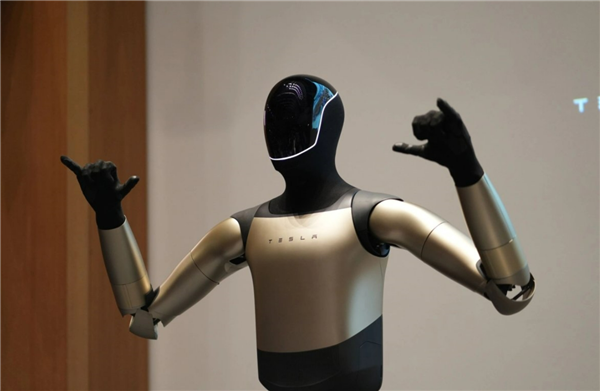
Treat the spec sheet as a shift plan, not as marketing copy. Optimus stands 173 cm tall and weighs about 57 kg, walks on two legs at a top speed of 1.2 m/s, and carries up to 20 kg. Its head carries a display for status and interaction. Tesla rates the body at 38 degrees of freedom, with 22 in each dexterous hand, which is what allows grabbing and assembly work instead of simple lifting.
The brain is borrowed from the car. Optimus uses Tesla's FSD pure-vision stack, multiple cameras and an in-house AI chip for perception and decision-making, closing the perceive-decide-act loop in 0.3 second. Power sits in a 2.3 kWh pack of 4680 cells, rated for about 10 hours of continuous work. Musk's stated ambition on the floor is output at five times an average human worker on repetitive industrial tasks.
| Spec | Tesla's number | How I would read it on a real line |
|---|---|---|
| Top walking speed | 1.2 m/s | A brisk adult walks faster, so travel time between stations is a throughput tax you must model |
| Carry limit | 20 kg | Fine for totes and cartons, not for heavy fixtures or machine tending |
| Continuous work | about 10 hours | Covers one shift, but the charging window still has to appear somewhere in the schedule |
| Loop time | 0.3 second | Enough for pick-and-place, not enough to catch what a human would snatch mid-fall |
The three things Tesla is not selling you yet
Blunt take, because the spec sheet flatters the robot. First, the productivity claim is company expectation rather than audited output: nobody outside Tesla has published shift-level data that the five-times figure can be checked against.
Second, the category is far smaller than the hype suggests. The International Federation of Robotics said in its World Robotics 2026 report, published on 24 September 2026, that about 5 million industrial robots are now operating in factories worldwide, while only nearly 7,000 humanoid robots were sold globally in 2025 across 174 identified vendors. IFR president Jane Heffner framed the milestone as proof that "industrial automation is progressing at high speed", with the installed base doubling over ten years. Humanoids still have to earn a slot inside that existing machine.
Third, safety is a project, not a spec. The collaborative contact force and pressure limits once carried by ISO/TS 15066 have been folded into ISO 10218-2:2025, which makes force and pressure testing a required part of any deployment where a robot can touch a person. A two-legged 57 kg robot that can also carry 20 kg is a very different risk assessment from a fenced arm.
The rental math nobody puts on the slide
Use a baseline before you negotiate a quote. Public robotics-as-a-service pricing trackers put a palletizing cell at roughly $14 to $18 per productive robot-hour and a warehouse picking robot at around $2,000 a month, with maintenance and software usually bundled in.
Now run Tesla's own cost figures through the same frame. This is my arithmetic on the numbers Musk disclosed, not a Tesla quote: at $30,000 per unit and 1,800 productive hours a year, hardware alone amortises to about $17 per hour, before service contracts, safety validation, support staff and downtime. At the $20,000 target that figure drops to roughly $11 per hour, which is finally inside the range operators already pay for proven automation. A rental deal hides that ramp risk with Tesla, but usually replaces it with a minimum-utilisation clause, so read the floor, not the monthly fee.
Six steps before you sign an Optimus pilot
- Pick one task with a measurable cycle time, not a demo-friendly one, and write down what a human costs per unit of that task today.
- Time the travel: at 1.2 m/s, map every metre the robot must walk and check the task still beats manual labour.
- Weight-check your boxes. Anything near the 20 kg limit should be excluded from phase one.
- Schedule the charge window around the about 10 hour runtime, including one busy-season day when nobody plugs it in.
- Run a documented risk assessment under ISO 10218-2:2025 with anyone the robot will share a lane with, before the first shift.
- In the contract, price the exit: response-time SLAs, spare-unit swap, firmware rollback rights and what happens if the ramp slips.
Four common misconceptions
- "$30,000 means it is cheaper than a worker." The robot cost excludes integration, safety sign-off, supervision and the productivity dip during ramp-up.
- "Deliveries start next year, so I can plan a 2027 rollout." First external deliveries at around the end of 2027 are not volume supply, and full mass production is a separate milestone.
- "It is just a robot arm on legs." The 38 body degrees of freedom and 22 per hand are what make the task list different from a caged arm, and what make tuning harder.
- "Vision stack from the car means it is road-ready." FSD pure vision is a strong starting point for perception, but factory manipulation has almost no label data behind it.
Optimus versus what you can order today
| Dimension | Tesla Optimus | Unitree G1 (shipping now) |
|---|---|---|
| Price signal | Initial cost about $30,000, later around $20,000, rental-first | Official store lists the base unit at $13,500 |
| Size | 173 cm, about 57 kg | 132 cm standing, about 35 kg |
| Run time | About 10 hours, 2.3 kWh 4680 pack | Roughly 2 hours per quick-release pack, per reseller listings |
| Status | Trial production at Fremont, external deliveries from around the end of 2027 | Available to order through Unitree and integrators |
FAQ: what readers keep asking
How much will an Optimus cost at launch?
Musk said at the Barron's Investment Summit that the initial cost is about $30,000 per robot, close to what an electric car costs today, and that Tesla expects it to fall to around $20,000 afterwards.
Can a normal company just buy one in 2027?
Not in the way you would buy a forklift. Tesla's stated plan is deliveries starting around the end of 2027, with the format possibly rental rather than sale, and the units first used inside Tesla's own plants before going out.
How fast and how strong is the robot?
Official figures: two-legged walking at up to 1.2 m/s, a maximum carry of 20 kg, a 0.3 second perception-decision-execution loop, and about 10 hours of continuous work on the 2.3 kWh 4680 battery.
Why does Tesla talk about 1 million units and still say it is early?
The 1 million units a year figure is the Fremont line's long-range plan. Early trial production is running, but the company itself says reaching full mass production takes more time.
Should I freeze hiring and wait for robots?
No. Plan a single-task pilot with hard cycle-time metrics. Until someone publishes audited shift data behind the five-times productivity claim, humanoids are an experiment you budget for, not a headcount swap.
Bottom line: is Optimus worth waiting for?
If you run a warehouse or a light-assembly cell with repetitive box-moving and a labour bottleneck you cannot clear, yes, get on the list early, but pilot one task and hold the vendor to published uptime. If you need capacity in the next 18 months, buy the boring automation that exists today and let Tesla work out the ramp. I would take a rental contract at the $30,000-equivalent tier over an outright purchase, because the risk in this product is not the price, it is the maturity.
References
- International Federation of Robotics, "Five Million Robots Now Operate in Factories Globally" (World Robotics 2026, 24 September 2026): https://ifr.org/ifr-press-releases/news/five-million-robots-now-operate-in-factories-globally
- The Robot Report on the IFR milestone and the quote from IFR president Jane Heffner: https://www.therobotreport.com/5-million-robots-now-working-factories-worldwide-ifr-reports/
- Unitree G1 official store page and product specifications: https://shop.unitree.com/products/unitree-g1 and https://www.unitree.com/g1
- Collaborative robot safety guidance on ISO 10218-2:2025 and the former ISO/TS 15066 contact limits: https://www.inmotion.global/resources/cobot-safety/collaborative-robot-safety-standards/
- Robots-as-a-service pricing reference points: https://www.layer3labs.io/robotics/robotics-as-a-service