
Cybertruck or Cybercab? Inside Tesla's Eight-Month Line Swap and What It Means for Your Deposit
By Sarah Chen, MyTechDailyNews General desk · Tech Daily
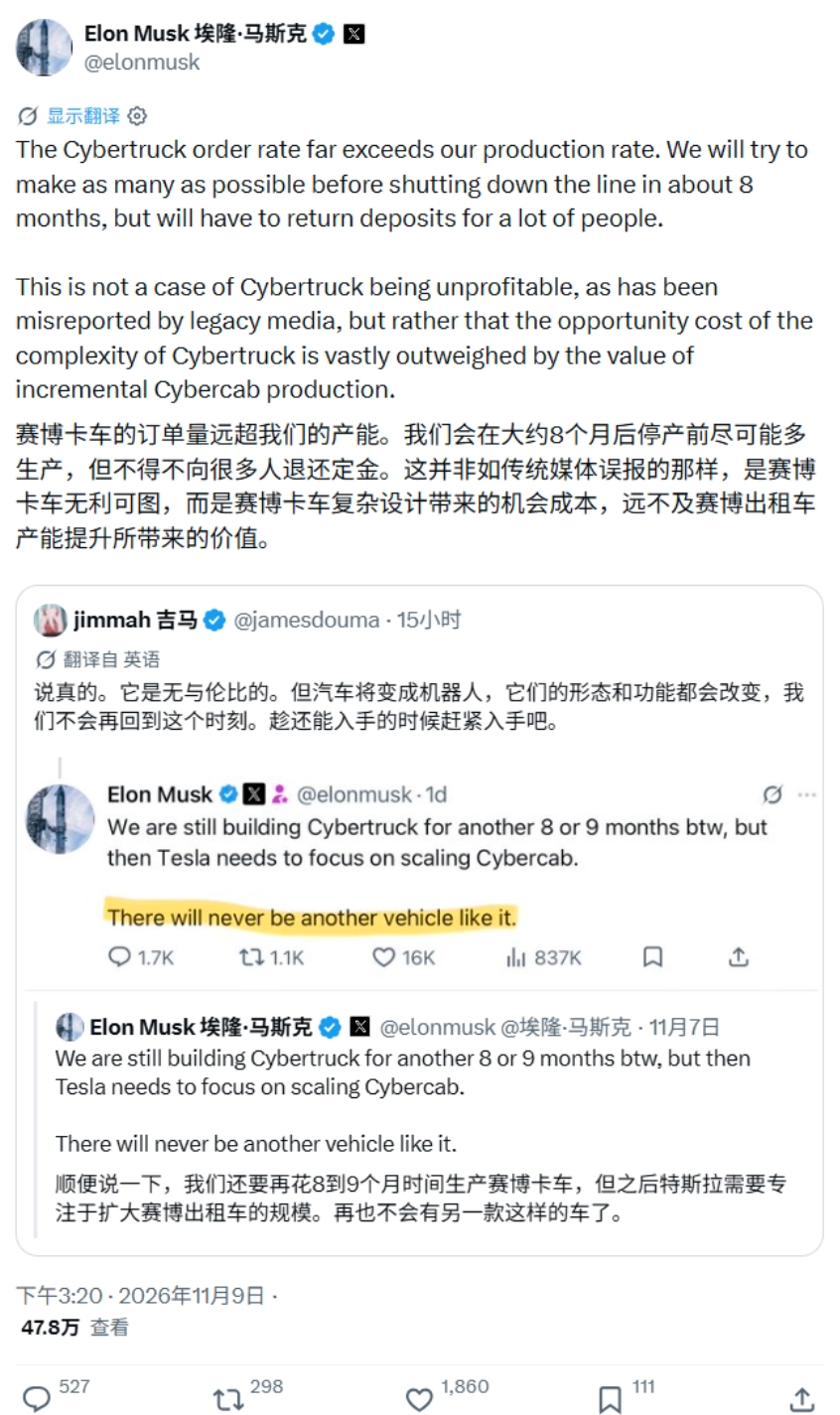
Tesla is closing out the Cybertruck line at the Texas Gigafactory in about eight months, Elon Musk said on November 9 in a post on the X platform, after conceding that orders are growing faster than the truck can be built. The floor space is going to Cybercab, the steering-wheel-less Robotaxi vehicle. Read plainly, the trade-off is: one product becomes a shrinking order book and a resale question, while the other becomes Tesla's priority — with a federal safety audit already attached to it.
What Musk rejected is the easier headline. Coverage since last week has framed the move as proof that "Cybertruck is not profitable". His stated reason is narrower and mostly about factory arithmetic: the complex processes behind the truck carry an opportunity cost that now exceeds the value of squeezing more Cybercab output out of the same building.
Why is Tesla trading a pickup line for a robotaxi line?
Short answer: the truck never became a volume product, so every square metre it holds is worth more as robotaxi capacity. Tesla does not publish Cybertruck numbers separately. The "other models" delivery line that wraps Cybertruck, Semi and the final batch of Model S/X came to just 12,364 vehicles in the second quarter of 2026. Across the first three quarters of this year, Cybertruck sales fell 28% year over year to roughly 11,600 units.
The other side of the ledger is scale, not margin per unit. Since its reveal in October 2024, Tesla has positioned Cybercab as a sub-$30,000 vehicle aimed at a fleet operating cost below $0.30 per mile — numbers that only make sense if the car is built by the hundred-thousand, on a line that runs continuously.
Neither choice is new for this factory. In January 2026 Tesla announced the end of Model S and Model X, and those lines were removed and retooled for the Optimus humanoid robot. Read the two decisions together and the pattern is consistent: low-volume halo hardware keeps surrendering floor space to robotics.
How do Cybertruck and Cybercab compare on the facts that matter?
They are not really competing for the same buyer, which is exactly why one can afford to lose. Here is the comparison a shopper or a reservation holder can actually use.
| Dimension | Cybertruck | Cybercab |
|---|---|---|
| Public debut / first deliveries | Revealed and opened for reservations in November 2019; first customer deliveries in November 2023 | Revealed in 2024; production started at the Texas Gigafactory in 2026 |
| Order book signal | Claimed reservations of more than 1 million at launch; today's backlog still outruns line output | Not sold as a consumer order book; built as the main Robotaxi fleet vehicle |
| Volume evidence | Inside "other models": 12,364 deliveries in the second quarter of 2026; about 11,600 units this year, down 28% | Robotaxi rides are being tested on Austin roads; fleet size is the metric to watch, not trim sheets |
| Price logic | Premium hardware, complex body and manufacturing processes | Cost-first design target, no steering wheel, no pedals |
| Automation level | Driver stays responsible | L4-level, unsupervised by design |
| Line status | Winding down around mid-2027 | Receiving the freed capacity |
What does not disappear is the engineering. Tesla chief engineer Wes Morrill pushed back on the idea that the truck is a dead end, saying Cybertruck functions as a technology development platform: its 48V low-voltage architecture, steer-by-wire system and Etherloop wiring design are being carried over into Cybercab. In other words, the pickup's factory complexity is partly being recycled as the robotaxi's production simplicity.
What are the common misconceptions here?
- Misconception: Tesla killed the truck because it loses money. Musk disputed that reading directly. His explanation is opportunity cost — the value of what Cybercab can build in that space — rather than a loss-making verdict.
- Misconception: the order book is worthless now. Demand, not supply, is the stated problem: Musk said orders are growing faster than the line can deliver, and that Tesla is adding shifts to finish as many as possible before the shutdown.
- Misconception: Cybercab is a clean-sheet product that throws the truck's work away. The 48V architecture, steer-by-wire and Etherloop harness pass forward, per Morrill.
- Misconception: this is Tesla exiting cars. It is exiting low-volume models. Model S and Model X left in January 2026 for Optimus; the core sedan and SUV lines are untouched.
- Misconception: a final-edition truck will hold value. Ownership risk is a separate question from nostalgia — see the recall history below before betting on resale.
What happens to my deposit, and what should I do next?
Musk's own line on the X platform was the clearest guidance yet: Tesla will try to build as many trucks as possible before shutting down the line in about eight months, and will have to return deposits for a lot of people. Tesla has not disclosed how many reservations remain or the refund total. If you are sitting on one, run this checklist before deciding.
- Confirm whether your order is configured. Unconfigured reservations are the most likely to be parked and refunded; configured orders with a build window inside the remaining months are the most likely to be delivered.
- Know the refund rule before you ask for one. Tesla's own Cybertruck support page states that reservations can be cancelled for a full refund of the pre-order payment until delivery — so a refund is not a penalty, it is the default exit.
- Track the added shift, not the announcement. Reuters reported that Tesla will add an extra production shift to clear orders before the line is dismantled. That is the variable that decides whether your slot moves forward or gets refunded.
- Price service history into any late build. NHTSA's recall file shows eleven Cybertruck campaigns since customers first received the truck, the most recent dated April 2026 and covering 2024 through 2026 trucks fitted with 18-inch steel wheels. Our General desk has tracked every hike and every campaign in the Cybertruck price and recall timeline.
- Do not treat "last one built" as an investment thesis. After the line closes around mid-2027, parts, software attention and service capacity all follow the fleet priority, which is no longer this truck.
Is Cybercab a safe bet for that freed capacity?
This is the part most summaries skip. The line being cleared for Cybercab is feeding a vehicle that a US regulator has not yet finished examining. On September 4, 2026, NHTSA opened an Audit Query into Tesla's self-certification that Cybercab complies with federal motor vehicle safety standards, noting the car has no steering wheel, brake pedal, accelerator pedal or mirrors. Reuters reported the review covers nearly 1,000 Cybercabs.
For readers weighing the trade-off, that changes the risk profile: Tesla is not simply swapping one product for another; it is swapping a product with settled rules for one that is stress-testing them. Cybercab already runs in Austin traffic as part of the Robotaxi programme, but its economics — the sub-$30,000 build target and the under-$0.30-per-mile operating cost — only hold if regulation, insurance and rider acceptance cooperate.
FAQ
Is Tesla stopping Cybertruck production because it does not make money?
No, at least not according to Musk. He rejected the claim that "Cybertruck is not profitable" as the reason. The reason he gave is the opportunity cost of its complex manufacturing processes versus the value of expanding Cybercab output at the Texas Gigafactory.
When does Cybertruck production actually end?
Musk's November 9 post put it at about eight months out, consistent with the earlier plan to wind down around mid-2027 and dismantle the line for Cybercab expansion.
Will I get my Cybertruck deposit back?
For many reservation holders, yes. Musk said Tesla will have to return deposits for a lot of people, and Tesla's support documentation says the pre-order payment is fully refundable until delivery. The company has not published the number of affected reservations.
Can I still buy a Cybertruck after 2027?
Only from inventory and the used market. New builds depend on whatever capacity remains before the line comes down, and Tesla has said orders already exceed what it can finish.
Does anything from Cybertruck survive?
Yes. Chief engineer Wes Morrill described the truck as a technology development platform whose 48V architecture, steer-by-wire and Etherloop wiring systems carry into Cybercab.
Three actions to take this week
- Reservation holders: log in, confirm configuration status, and decide now whether a refund or a wait serves you better — do not wait for Tesla's email.
- Shoppers comparing EVs: treat Cybertruck as a closing product with service-history questions, and weight total cost of ownership over design novelty.
- Robotaxi watchers: follow the NHTSA audit query outcome and Austin fleet coverage; they are the real scoreboard for the capacity this line change is buying.
Sources and further reading
- Reuters: Tesla to add a Cybertruck shift to clear orders before dismantling the line
- Reuters: US safety regulator opens probe into nearly 1,000 Tesla Cybercabs
- NHTSA press release: Audit Query into Cybercab self-certification
- Tesla support: Cybertruck reservation and refund terms
- Tesla Cybercab overview: price and operating-cost targets
- MyTechDailyNews: Cybertruck price, recall and discontinuation timeline