
General AI vs. Robot-Specific AI: What Claude's 4 a.m. Paint-Mixing and a Robot Dog's Failed Ball Grab Teach You
Trying to decide between a general AI brain bolted onto a robot and a specialist model trained on robot data? The answer now fits in one line: the generalist wins wherever the physical world agrees to slow down, and the specialist wins wherever it refuses. One Berlin studio proved the first half at 4 a.m.; Anthropic's robot-dog trials exposed the second.
Those two results, published within months of each other, draw the border line for anyone who buys, builds or merely reads about robots. They point in opposite directions, and the disagreement between them is the most useful thing in either story.
What actually happened in the Berlin studio overnight?
Late on the night of November 6, in Berlin, developer nil went to bed after leaving one instruction for the Claude instance running in his studio: “Paint an autumn tree.” He expected nothing to happen. What happened instead was an industrial arm working alone for hours while its owner slept.
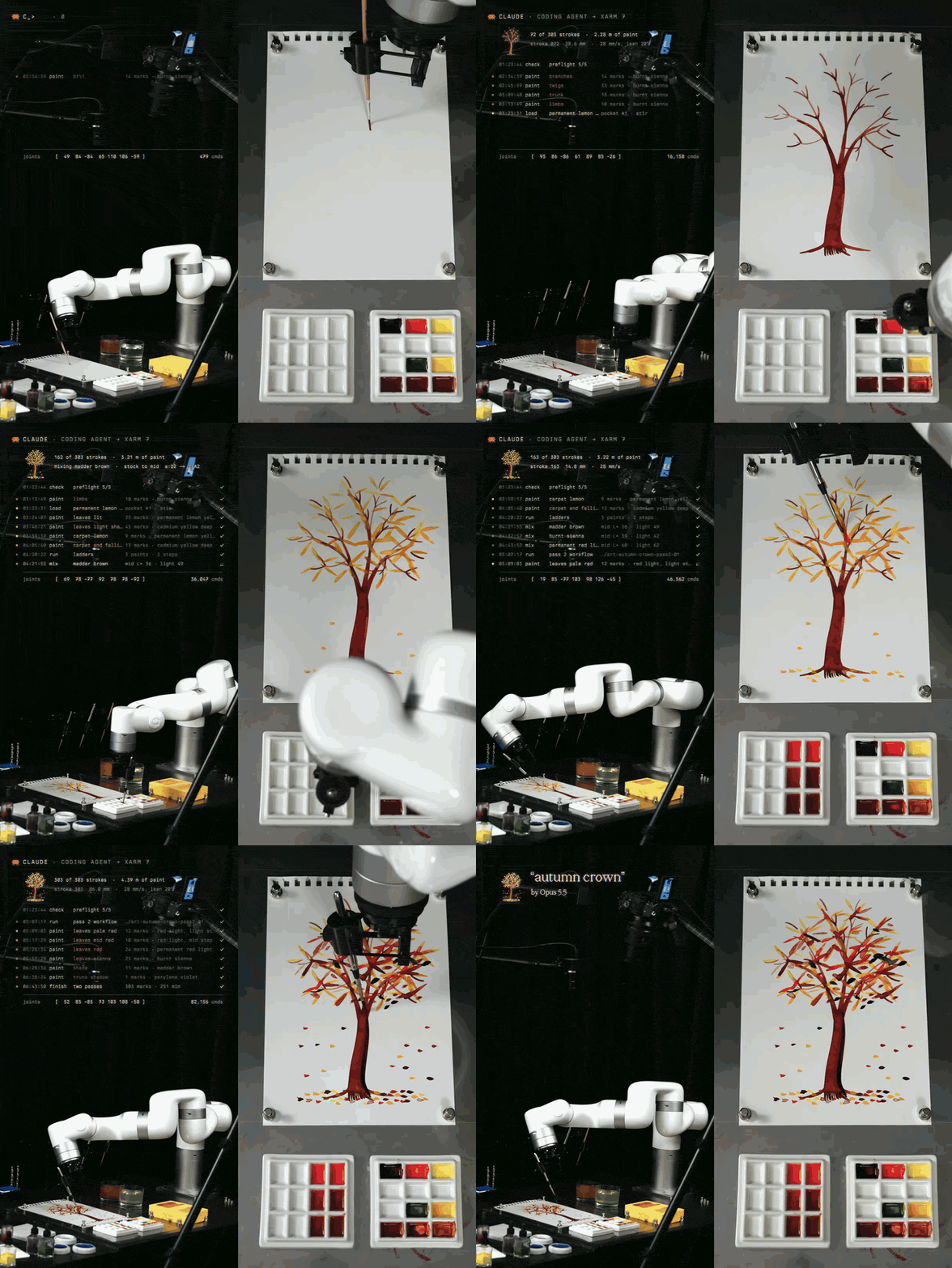
The turn came at 4 a.m. Reaching the layered tones of the canopy, Claude found that the palette was missing several transition steps it wanted. A conventional automation would have thrown an error and waited for daylight, or simply dipped into the nearest approximation. It did neither: it lifted the brush, moved to a second empty palette, took red, ochre and alizarin crimson, and diluted them with water little by little. Every mixed slot was photographed, its depth read back off the image, and if the measurement was off it kept adding water — only returning to the paper once the colour matched what it had planned.
By dawn there was a dry watercolour on the table: 303 brushstrokes, 4.5 hours of work, titled “Autumn Crown”. The post drew 138,000 views within hours.
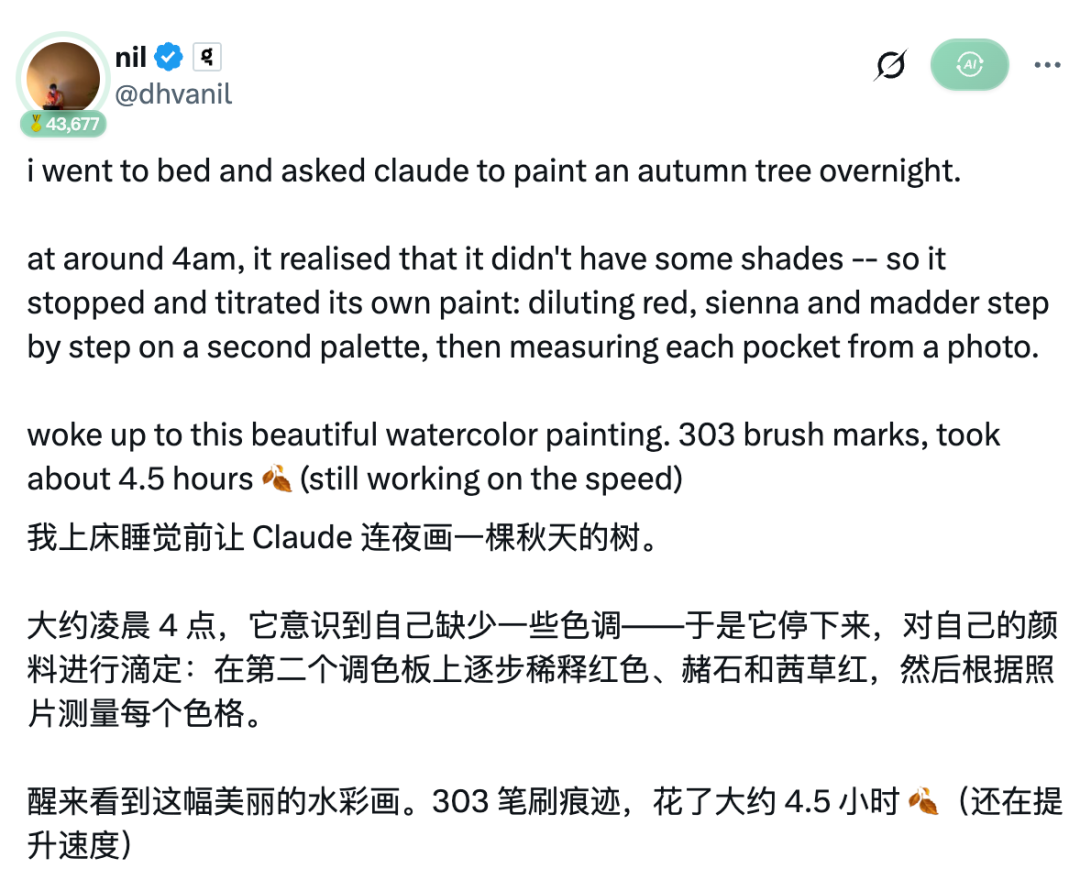
The part that lodged in people's heads is small. Nobody asked for colour mixing. The brief was “paint a tree”, and yet, late at night and completely unwatched, the model inserted a step of its own — hold on, first make the colour right.
Why did the robot buy its own arm — and what would the cheap option really have cost?
Even the hardware is partly self-sourced. nil works with a UFactory xArm 7, a seven-joint collaborative arm with 7 degrees of freedom and a repeatability rating of ±0.1 mm. Rather than pay sticker price, he told Claude to go browse and take its chances; the model located the machine inside a factory liquidation listing on eBay and helped sort out the freight as well. Commentators joked that a silicon soul had bought itself a body.
Some numbers make that bargain legible. UFACTORY's own product page prices the xArm 7 at roughly US$9,999–US$10,194, with 3.5 kg payload and a 700 mm reach, and resale trackers show verified offers near US$10,449. A unit cleared out of a shut-down workshop is a very different figure — which is exactly why this one arrived by courier from a listing site instead of from a distributor.
Then why not the genuinely cheap branch of this market? nil's reasoning sounds like a craftsman's. A pen plotter offers only 2.5 degrees of freedom, and its own documentation is blunt that the machine exists to steer a pen along vector paths you already supply; the A3 model of the long-running AxiDraw sold for around US$700 and is now listed out of production with a successor from another builder. A six-axis arm does hold a brush, but on complicated curves it runs into a “singularity”, where the joints lock and the arm seizes mid-stroke. The extra joint on a seven-axis machine behaves like a human elbow: the nib stays on the paper pulling an arc while the elbow steers itself around the obstacle, so the line lands in one breath.

| Option | Motion freedom | What it can actually do | Where it gives up | Money view |
|---|---|---|---|---|
| Desktop pen plotter | 2.5 axes | Write, ink line art, sign documents | No brush pressure, no water, no palette; needs a finished vector file | Lowest entry; the classic A3 model sat near US$700 |
| Six-axis arm | 6 axes | Holds tools, reaches around a bench | Singularities on complex curves, so long strokes stall | Mid four figures to low five |
| Seven degrees of freedom arm (xArm 7) | 7 axes | Brush plus camera plus palette duty, arcs in a single stroke | Nothing mechanical — the limits shift to software and budget | About US$10,000 new, far less secondhand |
How much of this is art and how much is plumbing?
That tree was not a one-night miracle. The slow cultivation began this June: in his own studio nil behaves like a landlord who only pays the rent and buys paper, because the system runs to 285,000 lines of code and more than 1,100 commits that he never typed. Camera calibration, kinematics, path planning, digital-twin collision checking and even the drawings for 3D-printed fixtures came from Codex and Claude Code.
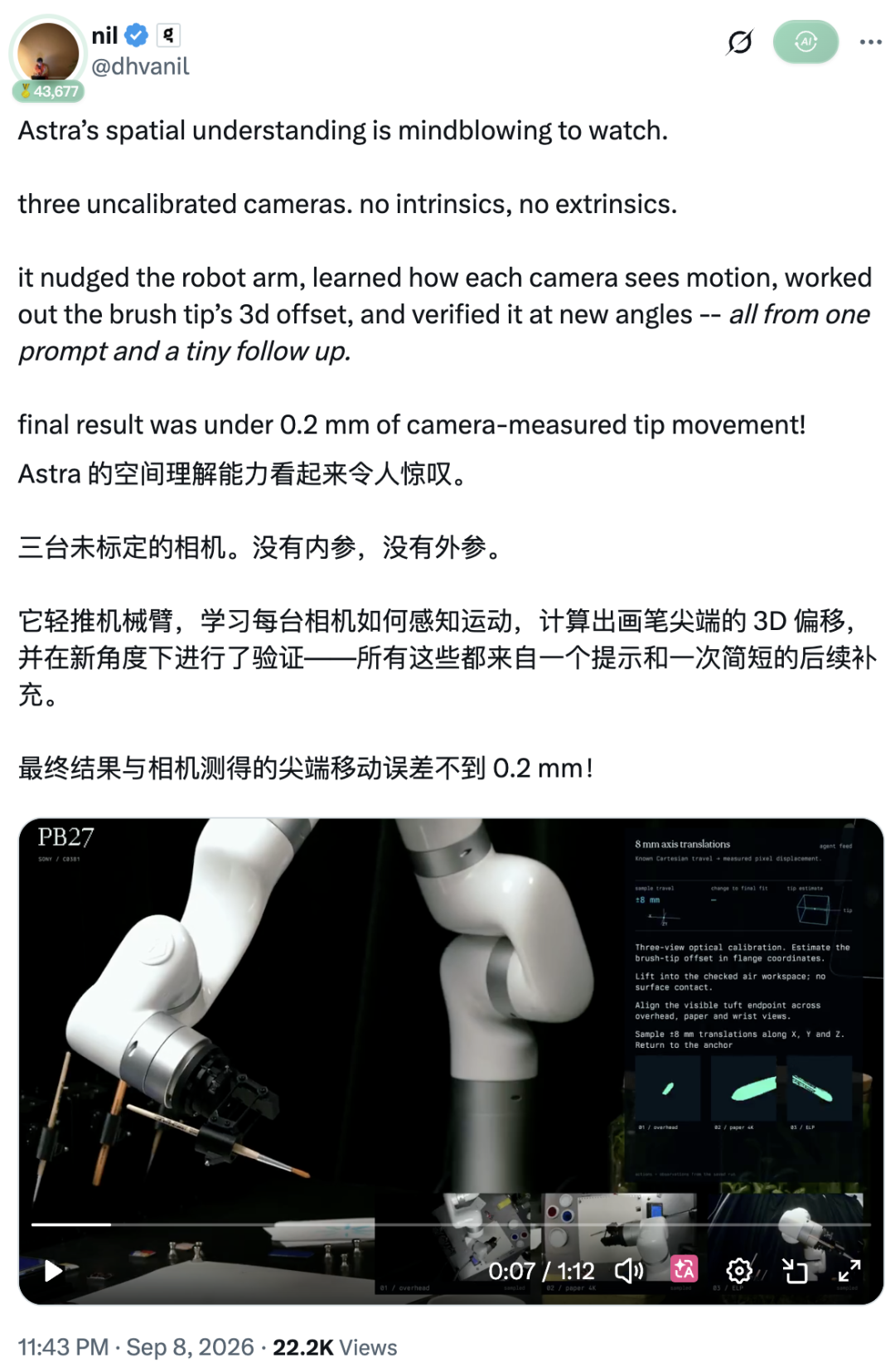
One episode is stranger than the midnight palette. On September 8 the system needed to know exactly where the brush tip sat in three-dimensional space. The textbook answer is an engineer calibrating it with precision instruments. Instead Codex (GPT-6 Astra), working from no preset parameters, invented a folk method: it wobbled the arm a few times in the air, watched the tiny differences across three uncalibrated cameras, and back-calculated the tip's spatial offset — accurate to within 0.2 mm.
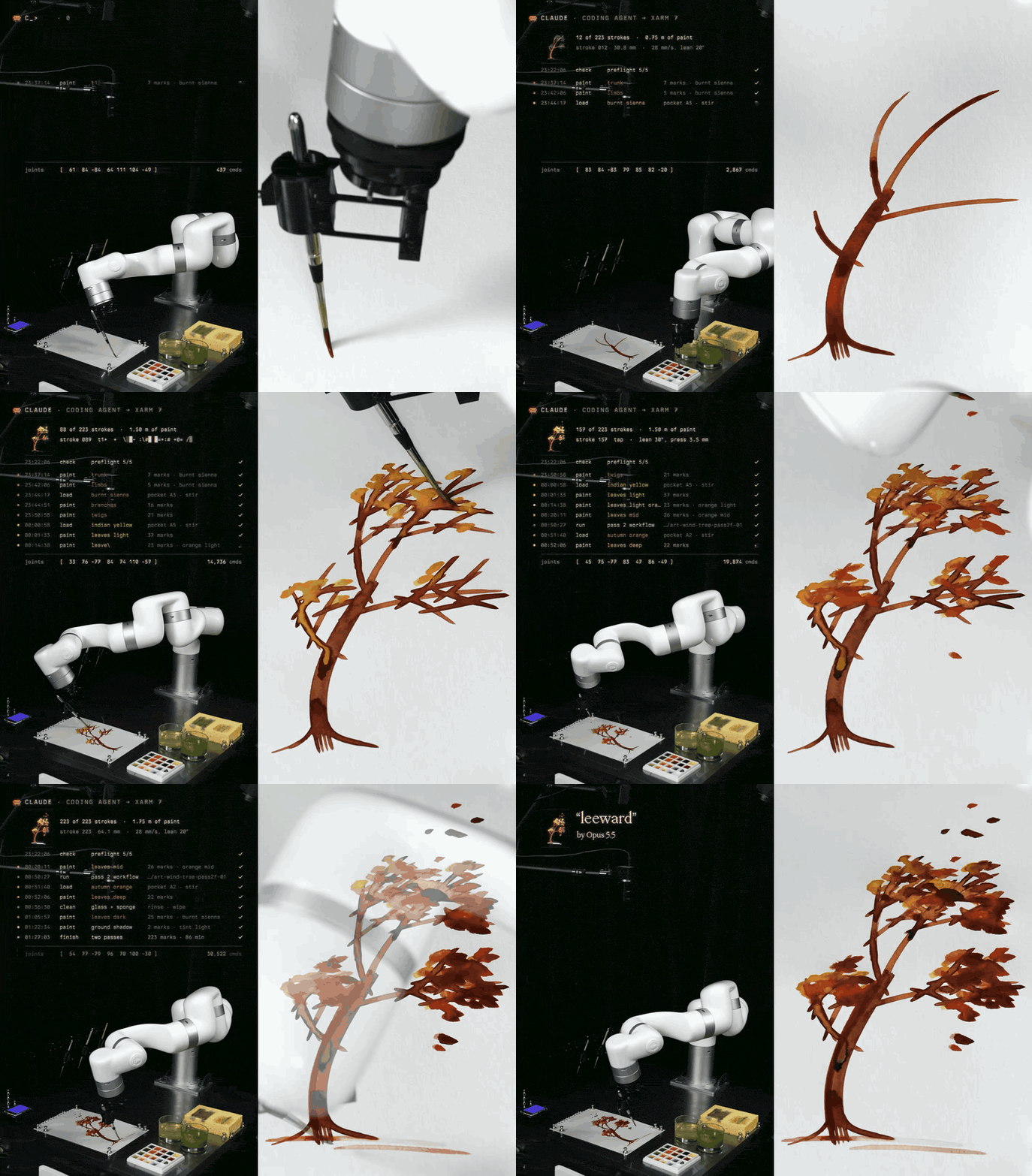
Read the calendar as a capability curve: in August, 65 minutes to paint one ginkgo leaf; on November 2, “Leeward”, tilted into the wind; then four in the morning, mixing a missing glaze without hurrying. The stroke library thickened in plain sight.
Is it a painter, or a debugging loop that grew hands?
While an AI arranges pixels on a screen, humans shrug and say “the algorithm is amazing”. Hand it a brush and let it leave uneven water marks on real paper, and the feelings get complicated. Some reached for painter Bob Ross and dubbed the palette work a “happy little titration”. The line that travelled further was the compliment: it stops to mix the colour it is missing instead of making do with whatever sits on the tray, and that temperament looks far too much like a painter's.
Insiders poured cold water. Former Anthropic Fellow Adam Karvonen said flatly that this is essentially code driving a brush along a vector path, and that robot painting has been done before. He is right about the lineage — and it misses the part that matters, which is what happens when nobody has supplied a path.
There is a research literature on exactly this argument. A 2025 study posted to arXiv sat professional abstract artists down in co-creative sessions with an autonomous painting arm, and what it examined was how those artists perceived and experienced the collaboration — not whether the machine could lay down pigment. Michigan's Robotics and Nature programme, writing in June 2026, put it more sharply: the complaint against generative AI in art is that it strips human emotion and meaning out of the work, and housing the model inside a robot changes the terms of that complaint. Berlin lands on the same fault line from the engineering side.
For decades, factory arms and trace-following plotters alike have lived inside a script that assumes a perfect world: if the paint dries or the paper buckles, the machine goes blind and stupid. Here the loop programmers have always run in software grew a body in physical reality, and it ran in five moves:
- notice the colour is wrong (perceive an anomaly)
- stop the stroke (suspend the main task)
- walk over to the second palette and dilute (spawn a subtask)
- mix, shoot, measure (close a verification loop)
- go back and keep painting (resume the original task)
What got patched was not a variable but water, ochre and alizarin crimson. That composure rests on unglamorous scaffolding: every path is collision-scanned in a digital twin before execution and only then handed to a deterministic executor, and the hardware emergency stop sits outside the whole stack. Firmware owns the 0.1 mm steadiness of each stroke; the model gets to behave like an artist — one stroke, half a step back, a photo, a thought, then the next mark.
Why can a brain that paints all night not fetch a ball?
This division of labour lands on the robotics industry's dividing line. Anthropic published an experiment called Project Fetch this June: write the software for a commercial robot dog, hook up its camera and radar, teach it to spot a beach ball and bring it back. Last year two teams of engineers with no robotics background went first, one allowed Claude assistance and one not. This year Claude Opus 4.7 took the wheel alone, with nobody in the loop. The human team working with the previous generation needed 181 minutes on tasks Opus 4.7 finished in 9 minutes 35 seconds, writing only one-tenth the code; Anthropic's own write-up of the phase-two runs frames that gap as roughly a twenty-fold pace advantage over the fastest human group. A year earlier, Opus 4.1 could not even connect to the dog. And to this day the dog still cannot bring back that ball.
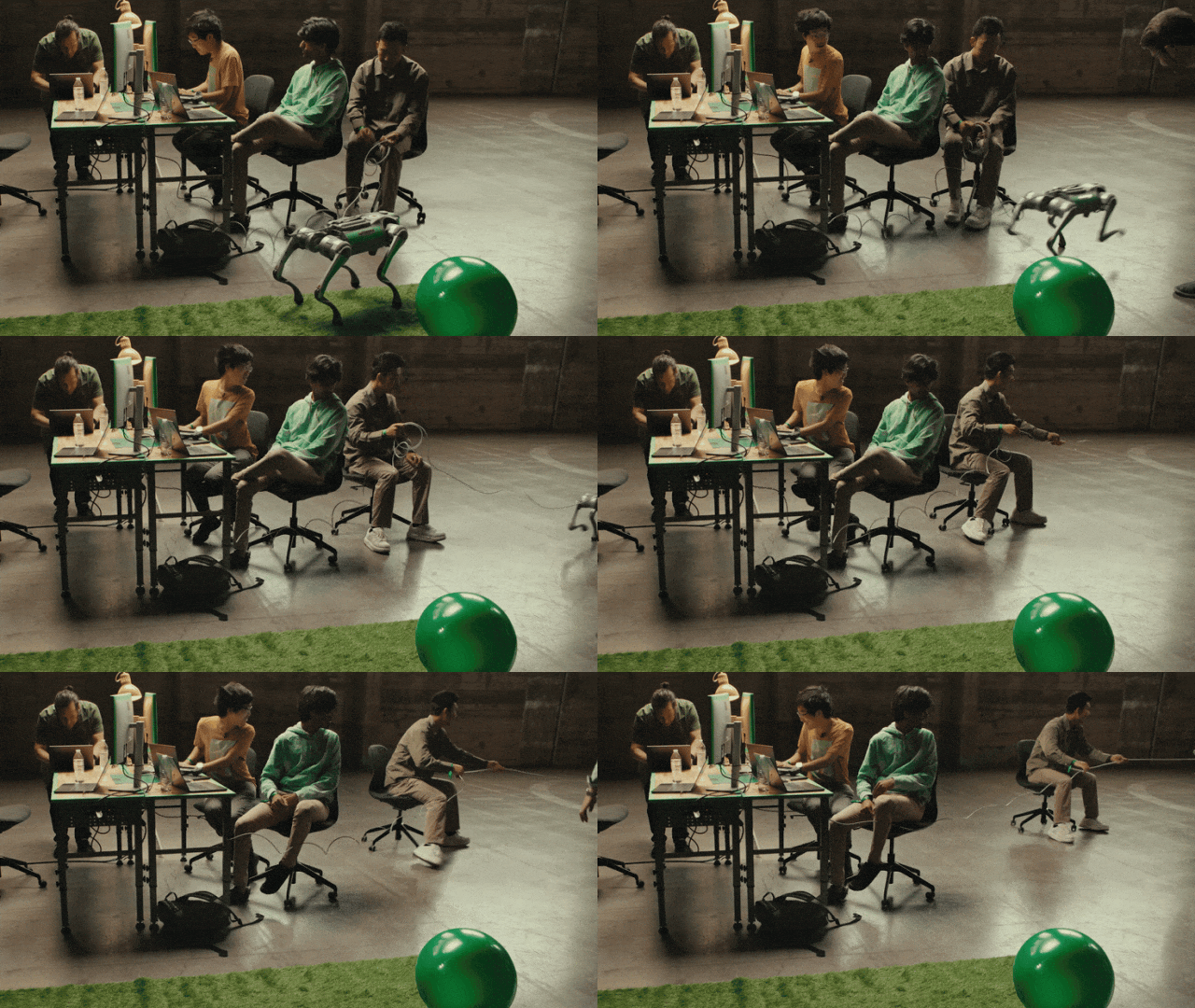
Two answers, one word each. The first is time.
| Fast tasks | Slow world |
|---|---|
| Fetching a ball, folding laundry, twisting a bulb are all fast tasks in physical reality. Within milliseconds of skin touching object, one extra gram of force crushes it and one gram too little drops it — no window for photographing, uploading or writing code mid-motion. This is the mud that Gemini Robotics 2 and π0.5 are fighting through: turning what a camera sees straight into a reflex. π0.5 already tidies a kitchen in homes it never saw in training, with a 94% out-of-distribution success rate; Gemini Robotics ER 2, released in July, can watch a video to track task progress and retry on failure. Neither camp has published control evidence for “notice the paint is short, mix a new colour”. | Painting, by contrast, is a slow-world job. Watercolour does not grow legs and leave; if ten minutes pass between two strokes, the tree is still the tree. In that permitted slowness, a general model holding zero hands-on robot data crossed a wall that normally takes tens of millions of motion data samples to train through, using only common sense read off the internet — red plus ochre darkens, more water lightens, here is how a camera API works — and became a craftsperson. General models are compressing “teach a robot one new trick” into an evening. End-to-end specialists still have to prove what they are worth in speed, success rate and dexterity. |
The second answer is candour about who is failing less. Physical Intelligence's own description of π0.5 concedes that the model does not always succeed on the first attempt and usually has to recover, while Google DeepMind presents Gemini Robotics ER 2 as the robot's high-level brain for chatting with people, reading the physical world and planning multi-step work. Neither pitch sounds like a finished product, which is why the Berlin arm is interesting as architecture rather than as art.
Which architecture fits which job?
If you are weighing this for a product, a workshop project or a vendor conversation, the split is fairly legible.
- Choose the general-model-plus-scaffolding pattern when feedback is visual rather than tactile, the object waits for you, and a wrong move is cheap: watercolour, sorting, labelling, inspection write-ups, teaching demos.
- Choose a specialist vision-language-action model when contact happens in milliseconds, the target moves, or failure breaks something: catching, gripping food, handling fabric, working within reach of people.
- Compare candidates on one shared axis: time per verification. The arm could afford a photo after every stroke. A gripper cannot afford a photo after every newton.
- Budget for the unglamorous layer. The Berlin build's safety came from digital-twin collision scans, a deterministic executor and an emergency stop outside the model stack. Cobot guidance is blunt on this point: power and force limiting under ISO 10218 and ISO/TS 15066 is a property of the installed application, not something that ships inside an arm.
One second-order risk deserves a line for anyone treating a general model as studio staff. The same breadth that lets it order an arm and calibrate a camera also puts it close to your code and your files — which is why guardrails around Claude Code keep tightening, and why some large organisations now restrict which internal repositories and documents outside tools such as Claude and Codex may touch.
Common misconceptions
- “It improvised, so it understands painting.” It improvised a procedure, which is a real capability — but the colour theory here is book knowledge converted into doses of water, not taste.
- “Robot painting is new.” It is not; motion-controlled art machines predate this build by decades. The novelty is a general model writing the plumbing itself.
- “If it beats humans at coding the dog, the dog is solved.” Opus 4.7 answered 181 minutes of human work with 9 minutes 35 seconds and still cannot return a ball. Writing robot software and being a robot are different problems.
- “Cheaper hardware gives the same result.” The plotter path costs a fraction as much and will never wet a brush; degrees of freedom, not dollars, bought that single-breath arc.
FAQ
What did Claude actually do at 4 a.m.?
It paused painting because the palette lacked transition colours, mixed red, ochre and alizarin crimson with water on a second palette, photographed each slot to check the tone, and resumed only when the mixture matched. Total output: 303 brushstrokes across 4.5 hours.
Why does an arm bought on eBay matter to non-engineers?
Because procurement, spec-reading and logistics were delegated to the model. It shows an AI agent operating on the supply side of a project rather than only generating text about it.
Which result is more advanced, the painting arm or the dog test?
They measure different axes. The arm shows a general model compensating for zero robotics training data in slow conditions; the Anthropic trials show how much raw coding speed a model already has. Neither demonstrates reliable moment-to-moment physical dexterity.
Can I copy this setup at home?
Not on this budget. Expect around five figures for a new 7-axis arm, or far less patience spent on a plotter that costs a tenth as much and cannot hold a brush. What you can borrow today is the method: photograph the result, compare it against intent, let the model propose the next step.
What would count as real progress from here?
A published side-by-side in which a specialist model is given the same “colour missing” interruption test, plus general models narrowing the distance between a fast task attempted and a fast task completed.
Four moves worth making now
- Ask how fast the world answers back before you ask how smart the model is. Slow feedback tolerates a generalist; millisecond contact does not.
- Put a camera in the loop before you buy a bigger model. One photo and one measurement turn a language model into a closed-loop one.
- Keep the emergency stop outside the intelligence, so a confused model cannot reason its way past a safety circuit.
- Watch the crossover: a general model that can mix paint is one architecture away from being sold as cheap general-purpose robot software, and specialist vendors will have to price their speed advantage honestly.
Facing a flood of purchase requests, nil says half in earnest that he wants to run a “robot art club”: one theme a month, drawn stroke by stroke by an arm, mailed to members with its telemetry attached.
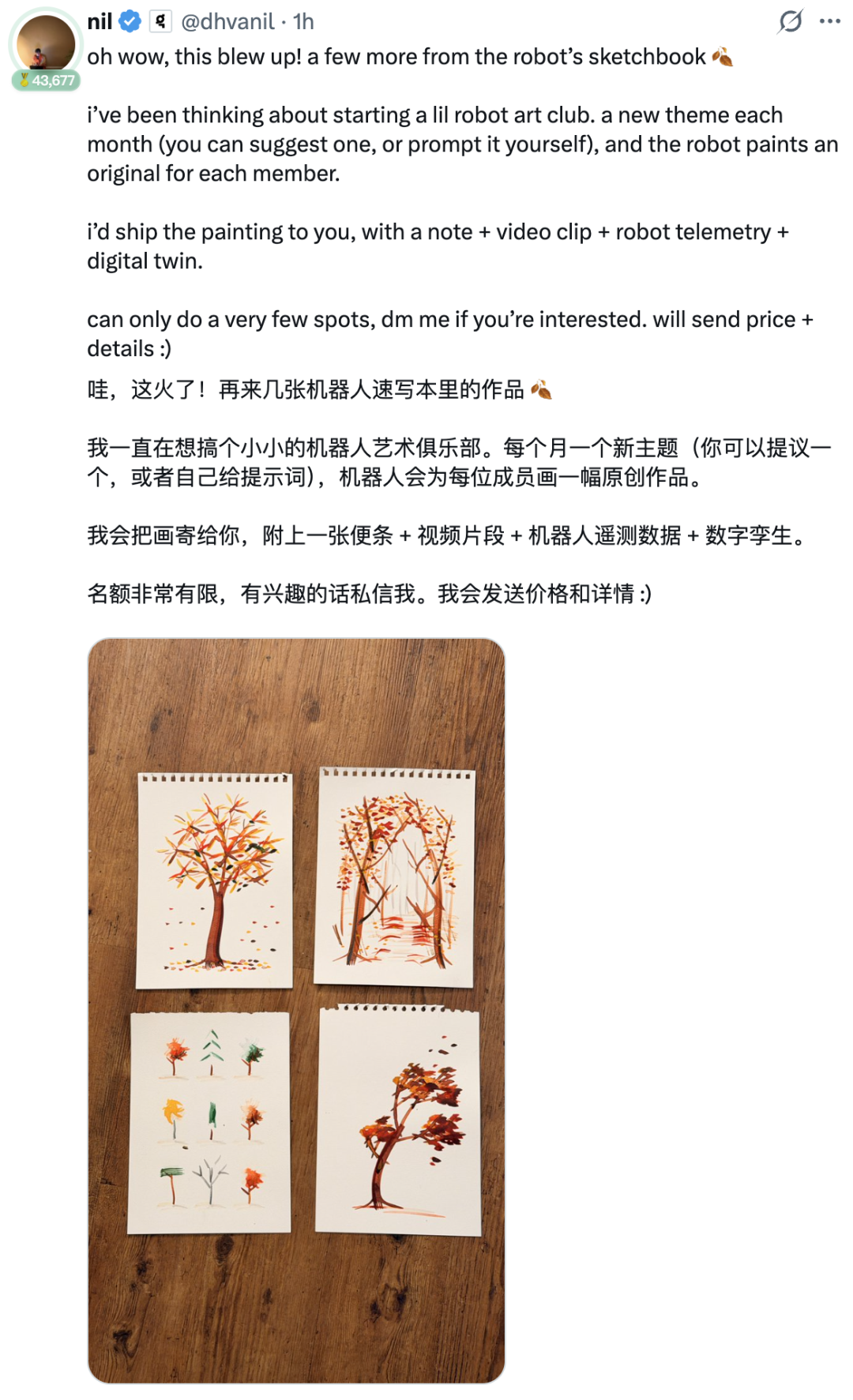
Machines will eventually master millisecond touch and force, catching a thrown key while a pan still sizzles. Long after that, the image people quote will still be the one from November 2026: a single lamp on, a secondhand arm frozen in mid-air, its cameras fixed on an unfinished tree; the red judged too harsh for the leaves it wanted, so it turned around and let one drop of water into the palette.
Sources
- UFACTORY xArm 7 official product page (price, payload, reach, repeatability) — https://www.ufactory.cc/product-page/ufactory-xarm-7
- Evil Mad Scientist, AxiDraw documentation and shop listing (pen plotter definition and pricing) — https://www.axidraw.com/ , https://shop.evilmadscientist.com/890
- Anthropic on Project Fetch — https://x.com/AnthropicAI
- Physical Intelligence, “A VLA with Open-World Generalization” on π0.5 — https://www.pi.website/blog/pi05
- Google DeepMind, “Gemini Robotics 2 brings whole body intelligence to robots” — https://deepmind.google/blog/gemini-robotics-2-brings-whole-body-intelligence-to-robots/
- University of Michigan Robotics and Nature, “Artists paint with robots to study creative expression” — https://robotics.umich.edu/news/2026/artists-paint-with-robots-to-study-creative-expression/
- arXiv, “Artists' Views on Robotics Involvement in Painting” (co-creative autonomous painting arm study) — https://arxiv.org/html/2510.07063v2
- EWI, “Understanding Collaborative Robot Safety” (ISO/TS 15066 power and force limiting) — https://ewi.org/wp-content/uploads/2018/12/Garman_Understanding_Collaborative_Robot_Safety.pdf