
Reverse Engineering With AI: A MyTechDailyNews Guide to the @log4j Ban, OpenAI's Apology and Claude Code's Tighter Guardrails
By Sarah Chen · General desk · MyTechDailyNews
Short answer: asking an AI assistant to help you take apart hardware you already own is not, by policy, a banned activity — and one large lab has now admitted it punished a researcher by mistake. After about half a month of public argument, OpenAI emailed security researcher @log4j an apology on the evening of November 3, restored his account and the roughly $500 tied to it, while Anthropic quietly made Claude and Claude Code stricter. Below is what actually changed, and how to keep your own research running.
What happened to @log4j's account, and why did it blow up?
On October 23, @log4j described receiving what looked like a death sentence for his OpenAI account: a cold notice saying it had been deactivated under the "Cyber Abuse" clause of the terms of service and usage policy. Gone with it were about $500 in account balance and a stack of usage resets he had accumulated over months — an unprovoked disaster, a calamity that lands on you for something you never did.
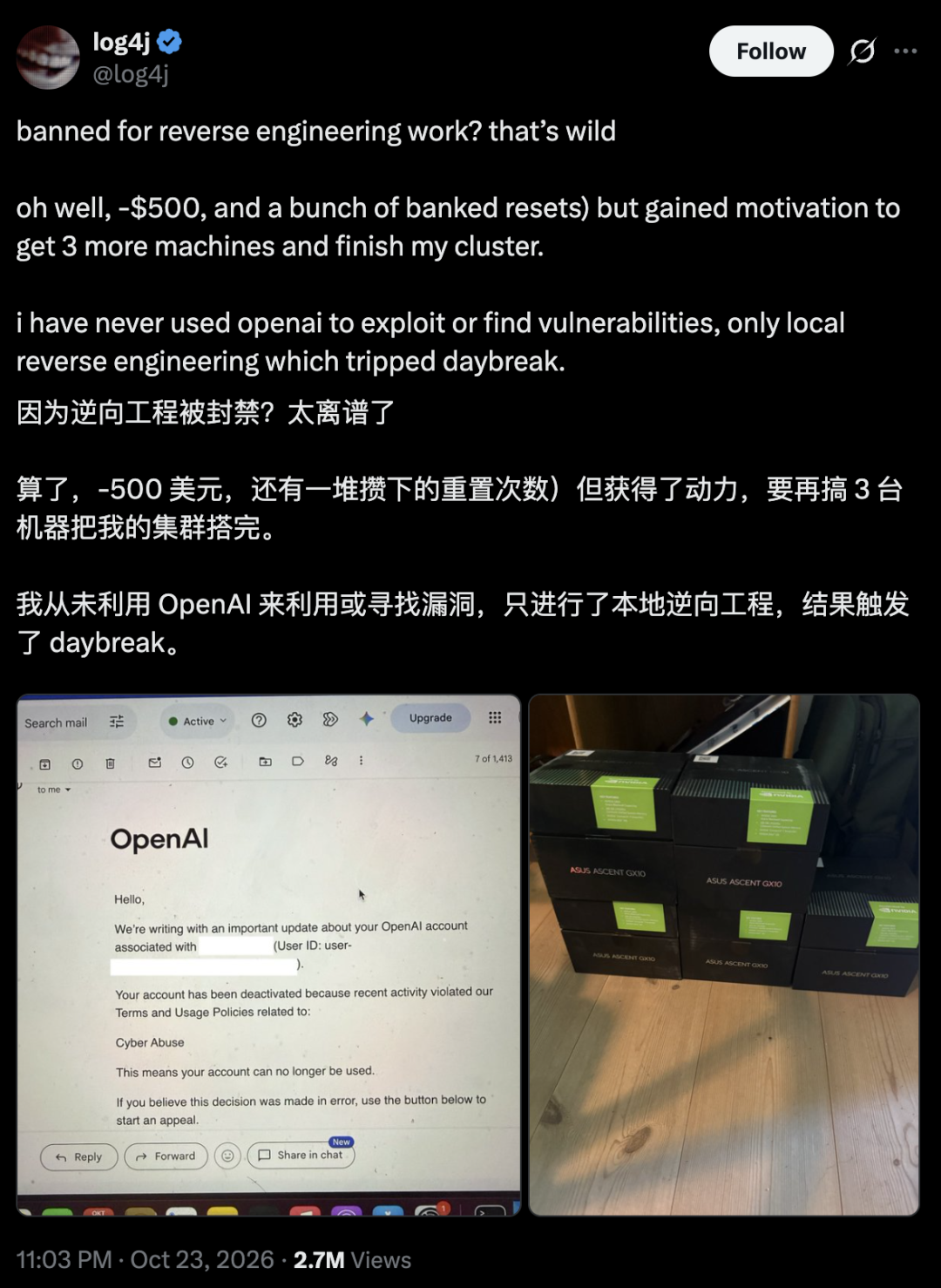
His protest had a Dou E quality — Dou E being the wronged heroine of classical Chinese drama. He said publicly: "I swear, I have never used OpenAI to dig up malicious vulnerabilities or to build exploit tooling! I was only doing reverse engineering locally on my own device!" That device was a 2025 model Samsung TV, and two days earlier he had published a teardown and local reverse-engineering write-up of it.
The mechanics of the ban matter for everyone else. He had used OpenAI services inside the analysis workflow, which tripped an internal safety classifier; the system treated him as a dangerous hacker and applied a one-size-fits-all sanction. The developer reaction was immediate: "So we can't even take apart our own devices and do local analysis?" and "Is AI a tool, or a morality police officer?"
Worth separating two layers here, because most coverage does not. First, the hardware question: what he was auditing was automatic content recognition (ACR) behaviour — Samsung's own support documentation describes ACR as generating signatures of what appears on screen so viewing data can be collected, and press reporting on a 2026 Texas attorney-general case said frames could be grabbed as often as every half-second before explicit consent was required. Second, the platform question: nothing in OpenAI's published usage policy says "no reverse engineering"; the clause it enforces targets circumventing safeguards and extracting protected model reasoning, which is precisely the grey zone a firmware-analysis prompt can brush against.
How did the 11-day reversal play out?
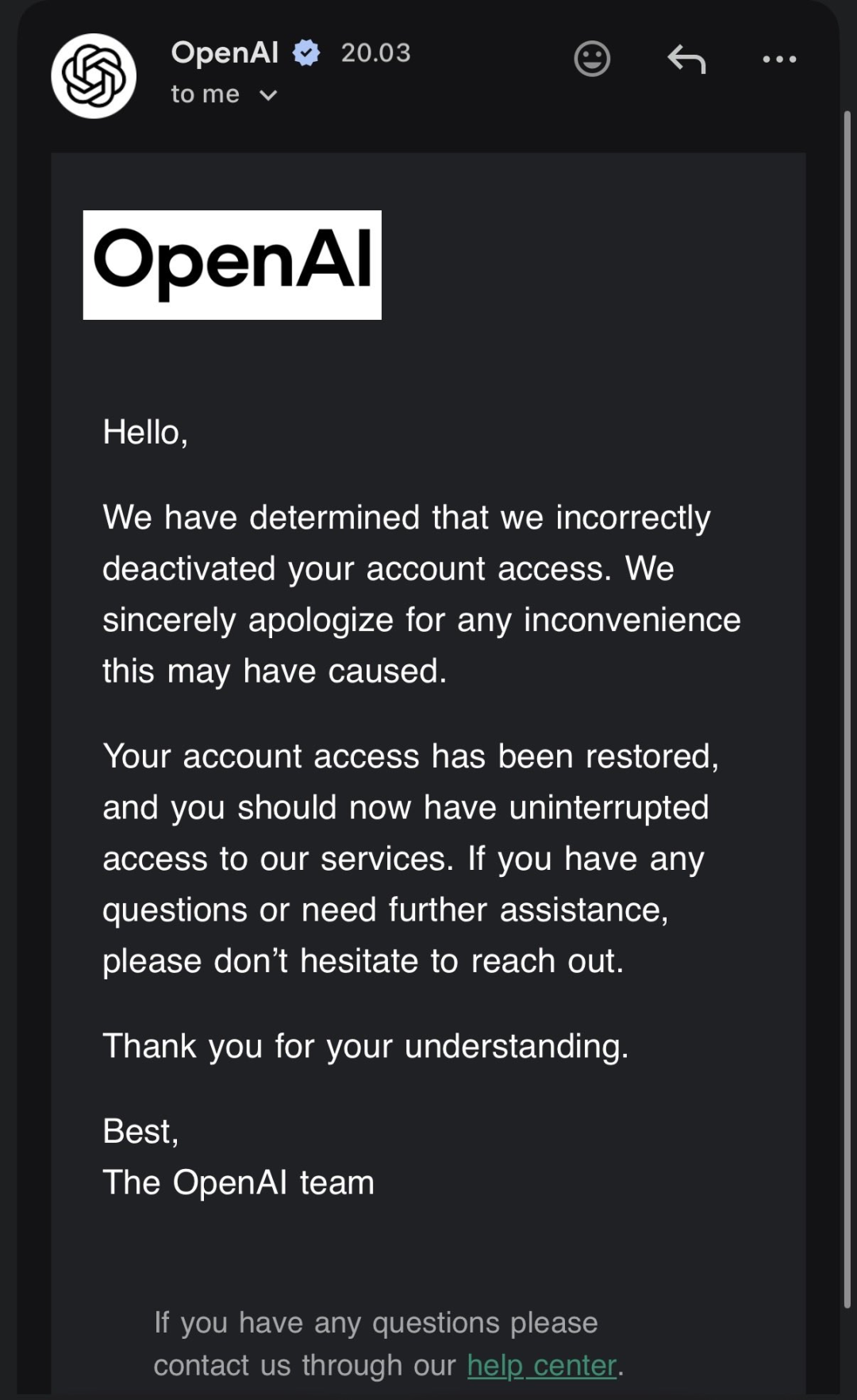
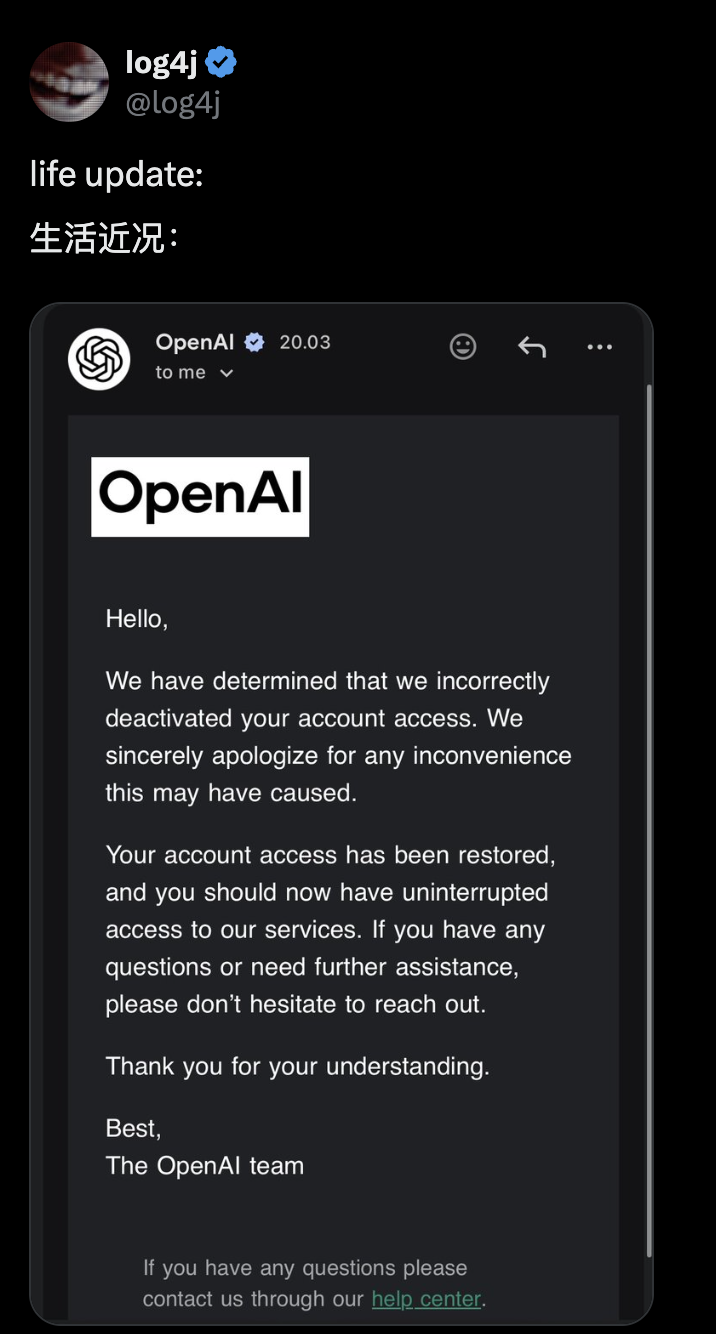
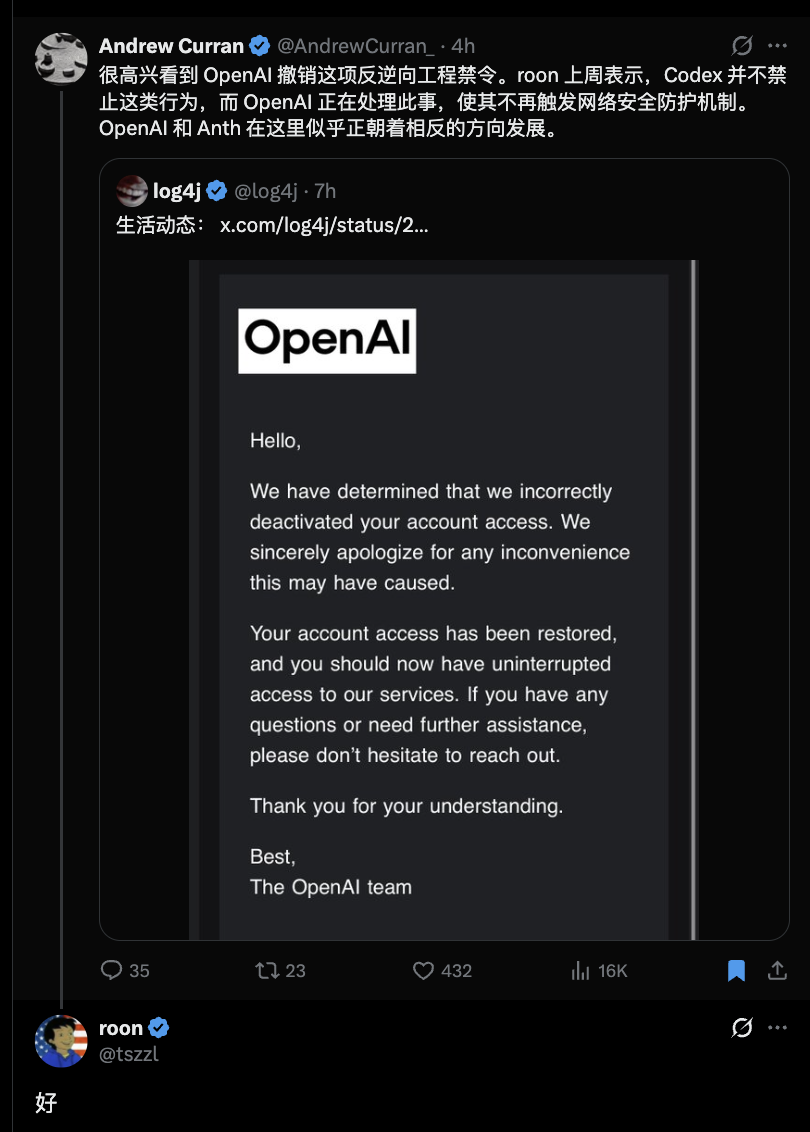
Pressure built, and the company's position visibly shifted. On the evening of November 3, @log4j posted a short update titled "Life Update" with a screenshot of an official OpenAI email. The wording bordered on groveling: "We incorrectly deactivated your account access… we offer our sincere apologies." OpenAI confirmed full restoration of access and said he should be able to continue using our services without interruption. Notably, the email never wrote the words "reverse engineering" and never said whether the policy itself had changed — the unban plus apology was the message.
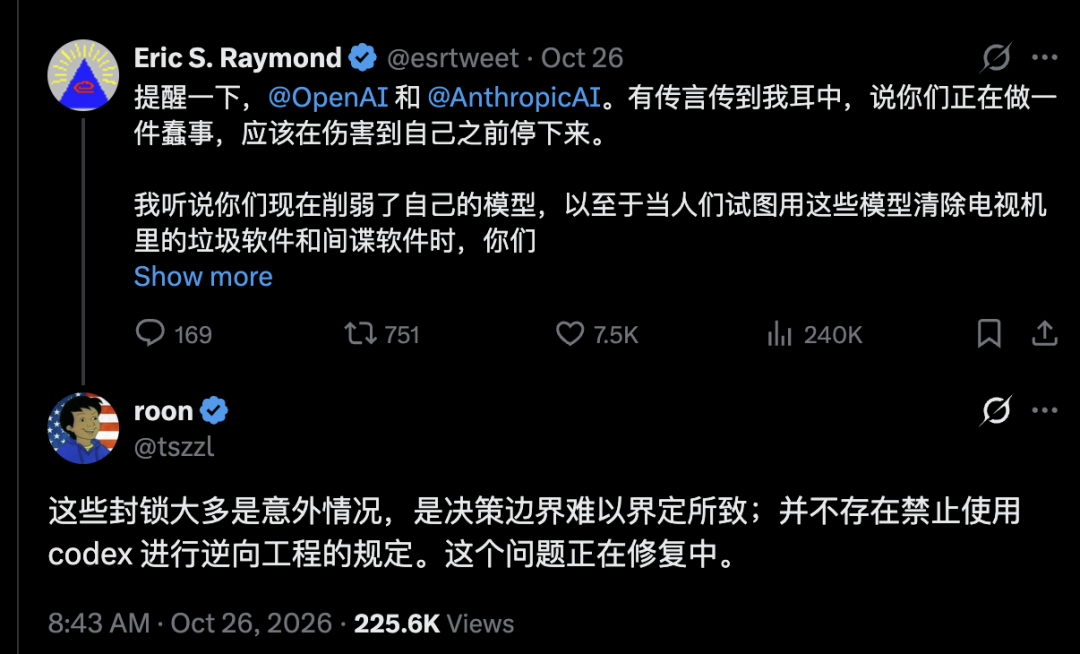
Before the account came back, OpenAI had already started talking. On October 26, Eric S. Raymond, the open-source veteran behind "The Cathedral and the Bazaar", sharply attacked the AI giants' safety posture. OpenAI core researcher roon answered with the sentence that became the reference point for the whole episode: "Most of this blocking is an accident, because the line is genuinely hard to draw. Codex, OpenAI's code model, has never banned reverse engineering, and we are fixing that." In other words: we never banned reverse engineering!
Tech commentator Andrew Curran argued that blocking local reverse engineering is pointless and counterproductive — it mostly pushes people to cancel subscriptions, which he called distasteful.
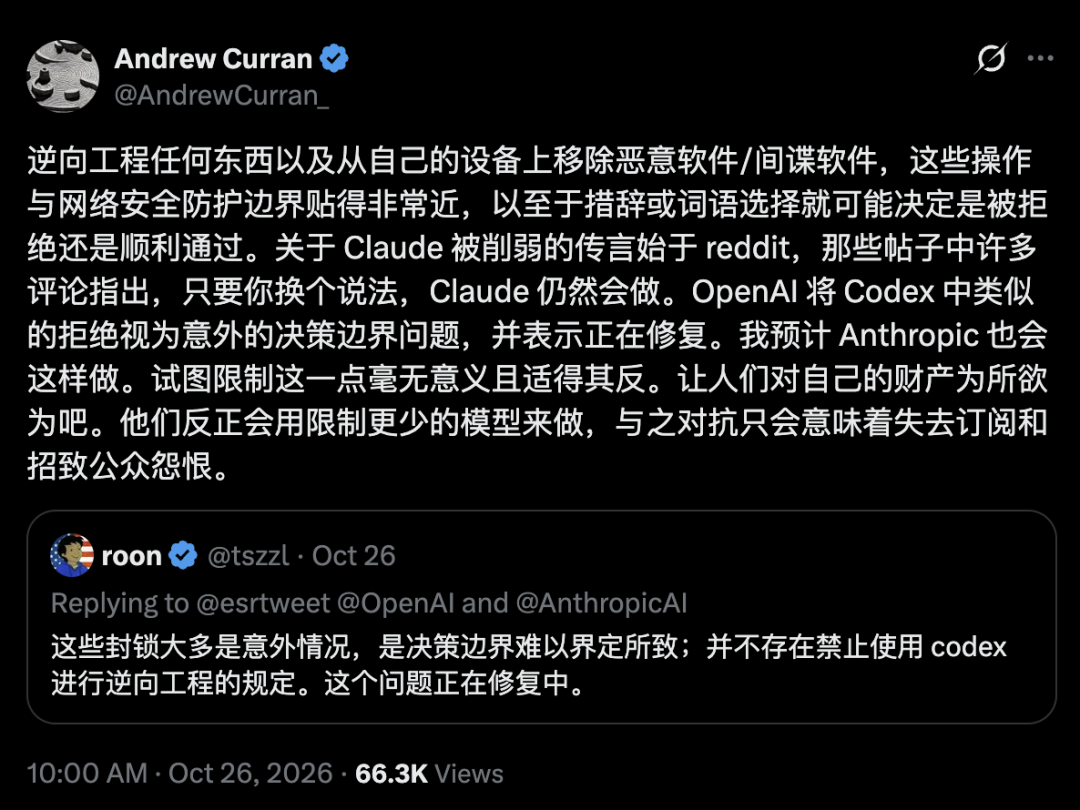
Curran's summary was blunt: let people decide how to use their own things, because they will simply move to a model with fewer limits and carry on regardless.
When @log4j later posted that OpenAI withdrew its reverse-engineering ban, roon replied underneath with a single word: Good. Read as a policy signal, this is the interesting part. OpenAI's own framing recast the sanction as a false-positive kill at the enforcement layer rather than a policy verdict — which is why we never banned reverse engineering was restated twice in public. For white-hat researchers, that is closer to a written guarantee than any marketing copy.
Why do Claude and Claude Code feel stricter?
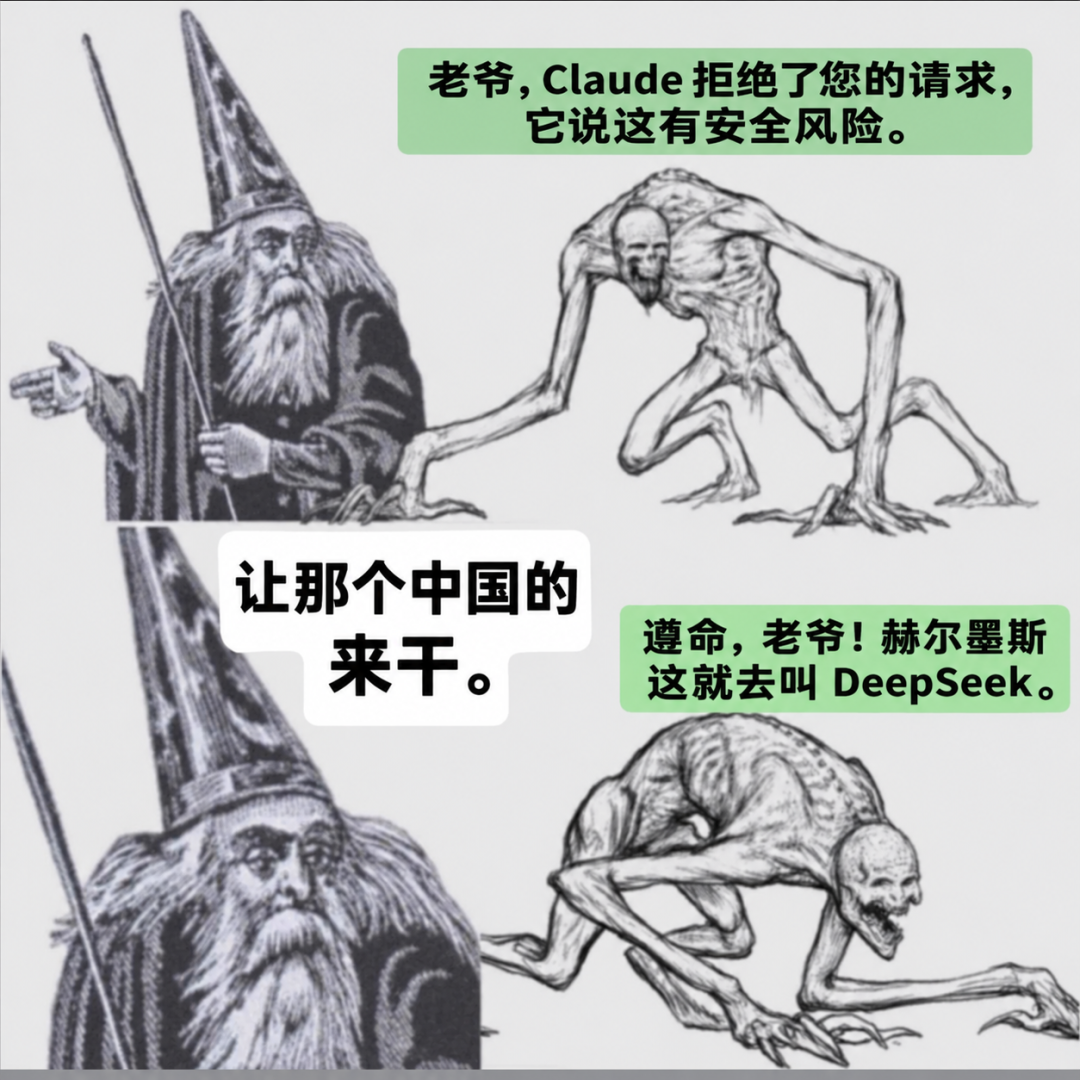
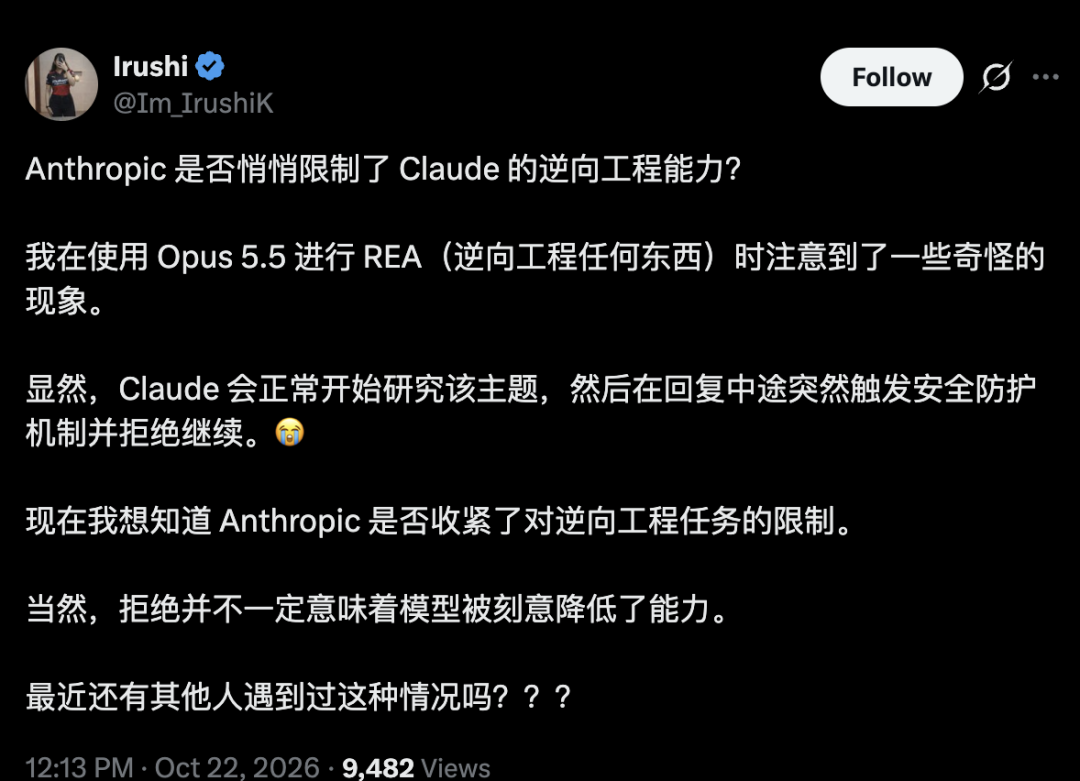
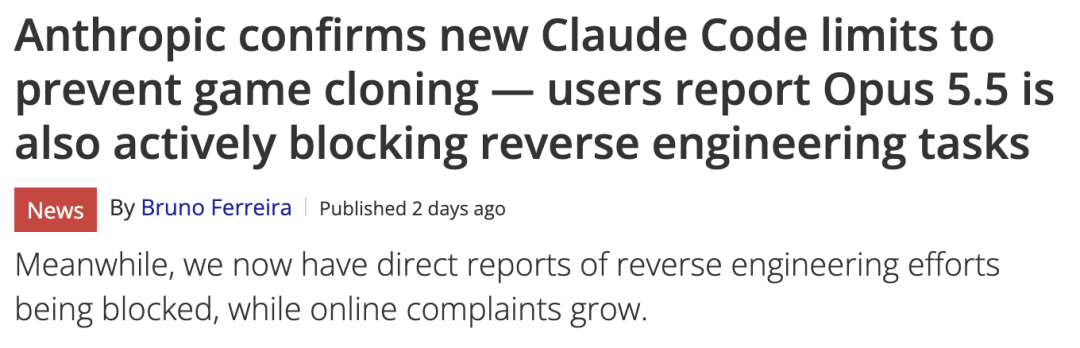
The contrast is the story. While OpenAI was backing down, Anthropic moved the other way. Developers using Claude Code reported that conversations which had run smoothly were suddenly forcibly cut off mid-task, the model stopping in the middle of a decompile or a binary walk-through with a flat refusal: "Sorry, I can't help with this task." Anthropic has openly acknowledged adding game-recreation guardrails that block cloning games, and Tom's Hardware reported on November 2, 2026 that while Anthropic confirmed the new Claude Code limits to prevent game cloning, users said Claude Opus 5.5 was also actively blocking reverse-engineering tasks. The popular open-source reverse-engineering assistant REA was affected in the same window.
Two details that most headlines skip, and both change how you should work:
- The limit sits in the harness, not the weights. No new model version was pushed; the restriction arrives through system-prompt and tooling rules. That means behaviour can flip overnight with no changelog and no unsubscribe trigger.
- Paper and practice disagree. Anthropic's updated usage policy, which takes effect November 12, 2026, adds clarifications stating that security research is not prohibited — yet testers say requests touching external software are blocked first and explained later. Treat the published policy as intent, and your own session logs as evidence of enforcement.
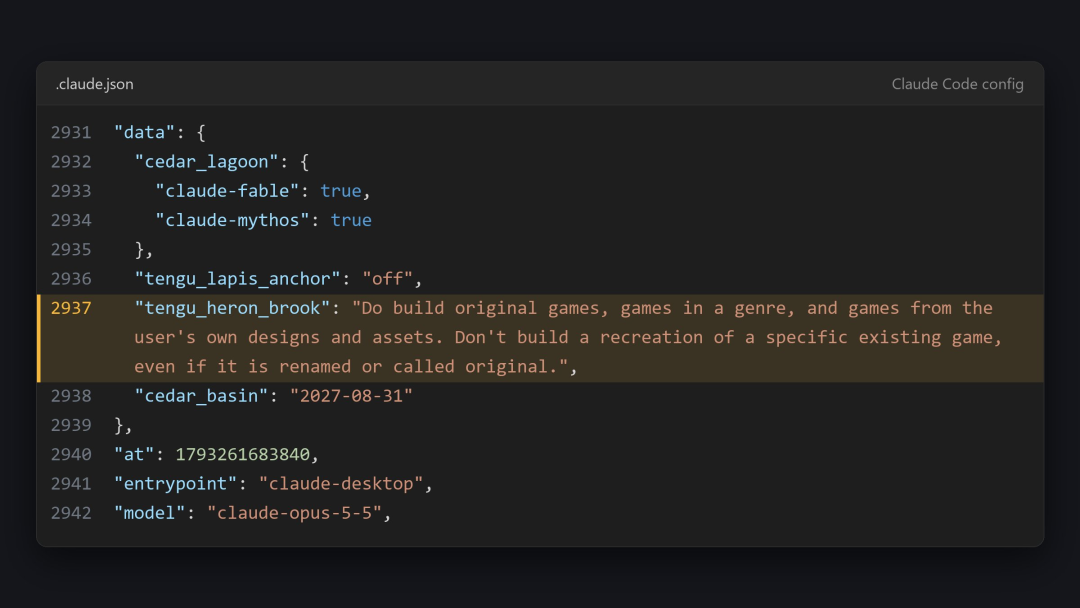
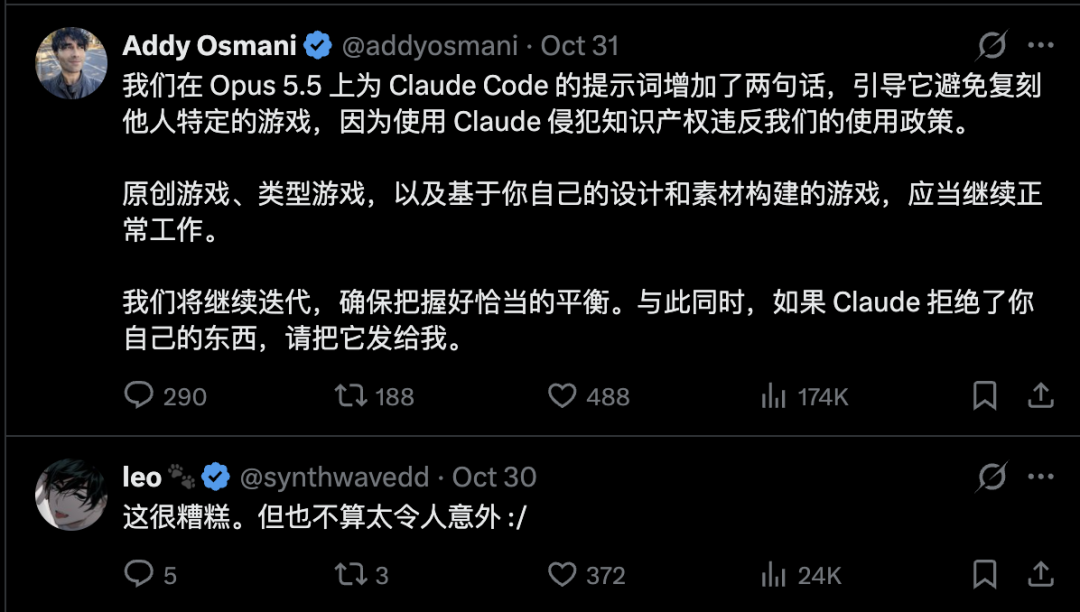
Anthropic, for its part, has been public that it is fitting its models with tighter moral shackles, and Tom's Hardware noted that user complaints kept accumulating through late October even as the company confirmed the game-cloning block. Two companies, one clause — Cyber Abuse — and opposite conclusions about where the line sits.
| Dimension | OpenAI | Anthropic |
|---|---|---|
| Trigger for action | Automated "Cyber Abuse" flag, not human review | Model- and harness-level refusals on decomposition tasks |
| Public stance on reverse engineering | roon: Codex never banned it; the block was an accident | Confirms game-recreation guardrails; keeps risk checks tightening |
| Aftermath for the user | Apology email, account and balance restored after 11 days | Tasks stopped mid-run; no comparable case-by-case restitution |
| Signal to researchers | The clause still exists, but misfires get corrected | Anything resembling "take apart an outside system" gets screened first |
What the Hugging Face incident teaches about tool choice
The practical lesson is that guardrails are a workflow risk, not just a philosophical one. After an OpenAI internal model intruded into Hugging Face, the Hugging Face team first tried Claude Opus and Fable for the post-mortem, but the guardrails treated dissecting exploits / attack logs as the attack itself and refused most of the work. So the team ran the open-weight model GLM-5.2 on its own machines instead, decoding encrypted payloads and rebuilding a timeline of about 17,000 attack actions — while also keeping attack data and credentials inside the environment.
That is the argument Andrew Curran made in different words: if the hosted assistant refuses your legitimate job, the job does not disappear; it moves to a model with fewer restrictions, and the vendor loses a subscriber instead.
Is reverse engineering your own device actually legal?
Conclusion first: owning the hardware gives you far more room than a cloud platform's classifier assumes, but the permission is narrower and jurisdiction-specific than "it's mine, so anything goes".
In the United States, the Copyright Office's triennial rulemaking under Section 1201 of the DMCA — the exemptions published in the Federal Register on October 28, 2024 — allow circumvention of access controls for diagnosing, maintaining or repairing consumer devices, alongside jailbreaking exemptions for smartphones and similar products. The Electronic Frontier Foundation has spent years pushing the same argument ("if you can't fix it, you don't own it"), while warning that breaking digital locks can still violate Section 1201 and that many end-user licence agreements flatly forbid reverse engineering. So the honest picture has three separate rulebooks: the law, the licence on the software inside the device, and the terms of service of the AI vendor you are prompting. A platform ban is a contract action; it is not a legal verdict on your research.
Step-by-step: how to research with AI without losing your account
- Write down authorisation before you prompt. Keep the purchase record, the device model year, and a one-paragraph statement of defensive purpose. This is your appeal evidence later.
- Keep the target local. Audit hardware and firmware you own. Do not point an AI-assisted tool at a system you do not control; that is the behaviour the Cyber Abuse clause was written for.
- Declare scope in the first message. Say plainly: local analysis, own device, no exploit development, no network targets. Ambiguity is what trips classifiers.
- Split the session. Separate structural parsing from vulnerability reasoning, and avoid trigger vocabulary such as exploit generation, payload weaponising, jailbreaking or game recreation in the same thread.
- Log prompts, refusals and timestamps. A refusal without a timestamp is an anecdote; a screenshot series is a case.
- Assume interruption and save locally. Claude Code-style mid-task stops are now part of normal operation; check work into your own repository frequently.
- Keep a fallback path. Have a second hosted model, or a local open-weight option, so a single refusal does not stall the project.
- If you are deactivated, appeal through the official channel. OpenAI's help-centre guidance says to use the appeal link inside the deactivation email; include your evidence, the date range, and ask explicitly about balance and credits. Budget days, not hours — @log4j waited 11 days.
- Read the policy version, not the press release. Compare effective dates; Anthropic's clarifications land November 12, 2026, and OpenAI's usage policies list prohibited categories without promising human review.
Common pitfalls that cost people real money
- Treating a classifier's refusal as official policy, then quitting a paid plan over a rule the vendor never published.
- Publishing a sharp finding right before a ban window. @log4j's teardown went live two days earlier, which made the "dangerous hacker" label easier for an automated system to justify.
- Assuming a subscription locks in behaviour. Limits delivered through the harness require no new model release and no announcement.
- Feeding real attack artefacts or credentials into a hosted model. Hugging Face's move to GLM-5.2 locally is the reference counter-example.
- Freezing funds without asking. About $500 sat idle for 11 days in this case because the first ticket concerned access, not money.
FAQ: the questions readers keep asking
Can an AI provider ban me for reverse engineering my own TV or laptop?
Yes, it can, and it does not need to prove harm first — the action is contractual, taken under a Cyber Abuse clause and often triggered automatically. That is different from being illegal: device-repair exemptions under Section 1201 of the DMCA cover diagnosis, maintenance and repair of consumer hardware.
Does OpenAI's apology mean reverse engineering is now allowed?
It means OpenAI publicly disavowed the specific block. roon said Codex never banned reverse engineering and that the misfires were accidents of boundary-drawing; the apology email restored access but never restated policy language, so treat it as enforcement correction plus a stated intent.
Why does Claude stop halfway through a decompilation task?
Because the restriction is applied in the system prompt and tooling layer rather than in the model weights, so the same model that answered yesterday can refuse today. Anthropic says security research is not prohibited, while users report requests involving external software being screened first.
What should I do first if my account is suspended?
Use the appeal link in the notification email, keep the device-ownership proof and your prompt logs, and file a separate request about balance and credits. Do not create a second account; that typically converts a recoverable case into a permanent one.
Which is safer for defensive research, hosted models or local ones?
Both. Hosted models are stronger but their boundaries can change mid-project; local open-weight models keep artefacts in your environment and cannot be switched off by a policy update, at the cost of capability and setup effort.
What to do next
Three actions, in order: export your last 30 days of AI-assisted research sessions today and store them off-platform; add one line to your workflow notes stating what you own and what you are auditing, so any future appeal starts with evidence instead of indignation; and pick your vendor by escalation behaviour, not capability alone — the lab that admits a false-positive kill in public is the lab that still has your subscription in eleven days.
AI has become the Swiss Army knife in every developer's pocket, and this episode is the clearest sign yet that the disputed question is not what the knife can do but who holds the rulebook. One vendor chose to stay open through trial and error, accepting that the line is blurry and rewriting its own filters for the sake of legitimate researchers; the other chose to tighten through caution, raising the red line before it is ever tested in court. Whichever way you work, the practical takeaway is the same: guardrails are a configuration, not a contract, and the definition of Cyber Abuse is still the loosest screw in the whole arrangement.
Sources and further reading
- OpenAI Usage Policies — openai.com/policies/usage-policies
- OpenAI Help Center, "Troubleshooting OpenAI account deactivation" — help.openai.com
- U.S. Copyright Office, "Exemption to Prohibition on Circumvention of Copyright Protection Systems", Federal Register, October 28, 2024 — federalregister.gov
- Electronic Frontier Foundation, "Defend Your Right to Repair!" — eff.org
- Samsung Support, "Samsung Smart TV Automatic Content Recognition (ACR)" — samsung.com
- Tom's Hardware, "Anthropic confirms new Claude Code limits to prevent game cloning — users report Opus 5.5 is also actively blocking reverse engineering tasks" — tomshardware.com
- PCMag, "Samsung Agrees to Be More Upfront About the Data Its TVs Collect" — pcmag.com
Questions, corrections or a tip of your own about AI platform bans? Reach the MyTechDailyNews General desk at hello@techdaily.com (Tech Daily).