
Physical AI in Practice: MyTechDailyNews' Builder's Checklist From OktoberTech Silicon Valley 2026
By Sarah Chen | MyTechDailyNews · General
Physical AI is artificial intelligence that steps off the screen and into a machine: it reads sensors, decides what should happen next, then drives motors in real time — and the gap between a crowd-pleasing demo and a product you can actually ship is usually settled by three unglamorous layers: motor control, a hardware root of trust, and enough memory on the board.
That was the through-line on the floor at Infineon's OktoberTech Silicon Valley this year in Mountain View, California, where live robots shared the room with developer benches and the company framed the shift as a journey from automation toward autonomy. Below is the practical version of that story — a build path, a standards checklist, a memory plan and the traps we keep seeing teams fall into.

Figure 1: Robots can use physical AI to perceive their environment, communicate securely, process data locally through edge AI, and act safely and reliably while using energy as efficiently as possible. Source: Infineon
What actually counts as physical AI
In scope: any system that closes the loop between sensing and a physical action in real time, without a human approving every step. Out of scope: a chatbot that drafts a maintenance checklist.
The exhibitors at OktoberTech Silicon Valley described the same loop in three blocks, which is a useful test when a vendor pitches you “AI-powered hardware”:
- Sense. Cameras, time-of-flight, torque and current feedback, proximity and temperature — the signals that tell a machine what the world just did to it.
- Think. Models running close to the motion, at the edge, instead of waiting on a round trip to a data centre.
- Act. Motor control and power delivery that convert an inference into force, movement and a safe stop.
Asked whether the idea reaches beyond robots, Stephan Zizala, division president of edge systems at Infineon, pointed straight at the drivetrain. “Several machine learning algorithms are now powering motor control designs,” he said, and described robotics as the tip of the iceberg for physical AI — the same techniques land in appliances, power tools and factory cells long before they land in a humanoid.
Why 2026 was the year the topic took over the room
Because the money arrived first. PitchBook's quarterly robotics and physical AI tracking recorded a record $18.6 billion raised across 450 deals in the second quarter of 2026, on top of $16.3 billion across 492 deals in the first quarter — back-to-back quarters that look nothing like the hardware drought of the early 2020s.
The event itself is a decade old: OktoberTech started in Silicon Valley in 2017, and Infineon's event page marked the 22 October 2026 edition as the forum's tenth anniversary, with sibling stops from Bengaluru to Tokyo built around the same physical-world themes.
The investor conversation explains the timing: cheaper actuators and sensors, tightening labour supply in warehouses and plants, and pressure to move production closer to home. Physical AI is the software answer to those three problems at once.
A six-step build path teams can copy
Step one is the one most teams skip: define the action, not the ambition.
- Pick one physical outcome. “Sort this bin” beats “general-purpose assistant.” The narrower the action, the cheaper the sensors and the shorter the safety argument.
- Map sensors to that action, including their failure modes. Write down what the robot sees when the light goes out, when a box is crushed, when a person steps in.
- Choose the compute tier before choosing a model. Tier decides memory, power and thermals — and later model swaps are far cheaper than a board respin.
- Put machine learning into motor control, not only vision. This is where Zizala's comment matters: learned torque and current control is the shortest path to smoother motion with existing hardware.
- Design trust in at the first schematic. Secure boot, key storage and a measured software supply chain are hardware decisions, not firmware patches.
- Reserve memory headroom now. Assume your first model will be replaced by a bigger one within a year.
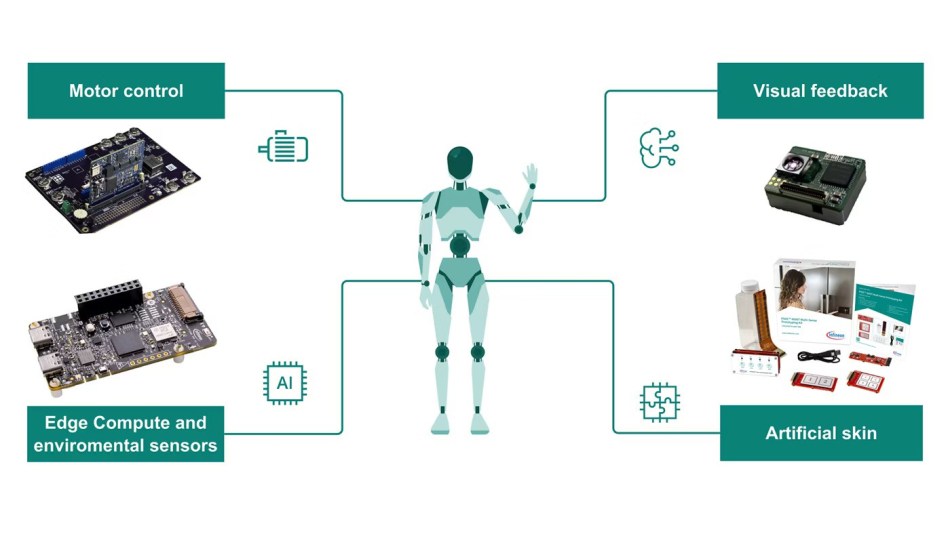
System-level solutions for physical AI were displayed at OktoberTech Silicon Valley 2026. Source: Infineon
Which safety and security standards belong on your checklist
The honest answer from the floor: the capability race is not the gating item. Zizala noted that physical AI is already at work, and said the real open question is whether it is ready from a security standpoint. “While physical AI translates perception into precise movement, functional safety and cybersecurity embedded at the hardware level provide an anchor of trust for even the most advanced robots.”
Earlier this year, Infineon introduced the OPTIGA Trusted Platform Module (TPM), SLB 9672, a hardware-based solution that secures the Jetson Thor platform from Nvidia. It stores cryptographic keys securely and verifies system integrity at the chip level, creating a certified, quantum-resilient root of trust for physical AI systems.
Four reference points cover most of a buying conversation, and none of them are chip-vendor material:
| Reference | What it covers | Reach for it when |
|---|---|---|
| ISO 10218 (Parts 1 and 2) | Foundational safety requirements for industrial robot design and system integration | An arm or mobile robot works in a cell alongside people |
| ISO/TS 15066:2016 | Collaborative robot systems, including human contact force and pressure limits (supplements ISO 10218) | The machine can physically touch a person by design |
| ETSI EN 303 645 | Baseline cybersecurity provisions for consumer IoT devices (version 3.1.3 published in 2024) | Home robots, appliance control and smart home security products |
| Hardware root of trust | Key storage and integrity measurement at chip level, such as the OPTIGA TPM on Jetson Thor | Any robot that updates over the air or leaves the factory |
How to plan around the memory wall
The constraint that generated the most hallway conversation at OktoberTech Silicon Valley was storage, not intelligence. Speaking in the keynote, Andreas Urschitz, chief marketing officer at Infineon, referred to the new parts as foundational MCUs — microcontrollers reimagined for edge AI and physical AI work. Zizala described the design value chain behind them: developers take sensor data, train models, then deploy them onto those MCUs.
That is where the plan breaks. Developers on the floor stressed the need for more memory; one said the issue comes down to more memory, so more AI models could be used. The “memory wall” story from data centres appears likely to reach physical AI designs sooner or later — teams just hit it at a much smaller scale.
| Tier | Realistic resources | What fits comfortably | Caveat |
|---|---|---|---|
| Microcontroller / edge AI MCU | Tens of kilobytes of SRAM up to a few megabytes of flash | Keyword spotting, vibration and current anomaly detection, small vision classifiers | Models must fit both flash and SRAM at the same time; the working buffer matters as much as the weights |
| Robotics module class | Nvidia rates Jetson Thor at 2070 FP4 TFLOPS with 128 GB of memory in a configurable 40–130 W envelope | Full perception stacks, vision-language-action models, multi-camera fusion | Power, heat and bill of materials move with the tier |
Three coping tactics are already standard practice: quantise and prune before you buy silicon; offload working buffers to external memory rather than accepting a bigger main processor; and split the model, keeping reflex-level inference on the MCU and heavier reasoning on the module.
Five common misconceptions
- “Physical AI means humanoid robots.” The functional blocks shown at Mountain View were sensing, computing, connectivity, motor control and power management — they fit a conveyor, a compressor and a door lock as well as a biped.
- “We can bolt on security after launch.” Keys, boot measurement and update signing are board-level decisions; retrofits usually mean a recall.
- “Bigger on-device models are always better.” Latency and safety ratings often improve by shrinking the model and moving judgement to a verified fallback.
- “The memory wall is a data-centre problem.” A robot with 32 KB of SRAM feels the same wall on a smaller scale, one model swap at a time.
- “A good demo is proof of reliability.” Demo conditions remove exactly the messiness — bad light, damaged packaging, unexpected humans — that the safety case has to cover.
What to do in the next 90 days
- Product owners: write a one-page action spec — single task, single environment, explicit stop condition — before any model discussion.
- Engineering leads: cost the compute tier twice, once for today's model and once for a model three times larger.
- Security and compliance: check your product against ISO 10218 / ISO/TS 15066 if it shares space with people, and ETSI EN 303 645 if it lives in a home.
- Operations: instrument energy per completed task, not per hour running — it is the metric that separates pilots from products.
- Marketing: publish what the system does when it is unsure. Public confidence in physical AI is being won on fallback behaviour, not on choreography videos.
The MyTechDailyNews take
Two years of generative AI taught an entire industry how to make machines fluent. The next competitive gap, visible across every booth we walked at OktoberTech Silicon Valley 2026, is making them careful. Robots are the headline, but the practical opportunity sits one level down: motor control that learns, chips that can be trusted, and boards with enough memory to survive their second model upgrade.
FAQ: questions readers keep asking
Is physical AI just another name for robotics?
No. Robotics is the vehicle; physical AI is the control loop that lets a machine sense, decide and act without step-by-step instructions. It reaches appliances, factories and grid equipment as easily as it reaches robots.
Why not just run everything in the cloud?
Because a moving machine has a deadline measured in milliseconds. Local inference removes network round trips, and local execution keeps motion going when connectivity fails — which is also the argument for edge AI MCUs.
Do small teams need a hardware security module?
Practically yes, if the device updates over the air. A dedicated root of trust such as the OPTIGA Trusted Platform Module (TPM), SLB 9672 secures a platform like Nvidia's Jetson Thor by holding keys and verifying integrity at the chip level; the alternative is a software key store that an attacker with physical access can copy.
When will the memory wall hurt my roadmap?
Typically at the second model, not the first. Prototype boards are chosen against today's model size, so headroom disappears the moment the team swaps in a better perception stack — the pattern developers described on the floor in Mountain View.
Is this a 2026 trend or a longer shift?
The capital says shift: PitchBook logged $18.6 billion in a single quarter, and Infineon's event series now spans four continents under the same theme. Treat it as infrastructure, not a news cycle.
Sources referenced
- Infineon OktoberTech event page (dates and 10th anniversary programme) — https://www.infineon.com/event/oktobertech
- PitchBook robotics and physical AI quarterly VC reports, Q1 and Q2 2026 — https://pitchbook.com/news/reports/technology-software/robotics
- Nvidia Jetson Thor product specifications — https://www.nvidia.com/en-us/autonomous-machines/embedded-systems/jetson-thor/
- ISO/TS 15066:2016, collaborative industrial robot safety requirements — https://www.iso.org/standard/62996.html
- ETSI EN 303 645, baseline cybersecurity for consumer IoT devices — https://www.etsi.org/deliver/etsi_en/303600_303699/303645/03.01.03_60/en_303645v030103p.pdf
- Arduino documentation on edge AI memory limits for microcontrollers — https://docs.arduino.cc/learn/edge-ai/eac2-ml-fundamentals/
- Texas Instruments application note on easing AI model memory pressure with external SDRAM — https://www.ti.com.cn/document-viewer/cn/lit/html/ZHDA243