
Case Review: How BDG's ECHO Moved Pampers and Innisfree Up AI Answers — and What It Still Can't Prove | MyTechDailyNews General
Who decides which serum or diaper an AI assistant recommends? Short answer: partly, the sources it cites — and BDG's ECHO program, built with Profound, now sells brands a way into that source list. Replaying its two flagship cases, Pampers and Innisfree, one pattern stands out: tracked visibility can move fast, but none of it proves a sale. Here is the case file, gaps included.
What exactly is BDG selling with ECHO?
Conclusion first: ECHO is branded content rebuilt around the questions people type into AI assistants, then measured by whether the answers cite it. The workflow starts with the advertiser's business questions, not a fixed template. BDG and Profound identify the prompts a brand wants to influence, review competitor mentions and the sources AI tools already cite, then produce articles across BDG titles — Bustle, Nylon and Scary Mommy — and watch whether ChatGPT, Gemini and Google AI Overviews pick those pages up as sources. Paid pushes on Reddit keep the live content circulating too.
What I find genuinely different from a standard sponsored post is that the measurement loop runs before the writing. BDG's Graham Howes, senior vice president of distribution and AI intelligence, has said the company keeps creative development with its own editors rather than the advertiser — which matters, because a plainly promotional ad is rarely a useful answer to a parent's actual question. This is not a two-client experiment either: per Reputation Insider, at least three brands have already paid for the ECHO program. And BDG is not alone in the lane — Mars Snacking has been testing its brands inside AI shopping answers with a similar discovery-first logic.
How did the Innisfree case actually play out?
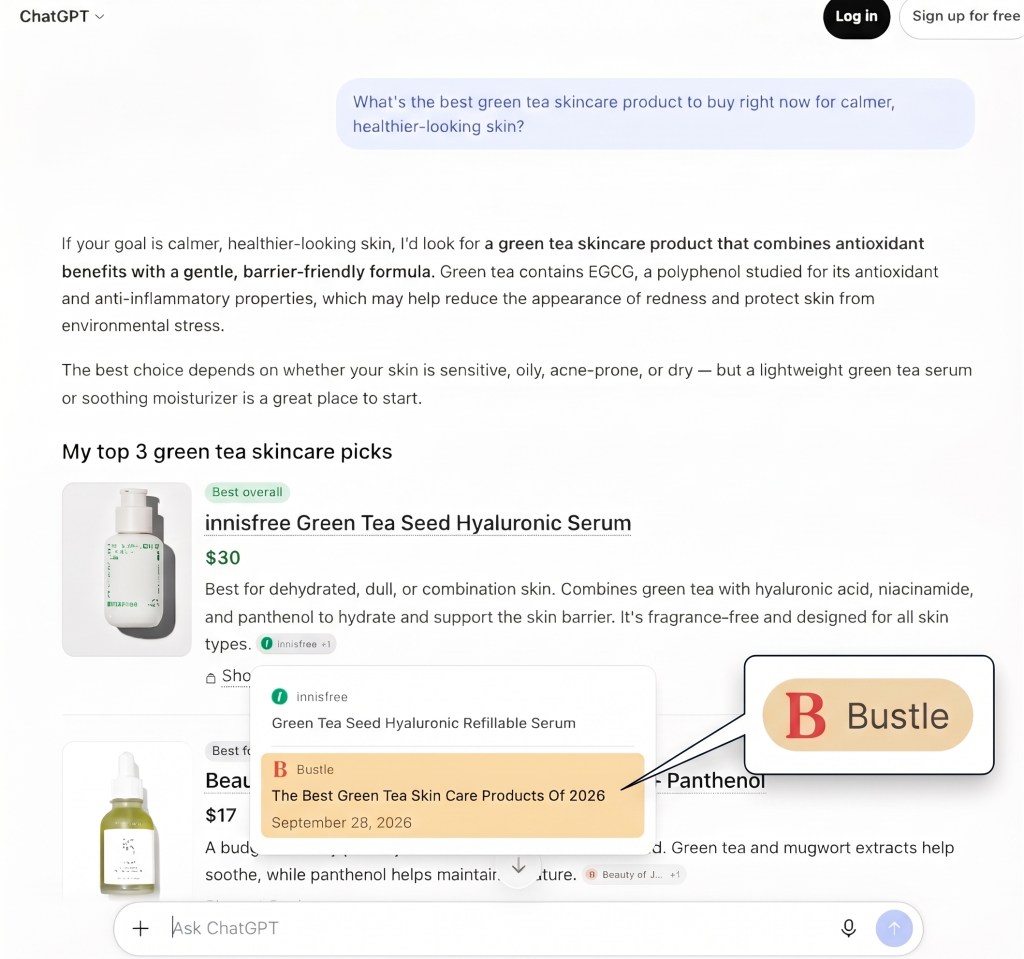
Mechanics first, numbers second. BDG used Bustle's beauty coverage to address questions around green tea skin care, including a September 2026 product guide that recommended the brand's serum. During the campaign, the marketer tracked AI-generated responses to a defined group of product questions.
The reported movement is specific: a BDG and Profound case study describes 30% higher AI visibility across 200 tracked skincare prompts for August 11 to September 30, and Bustle's citation rank improving from 709 to 12 within the monitored set. One caution I would underline: that is a shift in the vendor's AI-citation ranking — not Bustle's Google search position, and not evidence of product purchases.
What did Pampers win, and how?
Pampers took a different subject. A Scary Mommy explainer addressed the shift to fragrance-free Swaddlers — exactly the kind of question a tired parent puts to an AI search tool late at night. For fragrance-free diaper questions, BDG said the brand moved from second to first in tracked AI visibility after the campaign.
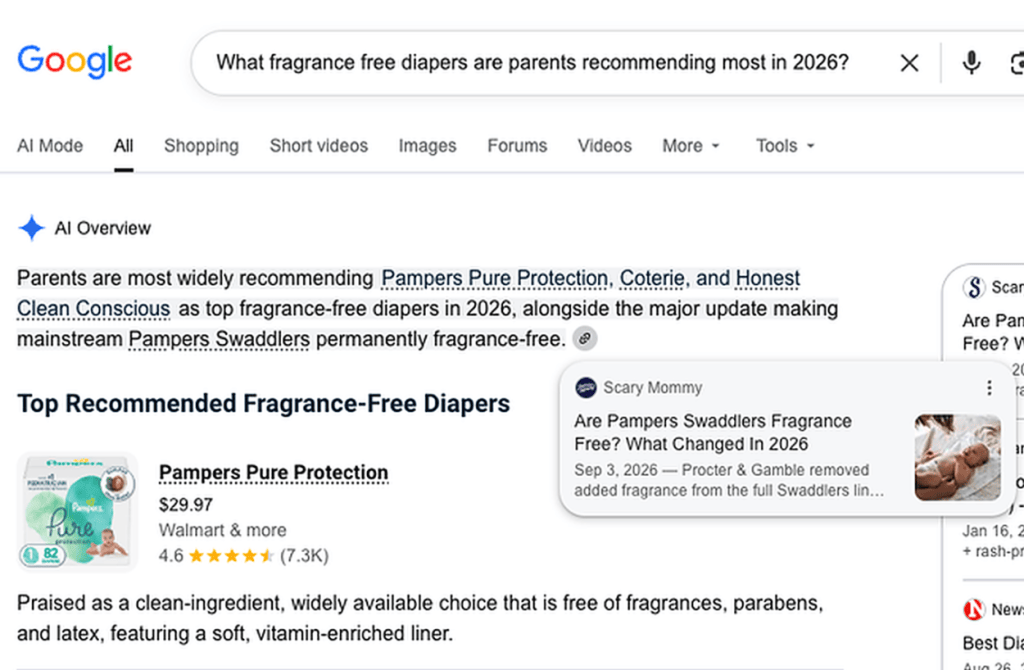
Both cases rehearse the same reusable move: tie one concrete product detail — a green tea serum, fragrance-free Swaddlers — to a real information need, publish the answer on a title AI engines already trust, then measure citation behavior. Neither proves the content alone caused the ranking change, nor that an AI recommendation led to a transaction; the measurements are vendor-reported and depend on which prompts, platforms and periods were sampled.
| Case | Content home | Question addressed | Reported movement | What it does not show |
|---|---|---|---|---|
| Innisfree | Bustle | Green tea skin care | 30% visibility lift across 200 prompts; rank 709 to 12 | Sales, causation, Google rank |
| Pampers | Scary Mommy | Fragrance-free Swaddlers | second to first in tracked AI visibility | Sales, causation, durability |
Where does Daily Mail fit into the picture?
Daily Mail was testing publisher-led GEO with brands before a 2027 product, with up to 15 GEO tests noted by ContentGrip. Read together with BDG's program, the direction is hard to miss: publishers are packaging citations as sellable inventory, the way they once packaged page impressions.
What are the shortfalls you should know before signing?
Three, in my read. First, attribution. Profound itself has acknowledged a gap between a consumer finding a brand through an AI answer and showing how that discovery affects a later sale. Josh Blyskal of Profound framed the operating challenge as: "You've got to be able to connect analytics into action." A dashboard only earns its fee if it changes the article.
Second, stability. Ahrefs' tracking study found 50–83% of AI citations disappear within a day, with roughly 75% of those returning within 20 days — so a rank screenshot is a moving number, not a trophy. If Bustle sits at 12 today, the honest question is where it sits next month.
Third, the difference between being mentioned and being cited. As the Content Marketing Institute points out, appearing in an answer's source list is a weaker signal than having your content actually used in the answer body. Add Pew Research Center's finding that Google users are less likely to click links when an AI summary appears, and the pitch rests on exposure without traffic — which is precisely why it must not be booked as revenue.
| Measurement | What it can establish | What it cannot establish alone |
|---|---|---|
| Brand visibility | How often a brand appears in selected AI answers | Incremental consumer demand |
| Publisher citation share | Whether monitored answers reference a publisher's pages | That readers visited or trusted those pages |
| Sales and conversions | Downstream customer action where tracked | Which AI answer caused it without attribution evidence |
For context, BDG's offer sits beside a wider toolset: Adobe Brand Visibility, previously LLM Optimizer, and Semrush's AI Visibility Toolkit also evaluate visibility, mentions and citations. BDG's distinct pitch is adding content creation and distribution through its own publishing properties.
Which misconceptions should you drop first?
- "A citation is a conversion." It is an upper-funnel exposure event. Report it alongside referral data and sales, never instead of them.
- "The rank improvement is permanent." Citation research shows heavy churn week to week; treat rankings as trends, not fixed positions.
- "Any sponsored article will get cited." The cited piece has to genuinely answer the tracked question; promotional copy tends to fail exactly there.
- "Visibility equals trust." If the cited article is thin, the brand inherits the thinness.
Who should test publisher-led GEO first — and what should they ask?
Brands with a specific, high-frequency product question and an established product line fit best: the Pampers and Innisfree pattern, not a logo-awareness play. Before signing, bring these questions to the table:
- Start with the consumer question, not the brand name. Fragrance-free diapers and green tea skin care were informative starting points; a brand keyword is not.
- Audit the source, not just the answer. If a publisher's page gets cited, check that it answers the question clearly and transparently.
- Separate visibility from business impact. Set sampled citation targets, but report them beside referral, engagement and sales data where reliable connections exist.
- Check how the content is made. Understand the publisher's editorial controls and where your own influence ends.
If a publisher deal is out of budget, there is a cheaper first step: claiming your brand's ChatGPT business profile gives you native visibility data before you pay anyone for citations.
FAQ
Does an AI citation send traffic to the publisher?
Usually not much. Pew Research Center found Google users click result links less often when an AI summary is present; the citation's value is exposure inside the answer, not the click.
Is BDG's 30% figure proof of return on investment?
No. It is vendor-reported visibility across 200 tracked prompts for August 11 to September 30 — a movement in measured mentions, not revenue. BDG reports those measures separately from any sales claim.
How stable are these citation rankings?
Not very. Ahrefs' study found most citations churn within days, with many returning within about 20 days — judge trends over weeks, not single screenshots.
What is the difference between a mention and a citation?
A mention puts your brand name in the answer text; a citation references your page as a source. The strongest outcome is your content used in the answer body with the brand named; the weakest is a bare source-list listing.
Can a smaller brand do anything like this?
Yes, on a smaller scale: answer real product questions clearly on your own site, keep product facts consistent across pages, and use free native visibility tools such as ChatGPT business profiles before buying publisher programs.
The verdict: is it worth testing?
My honest read: as a capped upper-funnel experiment, yes — for a brand with a concrete product question and the patience to judge citation trends over weeks. Ask for the prompt list, the tracking period and the platforms sampled before you sign. As a revenue line item, no — not until anyone, BDG included, can connect an AI citation to a sale. The most defensible thing a publisher ever sold was an audience; ECHO is selling the next best thing, an answer. Just don't let your finance team book the answer as income.
参考来源 (Sources)
- Digiday — How BDG is helping brands show up in AI recommendations: https://digiday.com/media/how-bustle-digital-group-is-helping-pampers-and-innisfree-show-up-in-ai-recommendations/
- Profound — Bustle Digital Group customer case study: https://www.tryprofound.com/customers/bustle-digital-group
- Reputation Insider — Bustle Digital Group sells campaigns aimed at AI recommendations: https://www.reputation-insider.com/bustle-digital-group-sells-campaigns-aimed-at-ai-recommendations/
- Ahrefs — How Stable Are AI Citations?: https://ahrefs.com/blog/how-stable-are-ai-citations/
- Pew Research Center — Google users are less likely to click on links when an AI summary appears: https://www.pewresearch.org/short-reads/2025/07/22/google-users-are-less-likely-to-click-on-links-when-an-ai-summary-appears-in-the-results/
- Content Marketing Institute — What It Means If Your Brand Is Mentioned But Not Cited in AI Answers: https://contentmarketinginstitute.com/ai-in-marketing/brand-cited-ai-answers