
Claim Your Brand in ChatGPT: A MyTechDailyNews General Playbook for Businesses in ChatGPT and Business Agents
OpenAI has handed eligible businesses a new front door: a claimable profile inside ChatGPT, visibility numbers showing how often the assistant mentions them and, for some, a branded Business Agent that picks up the conversation. The Businesses in ChatGPT beta, announced on November 10, turns a place where people already compare products into one where brands can manage their own facts, with a visible line between independent answers and paid promotion.
What actually launched, and who is allowed in?
Two things arrived together. Business Hub lets qualifying companies claim and verify their business inside ChatGPT, correct key details and submit product feeds carrying pricing and availability. Business Agents add a customer-facing layer: a separate, labeled conversation that a person can open from a business profile to ask about products or services.
Access is not universal. The initial Business Agents launch is limited to eligible ecommerce and online service companies in the United States, and OpenAI's Business Agents policy requires that business representation be honest and product information stay accurate. Local stores and restaurants can currently claim only an existing U.S. listing, and publishing an agent has a narrower set of requirements, as VentureBeat reported. Verifying a business does not automatically make it eligible to publish an agent.
How to claim your business profile, step by step
- Open Business Hub. Sign in to ChatGPT and open Business Hub from the sidebar, or through your Shopify admin if you sell on Shopify.
- Find and claim the listing. Select the matching business and confirm the account that will manage it. You must own the business or be authorized to represent it.
- Verify. Once verified, a blue check appears on your business profile in ChatGPT.
- Update the facts. Refresh business details such as hours, descriptions and contact routes so the assistant works from current information.
- Feed in product data. Eligible Shopify products are already connected via Shopify Catalog, so catalog details can flow in without rebuilding the storefront.
- Read the insights. Review aggregated mentions, clicks and discovery topics, then decide what to fix next.
These steps follow OpenAI's own setup guide, "Setting up your business on ChatGPT," which walks through claiming, verifying and maintaining a profile. The option exists for eligible businesses in markets where ChatGPT operates, though eligibility rules and verification still apply.
What the ChatGPT numbers can tell you — and what they can't
The genuinely new part for measurement is provenance: these signals come from the platform where the conversation actually happens. Business Hub surfaces aggregated business mentions, website clicks and discovery topics — the recurring themes in conversations where the company's site is cited.
But native visibility is not the same thing as full attribution. OpenAI says its insights are aggregated and appear only when interactions clear privacy thresholds. Individual customer conversations and Business Agent chat transcripts are not shared. Share of voice is not part of the initial beta, and website clicks signal interaction with supported links, not verified purchases or completed visits.
That caps how far the numbers should be read. Third-party GEO tools still have a role: Peec.AI, Otterly.AI and Semrush track AI visibility across prompts and platforms, including answers from ChatGPT and Google AI Overviews. OpenAI's own reporting supplies a different reference point, though it does not replace the cross-platform view those services aim to deliver.
Why attribution remains the weak link in AI search visibility
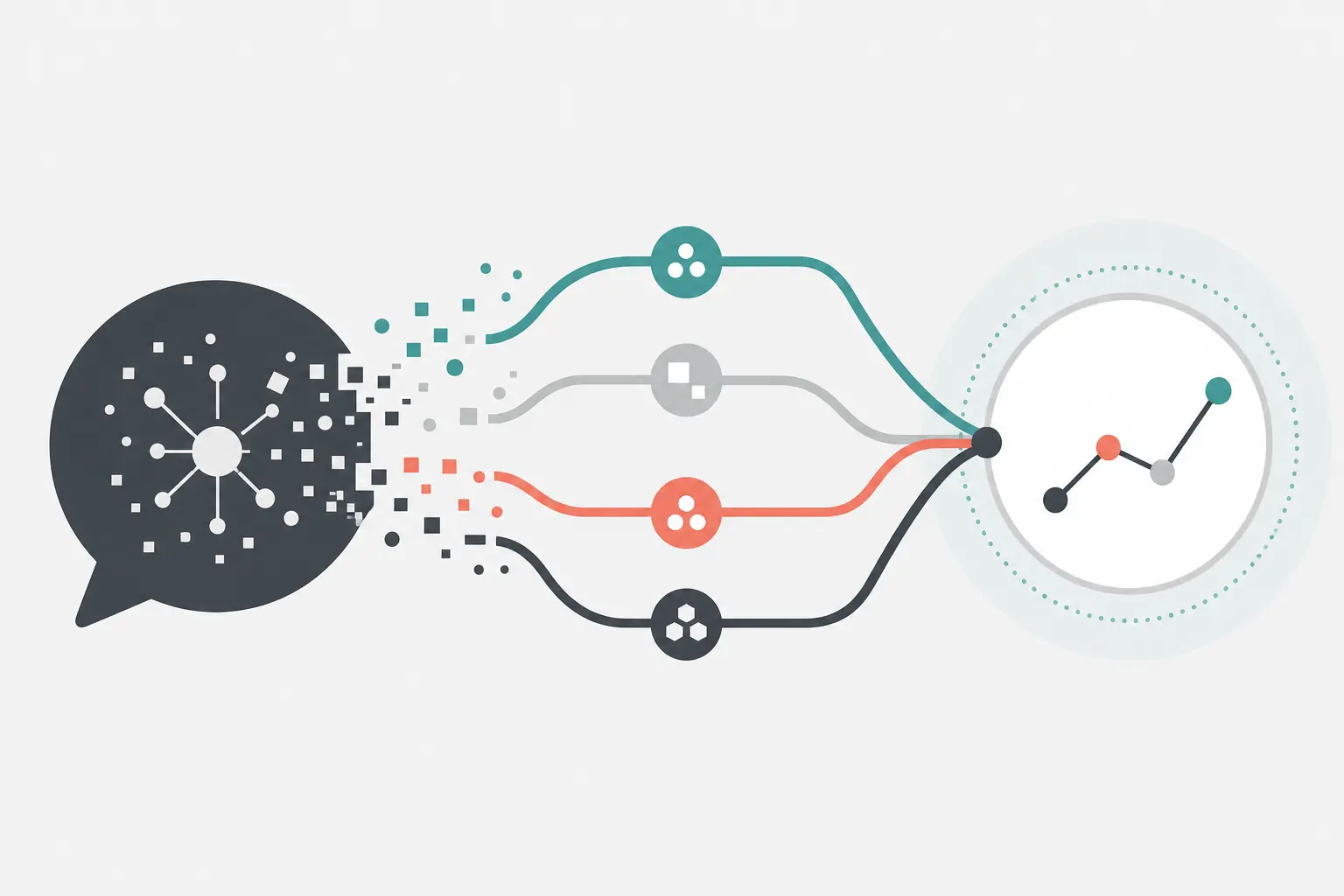
AI search visibility is getting simpler for marketing teams to watch and harder for them to tie back to revenue. Tools can reveal whether a brand shows up in answers from ChatGPT or Google AI Overviews, which sources get cited, and how its share of model stacks up against rivals — yet the last mile from mention to money stays fuzzy.
ContentGrip
Business Agents: where organic ends and paid begins
When a company appears in a ChatGPT response, a person can open its business profile and, where the option exists, start a separate conversation to learn more about products or services. OpenAI says participating companies can set information and guidance for these agents, while the original assistant answer stays independent.
The commercial distinction matters. A Business Agent can be available organically, and a business may also sponsor an agent as the destination for a ChatGPT Ads placement. Benji Shomair, OpenAI's vice president of monetization, put the difference this way: "The sponsored agent is the paid experience, but the agent that sits behind it should be the same."
The beta builds on OpenAI's September 2026 sponsored-agent tests, which framed conversations as an alternative to routing every interested customer straight to an advertiser's website. The current release puts a business-managed conversation beside a business profile, with sponsorship as one more route to that same kind of experience.
One policy boundary is worth flagging: an agent must be clear that it is AI representing the business, and must not appear to be an independent adviser or a human, according to OpenAI's Business Agents Policy.
| ChatGPT surface | Primary business role | Customer interaction |
|---|---|---|
| Business Hub profile | Maintain company and product information | See details about a discovered business |
| Organic Business Agent | Answer follow-up questions about offerings | Start a separate, labeled brand conversation |
| Sponsored Business Agent | Provide an ad destination for a brand conversation | Choose a clearly labeled sponsored experience |
Common mistakes people will make
- Treating a claim as a ranking boost. OpenAI has not promised a ranking lift for a claimed profile. Richer data earns its value by reducing ambiguity, not by purchasing preferential treatment.
- Treating the profile as a storefront replacement. For Shopify merchants, sharing catalog details through Shopify Catalog is a complement to the storefront, not a substitute for it.
- Reading mentions as sales. A rise in mentions may justify digging into which customer questions a brand is tied to. On its own, it cannot prove stronger consideration or a higher conversion rate.
- Assuming verification equals an agent. Eligibility to publish a Business Agent is narrower than eligibility to claim a profile, and honesty and accuracy rules apply.
- Letting product data go stale. When a product goes out of stock or its price moves, how useful the conversation turns out to be depends partly on whether the source information is current.
A pre-flight checklist before you claim
- Assign one owner for profile data and one for agent content.
- Audit names, descriptions, pricing and availability against what the business can actually deliver.
- Set a refresh cadence for product feeds so stock and price changes propagate.
- Decide which customer questions the agent should resolve — and which should route to a human or a page.
- Pick the outcomes you will track outside ChatGPT, such as next click, signup or purchase, so mentions are not your only evidence.
FAQ: quick answers before you start
Can any business claim a ChatGPT profile?
No. The option is for eligible businesses in markets where ChatGPT operates. Business Agents are narrower still: eligible ecommerce and online service companies in the United States, with local stores and restaurants currently limited to claiming an existing U.S. listing.
Does claiming a profile improve ranking?
No. OpenAI has not promised a ranking lift. A claimed profile helps ChatGPT grasp what a company offers; it does not buy preference.
Will I see individual customer conversations?
No. Insights are aggregated, appear only when interactions clear privacy thresholds, and do not include user-level transcripts.
Can I launch a Business Agent once my profile is verified?
Not automatically. Verifying a business does not make it eligible to publish an agent; agent access is a separate, narrower gate.
What should I update first?
Names, descriptions, hours, pricing and availability — the facts a customer would check before trusting the recommendation.
Where this leaves marketing teams
For marketing teams, Businesses in ChatGPT creates a fresh set of decisions about who owns information, how it gets measured and where helpful conversation stops and paid promotion starts. In 2026, brand presence in AI is becoming less like one search ranking and more like a chain of information handoffs. Each handoff has a different owner: the company supplying facts, the assistant generating an independent answer, the customer choosing to engage, and the brand responding through a labeled agent.
Context worth keeping in view: Similarweb estimates ChatGPT's share of generative AI website visits fell from about 76% in June 2025 to roughly 53% by May 2026, which means AI discovery is already splitting across several doors rather than one. A managed profile and a clear view of your own numbers become more useful, not less.
The open question: when the platform supplies both the listing controls and the analytics, which team inside a company ends up owning the brand's answer — and who gets to check it?
ContentGrow
Sources
- OpenAI, "Introducing Businesses in ChatGPT": https://openai.com/index/introducing-businesses-chatgpt/
- OpenAI Help Center, "Setting up your business on ChatGPT": https://help.openai.com/en/articles/20001635-setting-up-your-business-on-chatgpt
- OpenAI, "Business Agents Policy": https://openai.com/policies/business-agents-policy/
- Reuters, "OpenAI lets businesses claim ChatGPT profiles, adds AI agents for US e-commerce firms": https://www.reuters.com/technology/openai-lets-businesses-claim-chatgpt-profiles-adds-ai-agents-us-e-commerce-firms-2026-11-10/
- VentureBeat, "OpenAI lets you claim your business in ChatGPT and set up a custom agentic AI customer sales rep": https://venturebeat.com/technology/openai-lets-you-claim-your-business-in-chatgpt-and-set-up-a-custom-agentic-ai-customer-sales-rep
- Similarweb, "AI Search Stats": https://aisearch.similarweb.com/blog/gen-ai-stats/
By Cleo Howard, SaaS product lead, writing for MyTechDailyNews General.