
Amazon's World-First Home Robot Bet: A MyTechDailyNews Practical Guide to the New Team, the Astro Lessons and What to Do Next
By Sarah Chen, Tech Daily · MyTechDailyNews General
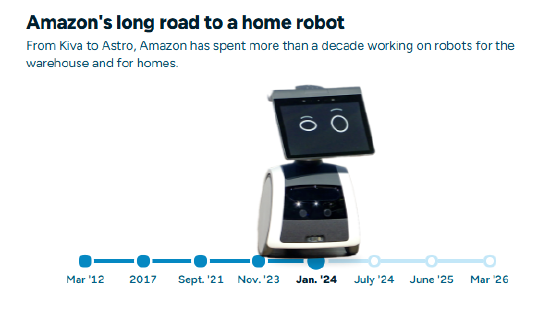
Amazon has stood up a new team over the past few months to build what it calls a world-first robot product: a machine that can move through dynamic home environments and run autonomously alongside household members. Nothing is on sale, and no launch date exists. The practical move is to read the Astro history first, then decide what a home robot must clear before it earns a place in your house, your product roadmap or your watchlist.
What is Amazon actually building right now?
Short answer: a category, not yet a product. Everything public so far comes from recruiting material and from the company's own investor letter, which is why the honest status is "invention phase".
A recently deleted engineering job post laid out the ambition. It wrote that "Robots are about to step out of the movies and into our homes," then described a device able to navigate dynamic home environments and operate autonomously alongside household members. Because that posting was taken down before anyone could buy anything, treat the wording as intent rather than specification: no task list, no price band, no shipping window has been confirmed.
Andy Jassy, Amazon's CEO, used his latest annual shareholder letter to frame the same ambition for investors, saying that AI and robotics represent "one of the biggest inflection points of our lifetimes." Jassy wrote: "We try to anticipate what will make customers' lives easier and better every day, and invent the next inflection point."
How did we get here? Five dates that explain the risk
The first attempt is the best free lesson available today, because its failure points are visible and mostly non-technical. Read the sequence, then reuse it as a due-diligence checklist for any home robot announced in the next decade.
- 2017 — Jeff Bezos, Amazon's founder and then CEO, a self-described science-fiction and robotics enthusiast, told a group of top device executives to start building a robot.
- Within a few years — that team produced Astro, a consumer unit priced at $1,450.
- Fall 2021 — Astro's first public appearance came at Amazon's autumn event. The hardware was essentially a wheeled tablet carrying Alexa: it could navigate a home on its own, recognize faces and patrol as a mobile security camera.
- After the debut — Astro never crossed out of the invitation-only stage. It reached only a few thousand customers, and some of those owners now assume the robot's remaining days are numbered.
- 2023 — Amazon tried an enterprise version of Astro. Less than a year later the product was discontinued. Publicly reported details add the sting: the business unit sold for $2,349.99 and its owners were told the devices would simply stop working on September 25, 2024, with refunds offered instead (The Verge, TechCrunch).
That last bullet matters beyond Amazon. A connected robot is a service as much as a gadget, and when a product line is shut down, a machine parked in your hallway can lose its intelligence remotely.
Why this second attempt starts from a different place
Conclusion first: the difference is the software layer, not the chassis. Amazon's hardware lab has already been reorganized around AI agents that can plan and act, which is exactly the capability the original Astro lacked.
In June 2025, reporting by CNBC and TechCrunch described a new agentic AI group created inside Lab126, Amazon's consumer hardware research-and-development lab behind the Kindle e-reader and Echo devices, tasked with building "physical AI" — robots that can understand natural-language instructions and carry them out. A home robot built on that stack is a different proposition from a scripted patrol cart, even if the marketing language sounds identical.
The corporate instinct is unchanged. Amazon is famous for long bets that look odd from the outside, accepting the risk of being misunderstood in the short term if it buys an early position in a new market — the playbook it ran with the Alexa voice assistant and the Kindle. Jassy restated that logic in the shareholder letter rather than promising a launch.
How big is the prize, and what does the forecast really count?
Conclusion first: the headline numbers are real, but they describe humanoid robotics as a whole, whose first paying customers are factories and warehouses — not living rooms.
Analysts expect that market to expand fast in the next few years. Barclays, in a report published in January, sized the global humanoid robotics market at $2 billion to $3 billion today, projected about $40 billion by 2035 in its base case, and up to $200 billion in the most optimistic scenario. The bank's own press materials make the same split between base case and upside explicit, so a $200 billion headline should be read as a ceiling, not a target.
The demand side also shows where the money is landing first: heavy-payload industrial humanoids are already doing palletizing, material transport and line-side feeding in warehouses and e-commerce fulfillment, where environments are structured and buyers sign contracts rather than make impulse decisions. Control-layer research is moving quickly too, as Apple's HALO robot control research demonstrates, but lab-grade task success remains a long way from an unattended household product.
Should you buy a home robot? Run this checklist first
You can run these tests today on devices you already own — camera-equipped robot vacuums, indoor security cameras, smart displays — and they are the same tests a future home robot has to pass before it is worth a four-figure price tag.
- Where does the data land? Floor plans, face labels, patrol schedules and audio clips are an unusually intimate profile of a household. Prefer devices that store video locally on a memory card or your own network drive and upload only when you choose; Consumer Reports' camera buying guide points to the same local-storage-first rule.
- Is there a physical off switch? A real lens shutter, a hardware mute and a power cut beat a software toggle that a firmware update can override.
- Who in the house consented? Roommates, children, elderly caregivers, cleaners and overnight guests are all recorded by an autonomous camera that wanders. Set rooms it may never enter.
- What happens when it is confused? The hard problem the job post names — dynamic home environments — means toys on the floor, open doors, pets, running children. Ask what the fallback is: freeze, retreat or continue.
- How long will it be supported? Ask three questions in writing: firmware support window, what happens to features if the subscription lapses, and whether the device becomes inoperable when a product line ends. Astro's business edition answered that question for everyone.
- Which daily job does it own? $1,450 bought a short list of tasks that a phone on a stand could mostly do. A home robot needs one job a household will miss within a week of it being turned off.
- What is the exit path? Return window, resale value, and how to wipe maps, faces and recordings before the device leaves the house.
Trust, not capability, is the gate. Pew Research Center found that 52% of Americans say the growing use of AI in daily life makes them more concerned than excited, up from 37% in 2021 — a sentiment problem for a product that must be welcomed into the most private room in the house.
Common misconceptions about this announcement
| What people assume | What the record shows |
|---|---|
| "World-first" means a product is close to shelves. | The phrase came from a recruiting post that has since been deleted; Amazon has not announced a launch, price or delivery date. |
| Astro failed because the hardware was bad. | It navigated, recognized faces and patrolled. It stalled at the invitation-only stage, reached only a few thousand customers, and never proved a daily job worth the price. |
| The $200 billion figure is a home-robot forecast. | Barclays' January estimate covers humanoid robotics broadly, starts from a $2 billion to $3 billion base, and puts $200 billion in the most optimistic scenario, with about $40 billion by 2035 as the base case. |
| Amazon is chasing the humanoid trend. | This is the same bet Jeff Bezos ordered in 2017, retooled around AI agents after the Lab126 agentic group formed in June 2025. |
| If Amazon ships it, homes will adopt it. | Adoption is a trust question as much as a price question; consumer concern about AI in daily life has risen sharply since 2021. |
What to do next, depending on who you are
If you run a household
- Do not pre-order a first-generation home robot, from Amazon or anyone else. First-generation device lines are where the Astro for Business lesson bites.
- Audit what already roams or watches your home: revoke always-on microphone permissions, disable cloud upload you never chose, and move cameras out of bedrooms.
- Define the one chore you would actually pay for, then test that job against a cheaper dedicated device before a general-purpose robot enters the picture.
If you build or market products
- Treat Amazon's sequence as three design requirements: one indispensable daily job, one physical privacy control that cannot be disabled by software, and a published support window.
- Expect the agentic AI layer to become the differentiator. A robot that follows plain-language instructions and adapts to dynamic home environments beats one that executes a scripted routine.
- Plan for the human in the room: Jassy's stated bar is making customers' lives easier and better every day, which is an outcome test, not a feature test.
If you track the market
- Watch four signals rather than headlines: new Lab126 job postings, robotics mentions in Amazon's earnings calls and shareholder letters, whether the device is wheeled or humanoid, and the first announced price band versus Astro's $1,450.
- Separate industrial humanoid revenue from household forecasts; they run on different adoption clocks.
- Remember that Amazon has repeatedly kept projects alive while being misunderstood, so quiet signals often precede loud launches by years.
FAQ: the questions readers are asking
Is Amazon still selling Astro?
Effectively no. Astro never grew past invitation-only sales, shipped to only a few thousand customers, and the enterprise version launched in 2023 was discontinued less than a year later.
What will the new robot actually do?
Unconfirmed. The deleted engineering post describes navigation of dynamic home environments and autonomous operation alongside household members; Amazon has published no task list, demo or price.
When could it launch?
There is no announced date. Amazon's own framing — Alexa and Kindle as long bets — suggests years rather than months, and the company's stated reason is to be early in a new market rather than first to a quarterly number.
Is a home robot a privacy problem?
It is a camera, a microphone and a floor-plan map that moves on its own, so the risk is cumulative rather than novel. Apply the checklist above: local storage, physical shutter, restricted rooms, and a written support window.
How large will the robot market become?
Barclays put the global humanoid robotics market at $2 billion to $3 billion in its January report, forecast about $40 billion by 2035, and said it could reach $200 billion in the most optimistic scenario.
Further reading and sources
- Barclays Research press release on the humanoid robotics market outlook: https://home.barclays/news/press-releases/20260/01/barclays-research-finds-humanoid-robotics-on-track-to-become-a--/
- TechCrunch on the agentic AI group formed inside Lab126: https://techcrunch.com/2025/06/05/amazon-launches-new-rd-group-focused-on-agentic-ai-and-robotics/
- The Verge on the Astro for Business discontinuation and device shut-off date: https://www.theverge.com/2024/7/3/24190410/amazon-astro-business-robot-discontinued-refunds
- Pew Research Center on U.S. attitudes toward AI in daily life: https://www.pewresearch.org/short-reads/2026/08/18/young-adults-in-the-us-are-increasingly-wary-of-ai-concerned-it-will-take-jobs/
- Consumer Reports home security camera buying guide: https://www.consumerreports.org/home-garden/home-security-cameras/buying-guide/
- CNBC reporting on Amazon's robotics hiring signals: https://www.cnbc.com/2025/06/04/amazons-rd-lab-forms-new-agentic-ai-group.html