
Apple's HALO Robot 'Brain' in Plain English: Qwen on a Mac mini, 91% Success on a Unitree G1
HALO is an autonomous control system from Apple's research team that lets a humanoid robot act in rooms it has never entered. Submitted to the preprint platform arXiv on November 4 (local time), it pairs the Qwen vision-language model running locally on a Mac mini with motion models trained entirely in simulation, and was validated on the Unitree G1. Across 360 single-task tests in 6 real-world environments, average success reached 91%.
That is the short answer. The longer one matters more for anyone who follows consumer technology rather than robotics journals: Apple published a robot 'brain', but not a robot. It also published the plumbing — data generation, model training and deployment code — which turns a press story into something other teams can reproduce, criticise and build on. Below, we unpack what HALO does, how it does it, where it still fails, and what the numbers imply for the home robots now arriving on the market.
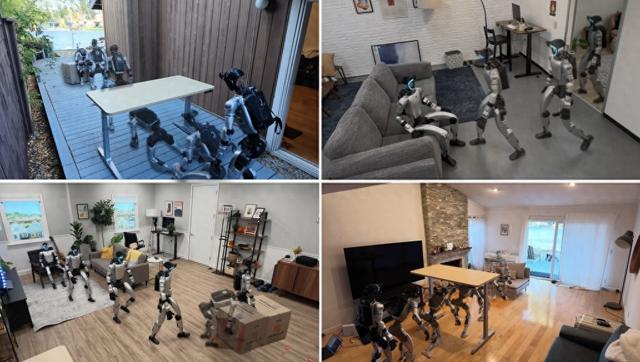
In demos released with the project, the Unitree G1 running HALO ducked under a table, sat on a sofa and pushed a box in ordinary rooms. Credit: HALO research team.
What did Apple's research team actually publish?
A system, a paper and working code — not a product. On November 4 (local time) Apple's research team submitted 'Perceptive Humanoid Motion from Simulation' to arXiv (paper ID 2611.06908), describing HALO, a humanoid autonomy system. The team deployed it on the G1 from Unitree Robotics so the robot could carry motions learned in a simulation environment into unfamiliar real rooms and execute them there.
Alongside the paper, the team released code covering data generation, action generation, action tracking, task orchestration, and both simulation and real-robot runtimes. The public repository (apple-aiml-research/ml-halo on GitHub) and the HALO project page are the primary sources for everything quoted here.
How does HALO's three-tier control architecture work?
HALO relies on three tiers working at three very different clocks: one module decides what should happen next, one plans how the whole body will move, and one turns that plan into joint commands. Nothing about the split is exotic — it is the same layering used in modern driver-assistance stacks, pointed at a roughly 35-kilogram biped standing in someone's living room.
| Tier | What runs it | How often it decides |
|---|---|---|
| Task orchestration | Vision-language model (VLM), by default Qwen3.6-35B-A3B, running locally on the Mac mini | Issues one clear sub-task at a time, checking progress against the robot's own video |
| Action generation | Qwen3.5-2B used as a frozen encoder, paired with a DiT decoder | Plans about 5 seconds of whole-body motion, replanning about 3 times per second |
| Action tracking | Tracker trained via reinforcement learning and policy distillation | Runs 50 times per second, converting a depth image plus the robot's own state into joint commands |
The top tier of the three tiers is where the fuzzy part of language gets resolved. 'Sit down' names no target, so the robot must judge from the scene in front of it where sitting is even possible. 'Sit on the chair' is more specific, and when the path is clear it can be executed directly; if a table blocks the way, the orchestrator breaks it into ducking under the obstacle, approaching, and then a sit-down. The module keeps watching the robot's point of view, decides whether the current action worked, and either advances the plan or retries — always handing the action generator one explicit sub-task rather than a whole to-do list.
Because the orchestrator and the action generator share a model-serving engine, the default setup needs no internet connection. Teams that want stronger reasoning and planning can instead reach a cloud model through an API. The same one-command-chains-many-steps logic is now appearing in Apple's software layer too, where Siri AI's App Skills on iOS 27.3 fold several app operations into a single spoken request; HALO is the physical version of that idea.
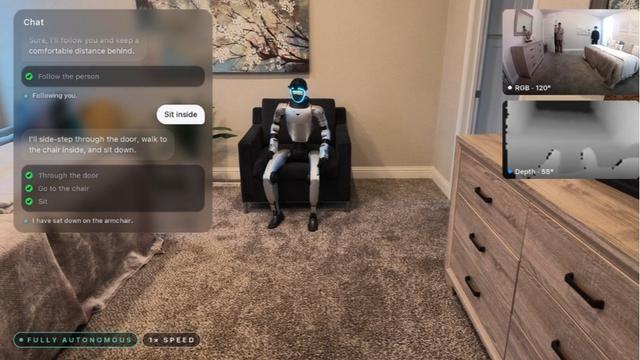
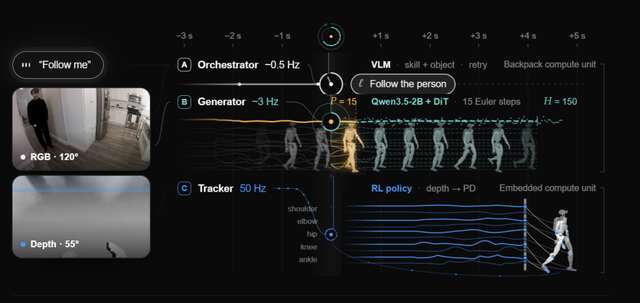
The three-tier control architecture: a vision-language model handles task orchestration, the action module plans whole-body motion, and a reinforcement-learning-trained action tracker issues joint control. Credit: screenshots from the HALO project page.
What do the published success numbers actually mean?
Two sets of results are reported, and the gap between them is the most useful data point in the paper.
| Test setup | Scale | Average success |
|---|---|---|
| Single tasks in 6 real environments that had not been pre-scanned or mapped | 360 trials | 91% |
| Combined, multi-step tasks in one real environment | 3 task types, 10 trials each | 70% |
| Hardest chain — duck under an obstacle—walk to the target—push the box | 10 trials | 50% |
The individual skills HALO was measured on include walking to a specified target, sitting down, turning sideways through a partially open door, bending, crawling and pushing a box. In the demos on the HALO project page, the robot also follows a person and sits on a chair on command.
Why the drop? Treating each step as roughly independent, a 91% per-step rate compounded over three steps predicts about 75% success — close to the 70% the team measured for combinations, and the hardest three-step chain sits well below even that. This is our arithmetic, not the paper's, but it points at the real bottleneck of home robots: not individual agility, but error accumulation across a chain of actions. A demo that succeeds once looks finished; a task that has to succeed every evening for a family does not.
Where HALO still falls short?
The research team is candid about three limits, and each one has a practical consequence for buyers and operators.
- Simulated data was not fully automatic. New physical tasks still required people to write prompts and design key poses for motions, and some actions drew on human video or motion-capture material. The paper frames its dataset as one that scales with compute rather than with human labour (arXiv:2611.06908) — but as long as each new skill needs hand-authored recipe steps, 'scaling' means engineering weeks, not an overnight download.
- Vision does the work, contact does not. The robot mainly relies on visual perception and cannot directly sense contact. When an object leaves the camera's field of view or is occluded, tasks involving heavy contact degrade. Adding tactile sensing is listed as a follow-up direction. On the Unitree G1 hardware itself, the perception kit is a head-mounted LIVOX MID-360 3D lidar (360° horizontal field of view, up to 59° vertical) plus an Intel RealSense D435i depth camera — strong on geometry, thin on touch.
- Numbers from one body type, in one class of space. Everything reported here runs on one humanoid platform: about 1,320 mm tall and roughly 35 kg with battery on Unitree Robotics' documentation, with 23 joints in the base configuration and 23 to 43 in EDU versions. A 35-kg machine moving through a room with toddlers, pets or clutter is a safety question the paper does not attempt to answer — nor does any lab success rate substitute for it.
One further constraint is easy to miss because it sits outside the paper: Unitree's developer documentation lists the G1's quick-release 9,000 mAh pack with a battery life of about 2 hours. Long-duration work in a real home — tidying a whole living room, say — is therefore as much a battery and duty-cycle problem as a model problem.
How was the training data built without scanning a single room?
The team synthesised about 300 hours of main training data inside 1000 procedurally generated simulated homes, pairing three things for every sample: what the robot sees, what instruction it receives, and how it moves.
The order of operations is counter-intuitive, and it is the core trick. The system generates the action first, drops that action into a virtual room, and only then renders what the robot would see from its own viewpoint while performing it. The HALO project page walks through 'sit in the armchair' as an example: the task is split into clips such as walking forward, turning and sitting; the action generation model produces motion sequences from a text prompt, waypoints and key poses; and a geometric check filters out results with foot sliding or a body sinking into the floor.
Next, the system places those motions into procedurally generated rooms, checks the spatial relationship between robot and furniture, and searches for placements without collisions. A simulation tool then renders the frames the robot would see while executing the action. During training the pipeline perturbs lighting, colour tone and image blur so the visual input stays varied. The same flow produces the matched instruction-image-motion data used elsewhere in the project.
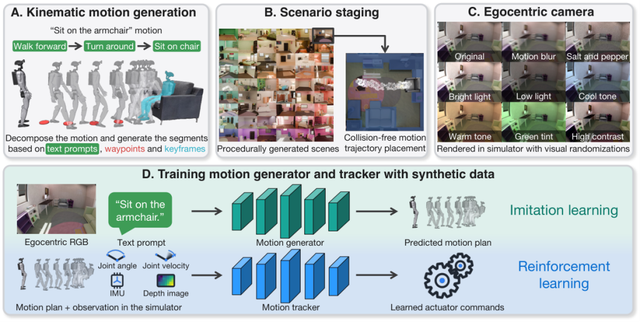
The synthetic data and training pipeline: motion trajectories are generated first, placed into virtual scenes, then rendered from the robot's viewpoint to form matched training data for the action generator and the action tracker. Credit: HALO paper.
How much compute did the whole system consume?
Three different budget lines appear in the paper, and reading them together is instructive.
- Synthesising the main training data used 250 Nvidia H100 GPU units over about 48 hours.
- The action generator, trained by imitation learning, used 64 Nvidia B200 units.
- The action tracker, trained through reinforcement learning and policy distillation, used 4 H100 units.
In other words, creating data cost more compute than the small control models themselves. That ordering is the trend worth noticing: as open-weight encoders shrink and robot-specific trackers become cheap, the expensive part of embodied AI moves to simulation, rendering and data pipelines — precisely the places where a company with silicon and graphics expertise has an advantage.
Why a Chinese robot, a Chinese model and one Apple box?
Two pragmatic reasons, both about cost and availability rather than politics.
First, the body. The Unitree G1 is listed from 85,000 yuan on Unitree Robotics' Chinese product page, and the company's own English store entry for the base configuration sits around US$13,500 — for a humanoid with knee torque up to 120 N·m and, on higher EDU builds, optional three-finger hands with tactile arrays. A research team can buy two, break one, and still afford the project. Compared with the in-house chassis programs that dominate the field, choosing a commodity platform looks less like a shortcut and more like the only way to make results reproducible outside a handful of labs.
Second, the brain. Apple's research team selected Qwen3.6-35B-A3B and Qwen3.5-2B, models from Alibaba's Qwen line, which has been pushing hard into embodied AI: the Qwen-Robot suite unveiled in June 2026 packages manipulation, navigation and world-model components for robots, with Alibaba describing it as foundational models for physical AI. Building on a widely deployed open model means tooling, quantisations and inference engines already exist; running the stack on a Mac mini is the on-device counterweight.
There is also a money thread here. Running the orchestrator locally avoids per-request API charges, which is not a trivial design preference given how often a robot replans — and it fits the pattern in our coverage of Apple's internal AI token caps, where teams were reported to have moved from $300 to $200 a day in October as token bills climbed.
Why does an Apple robot paper matter if Apple sells no robot?
Because it shows where the company thinks the bottleneck is. Bloomberg reported in April 2024 that Apple engineers were exploring a mobile robot that could follow users around their homes, after the company shut down its decade-long car project; since then Apple's robotics output has arrived as research rather than hardware launches.
HALO is consistent with that posture: the publishable asset is not a chassis but a data-and-control recipe. Where rivals are racing to ship bodies and rack up teleoperation footage, Apple's team attacks the input problem — how to produce enough paired vision, language and motion data that a robot transfers to an unseen room without a mapping pass or a human teleoperator. If that transfer problem is solved cheaply, whoever owns the software layer in the home is well placed to sell the intelligence even if someone else manufactures the legs.
Common misconceptions about HALO
- 'Apple announced a home robot.' No product was announced. The deliverable is a paper, a system and open code.
- 'A 91% success rate means it is nearly finished.' That figure covers single tasks; combined tasks averaged 70%, and the hardest chain reached 50%.
- 'Qwen is Apple's model.' Qwen comes from Alibaba; Apple's research team uses it as an off-the-shelf component inside its own pipeline.
- 'The robot must be online to think.' By default the vision-language orchestrator runs locally on the Mac mini; cloud APIs are an option, not a requirement.
- 'Simulation means no human work.' Adding new physical tasks still involved hand-written prompts and designed key poses, plus some human video or motion-capture material.
FAQ: the questions readers are actually searching
Is Apple building a humanoid robot for consumers?
There is no announced consumer robot. Apple's research team published a humanoid control system and its training pipeline; separately, Bloomberg reported in 2024 that Apple was exploring home-robot concepts after cancelling its car project. Publication is not a product commitment.
What is the Mac mini doing on the robot's back?
It provides on-board inference. By default the vision-language orchestrator, Qwen3.6-35B-A3B, runs locally on the Mac mini rather than in the cloud, so the robot can plan without network access, sharing a model-serving engine with the action generator.
Can hobbyists run HALO themselves?
Partly — and that is unusual for a corporate lab. The released code covers data generation, model training and deployment, including simulation and real-robot runtime. In practice you still need a Unitree G1, a Mac mini and access to hundreds of H100 GPUs to reproduce the full pipeline rather than a slice of it.
Why are combined-task numbers lower than single-task numbers?
Chained work inherits every earlier mistake, so small per-step error rates multiply. On the paper's own figures, individual skills averaged 91%, combinations averaged 70%, and the hardest three-step chain scored 50%.
What is the most likely next improvement?
Contact perception. The team states that the robot depends mainly on vision and cannot directly sense contact, and lists adding tactile sensing as a direction — something hardware partners such as Unitree already sell as an option on higher G1 configurations.
What readers and product teams should do next
- Watch the code, not the demo. Track commits and issues in the apple-aiml-research/ml-halo repository; release cadence tells you more than any single clip.
- Reframe your metrics. If you evaluate agents or robots, measure multi-step chains rather than isolated skills — a 90% step rate can quietly become a coin flip by the third step.
- Treat open-weight models as infrastructure. HALO's dependence on Qwen shows how far the 'brain' layer has commoditised; vendor choice is now about licence, tooling and on-device efficiency.
- Check hardware duty cycles. Before piloting any humanoid, verify payload, joint torque, camera field of view and battery runtime against your actual space.
- Expect safety questions first. A roughly 35-kg biped in a shared home raises contact and child-safety issues that success rates do not address.
References
- Apple research team, 'Perceptive Humanoid Motion from Simulation', arXiv preprint 2611.06908 — https://arxiv.org/html/2611.06908
- HALO project page — https://apple-aiml-research.github.io/ml-halo/
- HALO code repository (data generation, training, deployment) — https://github.com/apple-aiml-research/ml-halo
- Unitree Robotics, G1 developer documentation (D435i depth camera, 9,000 mAh battery, about 2 h life, ~35 kg) — https://support.unitree.com/home/en/G1_developer
- Unitree Robotics, G1 product page (from 85,000 yuan, 23–43 joints, 120 N·m knee torque) — https://www.unitree.com/cn/g1/
- Alibaba Cloud, 'Entering the Physical AI Era: Introducing the Qwen-Robot Suite', June 2026 — https://www.alibabacloud.com/blog/entering-the-physical-ai-era-introducing-the-qwen-robot-suite_603261
- Bloomberg, 'Apple Explores Home Robots After Abandoning Car Efforts', April 3, 2024 — https://www.bloomberg.com/news/articles/2024-04-03/apple-explores-home-robots-after-abandoning-car-efforts
- Yicai, coverage of the HALO disclosure and its 91% average success rate, November 7, 2026 — https://www.yicai.com/news/103430808.html
Edited by Sarah Chen, Tech Daily. Questions or corrections: hello@techdaily.com.