
MyTechDailyNews General: Starship V4 Explained — Bigger Rocket, 9 Engines, Fewer Moon Refueling Trips
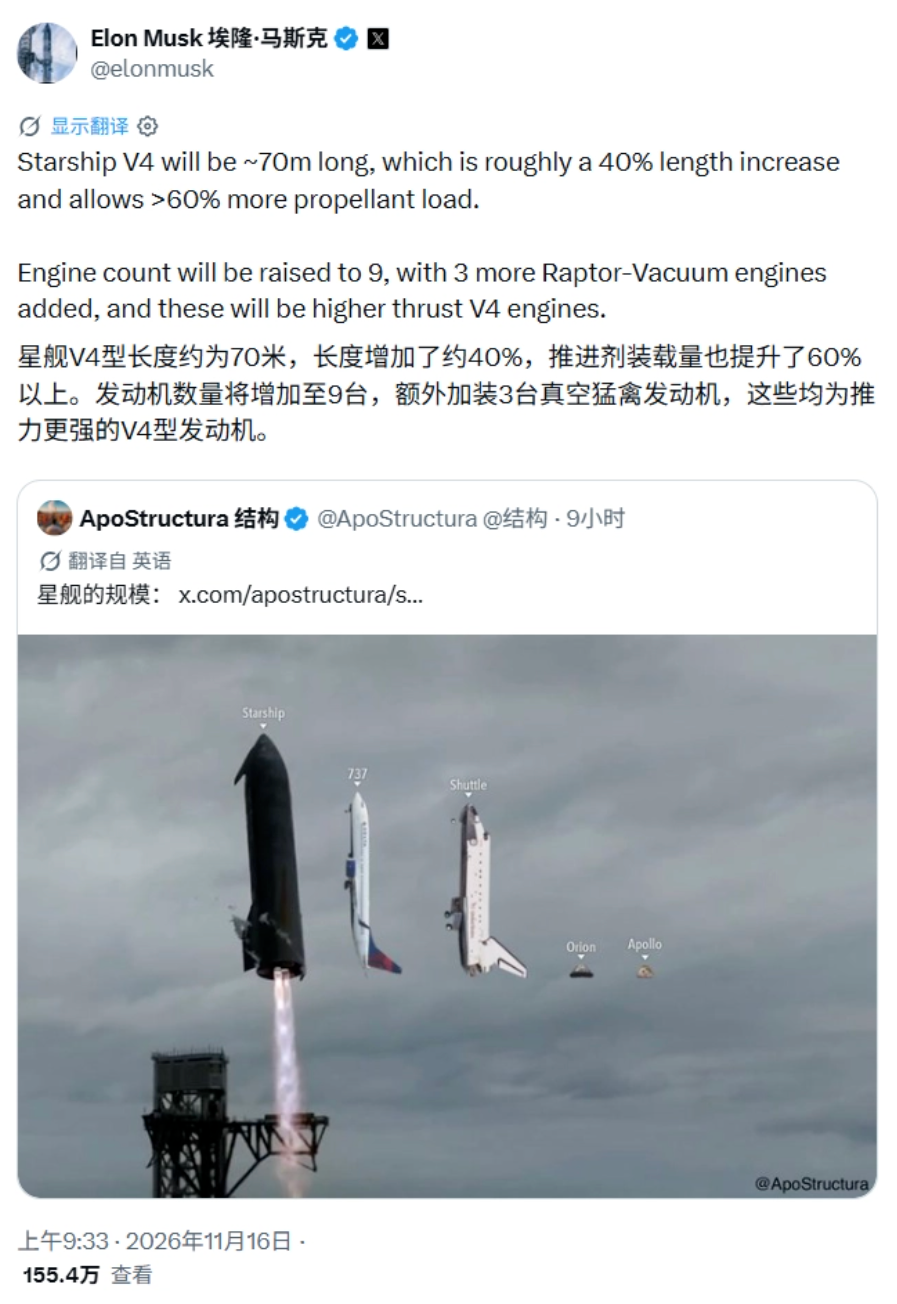
What actually changes with Starship V4? Musk says this bigger, 9-engine upper stage will cut the orbital refueling launches needed for one Moon mission from NASA's roughly 22 estimate to 5 to 6. I read announcements like this the way I test a new gadget — by asking what improves for the people who use it, not just what got longer. The dimensions are the easy part. The refueling math is the real story.
Before the details, one useful mental picture: getting to the Moon in a chemical rocket is a bit like driving cross-country with a tiny fuel tank. You reach orbit almost empty. Everything after that depends on topping up in space — and that is exactly where V4 is aimed.
What did Musk actually announce about Starship V4?
Bottom line: V4 is a stretched, more powerful upper stage, and every headline number points toward carrying and moving more propellant. In a post on X, Musk said the V4 vehicle will be about 70 meters long — roughly 40% longer than the current version — with propellant capacity up more than 60%. Engine count rises to 9, including 3 new vacuum Raptor engines, all of them the higher-thrust V4 version.
For context, the V3 Starship that flew on the 15th test flight stood about 52 meters tall and used 6 Raptor engines — 3 tuned for sea level and 3 for vacuum. V4 keeps that layout but adds vacuum engines and stretches the tank. Think of it less as a new rocket and more as the same product with a bigger battery and a stronger motor.
| Measure | V3 Starship (Flight 15) | V4 Starship |
|---|---|---|
| Height | about 52 meters | about 70 meters (up ~40%) |
| Propellant capacity | baseline | up more than 60% |
| Engines | 6 Raptor (3 sea level, 3 vacuum) | 9 Raptor, all V4 version |
Why does the tanker matter more than the spec sheet?
Because a bigger rocket only helps if you can fill it in orbit. Musk said a V4 Starship tanker can haul more than 200 tons of propellant per flight. NASA's own safety review team had estimated that one Moon mission would need roughly 22 launches' worth of orbital refueling; Musk's figure brings that down to 5 to 6. That gap is the whole story.
It is not just spin. Ars Technica broke the NASA-side number into one depot Starship plus about 11 tankers to fill it — a slow, busy cadence. NASA describes the setup in plain terms: tankers in low-Earth orbit behave like a gas station on Earth, passing super-cold propellant to a waiting depot. SpaceX notes that on-orbit refilling eventually lets Starship deliver up to 100 tons directly to the lunar surface. Fewer, fuller tankers mean fewer launches, fewer dockings, and less time moving cryogenic liquid oxygen and methane before the real mission even starts.
When will it fly, and what happened to Starship 42?
Short answer: not soon, and the honest timeline is fuzzier than the spec sheet. Before the full architecture works, SpaceX has to prove large-scale cryogenic transfer — NASA documents a demonstration of more than 3 metric tons of liquid oxygen moved between tanks — and NASA has spoken about accelerating lander work toward a 2028 Moon mission. The transfer demo has slipped before, so treat these as targets, not dates to circle.
The hardware that already flew is being checked over. Musk inspected Starship 42, the upper stage freshly caught by the launch tower's mechanical arm, and said its heat shield was in good overall shape and its engines performed well. After a few weeks of inspection and maintenance, it might fly again. Flight 15 itself was a genuine first: the ship put 26 Starlink V3 satellites into orbit and spent roughly 22 hours up there before the catch. That is the reuse loop V4 depends on.
Which common misconceptions should you ignore?
Three claims deserve a second look. Here is where casual coverage tends to overreach:
- A longer rocket automatically means fewer launches. Not on its own. The 5 to 6 figure assumes orbital transfer works efficiently; cryogenic boiloff and transfer efficiency are still unknowns, which is why NASA's estimate stayed near 22.
- 5 to 6 is a confirmed plan. It is Musk's estimate, not a NASA sign-off. Read it as a target.
- More engines means more reliability. Nine engines per ship add failure points, not fewer, and rapid reuse means catching and refurbishing vehicles like Starship 42 on a tight cadence.
Aggressive timelines are a Musk signature: our General guide to his Optimus robot plans shows the same mix of bold specs and distant dates. That is a reason to enjoy the announcement, not to bank on the calendar.
A practical checklist: what to watch next
Follow the signals, not the headlines. If you want to track this story without getting lost, watch these four things:
- A successful ship-to-ship propellant-transfer demo — the gate for everything else.
- NASA's published launch count versus Musk's 5 to 6 as the design firms up.
- Whether Starship 42 actually flies again after inspection — the real reuse test.
- Hardware that matches the roughly 70-meter length and 60%-plus propellant gain.
FAQ
Is Starship V4 flying now?
No. The about-70-meter, 9-engine design is a disclosed plan, with the 15th test flight still using the V3 Starship at about 52 meters.
Does 5 to 6 launches replace NASA's 22?
Not officially. NASA's safety review team estimated roughly 22; 5 to 6 is Musk's target built around a V4 Starship tanker carrying over 200 tons per flight.
Is Starship 42 reusable?
Musk says its heat shield and engines looked good after the catch, with a possible return to flight after a few weeks of maintenance — a possibility, not a guarantee.
Why add 3 vacuum Raptor engines?
Vacuum engines are tuned for thin air and orbit, so more of them improve high-altitude performance; the new ones are higher-thrust V4 versions.
Reference sources
- SpaceX — Mission: Moon
- NASA — Partners Accelerate Lander Development for 2028 Moon Missions
- NASA TechPort — On-Orbit Cryogenic Propellant Management
- Ars Technica — 22-launch estimate breakdown
- Flight 15 ship catch and satellite deployment