
Camera-Free Fall Alarms at Home: A Practical Setup Guide to Sony China's Wi-Fi Sensing System
Sony China's fall detection system spots a fall by reading how a body disturbs Wi-Fi radio waves travelling between a signal transmitter, a receiver and a data processor — no camera, no wearable, and an alert that reaches carers without seeing any image. Below is a working guide: how the signal is used, how to install it room by room, and which traps to avoid.
The timing explains the attention. During the 9th China International Import Expo (CIIE) in Shanghai, held November 5 to 10, 2026, Sony (China) Co., Ltd. unveiled the privacy-friendly wireless sensing fall detection system as a world premiere aimed at home-based eldercare. The demand side is stark: China's National Bureau of Statistics counted 323.38 million people aged 60 and above at the end of 2025, or 23.0% of the population, while the World Health Organization estimates about 684,000 people die from falls each year and attributes roughly 71% of 2023's fall deaths to adults aged 60 and older.
What the system actually detects
Short answer: it classifies a posture change, not an injury. Human motion alters the propagation characteristics of the radio channel; the system samples channel state information (CSI), then combines movement features with deep learning algorithms to recognise a fall event in real time, firing an on-site audio-visual alert or pushing a notification through an app or mini program.
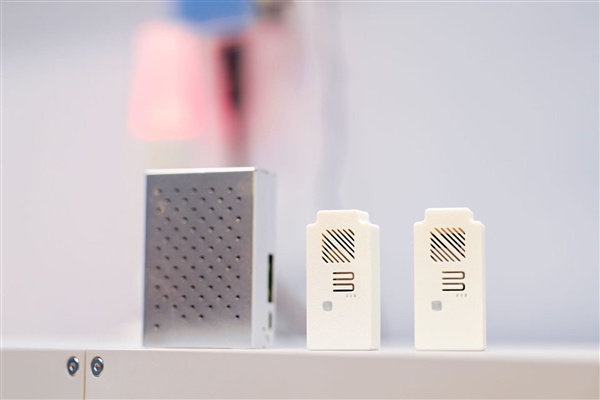
The hardware list is deliberately short — only a Wi-Fi signal transmitter, a receiver and a data processor. Because there is no camera and no image is collected, the privacy risk that blocks overhead sensors in bedrooms and bathrooms is removed at the source rather than managed later. Coverage today targets single-person detection of common fall types, including slow falls and slips.
Sony's own framing is practical rather than medical. Liu Shijia, senior manager of Sony's corporate information and media department, said at the expo that the product reads how walking and even breathing change the reflection and propagation of Wi-Fi signals, then infers activity and posture to confirm that a user has collapsed rather than simply sat down to rest (Qianlong Net, November 7, 2026).
Why "no image" decides where it can be installed
Conclusion first: privacy, not detection accuracy, is usually the reason the riskiest room stays unprotected.
"Many older people do not want a camera filming them all day," Liu said at the booth, in coverage republished by the Beijing Municipal Government portal. A radio-based sensor can therefore cover the two rooms where slips concentrate — the bathroom and the bedroom — and care staff receive fall alerts without adding any video monitoring to their workflow. Older residents themselves change nothing about their daily routine, since no device has to be worn, charged or remembered.
Wearables fail on a different axis: adherence. A pendant cannot help a person who left it on the nightstand, which is exactly the complaint that keeps pushing families and facilities toward ambient sensing.
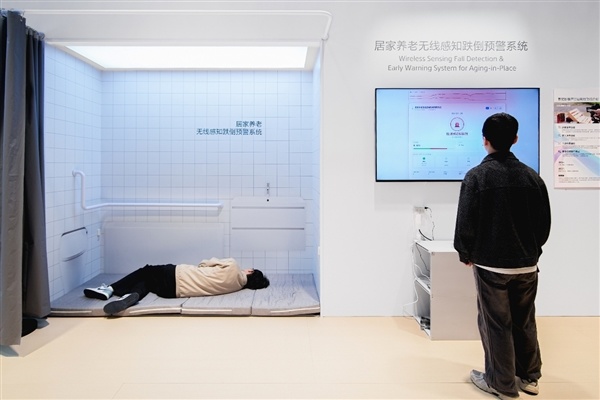
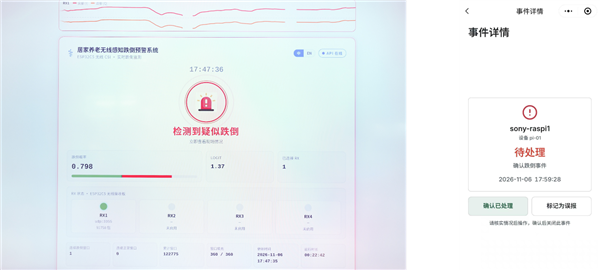
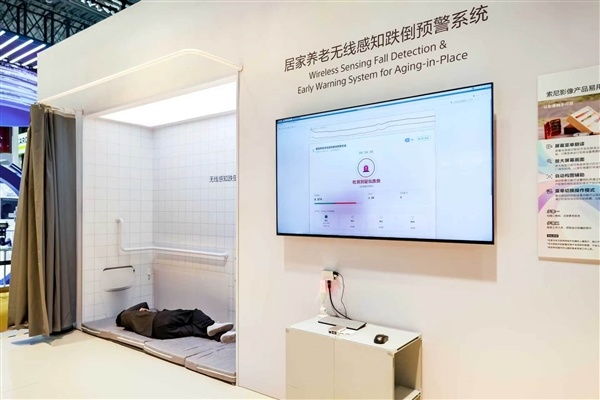
Sony's CIIE stand made that trade-off visible with a mock bathroom. A staff member simulated a fall, the system triggered its alarm and mirrored the event onto a wall-mounted screen in real time; visitors were invited to walk in and experience the simulated fall themselves, seeing how the alert fires while nobody is seeing any image. Independent reporting of the demo described on-screen confirmation within about three seconds.
How to deploy it room by room: a five-step walkthrough
Assume the room decides the outcome, not the box. The system enters monitoring automatically once powered on and needs no complex calibration, which is what makes quick roll-out realistic in homes and institutions alike. The steps below turn that simplicity into an alert someone can act on.
- Map the fall-prone floor area before buying anything. List the bathroom, the bed side, and the night route to the toilet; those are the paths where slow falls and slips happen.
- Position one transmitter and one receiver so the signal path crosses that area. Radio sensing depends on the propagation path being disturbed, so dense walls, large metal furniture and a signal that only grazes the room edge all degrade coverage.
- Power on and confirm automatic monitoring. Because there is no complex commissioning, a family member or a community volunteer can complete start-up — but record the time and the room configuration anyway.
- Set the alert route and name the responder. On-site audio-visual notification covers people inside the flat; the app or mini-program alert must reach one named person with a written response plan, not a shared inbox.
- Run a supervised test pass. Rehearse a simulated fall, then stress-test the negatives: sitting down quickly, dropping laundry, a pet crossing the room, and a second person entering. Log every response and re-test each quarter.
Home, community or facility: which setting fits best
Conclusion: the technology slots into institutional duty-of-care workflows today more easily than into a household where nobody is on call, because alert handling — not detection — is the bottleneck.
| Setting | Why wireless sensing fits | What to check first |
|---|---|---|
| Home with a nearby family carer | No lenses in private rooms; nothing to wear or charge | Whether the app or mini-program alert reaches someone awake at night |
| Public health service centre or community care station | Alerts arrive without adding screen monitoring to staff duties | Escalation rota and response-time targets per room |
| Nursing home or eldercare institution | Supports fall detection across many privacy-sensitive rooms | Single-person detection limits in shared rooms |
| Medical institution | Fits from-home-to-community-to-clinic continuity of care | Integration with existing call and documentation systems |
The deployment path is still being proven. Sony says the system has already begun pilot deployment in Shanghai, with live operation being used to further verify stability and detection accuracy. It was developed locally by the Sony China Research Center, and the research process involved cooperation with the University of Science and Technology Beijing.
Shanghai offers a useful benchmark for what scale looks like. The city has run camera-free fall-alert programmes for years: Changning district's charitable project aimed to cover 6,000 households of older residents with wireless sensing alarms, and in October 2026 the Zhelin Town pilot in Fengxian fitted the first 114 households of people aged 60 and above living alone with radar fall detectors, bed-side pull-cord buttons and voice help devices, according to Shangguan News reporting carried by Sina Finance.
Common pitfalls and misconceptions
- "It will catch every fall." The published specification is single-person detection of common fall types such as slow falls and slips; crowded rooms remain an open problem in the wider research literature.
- "Ambient sensing is plug-and-play perfect." A 2025 IntechOpen study using Wi-Fi CSI with a CNN-LSTM model reported up to 95.5% accuracy in a four-class posture task, and a 2024 IEEE study on home deployment found months of real living produced false alarms from everyday "fall-like" activities. Treat lab figures as ceilings, not guarantees.
- "Detection equals rescue." An alarm only saves the golden response window if a named person reacts; pair any sensor with a call plan and an emergency number.
- "No image means no data risk." Movement traces still reveal daily routines, so ask who stores them, for how long and who can access them. Any networked care device also widens a facility's attack surface — the same hygiene that the playbook for connected cold storage recommends applies to monitoring kit.
- "It is a mass-market product right now." The system is in Shanghai pilot operation, so buyers should expect reference-site visits rather than shelf availability.

FAQ: what readers ask first
Does it need a camera or a wearable device?
No. The setup uses a Wi-Fi signal transmitter, a receiver and a data processor only. No images are collected, and the older person wears nothing, so daily life is undisturbed.
Can it tell a fall apart from sitting down?
That is the design goal: by tracking how movement and breathing alter the signal, the system infers posture to distinguish a collapse from resting. Sony's demo showed a simulated fall raising an alert on the wall screen, with independent reports describing confirmation in about three seconds.
Which rooms benefit most?
Bedrooms and bathrooms — the spaces where slips are common and cameras are unacceptable — plus institutional rooms where staff cannot watch another video feed.
Is it available to buy now?
Not as a general consumer product. It was globally unveiled at the 9th CIIE by Sony (China) Co., Ltd. and is undergoing pilot operation in Shanghai to verify stability and detection accuracy.
Who should consider joining a pilot?
Community care stations, nursing homes and eldercare institutions with a defined responder rota, and families of adults aged 60 and above who live alone and refuse pendants or cameras.
Before you commit: a seven-point checklist
- Confirm the room, doorways and night route the signal path must cross.
- Verify audio-visual plus app or mini-program alerting both reach a named responder.
- Ask for the single-person detection limit in writing for shared rooms.
- Run the fall and false-positive test pass before signing off.
- Check data retention, access rights and local network isolation.
- Compare against wearables and cameras on adherence and privacy, not price alone.
- Track the Shanghai pilot results before scaling to a whole wing or building.
Sources
- World Health Organization, "Falls" fact sheet — global fall mortality and age distribution: who.int
- National Bureau of Statistics of China, commentary on 2025 population data (323.38 million aged 60+, 23.0%): stats.gov.cn
- Beijing Municipal Government portal on 9th CIIE premieres and Sony's fall-warning demo, including Liu Shijia's explanation: beijing.gov.cn
- Qianlong Net CIIE coverage of the three-second detection demonstration: china.qianlong.com
- IntechOpen, "Real-Time, Non-Intrusive Fall Detection via Wi-Fi CSI" (2025): intechopen.com