
MyTechDailyNews General Comparison: Fab Build or Field-Ready Electronics? Weighing Nova Scotia's Microelectronics Route
Nova Scotia is choosing field-ready microelectronics over wafer fabs, and the reason is straightforward: integrated systems that solve a concrete operating problem can be built with the talent and geography a region already has, while a fab demands capital, supply chains and process expertise that take years to assemble. For anyone comparing the two routes, that distinction is the whole story. The detail that pulls you into this story isn't a factory announcement — it's a fish tag small enough to sit on a fish, and the quiet engineering choices that keep it alive for months.
That framing comes straight from the people doing the work. Talk to the researchers involved and the picture is less about process nodes and more about what a system has to endure when nobody can reach it.
What is Nova Scotia actually betting on — and why not just build a fab?
The short answer: the province is betting on integration, not fabrication. Jean-François Bousquet, program director of Dalhousie University's MINDI Hub, told EE Times that the region's advantage is assembling microelectronics into systems that work reliably in remote, power-constrained, unforgiving settings — not inventing the next standalone chip. "Semiconductors will scare people away if we talk about semiconductors, but if we talk about integration of microelectronic systems, I think there's a strong capability of integrating into various domains, especially in ocean tech," he said.
Here is how the two paths compare, which is the useful frame if you're deciding which kind of regional tech strategy makes sense.
| Criterion | Building wafer fabs | Rugged integrated systems (the Nova Scotia route) |
|---|---|---|
| Upfront capital | Very high; fabs need massive facilities | Modest; funding buys design tools and lab time |
| Talent base | Wide process and materials expertise | Embedded, systems and domain engineers |
| Time to relevance | Long lead times before output | Faster — start from an existing operating problem |
| Best-fit scenarios | Volume chip supply | Ocean, defence, healthcare, energy at the edge |
| Main trade-off | Capital intensity | Harder system-integration problem |
Note the trade-off: the integration route swaps huge upfront capital for a less glamorous problem — making many small parts cooperate under real-world stress. That is a different skill set, and it is one this region already practises.
Why does "rugged" matter — what breaks under Arctic ice?
Because the environment does the testing, and it is ruthless. An autonomous underwater vehicle operating below Arctic ice for months cannot be babysat. It must sense, communicate, navigate, classify events, process data locally and conserve every joule, all inside a small, rugged, waterproof package. That is where edge computing — processing data where it is collected rather than shipping everything back to a server — becomes a survival requirement rather than a buzzword.
Depending on the mission, the stack may include AI acceleration, FPGA-based processing (reconfigurable chips), GPUs, MEMS devices, photonics, lasers, specialized communications and advanced sensing. "We have to find innovative ways of integrating our microelectronics and make our autonomous vehicles smart enough to be able to go under the ice in the Arctic," Bousquet said. "They have to communicate, they have to sense, and they have to know what's around them."
The same electronics can measure the environment rather than just navigate it. "We developed sensors that will measure the biological, chemical, and geological content of water in the ocean," Bousquet said. That dual-use character — one platform serving science, environmental monitoring, resource exploration and defence — is the economic hinge of the strategy.
Bousquet's group is working on autonomous underwater drones and on coordination between underwater and aerial systems for remote-area monitoring — inherently dual-use capabilities that can support surveillance as readily as climate observation.
Why Halifax, and what does the local ecosystem actually provide?
Because geography here is an engineering requirement, not a marketing line. Halifax concentrates defence research, a naval presence, defence primes and suppliers, universities, ocean-technology companies, and the Centre for Ocean Ventures & Entrepreneurship. Proximity to the Atlantic, Arctic routes, fisheries, offshore resources and shipbuilding turns abstract requirements into daily constraints — exactly what a systems-integration team needs.
That ecosystem got a concrete boost in January 2025, when the province announced a $1.4 million investment in the hub, with Dalhousie University working with partner CMC Microsystems on a research and development program. This is the kind of funding that buys lab time and shared design tools rather than a factory floor — a useful data point when you compare the two paths. (Sources: news.novascotia.ca; dal.ca.)
At the local level, MINDI Hub — short for Microelectronics Innovation Design Hub — is meant to be the connective tissue. Backed by the provincial government, it supports industry, develops curriculum around microelectronics for ocean technology, trains students and expands the workforce available to local companies.  The multidisciplinary team at MINDI Hub develops more efficient semiconductors, enables autonomous devices, builds state-of-the-art communications networks, and creates next-generation sensing technologies for ocean, health, aerospace, and IoT applications. (Source: MINDI Hub)
"This is an incubator that's intending to support industry, and we're training students," Bousquet said. "We're building new curriculum around microelectronics for ocean technology. We want to create more momentum, and we want to create a bigger workforce that will actually support the local industry."
MINDI sits inside a wider network across Canada: Dalhousie University collaborates with Quebec-based experts, including those at the University of Sherbrooke and Zero Point Cryogenics, while exploring international partnerships. The aim is to link local systems strengths to specialist facilities and suppliers elsewhere rather than duplicate every capability at home.
What can a fish tag teach us about low-power design?
Plenty — because a fish tag has no battery to spare. Bedford-based Innovasea designs and manufactures aquatic technology, including acoustic telemetry systems that track fish in oceans, lakes and rivers. Small acoustic tags attach to, or in some cases are implanted in, fish; underwater receivers detect the signals, letting researchers identify tagged animals and, with multiple receivers, pinpoint locations. The tag can also carry sensor data such as temperature or pressure.
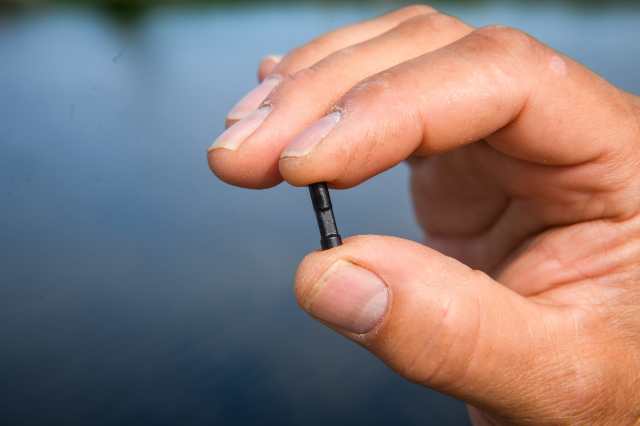 Small acoustic tags from Innovasea attach to (or, in some cases, are implanted in) fish. (Source: Innovasea)
Jean Quirion, VP of R&D for fish tracking at Innovasea, told EE Times the advantage lies in integrating components into compact, power-efficient systems that stay reliable in demanding environments. More efficient microcontrollers let designers do more computation within the same power budget — but components are only half the story. "Most of the innovations that we've come up with that really reduce power consumption and reduce size have been in some tricks that we've developed internally to just make the system behave in a more power-efficient way."
That split — buy better parts, then outsmart the power budget in system design — is the practical lesson for anyone comparing a component-led strategy with a systems-led one. Quirion also pointed to the industry-university link: Dalhousie University supplies engineering talent through co-op placements and full-time hiring, and acts as a research partner for work that is more uncertain than routine product development. Alongside organizations such as COVE, those ties connect research, workforce development and commercial engineering.
Who benefits — and what are the trade-offs of this route?
The beneficiaries are the sectors that need sensing and autonomy at the edge. Chris Morrissey, CEO of Invest Nova Scotia, treats microelectronics as an enabling layer within a wider economic strategy, not a standalone vertical. The province has identified six priority sectors, including energy, defence, natural resources, AI and the digital economy — and embedded systems cut across all of them.
Defence is the clearest example. Nova Scotia has naval and Coast Guard activity, shipbuilding, aerospace and drone capabilities, defence primes and a growing supplier base. Morrissey said the province has between four and six major defense prime contractors and more than 100 defense companies, creating procurement opportunities and demand for local R&D. "The advantage that Nova Scotia has is the research and development expertise that we have here, both in the public and private sectors," he said, pointing to MINDI Hub as an example of public funding.
A newer data point strengthens that case: Invest Nova Scotia has described the province's edge in drone and aerial systems as the ability to validate advanced systems in complex, real-world operating conditions beyond what a lab can offer — a direct fit for rugged integrated hardware. (Source: investnovascotia.ca.) That is the practical advantage behind the "field-ready" framing.
Opportunities are not limited to military contracts. Sonar and tracking can serve naval needs and fisheries; drones can support defence and wildfire management; sensing systems contribute to environmental monitoring, energy operations and safety. Dual-use is the recurring theme — a core competence extended into adjacent markets.
Within Atlantic Canada, Morrissey argues that provinces should pick complementary strengths instead of chasing identical projects. Newfoundland and Labrador's Marine Institute, for example, has capabilities in marine simulation. Nova Scotia can develop where it has distinct advantages in ocean technology, digital systems, defence, research and talent — and sustainable growth has to align with talent, capital and infrastructure rather than a speculative attempt to copy Silicon Valley. "We can be complementary to each other," he said. "We're trying to find each of our own lanes and what's the competitive advantage for each one but also working together and leaning on each other to make sure we can take advantage of the greater opportunity."
That cooperation now crosses borders: quantum sensing work depends on Quebec partnerships, supply chains span Canada, and ocean-facing industries have natural links to Europe, NATO allies and global marine research. Bousquet said Nova Scotia doesn't need to reproduce another region's cluster — it can build technology that fits the problems in front of it and connect that to capabilities across Atlantic Canada and the world. "We do have a lot of the capability; it's just a matter of growing it," he said.
FAQ: quick answers about this comparison
Is Nova Scotia abandoning semiconductors?
No. It is choosing where to sit in the value chain. The region still works on semiconductors — through MINDI Hub, Dalhousie University and partners — but emphasises integrating them into systems rather than fabricating wafers at scale.
Why not attract a wafer fab the way other regions have?
A fab needs enormous capital, specialist process expertise and long lead times. The integration route builds on existing defence, ocean and research strengths and, as the comparison table shows, reaches relevant applications faster with a smaller talent base.
What does "dual-use" mean in plain terms?
One technology serving both civilian and defence markets. The same underwater sensors can support scientific observation and naval requirements; the same drones can help with wildfire management or surveillance.
Where should a company or job-seeker start?
Look at the intersection points: ocean technology, embedded systems, low-power design and defence supply chains. The practical action is to build a specific, testable capability and plug into partners such as MINDI Hub or COVE rather than wait for a large fab to appear.
The observation to take away
Watch one thing: whether the curriculum and workforce pipeline keeps pace with the ambition. The strategy is coherent on paper and the funding — including that January 2025 investment — is real. But integrated systems live or die on whether there are enough engineers who can debug a sensor under ice at 2 a.m. If Nova Scotia grows that bench, the "second path" may look less like a compromise and more like the smarter bet. Which matters more for a region: owning the factory, or owning the problem the factory's chips were meant to solve?
Reference sources
- EE Times — "Nova Scotia Bets on Microelectronics Integration, Not Chip Fabs": https://www.eetimes.com/nova-scotia-bets-on-microelectronics-integration-not-chip-fabs/
- Province of Nova Scotia — "Province Invests in Advanced Technologies Design Hub" (21 January 2025): https://news.novascotia.ca/en/2025/01/21/province-invests-advanced-technologies-design-hub
- Dalhousie University — industry-focused R&D hub receives $1.4M (22 January 2025): https://www.dal.ca/news/2025/01/22/dalhousie-semiconductor-research-nova-scotia.html
- Invest Nova Scotia — "Nova Scotia's Advantage for Drone and Aerial Systems Development": https://investnovascotia.ca/news-and-stories/nova-scotias-advantage-drone-and-aerial-systems-development
- Digital Nova Scotia — what Nova Scotia can learn from Taiwan's innovation ecosystem: https://digitalnovascotia.com/news/from-semiconductors-to-ocean-technology-what-nova-scotia-can-learn-from-taiwans-innovation-ecosystem