
MyTechDailyNews General Comparison: Nuvoton's Gerda IC + Qt for MCUs vs. External Memory — What You Actually Save
Picture the brief: a 7-inch washing-machine touch panel, a motorcycle cluster, a head-up display — and a bill of materials that must stay cheap. Short answer: pairing Nuvoton's Gerda IC with Qt for MCUs lets those panels render fluid graphics from internal RAM and compressed textures, so you can drop the external memory chip. The saving is genuine at volume, but it is only part of the cost story, and it comes with trade-offs worth spelling out before you commit.
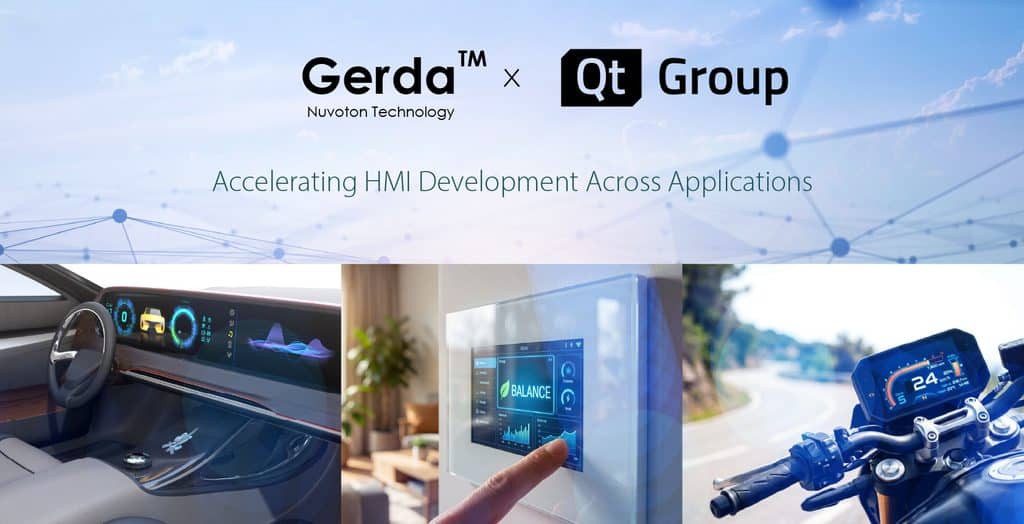
Nuvoton's Gerda IC and Qt for MCUs Bring Premium User Interfaces to Cost-Efficient Products Without External Memory.
What exactly is on offer here?
Bottom line: it is a hardware-plus-software bundle aimed at mainstream panels, not a chip you buy alone. Nuvoton Technology Corporation Japan (NTCJ) and Qt Group have combined Nuvoton's Gerda HMI controller platform with Qt for MCUs so that automotive displays and home appliances can run rich graphical interfaces without external memory. Concretely, that targets motorcycle dashboards, head-up displays and washing-machine interfaces — the exact products where buyers want a touch screen that reacts quickly but refuse to pay a premium for the hardware behind it.
From a reviewer's seat, that framing matters. Most "premium UI" stories are sold to flagship cockpits. This one is pitched at cost-efficient, high-volume goods, which is why the memory question does the heavy lifting in the pitch.
Why does removing external memory actually cut cost?
Conclusion: because a frame buffer is expensive in two ways — the chip itself, and everything around it. Gerda's internal RAM plus its display, connectivity and control interfaces let engineers build HMI applications without external memory, while Qt for MCUs contributes a graphics engine, a component library and a development environment. Its optimised graphics lean on Gerda's texture compression to lower the memory needed to show graphics and animation, cutting component count and system cost, especially in high-volume products.
Here is the number the press releases skip. A typical 800×480 panel at 16-bit colour needs roughly 750 KB for one frame buffer and about 1.5 MB for double buffering, before icons, fonts or animation assets — according to an ST-based engineering write-up on single-chip GUI design from EEFocus. Once you add external PSRAM or SDRAM plus QSPI flash, you are also paying for high-speed PCB routing, possible extra board layers, signal-integrity and EMC debugging, higher power draw, and supply-chain exposure. That is the real cost stack this pairing attacks.
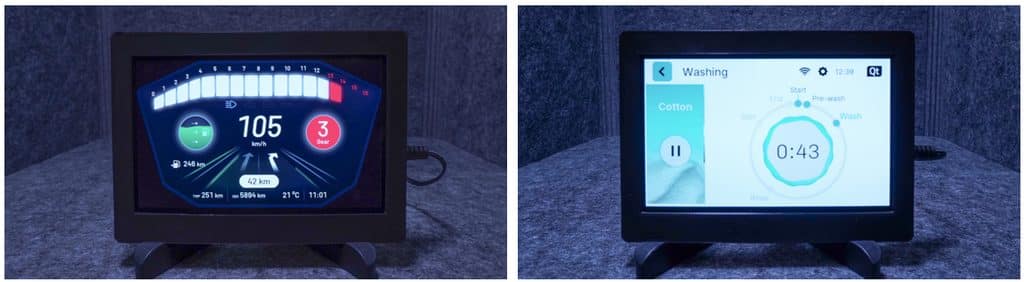
Demo of motorcycle instrument cluster (left) and a home appliance washing machine UI (right) running on the Nuvoton's Gerda IC and Qt for MCUs.
When is external memory still the smarter call?
Short answer: when your resolution, language set or panel count outgrows on-chip RAM. This is the honest shortcoming in an otherwise tidy story. External PSRAM, for example, costs a fraction of equivalent SRAM — engineering write-ups put it around one-fifth to one-tenth per unit of capacity — and system-in-package designs now put gigabits of cheap RAM next to the MCU while keeping GPIOs free. For a large cluster, multiple displays, or a product shipping dozens of font sets, that cheap capacity can still win.
My rule of thumb: if the UI is one moderate-resolution panel with a bounded asset set, the no-external-memory approach is compelling. If you are pushing very large screens or heavy 3D content, do not force the square peg. Omdia data shows displays of 10 inches and above rose from 37% of touch-display shipments in 2021 to 58.5% in 2023 — a trend that increases memory pressure across the board, even as chips like Gerda narrow the gap.
What does the software side really cost?
Conclusion: the silicon saving is only half the ledger; licensing and toolchain shape total cost too. Qt for MCUs brings pre-built components, a development environment, the QML language for describing interfaces, plus simulation tools and AI-driven tools that cut development effort. Qt Group offers commercial and open-source licensing across its portfolio — the open-source route is typically LGPLv3, with commercial terms for proprietary devices — so procurement teams should price the licence, not just the BOM.
That is the second number the launch coverage omits. "Lower system cost" is a hardware claim; a defensible TCO comparison adds licence fees and engineering hours. Developers who already know QML will move faster; teams starting cold should budget for the learning curve.
Who is this for — and what about OTA and security?
Bottom line: connected products that need to change after they ship. The solution supports Over-The-Air (OTA) updates, so manufacturers can refresh graphics interfaces and add features, with Gerda's security features combined with Qt for MCUs making that possible — a capability growing in importance for connected vehicles, 2 Wheeler and home appliances.
What did Nuvoton's VP actually say?
Yoshihide Kanakubo, Vice President, Battery and Automotive BG, Nuvoton, puts the pitch plainly: "By combining Gerda with Qt for MCUs, customers can deliver premium graphical user experiences while balancing performance, memory efficiency, and system cost." It is a tidy summary of the trade-off — three variables held in balance rather than one maxed out.
FAQ: the questions I'd ask before deciding
Does this really work without any external memory?
For the intended class of one moderate-resolution panel with compressed assets, yes — Gerda's internal RAM and interfaces plus Qt for MCUs' texture compression are designed for exactly that. Very large or multi-panel designs are a different story.
Is it only for car dashboards?
No. Home appliances such as washing machines, motorcycle instrument clusters and head-up displays are all named targets, and the OTA angle applies to any connected device.
Will it be cheaper for my product?
At high volume, dropping the memory chip and its PCB and validation overhead is where the saving concentrates. At low volume, licensing and development effort can dominate — run the numbers per project.
Do I need to rewrite my UI?
If your team already works in QML, reuse is straightforward; otherwise budget for the subset and toolchain that Qt for MCUs uses.
Common misconceptions
- "No external memory means no compromise." It means a bounded asset and resolution envelope, not unlimited graphics.
- "Cheaper BOM equals cheaper product." Licensing, validation and engineering hours belong in the comparison.
- "More screen is always better." Bigger displays raise memory pressure; the Omdia trend cuts both ways.
Action checklist: how to evaluate it
- List panel resolution, colour depth and frame-buffer need (single vs double buffering).
- Count assets, fonts and languages; check they fit compressed in internal RAM.
- Price the external-memory route fully: chip, PCB layers, EMC testing, power, supply risk.
- Quote the Qt licence scenario for your volume and distribution model.
- Confirm OTA and security requirements before locking the design.
The verdict
My honest take: this is a smart, well-scoped pairing for high-volume makers of dashboards, clusters and appliance panels who want fluid graphics without paying the external-memory tax — and the cost case is strongest when you include the hidden PCB and validation savings. It is not a universal answer: big displays, many fonts and tight licence budgets still favour the old approach. If you are in the target zone, put Nuvoton's Gerda IC and Qt for MCUs on the shortlist and run the checklist above before you sign off the BOM.
Sources
- Omdia — in-cell touch display and display-size share data: https://omdia.tech.informa.com/pr/2024/mar/omdia-in-cell-touch-tft-lcd-displays-in-automotive-csd-application-will-become-dominant-reaching-over-50-shipment-share-in-2025
- EEFocus / ST-based single-chip GUI analysis (frame-buffer math): https://www.eefocus.com/article/2096834.html
- Qt — licensing options: https://www.qt.io/development/qt-framework/qt-licensing
- MarketsandMarkets — automotive HMI market outlook: https://www.marketsandmarkets.com/core/PressReleases/automotive-human-machine-interface.asp
- PR Newswire — Nuvoton Gerda and Qt for MCUs announcement: https://www.prnewswire.com/news-releases/nuvotons-gerda-tm-ic-and-qt-for-mcus-bring-premium-user-interfaces-to-cost-efficient-products-without-external-memory-302930093.html