
MyTechDailyNews How-To: What Meta's Muse Wonder Rollout Changes for Everyday AI Users
Starting November 6, Meta is bringing specialized versions trained from Muse Wonder into Muse and Meta AI, so ordinary users get stronger memory and task recovery without automatically paying for the most powerful tier. The practical takeaway: everyday assistants become more reliable, but Wonder Full and heavy developer use remain tied to paid access.

What did Meta actually change on November 6?
Meta moved part of the Muse Wonder model family closer to consumer use by deploying specialized versions inside Muse and Meta AI. These are not simply smaller Wonder models; they are task-trained variants built around the routines of a personal assistant: booking, follow-up, mailbox triage, and recovering when a website or workflow breaks. The change matters because a general assistant can now keep working after interruptions, instead of stopping and asking the user to restart a task.
The timing is important. Meta launched the personal assistant app Muse in September this year. Muse Wonder and the stronger Wonder Full arrived in October 2026. By November 6, the company was no longer waiting for all users to move to a frontier model; it was sending task-trained variants into the consumer surfaces where people already use AI.
The shift also clarifies the commercial split. Muse Wonder, sometimes shortened to Wonder, remains available through the Meta Model API and Muse Code; Wonder Full, the stronger variant, is reserved for higher-end paying users. The new specialized models serve the broad audience that expects an AI helper inside everyday Meta products, not a coding environment.
Why are Active Memory and Active Focus more useful than a bigger chatbot?
These are the two capabilities Meta says the specialized versions inherit from Muse Wonder, according to Meta's research blog. Active Memory helps the assistant decide what should be retained; Active Focus helps it keep moving when a task hits an obstacle. For daily use, that is less like a knowledge quiz and more like a capable assistant who knows the difference between a temporary note and a durable preference.
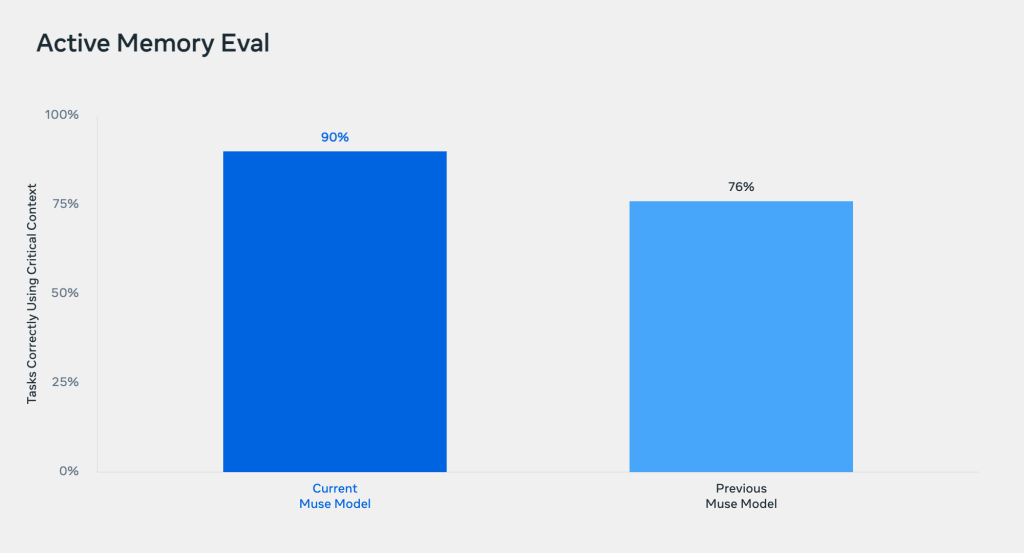
Meta reports that the new models correctly used key context during task execution in 90% of internal tests, versus 76% for the previous generation. In Muse, the company says the models' ability to complete ordinary tasks after unexpected problems improved by 67%. The exact benchmark details have not been published, so treat these as company-reported signals rather than independent proof.
Who can use it, and who still needs a paid plan?
| Model or product | Practical role | Access path |
|---|---|---|
| Muse Wonder | Flagship model for complex, high-difficulty tasks | Meta Model API and Muse Code; billed according to input and output tokens |
| Wonder | Shortened reference to the Wonder family used in developer tools | Integrated into Meta Model API and Muse Code |
| Wonder Full | Stronger variant for demanding subscription use | Muse Code high-end paid plans |
| New specialized versions | Everyday assistant behavior inside Muse and Meta AI | Rolling out to users from November 6 |
This split reflects an economic choice, not just product packaging. Running frontier-class models for every casual prompt is expensive, while consumer assistants can win by handling narrow tasks well. The public rollout suggests that the everyday path is not to force everyone onto the highest tier, but to let specialized variants absorb common assistant work while leaving the hardest reasoning and heavy coding to paid access.
For readers deciding whether to pay, the simplest rule is: use the free tier for low-stakes reminders, short summaries, and occasional planning; consider a paid plan when the assistant must act across many long tasks, handle harder code work, or need higher usage ceilings. Meta's Muse subscription help page lists Power at $20 per month and Maximum at $100 per month, with weekly Muse token allowances of 500 million and 3 billion, respectively. That usage framing is useful because the new specialized models may improve reliability, but they do not remove limits or make the most advanced tier unnecessary.
How should a normal user test the rollout in the next week?
- Start with a task that has a deadline and a correction. Ask Muse to draft a plan, then change one requirement halfway through. This checks whether the specialized versions carry the updated context.
- Give a small personal note, such as a dietary preference or recurring schedule, then revisit it in a new session. Do not overload it with private data; test only information you are comfortable letting the assistant retain.
- Run one interruption. If a booking or research task stalls, observe whether the assistant proposes alternatives or stops. The 67% claim is about this recovery behavior, not about general chat quality.
- Try it where you already work. Meta AI is integrated across WhatsApp, Instagram, Facebook, and Messenger, so users can compare assistant behavior without opening a new workflow.
- If you often use voice or avatar mode, our guide to Meta Muse real-time voice and avatars explains how those modes fit into the app.
- Keep a log for three days: how often the assistant forgets, how often it recovers, and how many corrections it needs. This gives a personal baseline before subscribing.
What are the most common misconceptions?
- It is not an automatic upgrade to Muse Wonder. The specialized versions are designed for assistant tasks, not full frontier capability.
- It is not a memory guarantee. Active Memory may still need user confirmation, especially for sensitive personal information.
- It is not a free pass for power users. Wonder Full remains for subscribers with heavier needs, and Meta Model API usage remains token-based.
- It is not an independent quality report. The 90%, 76%, and 67% numbers come from Meta's internal testing.
- It is not a universal benchmark. The company has not published detailed public benchmark results, so users should run their own tests.
What should you do if you depend on AI assistants?
- Free users: test public, low-risk tasks first, then note whether the assistant asks too many confirmation questions.
- Paid users: compare your weekly token ceiling against real work; the $20 and $100 tiers change only if you hit volume limits.
- Developers: evaluate the specialized versions as workflow components, not as replacements for Muse Code or the Meta Model API.
- Workplace users: document what the assistant remembers and what it should forget; do not assume long-term memory is acceptable for confidential data.
FAQ
Can normal Muse users access Muse Wonder directly?
Not in the same way. The November 6 change gives Muse and Meta AI users specialized versions trained from Muse Wonder. The flagship remains mainly for paid, complex, and developer-oriented use.
What is the difference between the specialized models and Wonder Full?
Specialized models optimize personal-assistant behavior: memory relevance, user correction, and task recovery. Wonder Full is the stronger variant aimed at higher-end subscribers and difficult tasks, while the Wonder family is accessible through Meta Model API and Muse Code.
Is the free Muse tier enough?
Enough, if you use occasional summaries, reminders, and simple drafting. It may not be enough if you need sustained coding, long-running tasks, or a higher weekly token allowance.
Does more memory always mean a better assistant?
No. The better assistant is the one that knows what to keep, what to retrieve, and when to ask. A model that retains everything can become noisy, stale, or riskier if users do not manage what is remembered.