
Madison Huang Skips Nvidia AI Day Seoul: How To Read A Last-Minute Executive Cancellation
Short answer up front: Madison Huang, senior director of product and technical marketing for Nvidia's physical AI platform, called off her trip to Korea citing "family reasons", and the meeting she had lined up with Deputy Prime Minister and Minister of Science and ICT Bae Kyung-hoon in Yeouido, Seoul on the afternoon of the 8th fell away with it. The event she was flying in for, 2026 Nvidia AI Day Seoul on the 9th to the 10th of this month, went ahead with other Nvidia executives standing in.
What moved on the calendar, and what did not
The practical reading is narrow: one person dropped out, the programme did not. Korea's Ministry of Science and ICT (MSIT) and the local IT industry disclosed the change on the 8th, and Yonhap News reported the stated reason as "family reasons", with no further detail made public.
| Schedule item | Planned | After the cancellation |
|---|---|---|
| Meeting with Bae Kyung-hoon | Afternoon of the 8th in Yeouido, Seoul | Scrapped; no replacement meeting was announced |
| Korea AI Startup Partnership Forum | Co-chaired by Madison Huang and Ryu Je-myung, second vice minister of the science and ICT ministry | Her co-chairing seat went with the cancelled itinerary |
| 2026 Nvidia AI Day Seoul | Held on the 9th to the 10th of this month | Held as scheduled, with other Nvidia executives attending in her place |
Two details explain why this was treated as more than a speaker swap. Bae Kyung-hoon has held the science and ICT portfolio since 2025 while also carrying the deputy prime minister title, so the Yeouido slot was a cabinet-level engagement. And the startup forum she was meant to co-host sat on the same government agenda: Korea.net shows the science ministry's second vice minister, Ryu Je-myung, already active on physical AI briefings, including a Physical AI Tech Day appearance on 20 October 2026, so the day had been built around her presence.
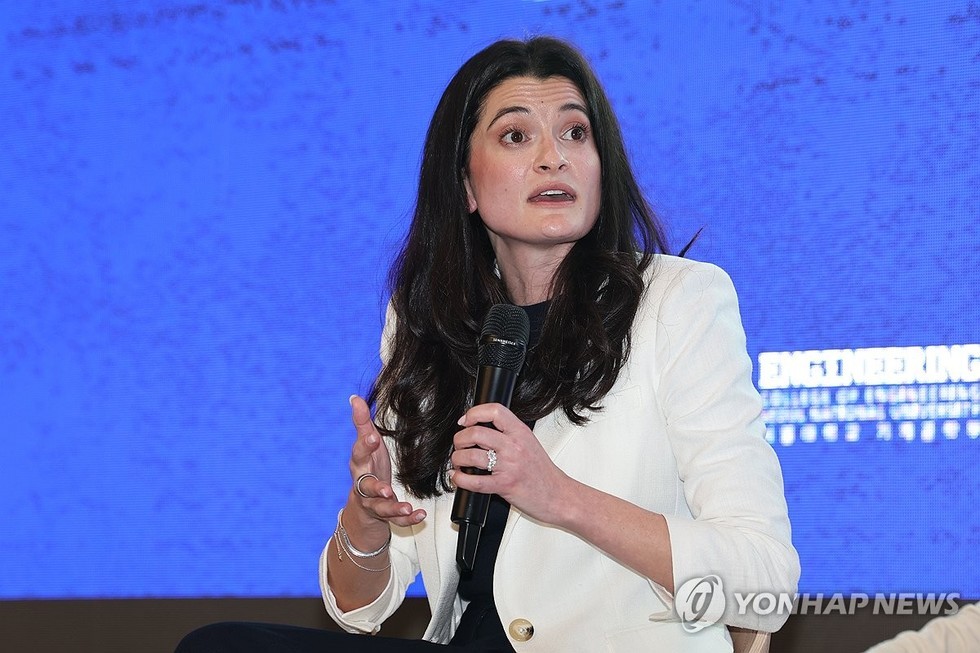
Madison Huang, file photo via Yonhap News.
Why her absence landed harder than an ordinary swap
Conclusion first: she owns the product-marketing side of exactly the topic the Seoul agenda was built around. Nvidia's own author profile lists Madison Huang as senior director of product and technical marketing for physical AI platforms, covering Omniverse and the OpenUSD development framework. A Chosun profile from April 2026 described her the same way, noting she joined Nvidia in 2020 and oversees marketing for the physical AI platform.
That matters because the Seoul line-up is stacked with Korean companies shipping this exact stack. Nvidia's 2 November announcement for the event lists SK hynix using CUDA-X and PhysicsNeMo to accelerate semiconductor device and process simulation, Samsung Electronics applying PhysicsNeMo-based physical AI to fluid-flow work and agent-driven design exploration, and LG Electronics showing an Isaac GR00T based closed-loop learning system in its factories. The person who translates those platforms into a product story for the region was the one missing from the room.
What attendees still got on the 9th and the 10th
If you were registered, the recovery path is better than the headline suggests. Based on Nvidia's published event programme and its regional AI Days page, the remaining content was:
- Scale and venue: two days at COEX in Gangnam, Seoul, with roughly 2,000 developers, startup staff, enterprise executives and researchers expected.
- Structure: 15 concurrent sessions across three tracks — agentic AI, physical AI and AI infrastructure.
- Keynotes: Nvidia's robotics and edge AI leadership on robot development platforms, world models and the AI factory blueprint, delivered by other executives.
- Ecosystem presence: about 20 partners on site, including Samsung Electronics, SK hynix, LG Electronics, Naver Cloud, Doosan Robotics, Coupang Intelligent Cloud, Dell Technologies and SK Telecom.
- Day two: paid hands-on workshops on inference deployment at scale, robot workflow simulation and safer agent development, plus free Nvidia certification exams across five subjects.
Session takeaways from the keynote and track talks are published on demand after each stop in the series, which is the cheapest way to reclaim most of the day-one value if you were sitting in a slot that changed speakers at short notice.
A six-step way to read any late executive cancellation
- Separate the person from the programme: ask what actually failed (a meeting, a co-chairing role) versus what merely lost a named face.
- Check whether the sessions still have owners. Here they did, and the event ran on schedule.
- Treat "family reasons" as a closed statement, not a clue. Yonhap News reported that no more specific reason was made available.
- Go to the primary readout: the science and ICT ministry's own statement and the vendor's event page, not aggregator rewrites of a single anonymous sourcing.
- Give it a 24 to 72 hour window before you republish a cause. Unverified supply-chain and personnel signals travel fast, as our case review of the TSMC 3D DRAM rumour cycle shows.
- Score the durable output separately from the optics: what shipped inside the venue is what clients and roadmap teams will actually cite.
Four misreadings this story tends to trigger
- "The event is in trouble." It ran on the 9th to the 10th as planned, with substitute Nvidia executives on stage and the full partner line-up on the floor.
- "Korea's AI push is cooling." The opposite signal came days earlier: on the 6th, Bae Kyung-hoon argued that South Korea should expand domestic AI data centre investment even as construction rules tighten in the United States.
- "'Family reasons' hides a strategy shift." Nothing supports that. It is also worth remembering the stock was already twitchy: Nvidia shares slid roughly 25% from their 6 October peak, and that episode has been read mostly as a data-centre politics story, not a personnel one.
- "One senior director does not move the needle." For a physical AI event, she is the product-marketing owner of the platform stack being demoed, which is why the calendar change registered at all.
Why the family question keeps surfacing
Jensen Huang has a son and a daughter, Spencer Huang and Madison Huang. Madison worked as a chef for a stretch, then moved to LVMH, the luxury giant founded in France, before entering Nvidia as an intern in 2020. Spencer ran a bar for years before joining the company in 2022. Both were promoted repeatedly after joining, and Madison in particular has become an executive who works closely with the CEO's core team to prepare major company events. Their beat, simulation software and robotics, is one of the arenas Nvidia has been cultivating heavily in recent years.
The subject surfaced directly in 2025, when Jensen Huang was asked whether the company runs on nepotism. He answered without hedging that Nvidia has hired many employees' children and that he is unbothered by it, because parents would not recommend a child who would bring them shame. He added, laughing, that many of the so-called "Nvidia second generation" — the company's children-of-employees hires — now outperform their own parents.
Action notes, depending on who you are
If you were pitching her team
Recycle the deck into the on-demand session follow-ups and the day-two workshop track, then route your request to the regional physical AI marketing group rather than waiting for the same calendar block to reopen. One missed meeting is a scheduling problem, not a lost account.
If you track the vendor beat
Log the three verifiable facts and stop there: the cancellation on the 8th, the standing event dates on the 9th to the 10th, and the substitution of other Nvidia executives. Anything beyond that is inference and should be labelled as such.
If you are a Korean AI startup
The forum format survived the week, and the science and ICT ministry's own AI agenda did not pause. Watch the ministry's press releases for a rescheduled session, and treat event participation as the cheapest route back into the same conversation.
FAQ: the questions this story actually generates
Was 2026 Nvidia AI Day Seoul cancelled?
No. Korea's Ministry of Science and ICT and industry sources confirmed the event went ahead on the 9th to the 10th of this month; only Madison Huang's participation changed, with other Nvidia executives attending on her behalf.
Why did Madison Huang cancel her Korea trip?
Yonhap News reported the reason as "family reasons" and noted that no more specific explanation was publicly available. Any further cause is speculation.
Did the government meeting still happen?
No. Bae Kyung-hoon had been set to meet her on the afternoon of the 8th in Yeouido, Seoul, and that engagement fell through along with the trip. Her planned co-chairing of the Korea AI Startup Partnership Forum with second vice minister Ryu Je-myung was cancelled on the same basis.
Is she the only one of Jensen Huang's children at the company?
No. His son, Spencer Huang, joined in 2022 after running a bar for years, and both children have moved up inside the simulation and robotics businesses.
Does one absence change Nvidia's physical AI roadmap?
Nothing announced supports that reading. The Seoul agenda, partner line-up and workshop programme stayed in place, so on the published record this is a scheduling event rather than a strategic one — an interpretation, not a company statement.
What is worth keeping from the week sits on the other side of the cancellation: the physical AI sessions that still ran, the partner use cases on the floor, and a ministry that spent the same week arguing for more AI data centre investment. The name on one calendar block is not the story.
Sources
- Nvidia official AI Days programme page: nvidia.com/en-us/ai-days
- Nvidia technical blog author profile: Madison Huang, senior director of product and technical marketing for physical AI platforms (Omniverse, OpenUSD)
- Chosun, "NVIDIA Senior Director Urges Students: Embrace AI, Don't Fear It", 29 April 2026
- Chosun, "Deputy Prime Minister Bae Urges AI Data Center Investment Expansion", 6 November 2026
- Korea.net press release, "Second Vice Minister Ryu Je-myung Attended Physical AI Tech Day", 20 October 2026
- Wikipedia entry on Bae Kyung-hoon, Minister of Science and ICT and deputy prime minister since 2025
- Yonhap News report on the cancelled Seoul trip, 8 November 2026, as carried by RFI