
A MyTechDailyNews General Guide: Qingqibing, the Pickup-Launched Solar Drone Built for 30-Hour Patrols
By Isla Sanders · MyTechDailyNews
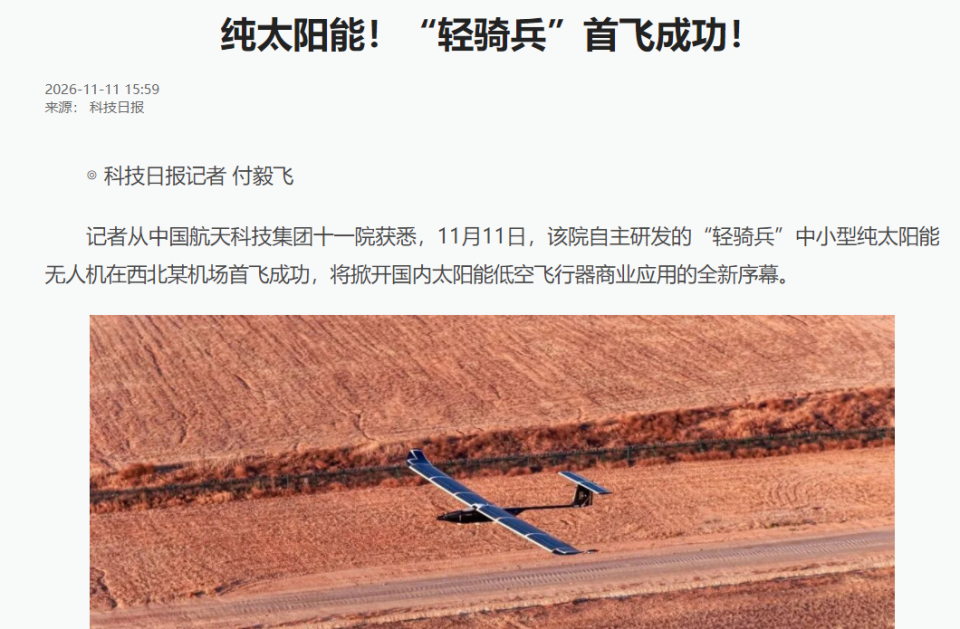
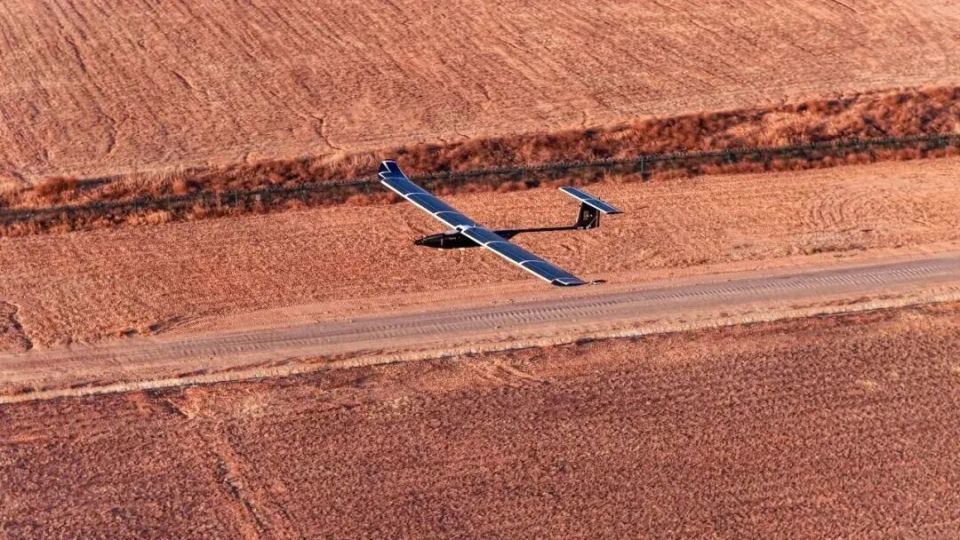
A pickup truck backs onto an airfield apron in northwest China, a launch rail locks into place, and twenty minutes later a paper-thin wing is circling overhead without burning a drop of fuel. On November 11, 2026, the 11th Academy of China Aerospace Science and Technology Corporation (CASC) flew Qingqibing — 'light cavalry' — reported by Xinhua as China's first commercial-grade small pure-solar drone. The short answer to why it matters: the category just moved from 'can it fly' to 'is it worth using.' This guide breaks down the numbers, the field logic, the traps and what to watch.
What happened, and which numbers matter?
The label doing the heavy lifting is 'commercial-grade': earlier Chinese solar aircraft were research platforms, while this one was engineered to be bought, driven and flown by ordinary operators.
- Fuselage length: 3.2 m
- Wingspan: 8 m
- Takeoff weight: 45 kg
- Service ceiling: 7,000 m
- Payload: more than 5 kg, in modular bays that per the Academy's first-flight note 'can be swapped quickly' between remote-sensing and communications modules
- Endurance: 30 hours by design — one full day-night cycle
- Deployment: vehicle launch, no runway, about 20 minutes of ground preparation
Sunlight is the only power source: thin-film photovoltaic cells blanket the wings and top up lightweight onboard batteries by day, while stored charge carries the night. The carbon-fiber structure is built to survive a rail-catapult launch, and every link in that chain — cells, batteries, composites, drones — draws on China's enormous civilian manufacturing base. That supply chain, not any single spec, is the quiet cost lever here.
Why is the small aircraft the bigger story?
The solar-drone graveyard explains it. NASA's Helios, with a wingspan wider than a Boeing 747, was shredded by low-level turbulence. Google and Meta poured hundreds of millions of dollars into the idea; one of their aircraft was airborne for four minutes before a wing snapped, and another lost its right wing to little more than a breeze on landing. Airbus's Zephyr still owns the records — a 25-meter wing, 67 days aloft, above 20,000 m — and per AALTO, the company now flying it, the latest record run lasted 67 days, 6 hours and 52 minutes before ending on April 28, 2025. Britain's BAE Systems put its 35-meter PHASA-35 through stratospheric trials in 2023 and again in 2024, past 66,000 feet each time.
Impressive aircraft, mostly irrelevant to a pipeline crew. Those platforms need long runways, big support teams and cooperative weather, and their job — months of stratospheric loitering — sits layers above ground patrol work. The physics behind them is a loop: longer flight means more batteries, more batteries mean more weight, more weight means a bigger wing, and a bigger wing means a more fragile, more expensive airplane.
Qingqibing changed the question instead of grinding through the loop. Not two months in the air — a 30-hour cycle covering a full shift from dawn to dawn. Not 20,000 m — 7,000 m, high enough for an electro-optical payload to make out the shape of vehicles on the ground, low enough for field teams to reach it with light radio sets.
Who built it, and why does the resume matter?
The 11th Academy is the state team behind the Caihong series, and in 2017 it flew a 45-meter-wingspan solar drone above 20,000 m. The glamorous big-wing route was never out of reach: they flew it, learned its limits, and chose to build small — a product decision, not a fallback.
China's effort runs on parallel tracks. Zhou Zhou's Meiying team at Northwestern Polytechnical University flew a low-altitude civilian solar UAV for 27.6 hours in 2019, a domestic record for the class, while Zhu Shengli of AVIC's First Aircraft Institute leads Qimingxing 50, the big high-altitude platform. From Caihong to Qimingxing 50 to Qingqibing, one line runs through it all: cover different mission layers instead of betting on a single platform.
How would a real patrol actually run?
Press releases skip this part, so here is the field checklist, assembled from the aircraft's published capabilities:
- Match the payload to the mission. The modular bays take remote-sensing or communications modules within a 5-kilogram budget. Mapping day? Sensors. Disaster-zone comms relay? The radio package.
- Drive to the job, not to an airport. Launch is vehicle-based — pickup plus rail, no runway — workable in mountains, along coastlines and in open wilderness, wherever the pipeline, river or fire line actually is.
- Give the crew twenty minutes. Published ground preparation is about 20 minutes, so the schedule starts when the truck parks, not when a runway slot opens.
- Fly the sun. Launch in daylight, let the cells refill the batteries, let stored charge carry the night. One aircraft covers shifts that used to need relays of short-endurance drones.
- Land, swap, re-task. Recovery and reuse is the design intent; the same airframe flies the next mission with a different module.
The official mission menu reads like a list of chores nobody wants to do on foot: long-distance pipeline patrol, reservoir and embankment inspection, mapping and natural-resources survey, rapid disaster-zone assessment, wide-area monitoring.
What does it replace — and what doesn't it?
| Option | Endurance | Deployment | The catch |
|---|---|---|---|
| Foot and vehicle crews | One working day | None | Slow, risky, narrow view |
| Battery multirotors | Tens of minutes to about 2 hours | Easy | Shift changes interrupt the task |
| Manned helicopter | Hours | Airport, crew, fuel | Costly per hour, weather-limited |
| Satellites | Always up | None for the user | Long revisit gaps; clouds block the view |
| Qingqibing | 30 hours by design | Truck plus 20 minutes | New and unproven at scale; needs sun |
The economics bite where coverage is long and thin. A scenario catalogue published by Shandong's industry and information technology department describes a drone patrol team covering 419 km of pipeline in a single day, roughly three times the efficiency of manual patrols — the arithmetic behind pressing costs into a range an ordinary field crew can afford.
What are the common misconceptions?
- 'The 30 hours are proven.' They are a design value; the debut was a shakedown flight. A performance claim deserves the same scrutiny as any early-warning gadget — the standard we applied when explaining why detection claims need an auditable trail.
- 'It's a pseudo-satellite.' No. Stratospheric craft like Zephyr and PHASA-35 fly above 20,000 m for weeks. Qingqibing tops out at 7,000 m and is built for work, not records.
- 'Any weather, mission on.' Solar input collapses under consecutive overcast skies and in high-latitude winters, so endurance shrinks exactly when irradiation does.
- 'It retires helicopters and satellites.' It slots between them: closer and cheaper than satellites, more persistent than most battery drones — but it won't lift heavy cargo or see through a storm front.
What should you watch next?
Three things. First, payload trials — how fast the communications-relay role matures, where disaster agencies will look first. Second, an endurance demonstration that actually stretches past one full night. Third, the paperwork: routine long-duration patrol needs operating approvals, and as of debut coverage no production or rollout schedule has been announced. Consumer hardware teaches the same lesson — our practical guide to Ring's indoor drone shows how deployment limits, more than spec sheets, decide what a flying camera can do.
If you run infrastructure and a vendor offers a demo, ask three questions before signing: does your payload fit the 5-kilogram budget; is there a runway-free launch zone near the asset; do you need a full day-night cycle per launch? Three yeses, and this category deserves your time.
FAQ
Is Qingqibing's 30-hour endurance proven?
No. It is the design target. The November 11 flight confirmed the systems work; a demonstration of the full day-night cycle has not been published.
Is it a pseudo-satellite?
No. That label belongs to stratospheric platforms such as Airbus's Zephyr, which flew 67 days above 20,000 m, and BAE Systems' PHASA-35. Qingqibing flies at up to 7,000 m for patrol work.
Who builds it?
The 11th Academy of China Aerospace Science and Technology Corporation — the Caihong team, which flew a 45-meter solar drone above 20,000 m back in 2017.
How fast does it deploy?
About 20 minutes from truck parked to airborne, launched from a rail with no runway required.
What is it for?
Pipeline patrol, reservoir and embankment inspection, mapping, early wildfire detection, post-flood assessment and wide-area monitoring — cheap, persistent, repetitive observation.
The open question isn't whether a solar wing can outlast a battery quadcopter — on paper it clearly can. It's whether regulators, insurers and pipeline operators will let an unpiloted aircraft loiter over a gas line at three in the morning. The airframe looks ready. Is everyone else?
References
- Xinhua: first flight of China's first commercial-grade small pure-solar drone, Nov 11, 2026 — http://www.news.cn/politics/20261111/1da59e63f2474d3d90b7139a87de523f/c.html
- CASC 11th Academy first-flight note on modular payloads — http://www.caaa-spacechina.com/n301/n2697/c2645741/content.html
- BAE Systems, PHASA-35 product page (stratospheric trials 2023 and 2024) — https://www.baesystems.com/en-us/product/phasa-35
- AALTO: Zephyr's 67-day record flight concluded April 28, 2025 — https://www.aaltohaps.com/zephyr-sets-world-record-for-longest-continuous-flight-flying-67-days-in-stratosphere/
- Shandong Provincial Department of Industry and Information Technology, drone application scenario catalogue — http://gxt.shandong.gov.cn/module/download/downfile.jsp?classid=0&filename=ed5e234c4f6c4b72890693ac2c6af25c.pdf