
The Dreamer vs. A Critter Carol: My Honest Verdict on Apple's 2026 Holiday Ad | MyTechDailyNews General
Can a $599 laptop actually hand a teenager back the part of themselves they lost growing up? That is the bet Apple makes in its 2026 holiday film The Dreamer, and after watching it back to back with 2025's A Critter Carol and Disney's The Invisible Horse, my verdict is: it is the most quietly confident of the three, though not the flashiest. Below is what works, where it wobbles, and who the MacBook Neo at its center is genuinely for.
What is The Dreamer, and what actually happens?
Short answer: it is a near-silent film, just under four minutes, released on November 12, 2026, that follows one boy from a crib under a colorful mobile to a teenager who hides his sketches from everyone — until a Christmas-morning MacBook Neo lets him animate his old characters again. The laptop shows up late on purpose. By the time it arrives, you already understand that it is not being bought; it is being believed in.
There is virtually no dialogue; Strawberry Guy's Give Me A Dream does the emotional lifting. Behind the camera is director Melina Matsoukas — whose credits include Beyoncé's Formation and Queen & Slim — with cinematographer Bradford Young and artwork by Chicago-born artist Hebru Brantley, produced through TBWA\Media Arts Lab, PRETTYBIRD and De La Revolución. Brantley drew every piece of the boy's art, from the childhood scribbles to the animated character he finishes on the MacBook Neo itself.
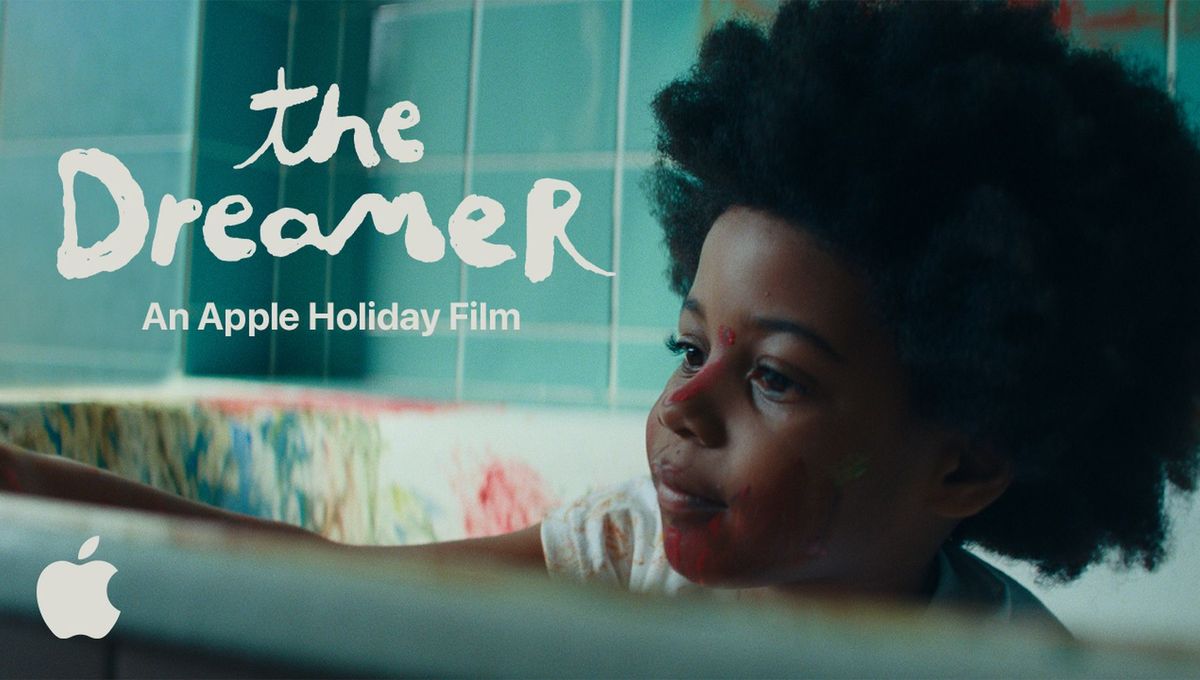 A scene from Apple's 2026 holiday film The Dreamer.
One detail that sold me: the film never explains a single specification. A viewer who knows nothing about the machine still follows the emotional turn, which is exactly the test most product-led holiday ads fail.
How does The Dreamer compare with A Critter Carol and Disney's The Invisible Horse?
My ranking, for what it is worth: The Dreamer wins on emotional specificity, A Critter Carol wins on craft spectacle, and Disney's short competes on warmth rather than product. The table is where the trade-offs get honest:
| Dimension | The Dreamer (Apple, 2026) | A Critter Carol (Apple, 2025) | The Invisible Horse (Disney, 2026) |
|---|---|---|---|
| Who is in the spotlight | A boy who stopped drawing | Handmade woodland puppets, directed by Mark Molloy | A child's imagination and a family bond |
| What the product does | MacBook Neo lets him animate his old characters | iPhone 17 Pro records the puppets' music video | No product; emotion carries the story |
| The real promise | Permission to start again | A camera as memory-keeper | The holiday feeling itself |
| Best for | Parents and lapsed creatives | Craft and animation fans | Family-viewing traditions |
The 2025 film kept human-made craft front and center: physically built puppets, animated by hand on miniature sets, with the iPhone 17 Pro visibly doing the capturing. The Dreamer keeps the craft but switches the protagonist to someone who has stopped creating — a harder, braver choice. I have argued something similar before with Snapdragon's cardboard time machine vs. the kart race: the winning holiday spots put the product inside someone's comeback, not inside a feature list. Apple runs the same playbook across seasons too — its Diwali film shot on the iPhone 18 Pro trades on light and place rather than specifications.
Where does The Dreamer fall short?
First, the marketing caveat: Apple has disclosed no sales lift and no measured brand response for the campaign, so any claim that it "works" commercially is speculation. Emotional advertising has a known failure mode — a moving film that could sell any product wins applause and leaves the brand behind. The Dreamer partly dodges that by making the computer part of the character's act of creation, but a lovely film is not evidence of MacBooks moving off shelves.
Second, the product reality check. The MacBook Neo arrived on March 4, 2026, was available from March 11, and starts at $599 ($499 for students and educators) as Apple's most affordable laptop, built on the A18 Pro chip with 8GB of memory. For drawing, animation as a hobby and schoolwork, that is a genuinely defensible machine. For heavy 3D, professional video or large projects, it is the wrong tier — and the film, understandably, never mentions any of this.
Third, the context. NRF forecasts November-December retail sales to grow 4.2% over 2025, reaching $1.013 trillion, which means your feed will be wall-to-wall holiday sentiment this season. A quiet, dialogue-free film cuts through that noise better than most — but cutting through noise is not the same as converting. It is also Apple's first holiday campaign under new CEO John Ternus, per Adweek, which makes the understated tone read as a deliberate brand statement rather than an accident.
What should marketers actually steal from it?
The whole spot compresses into one line: a gift that says "I remember who you are." lands differently from a gift that says "here is what it does." The rest is execution. My takeaways from comparing it against this year's alternatives:
- Start with a human moment that needs no product. The lost sketchbook and a parent's memory are legible before any technology appears.
- Let the product change what the character can do. The MacBook Neo earns its late entrance by enabling the animation, not by appearing in it.
- Put the makers in the story. Brantley's hand-drawn work, and the companion behind-the-scenes film Creating the Art, turn production credits into discoverable content.
- Build continuity, not novelty. From woodland puppets to a young illustrator, Apple keeps routing back to human creativity, which is how a brand identity compounds.
The most credible detail is Brantley's own: "My mother saw the artist in me before I could see it in myself," he said in remarks published with the campaign. When the artist's biography and the ad's premise line up that cleanly, the sentiment stops feeling manufactured.
FAQ
What is The Dreamer about?
A boy's love of drawing fades under social pressure as he grows up, until his parents give him a MacBook Neo for Christmas and he animates his old characters again.
Who made The Dreamer?
Melina Matsoukas directed, Bradford Young shot it, Hebru Brantley created the artwork, and the production came through TBWA\Media Arts Lab, PRETTYBIRD and De La Revolución. Matsoukas's background in music videos and film explains why it plays like a short narrative rather than a product demonstration.
How much is the MacBook Neo, and is it a good gift?
It starts at $599, or $499 for students and educators. For a student or lapsed hobbyist who draws, animates or edits casually, it is a sensible gift; for professional video or 3D work, step up a tier.
How is it different from A Critter Carol?
The 2025 film followed puppets already busy making something, with the iPhone 17 Pro capturing it; the 2026 film follows a person who has stopped, with the Mac restarting him.
Did the ad increase sales?
No sales lift or measured brand response has been disclosed, so treat the emotional response and the purchase data as two separate conversations.
The verdict: who is this ad — and the MacBook Neo — for?
For marketers: watch it twice and steal the structure, not the sentiment. For gift buyers: if there is a teenager in your life who quietly quit drawing, the $599 MacBook Neo — $499 with education pricing — is one of the few gadgets that can honestly carry the meaning this film attaches to it. If your recipient needs a professional machine, skip the romance and buy the specifications. My clear recommendation: right story, right machine, for a specific kind of person — and not a general-purpose pitch.
Sources
- Apple Newsroom — MacBook Neo availability and pricing, March 2026
- Reuters — Apple debuts $599 MacBook Neo to challenge Chromebooks, Windows PCs
- Adweek — Apple's Heartfelt Holiday Ad Gifts the Power of Belief
- NRF — Winter Holiday Data and Trends, 2026 forecast
- Ad Age — Inside Apple's holiday ad — and how it mirrors the life of the artist behind it
- Forbes — Apple's 'The Dreamer' Shows What It Means To Be Seen