
By Daniel Lopez · MyTechDailyNews General
Imagine a small box with nine neon lamps blinking at their own unruly pace — would you call it junk? Short answer: no. A little engineering imagination turns this derided flasher into a children's night light or a blinky little friend for a bedside table. That is the real lesson behind a decades-old Candid Camera prank, and it still shapes how we judge 'useless' gadgets today.
What was the Candid Camera 'useless machine', exactly?
The verdict was that it had no use at all — but the object itself was quietly ingenious. In one Candid Camera installment, Alan Funt presented what was described as a useless machine: a Bud enclosure holding nine NE-2 neon lamps, fixed three-by-three with rubber grommets, every lamp flashing on and off at its own individual rate.
The show itself had begun on radio in 1947 before moving to television the following year, according to Wikipedia's history of Candid Camera — a format built around deadpan reactions to invented situations. This particular prop fit that format neatly.
Alongside Durwood Kirby, Alan Funt called the device utterly and absolutely useless, then carried it out to the street and asked passersby what possible use it could have. The joke rested on watching people strain to invent a function and fail. Nobody landed on the obvious domestic angle: a soft, irregular glow that might keep a child company at night.
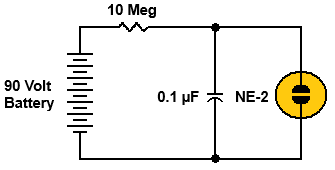
Figure 1: the relaxation-oscillator circuit in all its simplicity.
How does a nine-lamp relaxation oscillator blink?
Each bulb is its own tiny timing loop, and the randomness is an illusion born of poor synchronization. Every bulb formed part of a relaxation oscillator, and because the oscillators were never synchronized to one another, the combined flashing of the nine lamps appeared random.
In its typical form the circuit employed a 90 volt battery, a multi-mega-ohm feed resistor, plus a 0.1 µF capacitor wired in parallel with an NE-2. As Wikipedia's relaxation-oscillator overview explains, the neon lamp stays non-conducting until the capacitor reaches its breakdown voltage, then fires and dumps the charge — one visible flash per cycle. Practical write-ups put the NE-2 strike point near 90 V and its extinction point near 60 V, which is why the blink rate responds so readily to small changes in resistor and capacitor values.
Why did the 'useless' label stick — and who gets to decide?
Because the frame was a comedy setup, not an engineering brief. The supposed humor lay in watching people try very hard, yet without success, to imagine a function for an object deemed so useless — the punchline being that the 'silly people' had silly ideas. Yet no one raised the possibility that the device could act as a children's night light, or as a blinky little friend placed on a night table beside the crib or bed.
That omission is where the deeper reading begins. Writing the original piece, John Dunn — an electronics consultant who graduated from The Polytechnic Institute of Brooklyn (BSEE) and New York University (MSEE) — said he did not know for sure, but just maybe the object was not truly the useless tchotchke it was cracked up to be. His point is less about neon than about humility: purpose is a property we assign, not something an object carries on its own.
Common misconceptions about 'useless' gadgets
- Myth: no obvious function means no value. An irregular glow is a feature if the job is comfort rather than computation.
- Myth: the prank proved the passersby were unimaginative. It mostly proved the question was framed to produce a laugh, not an answer.
- Myth: a blink is a defect. Unsynchronized oscillators are exactly what make the display feel alive instead of mechanical.
- Myth: old components are inherently inferior. A neon lamp's simple two-state behaviour is still a perfectly legible teaching tool.
Is a blinking neon box actually safe beside a crib?
No — not by modern safety standards, and this is the part the original joke never had to answer. The creative leap is sound; the hardware is not. An exposed circuit running on a 90 volt battery, with reachable wiring and no enclosure rating, is a poor choice for a nursery.
Children are also more light-sensitive than adults. A 2023 systematic review in ScienceDirect reports roughly twofold melatonin suppression in children compared with adults. Cleveland Clinic's Dr. Chen said in 2025 that a red-coloured night light is best for bedtime because it does not disrupt melatonin production. And the American Academy of Pediatrics' updated 2022 safe-sleep recommendations caution against products that do not meet federal safety standards and stress a bare, firm sleep surface. Translation: keep any glow dim, warm and well away from the sleep surface — and leave the bare circuit board on the workbench.
Where else does 'useless' hardware hide a second life?
The pattern runs well beyond one novelty box. Engineers routinely turn existing hardware into something unexpected — solar panels paired with vibration sensors, for example, can be used to estimate light rain. The through-line matches John Dunn's argument: value often sits in a capability nobody bothered to name.
A quick checklist before you call something junk
- Name the capability, not the category — a blinking lamp is a low-power indicator, not a toy.
- Test the safety envelope: voltage, heat, exposed conductors, and proximity to a sleeper.
- Look for a purpose already established in a nearby context, such as night lighting, status alerts or classroom demos.
- Compare with a purpose-built alternative before investing time in a retrofit.
- Keep the experiment, but keep it out of the nursery.
FAQ
Was the box really called useless on Candid Camera?
Yes. Alan Funt and Durwood Kirby described it as utterly and absolutely useless, then took it to the street to ask passersby for a use.
How many lamps were in the box, and how were they arranged?
There were nine NE-2 neon lamps, mounted three-by-three with rubber grommets inside a Bud enclosure.
What is a relaxation oscillator in plain language?
A capacitor charges through a resistor until a neon lamp fires and discharges it, then the cycle restarts — effectively a very simple flashing timer.
Who wrote the original article?
John Dunn, an electronics consultant and graduate of The Polytechnic Institute of Brooklyn and New York University.
Should I build one for a child's room?
No. Use a certified, dim, warm night light placed away from the sleep surface, and treat the flasher as a bench experiment.
Verdict: is the idea worth buying into?
My honest call: don't buy or build a 90 volt neon flasher for a nursery — the safety math does not work, and a certified dim red night light does the job better for a few dollars. But do buy into the habit of mind it represents. Before you bin the next odd gadget, ask what capability it quietly offers. That single question is what turns a laugh-line prop into a genuinely useful idea, and it costs nothing.
Further reading on MyTechDailyNews
- The 2024 CES: It's "AI everywhere", if you hadn't already guessed
- A holiday gift wish list for 2020