
Your Solar Roof Could Double as a Rain Gauge: A Practical Guide to Fraunhofer IDMT's lokalRAIN Sensor
Short answer: yes, but only in light rain for now. Researchers at the Fraunhofer Institute for Digital Media Technology (IDMT) in Ilmenau, Germany, have shown that a photovoltaic module can also work as a rainfall sensor. Small structure-borne sound sensors attached to the panel listen to the vibration each raindrop leaves behind in the glass, and a machine learning model running on the node itself turns those signals into a rainfall estimate. Measured against reference instruments, the prototype landed within 1.88 mm/h in light rain. In a downpour, nobody can yet say what it reads.
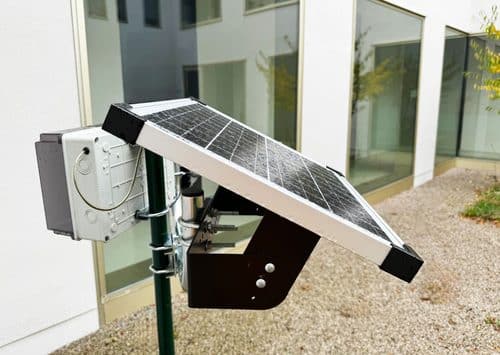
The test setup for precipitation measurement in the courtyard of the Fraunhofer IDMT (image: Fraunhofer IDMT)
By Ruby Cook · MyTechDailyNews, General
What was built, and who built each piece
The interesting part is not the idea of "listening to rain". It is how little hardware the signal chain needs. Here is the path one raindrop follows, from impact to a map of local rainfall:
- Impact. A raindrop strikes the module surface and sets the panel vibrating.
- Sensing. Structure-borne sound sensors mounted on the solar panels capture those vibrations; the sensors record the module vibrations as an acoustic signal rather than counting drops.
- On-node inference. Each sensor unit runs a machine learning algorithm on an energy-efficient microcontroller to infer rainfall. Only compact measurement data is sent wirelessly, so the panel does not stream raw audio.
- Hardware partner. Pan Acoustics, the project partner based in Wolfenbüttel, created the sensor-node hardware and the wireless transmission technology.
- Central view. Fraunhofer IDMT collects and analyses data from several locations centrally, producing a more detailed picture of local rainfall than any single site could.
- Upkeep. Because the sensors have no moving parts, maintenance needs may be lower than for a mechanical gauge with a funnel, a bucket and a hinge.
How accurate is the panel-as-gauge trick, really?
Conclusion first: the published evidence covers light rain only, and it is real evidence, not a simulation. The method was first tested with a laboratory rain simulator, where the trials covered different rainfall rates, drop sizes, and photovoltaic modules. Then the team installed three outdoor measurement systems at the IDMT courtyard, Pan Acoustics, and the weather garden of the Technical University of Ilmenau.
| Item | Reported value | How to read it |
|---|---|---|
| Tested rainfall window | between 2 and 5 mm/h | Drizzle to a steady, light-to-moderate shower — not a storm |
| Mean absolute deviation vs reference | 1.88 mm/h | An average miss distance, not a worst case |
| Accuracy classification claimed | Class C of the World Meteorological Organization (WMO) accuracy classification for low rainfall intensities | Fraunhofer states this class permits a maximum deviation of 2 mm/h |
| Wireless range in field trials | four kilometers in urban settings; over 35 kilometers in rural settings in line-of-sight mode | Range is the easy part; heavy-rain accuracy is the hard part |
The classification point deserves a pause, because "accuracy class" is not marketing language — it is metrology. WMO guidance and the newer European standard EN 17277:2019 both sort catching-type rainfall intensity instruments into performance classes (A, B and C) based on calibrated laboratory tests, and a review of that standard in the journal Sensors (Segovia-Cardozo et al., 2023) summarises how those classes are derived from calibration results. Context matters too: the WMO ran a large field intercomparison of precipitation instruments from October 2007 to April 2009 in Vigna di Valle, Rome, covering around 30 different gauge types, and the follow-up synthesis for urban stormwork reporting concluded that synchronised tipping-bucket gauges and weighing gauges give the best 1-minute intensity readings. The panel-based method is being judged against that yardstick — as an additional data source, not a certified replacement.
Why a city should care about rain that falls on solar panels
Because cities are usually blind exactly where they need to see. A modelling study in the journal Water (Yoon et al., 2017) put it plainly: urban flood prediction is hard because it relies on sparse gauge data and radar estimates of limited accuracy. Public agencies are trying to close that gap with cheaper, denser sensing — the USGS, for example, runs low-cost sensor networks for pluvial flash flooding so that city engineers get advance warning at specific street-level locations.
A PV module has one obvious advantage in that picture: it is already on the roof. Fraunhofer says operators of municipal infrastructures and firefighting brigades have expressed interest in a tool for rainfall measurement, and the intended applications line up with that gap — urban digital twins, municipal control rooms, and flood monitoring. The technology is designed to support conventional rain-gauge systems rather than replace them, and each sensor node processes the data before transmission.
The comparison with the incumbent hardware is where the practical case gets sharper:
- Mechanical gauges fail quietly. Extension guides such as Cornell University's NEWA weather-station maintenance guide list leaves, moss, algae, pollen and debris as routine cloggers of the tipping-bucket screen, and recommend cleaning on a regular schedule; an end-user review of low-cost urban sensing (Water Science and Technology, 2023) treats gauge calibration and siting as recurring operational costs.
- Sensor nodes fail loudly. A vibration node has no orifice to plug, but it depends on adhesion, housing integrity, wireless link quality and a model that has seen similar rain before. Fraunhofer's own next steps are about exactly that: better housing for the sensor and its electronic components and quality assurance of the system.
Where it breaks: heavy rain and the road to a product
Heavy rain remains the key limitation. The team still lacks sufficient training and test data for high rainfall intensities, so the accuracy of the system under those conditions has not been established. "We have proven the feasibility of our approach for light rain," said Jakob Bergner, group leader for Smart Acoustic Solutions at IDMT and scientific head of the project.
That is the sentence to keep in view. The most interesting thing about lokalRAIN is not the acoustic trick; it is how narrow the proven range is. Project lokalRAIN ran between October 2024 and June 2026 as part of the Central Innovation Program for SMEs (ZIM) in Germany. It produced a prototype that is not yet a marketable product. The gap between "it worked at the test bench" and "you can buy it and trust it in a storm" is familiar territory — it is the same gap we measured in the piezoelectric toothbrush story, where a lab-grade result is not yet a consumer product proof.
Without heavy-rain data, the system can only be considered a source of additional local rainfall data, not a substitute for traditional rain gauges. The stated priorities are to collect more data during heavy rains and to test the technology in varying environmental situations.
A pilot checklist if you are evaluating panel-based rainfall sensing
Treat this section as MyTechDailyNews editorial analysis rather than vendor guidance — nothing below comes from Fraunhofer's project documentation.
- Define the rain band you actually need. If your use case is storm drainage or flood triggers, the current evidence window of between 2 and 5 mm/h does not cover it.
- Demand a side-by-side record. Ask for simultaneous readings from a reference gauge at your site, expressed as mean absolute deviation — the same published-evidence habit we apply to vendor accuracy claims in other categories.
- Check class claims against the standard, not the slide. Ask which WMO or EN 17277:2019 class is being referenced, over which intensity range, and with what sample size.
- Survey the radio path before the panel. four kilometers in a city and over 35 kilometers in rural line-of-sight are trial figures, not guarantees; roof density, trees and terrain change the answer.
- Ask about mounting and warranty. Sensors, adhesive and housings sit on a module that has its own performance guarantee; nobody in the published record addresses retrofit effects on the panel itself.
- Plan for model drift. A structure-borne sound algorithm is only as good as its training set; different module types, ages, tilt angles and surface coatings all change the sound of rain.
- Set a maintenance baseline. Compare total cost of ownership against the cleaning and calibration cycle of a tipping-bucket gauge, not just the sticker price of the node.
- Decide data ownership early. A city-wide rainfall map built on private roofs raises questions about who publishes, who audits and who is liable when a warning is wrong.
Common misconceptions about this result
- "The panel measures rainfall. "What is demonstrated is an estimate of rainfall inferred from vibrations, calibrated against reference instruments at a handful of sites.
- "1.88 mm/h means it is 96% accurate. "That figure is a mean absolute deviation over a narrow light-rain window; it is not a percentage and does not extend to heavy rain.
- "This replaces rain gauges. "The stated intent is to support conventional rain-gauge systems, not to replace them.
- "It is on the market. "lokalRAIN delivered a prototype between October 2024 and June 2026, with housing and quality-assurance work still ahead.
FAQ: what readers ask about solar panels that hear rain
Does this generate electricity from rain, like those hybrid panel articles?
No. This project is about measurement, not energy harvesting. The same drop hitting a panel has been explored in separate research on piezoelectric and hybrid solar films, but lokalRAIN uses the vibration as a signal, not as a power source.
Why use a solar panel instead of a purpose-built sensor?
Coverage. Panels are already installed across roofs in the districts where cities lack rain data, so each existing module is a candidate measurement site. The sensor node is the add-on; the panel is the diaphragm.
Can I add this to my own rooftop system today?
Not as a consumer product. The hardware is a research prototype built with a specialist partner, and the housing and quality-assurance work is still open.
What would make this trustworthy in a storm?
Training and test data at high rainfall intensities, plus long-term field tests across different module types and weather conditions — precisely what Fraunhofer lists as its next priorities.
What to watch next
Watch two things over the next few seasons: whether the team publishes accuracy figures for heavy rain, and whether the sensor housing survives real rooftops long enough to matter. If both come back clean, "every solar panel a rain gauge" stops being a lab demo and starts being infrastructure. If the heavy-rain numbers stay missing, this stays a nice way to hear drizzle.
The open question is the one nobody in the project is answering yet: when a flood warning depends on a machine learning model trained mostly on light rain, who is accountable for the misses?
Sources referenced
- Fraunhofer IDMT — lokalRAIN project page
- End-user perspective of low-cost sensors for urban stormwater management, Water Science and Technology (2023) — WMO field intercomparison, Vigna di Valle, October 2007 to April 2009
- Segovia-Cardozo et al., Tipping Bucket Rain Gauges in Hydrological Research: measurement uncertainties, calibration and error reduction (Sensors, 2023) — EN 17277:2019 performance classes
- Cornell University NEWA — Weather Station Maintenance Guide (tipping-bucket screen cleaning)
- USGS — Low-Cost Sensor Networks for Pluvial Flash Flood warning
- Yoon et al., Effects of Using High-Density Rain Gauge Networks in Urban Flood Prediction, Water (2017)