
Hy4 flash vs Hy4 preview vs DeepSeek: A Practical Cost Comparison | MyTechDailyNews General
By Julian Campbell, MyTechDailyNews General
If you're asking whether Tencent's new Hy4 flash is cheap because it's weak, the short answer is no: on the internal WorkIndex benchmark it scores slightly better than the far larger Hy4 preview while costing 1/13 as much per task. That's the pitch. What matters more for your wallet is the trade-off behind those numbers, where the model sits in the lineup, and how long the free window lasts. Here's the comparison, minus the launch-day gloss.
What happened with Hy4 flash?
The Hunyuan team released Hy4 flash on November 16 as the budget workhorse of the Hy family: a model built for slide drafts and edits, document cleanup, spreadsheet repair, audio and video handling, and visual understanding, not for topping abstract leaderboards. This was not a surprise drop. On October 29, at Tencent's global digital ecosystem conference, senior executive Dowson Tang previewed both Hy4 and Hy4 flash and said the full generation would add visual understanding; the earlier Hy4 preview had been released and open-sourced on August 28. Flash is the 'run it all day without wincing at the bill' branch of that plan.
What does '224B total, 12B active' actually mean?
Conclusion first: it's a sparsity trick, with a large knowledge base but a small working set per token, and it is the main reason the cost curve bends down. According to Tencent's official release, Hy4 flash carries 224B total parameters (including 64B Engram parameters) with only 12B active per token, supports multimodal input and a 1M-token context window. Think of 224B as the warehouse and 12B as the boxes a worker actually carries for each job: you pay for the boxes moved, not the building.
The engineering behind that is easier to follow in plain language. Mixed attention, LatentMoE and Engram features compress the KV cache, the running memory of a conversation, to 1/24 of Hy3's and 1/6 of Hy4's. Self-distillation from Hy4 lifted broad capability, and reinforcement learning cut end-to-end task output length by 50%. Shorter answers and a smaller memory footprint are not cosmetic details; they are the mechanics of the savings.
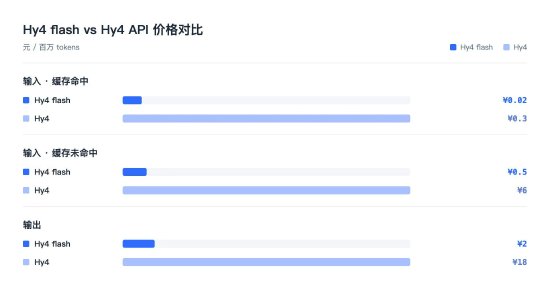
On sticker prices, Tencent quotes 0.5 yuan per million input tokens, 2 yuan per million output tokens and 0.02 yuan on cache hits, while an independent tracker lists about $0.07 per million input tokens. Treat those as list prices rather than the full story. Per-task cost is the number that matters, and that is what WorkIndex was built to measure.
How much cheaper is Hy4 flash, really?
Bottom line: dramatically cheaper on office-style tasks, but only inside the specific comparison Tencent ran. WorkIndex is an internal benchmark assembled from typical WorkBuddy jobs and scored alongside human ratings on output quality, single-turn length and end-to-end time, rather than on a public leaderboard.
| Model | Parameters | Cost per task (WorkIndex) | Best fit |
|---|---|---|---|
| Hy4 flash | 224B total / 12B active (64B Engram) | Baseline | High-volume office work, tight budgets |
| Hy4 preview | 770B total / 49B active | 13x Hy4 flash | Where maximum capability is worth paying for |
| Hy4 | Not detailed in the cited release | 20x Hy4 flash | Flagship workloads |
| DeepSeek-V4.1-Flash-1027 (Max tier, peak-hour pricing) | Not stated in the comparison | 8x Hy4 flash | Cross-vendor reference point |
Read the ratios carefully: Hy4 flash costs 1/13 of Hy4 preview per task, 1/20 of Hy4, and 1/8 of DeepSeek-V4.1-Flash-1027 at its Max tier and peak-hour pricing. The same evaluation says its overall result is slightly better than Hy4 preview's despite the 770B-versus-224B gap in total parameters. The less quoted number is speed: decoding above 150 tps is what keeps a cheap model usable when a lot of people hit it at once.
Is it any good in real work, or just cheap?
Short answer: the human data is more interesting than the benchmark, though it is still vendor-run. TMTPost reports that Tencent recruited 85 WorkBuddy users to blind-rate outputs across 27 categories and 259 everyday tasks; satisfaction came close to Claude Haiku 5.5, with Hy4 flash posting the shortest end-to-end time among the models compared. One account puts the satisfaction gap at 0.02 points.
That is a real signal for a value model, and it fits the engineering story: shorter outputs and a smaller cache should show up as faster completion. It is also an internal user panel, not an independent audit. Treat it as directional evidence, then run your own documents through the model before moving a workflow.
Tencent's own framing is explicit: the Hunyuan research page calls Hy4 flash 'our most cost-effective Hy model to date'. That is a claim, not a verdict. The verdict comes after the trial.
Who should switch, and who should wait?
Recommendation: switch if you pay per token or per task for repetitive office work; wait if you need the absolute ceiling of model quality or guaranteed depth on long documents.
- High-volume teams: if slides, docs and spreadsheets are the daily grind, the 1/13-per-task math is hard to ignore.
- Developers on a budget: Tencent Cloud TokenHub's API is 50% off for a limited time, which suits a pilot better than a permanent architecture decision.
- Existing Tencent users: Hy4 flash is already live in WorkBuddy, Yuanbao, WeCom, QQ, ima and Marvis, so no migration is needed to try it.
- Gateway shoppers: OpenRouter integration is coming; if you prefer a neutral router, that is the moment to test rather than today.
- Free-window watchers: WorkBuddy offers limited free use through November 30. Put it on the calendar.
What do people get wrong about cheap AI models?
- Myth: low price means low intelligence. WorkIndex says the opposite on a narrow, office-focused task set: slightly better than Hy4 preview. Narrow, but real.
- Myth: per-token price tells you the bill. Output length and cache hits can move real cost more than the headline rate, which is why the 50% output-length cut matters.
- Myth: blind tests settle the argument. 85 internal users are a signal, not a census. Independent results and your own samples still win.
- Myth: the discount is forever. The 50% off TokenHub pricing and the WorkBuddy free window are time-limited by definition.
For a wider view of AI in office settings, our case file on Anthropic's Claude business push covers the same productivity question from a competitor's side.
FAQ: quick answers
Is Hy4 flash actually free?
Not permanently. WorkBuddy offers limited free use until November 30, and Tencent Cloud TokenHub's API is 50% off for a limited period. Normal rates apply afterwards.
Is it better than Hy4 preview?
On Tencent's WorkIndex it is slightly better overall, at 1/13 the per-task cost. That is an internal benchmark, so treat 'slightly better' as a claim to verify on your own tasks.
What does 150 tps mean for me?
It is decoding speed, measured in tokens per second. Above 150 tps means text streams out fast enough that, for short office outputs, waiting is rarely the bottleneck.
Does it handle images and long files?
Yes. Tencent lists multimodal support and a 1M-token context window, so long documents with visual material are within scope, though worth testing on your own files.
Where can I use it?
WorkBuddy, Tencent Cloud TokenHub, Yuanbao, WeCom, QQ, ima and Marvis today; OpenRouter is next.
What to watch next
The thing to watch is not the next benchmark but the price curve. If Hy4 flash really delivers near-preview quality at a fraction of the per-task cost, rivals will answer with value tiers of their own, a dynamic we tracked in our comparison of Gemini 4 Carbon, Fable 5.2 and GPT-6 Astra. The open question: when the same practical capability gets 13 times cheaper, does 'good enough' become the rational default for office work, or do we still reach for the biggest model out of habit?