
Tape vs. HDD vs. Cloud: What Fujifilm's Biggest LTO Bet in Nearly 20 Years Means for Your Storage Bill | MyTechDailyNews
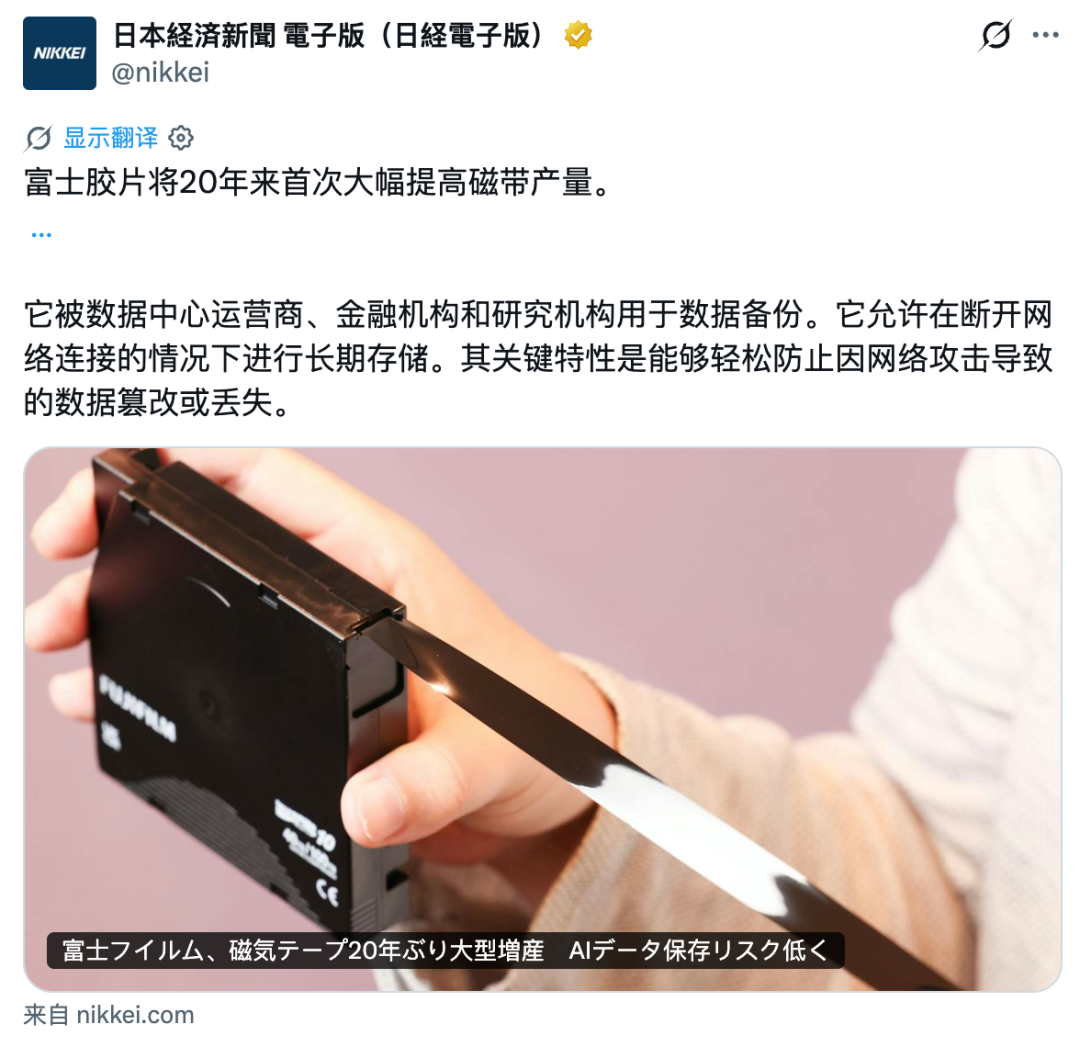
Short answer: tape wins for cold archives, spinning disk wins for warm data, and the cloud wins only when you would rather rent shelves than own them. Fujifilm is putting money behind that verdict with its largest LTO tape capacity investment in nearly 20 years, because generative AI has left companies sitting on mountains of data nobody dares delete but almost nobody opens. Here is how the three options stack up on cost, speed, safety and lock-in.
What changed: AI filled a storage tier nobody was planning for
The change is not that new media got better; it is that one old tier of the storage hierarchy suddenly got enormous.
There is a running joke in computing. Computer scientist Andrew Tanenbaum once quipped that you should “never underestimate the bandwidth of a station wagon full of tapes hurtling down the highway”. It sounds absurd — until the transfer reaches petabyte or exabyte scale, at which point putting storage on a truck can genuinely beat a network link.

In 2016, Amazon's AWS launched Snowmobile, a service that hauled storage inside heavy trucks and could move as much as 100PB in a single trip. What it carried were drives rather than tapes, and the service was retired in 2024 — but the underlying engineering headache it exposed has only grown.
Generative AI sharpened it. Training a model depends on GPUs, HBM and fast SSDs. When the training run ends, what remains behind is far bulkier than the model itself: raw corpora, cleaned datasets, training logs, checkpoints and every historical version produced by relentless iteration.
According to Fujifilm's description, the spending goes to facilities dedicated to LTO tape, and the scale is the largest in nearly 20 years; the trigger is archive demand created by generative AI. Reporting by Nikkei Asia puts the figure at roughly ¥10 billion for a Kanagawa plant build-out aimed at lifting shipped capacity to five times the fiscal 2025 level by fiscal 2028, and the company's own release describes it as holding the top global share of the magnetic tape market.
The macro numbers underline how little room there is to improvise. IDC's Global DataSphere outlook, cited by Western Digital in September 2026, puts worldwide data generation at 274 zettabytes in 2026, climbing past 718 zettabytes by 2030. In other words, the debate is no longer whether AI will scale — our breakdown of which AI bottleneck matters most covers how memory, power, data centers and financing now set the pace — it is whether the archive layer beneath it can be bought at a sane price.
Where does tape sit in the storage hierarchy?
Conclusion first: tape belongs at the bottom of the pyramid — the cheapest place to park bytes you may open once a decade, never the place for live queries.
| Data state | Best home |
|---|---|
| Actively participating in computation | High-speed storage (SSD, HBM) |
| Large datasets accessed often | Mechanical hard drives |
| Untouched for months or years, yet not safe to delete | Long-term archive system (cold data) |
Consider a concrete case. Once an AI company ships a new model, the previous dataset has no immediate job, yet reproducing an experiment, retraining from scratch or satisfying a compliance audit may require pulling it back into service.
That raises the uncomfortable budget question: should every disk in the fleet stay powered, cooled and maintained to serve files that may not be opened for a decade?
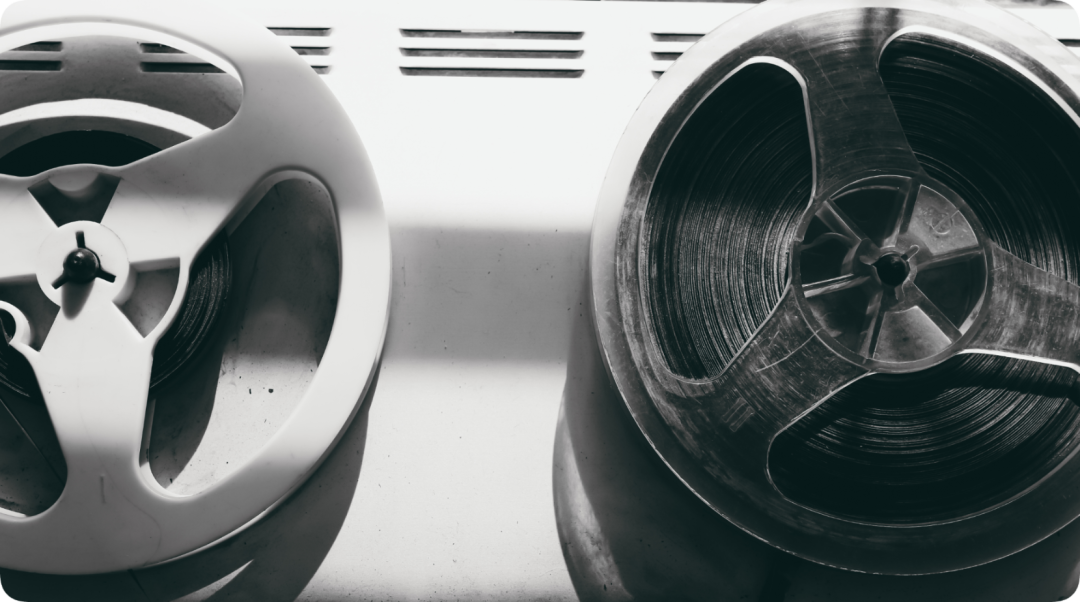
Why tape beats disk and cloud for long-term archives
On the two variables that dominate archive budgets — energy and time — tape is difficult to argue with.
- Cheap and quiet. Cartridges sleep offline. No standby power, no cooling loop, no live array maintained for a decade.
- Harder for attackers to reach. A cartridge can be removed and stored away from the network; even if ransomware wipes the servers, a physically isolated copy survives.
- Faster than the stereotype. An LTO-10 drive reaches raw sustained transfer rates up to 1200MB/s, and automated libraries load media with robotic arms instead of humans.
Fujifilm's own modelling makes the case bluntly: retaining 100PB for a cycle of ten years under a defined setup, an automated tape system cuts total cost of ownership by about 86% and carbon emissions by about 95% compared with an all-hard-drive design.
Third-party comparisons point the same way, though they should be read as vendor and reseller estimates rather than audited prices: LTO media is commonly quoted around $5 to $7 per TB versus roughly $15 to $30 per TB for enterprise disk, and cartridges are rated for up to 30 years of shelf life in controlled conditions (about 16–25 °C and 20–50% humidity), while enterprise drives are typically retired after a short service life. The media-lifespan figures come from tape-industry technical guides at tapebackup.org and StorageDNA.
The catch is access pattern. Tape searches sequentially, so retrieving one random file can take a long time, which rules it out for frequent reads and real-time jobs. If the SSDs in an AI data center behave like an on-call engineer who answers at any hour, a tape library is a vast, low-cost warehouse you visit by appointment.
Science adopted this arrangement long before AI did.
In December 2025, the European Organization for Nuclear Research (CERN) announced that the Large Hadron Collider had accumulated 1EB of stored experimental data — the equivalent of 1 million TB — with most of it resting on roughly 60,000 cartridges.
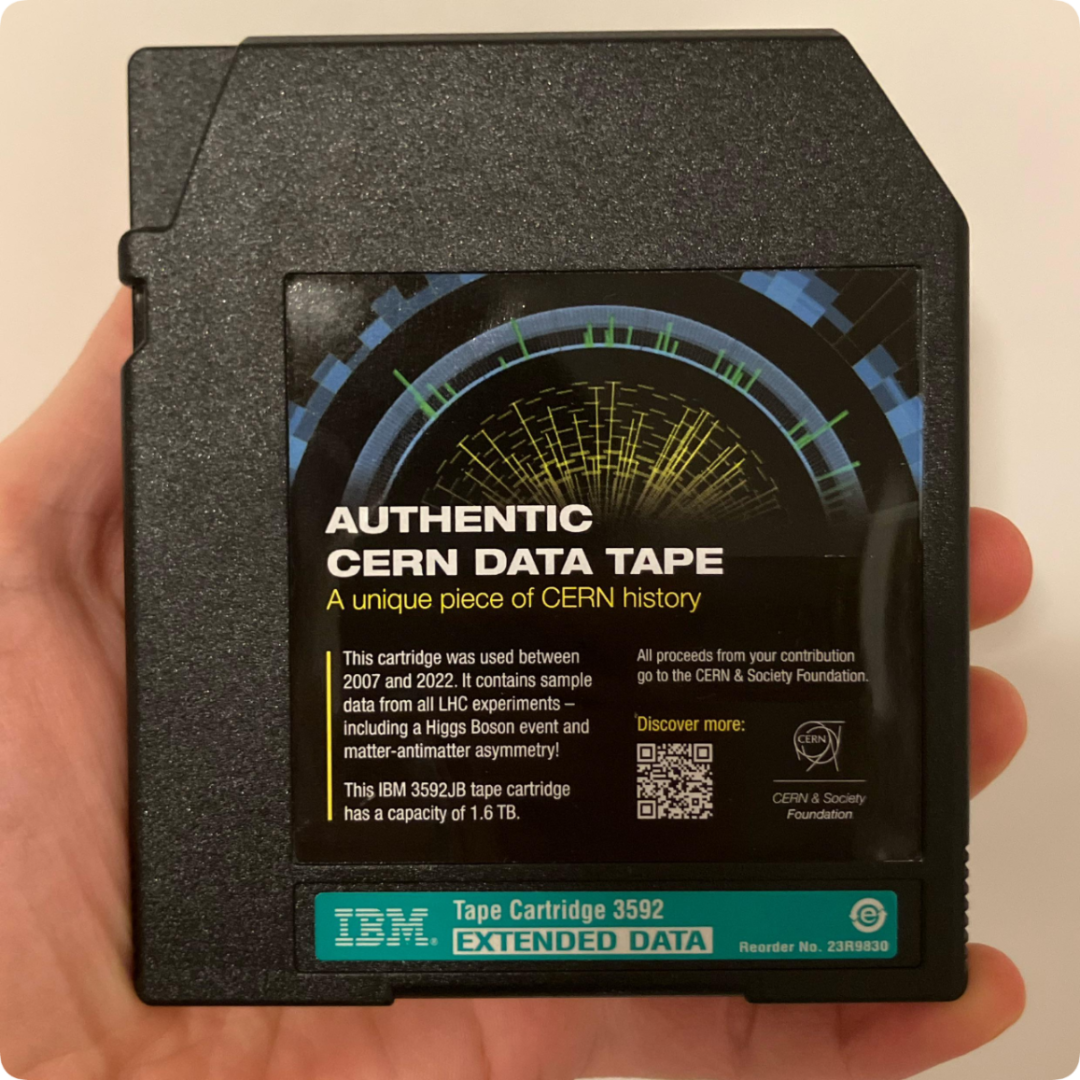
Data gathered decades ago can regain value the moment a new theory appears. CERN expects the volume it needs to store and process over the next decade to reach about ten times everything it had accumulated up to that point.
The identical logic governs the historical corpora, training records and model backups that AI companies now hoard.
Market data confirms the trend rather than just the rhetoric. According to figures released by the LTO Consortium in September 2026, global LTO tape shipped capacity hit a record 176.5EB in 2024, growing 15.4% year on year; 2025 eased back but still reached 160.3EB. In the first quarter of 2026, with LTO-10 shipping and archive demand climbing, worldwide tape shipped capacity grew 57% year on year. That statistic measures the storage capacity supplied, not the number of cartridges sold.
How much does a single LTO-10 cartridge actually hold?
The reason tape is back in the conversation is a density curve that consumers stopped watching.
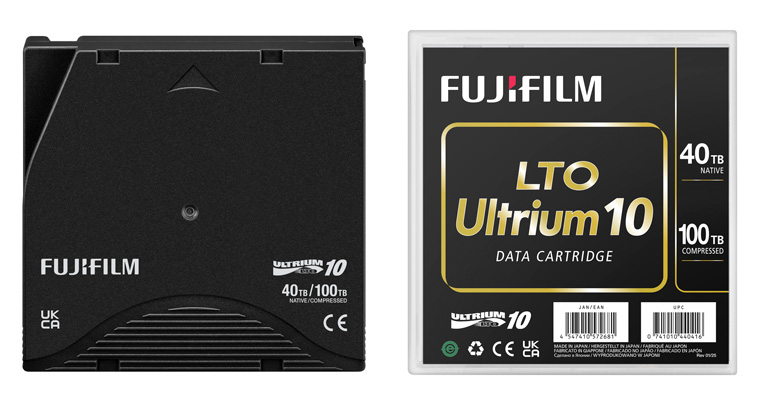
In June 2025, Fujifilm introduced the LTO-10 30TB data cartridge; that same December it announced a 40TB version, with supply beginning in 2026. The current product carries 40TB of raw capacity, and at an ideal 2.5:1 compression ratio the theoretical figure reaches 100TB.
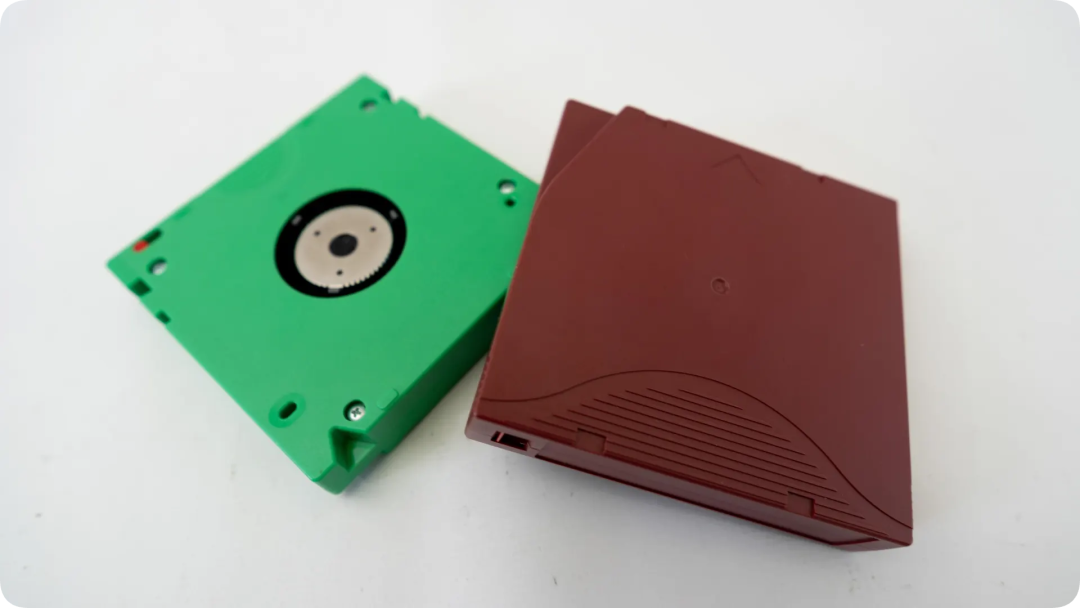
Shown: the LTO-10 30TB cartridge.
Against that, the first-generation LTO cartridge launched in 2000 offered only 100GB. In 26 years, capacity per cartridge rose 400 times. One qualifier matters for budgeting: 100TB is a compressed, ideal-case number. Already-compressed video, images and model weights will not get there.
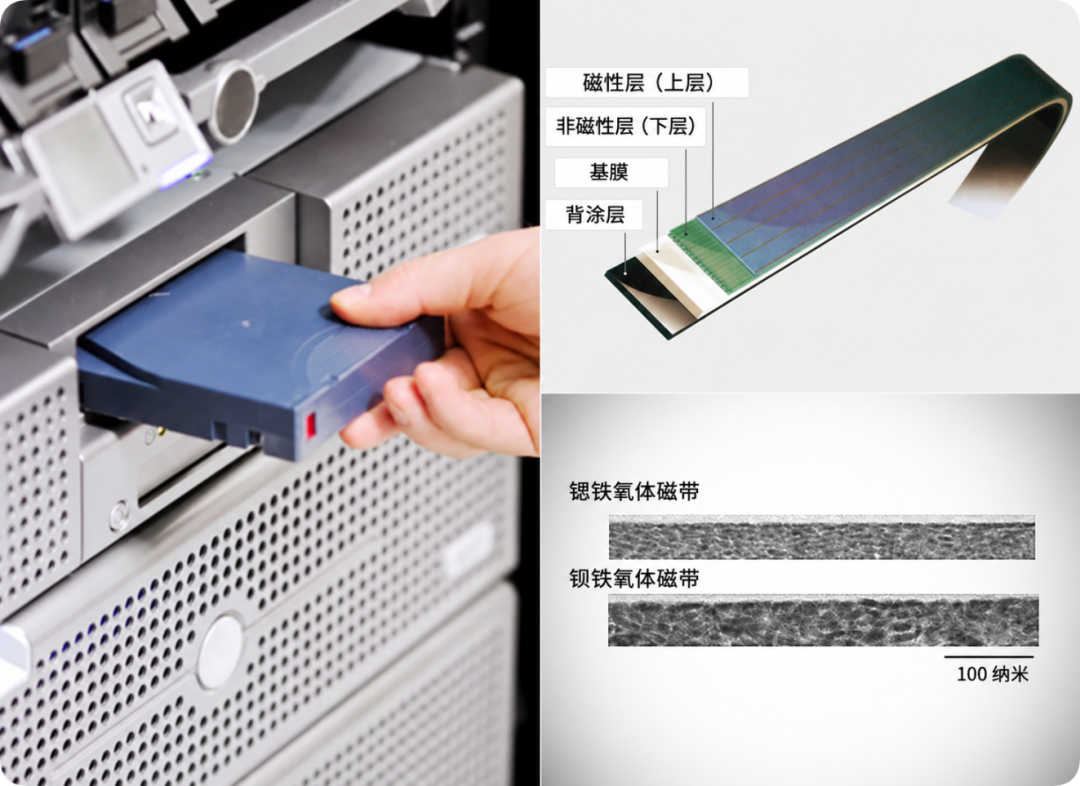
The packaging is the more surprising part. An LTO-10 cartridge measures about 10 cm on a side and 2.15 cm thick, yet contains 1337 meters of tape — more than three laps of a standard athletics track. To fit that length into such a small shell, Fujifilm used aramid film and new thin-layer manufacturing to bring total tape thickness down to 4 micrometers, alongside ultra-fine magnetic particles combining barium ferrite and strontium ferrite technology to raise bits per unit area.
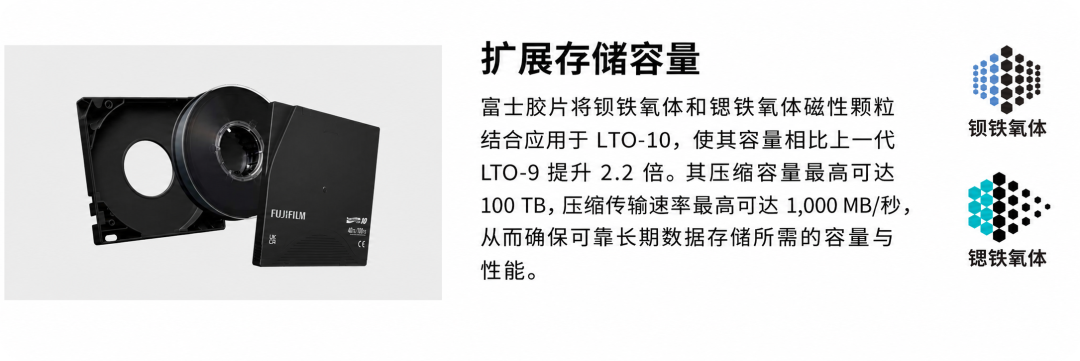
How the bits are written, and where the ceiling sits
The recording principle descends directly from the audio cassettes of decades past: microscopic magnetic particles coat the surface, the head flips local magnetisation to write, then senses field changes on read-back and reconstructs the data through decoding and error correction.
Modern LTO media uses linear serpentine recording — picture a highway with tens of thousands of lanes. The head writes a group of tracks end to end, shifts position and writes back in the opposite direction. The latest LTO-10 format carries 15104 data tracks, and a drive reads or writes 32 tracks at once, leaning on finer materials and servo control to keep pushing density.
The runway is not exhausted. In 2020, IBM and Fujifilm demonstrated 317Gb of magnetic recording density per square inch in a laboratory, showing that a single cartridge could eventually hold 580TB — 14.5 times today's 40TB commercial product.
That 580TB remains a lab demo; commercialisation is a long way off.
Compatibility is the cost nobody budgets for
Media longevity is not the same as readability. Tape can survive many years, but tomorrow's drive may not speak yesterday's format: the newest LTO-10 drive reads and writes only LTO-10 cartridges, so operators must keep aging hardware alive or migrate history onto new media on a schedule.
For a data center managing tens of thousands of cartridges, migration, verification and drive maintenance are real line items.
Even with those caveats, tape stays aggressively competitive on cost and energy at archive scale — and the precision coating, film and magnetic-particle expertise Fujifilm built over the past few decades has found fresh commercial value in the AI era.
Tape vs. HDD vs. SSD vs. cloud: the trade-off matrix
Use this matrix the way you would use any comparison review: pick by access frequency first, price second, and risk tolerance last.
| Option | Shines when | Goes wrong when | Cost behaviour |
|---|---|---|---|
| LTO tape | Data is touched rarely, retention runs for years, copies must be offline | Someone needs one small file back in minutes | Lowest per-TB media price; power and cooling near zero while idle |
| Mechanical hard drive | Large datasets are read often and must stay online | Volumes keep growing faster than the refresh budget | Mid-range per TB; steady electricity, spares and rebuild costs |
| SSD / HBM | Active training and inference demand high random performance | The data is cold and nobody objects to waiting | Highest per TB; buys speed, not capacity |
| Cloud archive | Volume is unpredictable and you want no capital outlay | Retention stretches out and retrieval fees start to bite | Rent that compounds for as long as the data exists |
Are mechanical hard drives the losers in this story? Not yet
The verdict: no. The same AI appetite that revived tape is also stretching disk far past what the consumer market implied.
This past January, Western Digital disclosed that essentially all of its hard-drive output capacity for the 2026 calendar year was sold out, with long-term supply agreements from several large customers already reaching 2028.
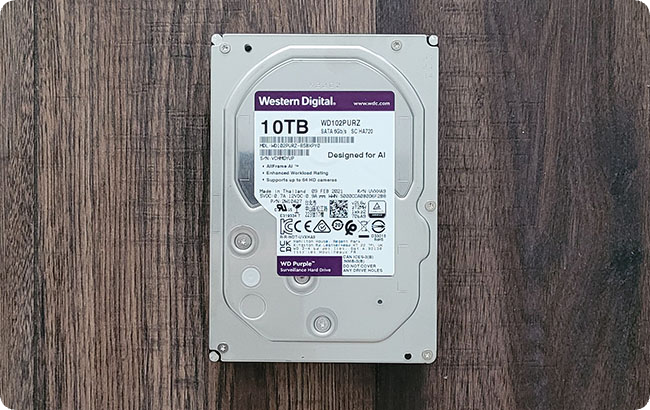
Seagate's position is even more extreme. On the earnings call in late October, the company said most of its nearline hard-drive shipped capacity had been allocated under long-term agreements through 2028, and that procurement contracts with some cloud providers extended as far as 2030.
Notably, it is not only volumes climbing — hard-drive prices are rising too. The explanation is simple: SSDs dominate on random read and write, yet for cloud operators that must keep enormous amounts of data online, disk still wins on cost per TB. As AI expands and training sets, model files and generated outputs pile up, a data center needs not just faster flash but drives that can supply tens of PB and hundreds of PB at a defensible price.
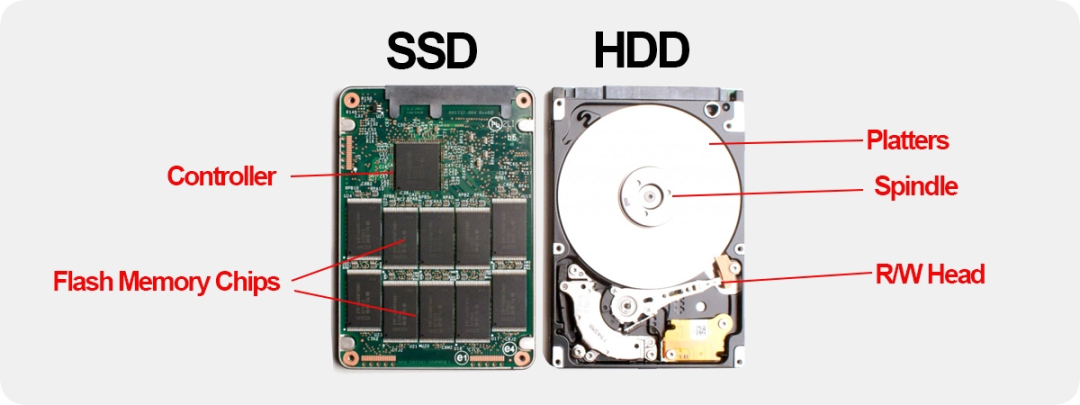
Hard drives keep their own tax, of course: as single-platter capacity grows, random-access ability does not improve proportionally, and rebuilding a failed large drive takes longer than the older, smaller generations it replaced.
For cloud operators the test is pragmatic — if cost, capacity density and access performance all clear the bar, disk remains worth buying.
Old media, new demand: the same playbook spreading across components
Read the announcements together and a pattern emerges: Fujifilm declaring a fivefold expansion in tape capacity, Western Digital effectively sold out for the year, Seagate signing disk supply agreements into 2030. Technologies that faded from the consumer spotlight have found growth by serving AI data centers — a rotation also visible in our review of Macronix leaving ROM to chase flash margins.
The strategic lesson for buyers is uncomfortable but useful: pricing leverage is shifting to suppliers of boring components, so multi-year commitments increasingly decide whether you get capacity at all.
Could glass or another medium replace tape?
Tape's future challenger may be a slab of glass.
In February 2026, Microsoft Research published the latest Project Silica results in Nature. Using femtosecond lasers to inscribe data inside glass, the team stored 4.8TB in a piece roughly 12 cm square and 2 mm thick. Accelerated ageing tests led researchers to project that the data could survive more than 10,000 years.
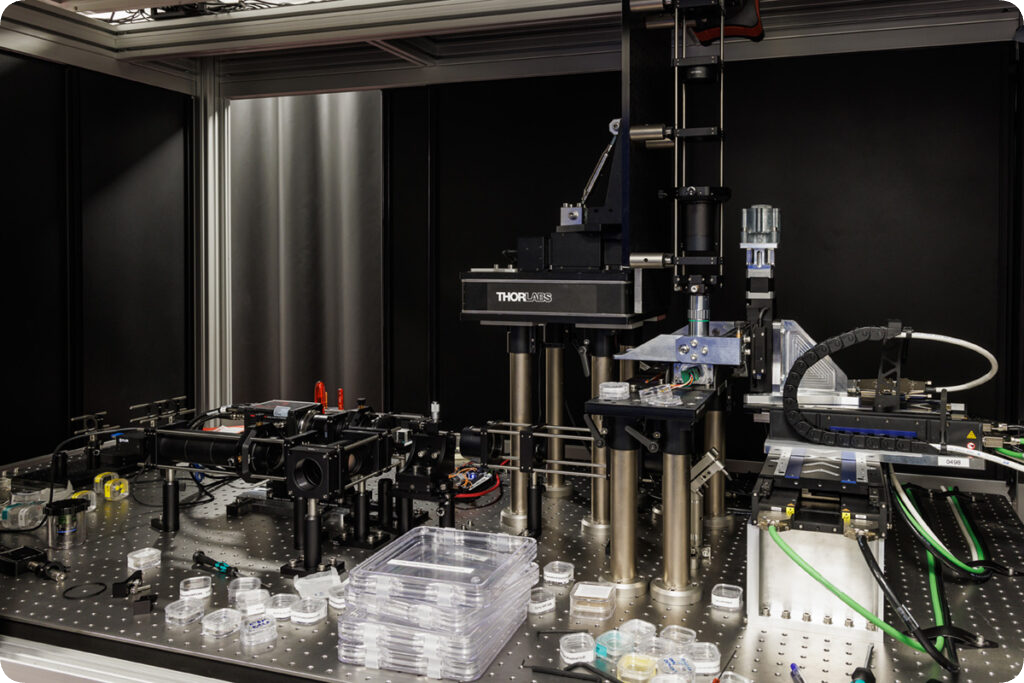
Mass commercial deployment is still distant, but Microsoft has shown a second route to deep archive.
The resulting picture of AI-era storage is oddly poetic. On one side, Fujifilm is still refining a magnetic-powder coating process inherited from decades of film manufacturing so that a small shell can hold tens of TB. On the other, researchers are etching information into glass the way ancient people carved it into stone.
While the world chases bigger GPUs and smarter models, the technologies responsible for simply remembering everything are having their own boom. The windfall is not reserved for newcomers; it also rewards old crafts that found a place in a new cycle.
Which storage should you choose? Three buyer profiles
- Training-set owners and research labs. If datasets will be revisited only for retraining or audits, buy tape from day one and keep one warm copy on disk for active work.
- Mid-size companies under compliance obligations. Tape plus an offline rotation is usually the cheapest defensible answer to retention rules and ransomware exposure.
- Teams with spiky, unpredictable volumes. Cloud cold tiers still make sense for bursts — just model retrieval fees and a multi-year total cost, not the headline monthly rate.
Common misconceptions about tape storage
- “Tape is dead.” Global shipped capacity of 176.5EB in 2024 and 57% year-on-year growth in the first quarter of 2026 say otherwise.
- “Tape is always slow.” Sequential streaming at up to 1200MB/s is respectable; the penalty is seek time for randomly scattered files.
- “Compression doubles everything.” The 2.5:1 ratio that turns 40TB into a theoretical 100TB does not apply to data that is already compressed.
- “Buy once, read forever.” Drive compatibility, not media decay, is often what forces a migration of decades-old cartridges.
Action checklist before you renew a storage contract
- Tag every dataset by last-access date and legal retention requirement; anything untouched for months is an archive candidate.
- Model a ten-year total cost for tape, disk and cloud, including power, cooling, spares and retrieval fees.
- Confirm your library can read the cartridges you will still own years from now, or budget for migration.
- Keep at least one offline copy isolated from the production network as ransomware cover.
- Lock supply early: with capacity committed into 2028 and beyond, late purchasers risk both queues and price.
Frequently asked questions
Why are tape sales rising if tape looks obsolete?
Because idle bytes are the fastest-growing category in AI. Corpora, training logs and model checkpoints rarely get read but rarely get deleted, which is exactly the workload LTO is built for.
How much data fits on one LTO-10 cartridge?
40TB raw from the current product, or a theoretical 100TB at 2.5:1 compression; already-compressed media will land below that ceiling.
Is tape safer than cloud backup?
It is safer in one specific way: a removed cartridge is air-gapped, so an intrusion that reaches live servers cannot touch it. Cloud archives, by contrast, remain reachable through the same credentials attackers target.
Does Fujifilm's expansion mean prices will fall?
Not in the near term. A fivefold capacity build takes time to come online, and the same demand surge has disk suppliers booking capacity years out. Treat this as an analytical view of supply tightness rather than a forecast.
Sources and further reading
- Nikkei Asia, “As AI revives magnetic tape, Fujifilm plans biggest buildup in two decades” — https://asia.nikkei.com/business/technology/artificial-intelligence/as-ai-revives-magnetic-tape-fujifilm-plans-biggest-buildup-in-two-decades
- Fujifilm news release via Business Wire, “Fujifilm to Increase Production Capacity by 5x for Magnetic Data Storage Tape” — https://www.businesswire.com/news/home/20261030239604/en/Fujifilm-to-Increase-Production-Capacity-by-5x-for-Magnetic-Data-Storage-Tape
- Western Digital blog citing IDC's Global DataSphere forecast, “AI Data Management at Scale” — https://blog.westerndigital.com/ai-storage-infrastructure-idc-research/
- tapebackup.org, “How Long Do LTO Tapes Last? Lifespan and Storage” — https://tapebackup.org/why-tape/lto-tape-lifespan
- Storage Review, “LTO Tape Shipments Up 57% in Q1 2026” — https://www.storagereview.com/news/lto-tape-shipments-up-57-in-q1-2026-as-ai-and-archive-demand-accelerate