
Can a Cheaper Spectral Camera Catch Crop Disease Before You Can? A MyTechDailyNews Practical Guide
What if your tractor could flag a sick soybean plant before you noticed anything wrong? That is the question researchers at North Dakota State University are exploring. In a greenhouse trial, hyperspectral imaging distinguished sudden-death syndrome infections from healthy plants Twelve days after planting — no visible symptoms yet. The catch is cost: research cameras run tens or hundreds of thousands of dollars. The answer is to identify the few wavelengths that expose a disease and build cheaper multispectral sensors around them.
Sudden-death syndrome is no minor nuisance: it caused more than 21 million bushels of soybean yield loss in the United States and Ontario in 2022, according to the Crop Protection Network, and historical losses generally range from 1 to 25 percent, per Kansas State University Extension. Early detection is what turns a field-wide problem into a targeted response.
What actually happened in the greenhouse?
The setup was simple: soybean seeds in a greenhouse at North Dakota State University, then regular hyperspectral scans. The camera picked up spectral differences several days to roughly a week before the plants showed any visible sign of sudden-death syndrome — and the team says the result still needs field validation.
For Xin "Rex" Sun, who directs the Peltier Institute for Advancement in Agricultural Technology at North Dakota State University, the result shows what is possible when disease is caught before symptoms appear. It points to a genuinely useful tool: a sensor that flags problems early enough for farmers to act before damage spreads.
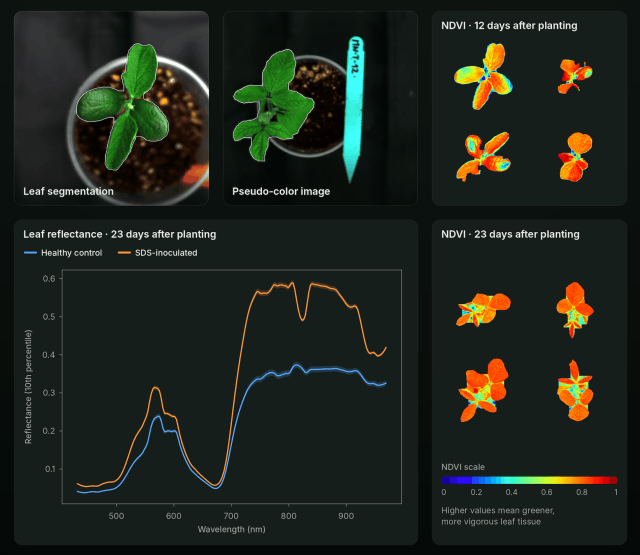
Soybean sudden-death syndrome detection using hyperspectral imaging technology (Source: Rex Sun and Febina Mathew | North Dakota State University)
Why can a few wavelengths replace hundreds?
A standard camera records reflected light in three broad bands: red, green and blue. Hyperspectral imaging splits light into many narrower bands, exposing shifts in a plant's physiology or chemistry that have not yet surfaced in how the plant looks.
Sun's lab recently took delivery of a short-wave infrared (SWIR) camera covering roughly 1,000 to 2,500 nm, with more than 200 spectral bands. For research that is useful, because scientists cannot know in advance which wavelengths will expose the differences they are chasing. A grower dealing with one specific disease, though, may need only a small share of that information.
"That's the beauty of using hyperspectral imaging technology," Sun said. "It's all about selecting the bands."
He sketched a hypothetical case: suppose researchers find that two or three wavelengths reliably separate soybeans hit by sudden-death syndrome from healthy ones. A multispectral camera built around those wavelengths could then replace the far costlier research instrument.
Sun's lab already works with multispectral cameras holding four to 10 bands. Those can cost hundreds or thousands of dollars, rather than the six-figure sums attached to some research-grade hyperspectral systems.
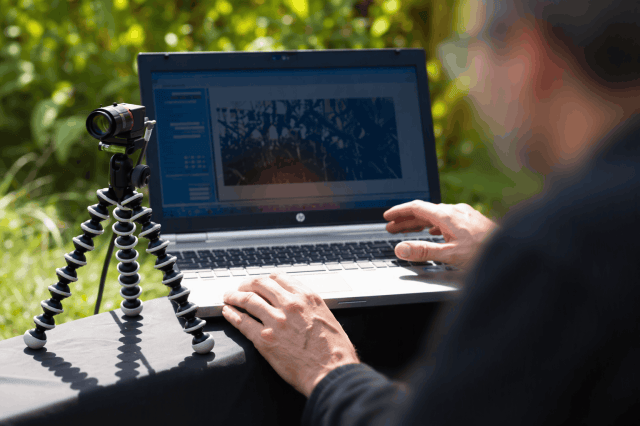
A snapshot multispectral camera used in the field (Source: imec)
What does spectral disease detection really cost?
Economics decide everything here. Hyperspectral cameras can cost tens or hundreds of thousands of dollars, demand specialized expertise and generate very large volumes of data. Without a clear financial return, few farmers can justify that kind of outlay.
| Approach | Bands | Price | Data load |
|---|---|---|---|
| Research hyperspectral | 200 spectral bands or more | tens or hundreds of thousands of dollars | hundreds of gigabytes or more |
| Field multispectral | four to 10 bands | hundreds or thousands of dollars | Light enough for small processors |
| Wafer-level snapshot (imec) | nine, 16, or 25 spectral bands | Falls sharply with volume | Compact single-exposure capture |
"If we can find three or four bands out of the hyperspectral imaging, those small processors can process them," Sun said. "Then it can be fast enough in the field to give you a good result."
How imec prints color filters onto sensors
At imec, the Belgian semiconductor research organization, researchers are working on technologies that could make application-specific spectral sensors commercially practical. Carolina Blanch, a senior researcher on hyperspectral imaging applications, agrees that many uses do not call for the full spectrum.

Imec's Carolina Blanch
"We typically start with high-resolution spectral cameras that capture around 100 bands, then identify which ones are most relevant," she said. "For most applications, 10 or fewer bands are sufficient."
Designing a separate sensor for every crop disease is not necessarily economical. Blanch says imec also develops standardized sensors with nine, 16, or 25 spectral bands, which can serve several applications at once and spread manufacturing costs across larger markets.
Klaas Tack, technical lead of hyperspectral imaging at imec, says traditional hyperspectral cameras rely on separate optical components to split light into wavelengths. imec's alternative is to integrate spectral filters directly with image detectors during semiconductor fabrication.
"We developed a process in our fab where we integrate the filters with the detector," Tack said. "Because we're doing this at wafer level, we're manufacturing many detectors at the same time."
That approach trims components, size, weight and alignment requirements, and enables compact snapshot sensors that capture spatial and spectral information in a single exposure — sidestepping some motion artifacts of scanning cameras. That matters when sensors ride on moving tractors or drones, or when wind stirs leaves during image acquisition.
Manufacturing volume is the remaining hurdle. Fabrication carries substantial upfront costs, but high volumes could drive unit prices down dramatically. Tack points to Spectricity, an imec spinoff targeting smartphone applications with low-cost snapshot multispectral sensors: founded in 2018 and headquartered in Belgium, it unveiled its S1-A accessory — a 15-channel multispectral imaging device — in January 2025, and its S1 sensor spans 400 to 700 nm.
"When the volume is high enough, you can dramatically reduce the cost," Tack said.
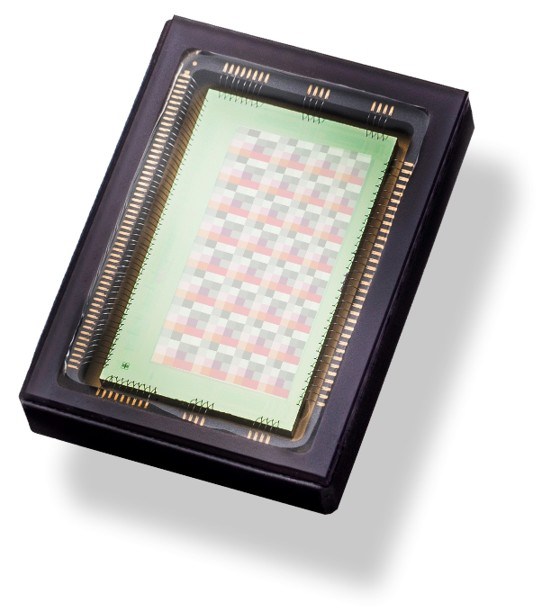
A snapshot multispectral detector with 25 bands organized in 5 × 5 patterns of pixels. Because of the small size of the pixels, the picture shows an artistic impression of this layout. (Source: imec)

Imec's Klaas Tack
Why lab results don't automatically work in the field
Spotting useful wavelengths is only half the battle. Sun warned that disease and other stresses can produce similar spectral shifts, especially before symptoms become visible, and changing sunlight, soil conditions and other environmental factors also affect measurements.
To build models that hold up outside controlled experiments, his team has been gathering agricultural imagery under varied conditions. It has not yet established a sufficiently validated set of wavelengths for field diagnosis of soybean sudden-death syndrome.
Not every application will gain equally from cheaper, silicon-based sensors. Some diseases and stresses show up in visible and near-infrared wavelengths; others are better served by SWIR measurements, which reveal extra detail about plant chemistry and water-related stress — but SWIR detectors remain more expensive than conventional CMOS sensors, and Tack said integrating spectral filters with them is more complicated.
Common mistakes to avoid before you spend money
- Buying a research-grade hyperspectral camera for routine scouting — the tens or hundreds of thousands of dollars price tag is hard to recover on one disease.
- Assuming more bands always mean better detection; for a single disease, two or three wavelengths may be enough.
- Ignoring the SWIR premium if your target disease needs short-wave infrared.
- Skipping ground-truth validation; a greenhouse model can fail under changing sunlight and soil.
- Forgetting the data burden — hundreds of gigabytes or more of hyperspectral data need real processing power.
Should you buy now? A practical checklist
- Define the disease first; a soybean sudden-death syndrome sensor is not automatically a sensor for everything else.
- Do the payback math — with SDS losses historically ranging from 1 to 25 percent, even a partial early-warning win can justify hundreds or thousands of dollars, but not six-figure sums.
- Start with four to 10 bands; multispectral cameras in that range cost hundreds or thousands of dollars and handle many visible and near-infrared cases.
- Validate on your own fields; ask vendors for local trial data, not just greenhouse results.
- Watch the timeline; Sun expects significant progress over five or six years, but field validation remains essential.
"If you're a farmer, you need to think twice," Sun said of investing in an expensive hyperspectral system. "If I spend that much money, I want to know how soon I get my money back."
For Sun, the bigger challenge is turning spectral measurements into reliable decisions. His team is developing a field-based platform that could carry sensors through crops, diagnose problems and eventually support interventions — replacing expensive laboratory analysis with affordable sensing and processing on agricultural machinery.
Tack believes the underlying visible and near-infrared sensor technology is already available to application developers, though he cannot predict when agricultural products will reach widespread deployment. "I think today we can provide them with the technology that is required," he said.
So, should you buy? If you manage soybeans at scale, start with a four to 10 band multispectral setup or a contracted drone scan, and treat any six-figure hyperspectral purchase as a research partnership, not farm equipment. If you buy ag-tech, watch the wafer-level sensor makers: when volume arrives, prices drop fast, and affordable disease-specific cameras should follow.
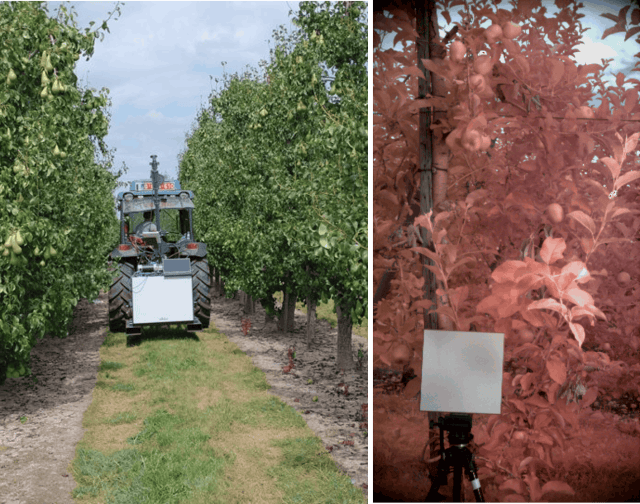
In-field demonstration of a multispectral camera used to detect fire blight in orchards (Source: imec)
FAQ: What farmers actually ask
Does hyperspectral imaging work in real fields?
Not yet at scale. The North Dakota State University results come from a greenhouse, and the team says field validation is still pending. Treat early claims as promising, not proven.
How many bands do I actually need?
For most applications, 10 or fewer bands are sufficient, according to imec's Carolina Blanch. A single disease may need only two or three wavelengths.
What will an affordable setup cost?
Multispectral cameras with four to 10 bands run hundreds or thousands of dollars; contracted drone scouting typically costs $15 to $35 per acre, based on 2025 pricing compiled by Farmonaut.
Sources
- imec, "Spectricity Unveils S1-A Accessory Device for Plug-n-Play Spectral Imaging on Mobile Platforms" (January 2025): https://www.imec-int.com/en/press/spectricity-unveils-s1-accessory-device-plug-n-play-spectral-imaging-mobile-platforms
- Crop Protection Network, "Soybean Disease Loss Estimates from the United States and Ontario, Canada: 2022": https://cropprotectionnetwork.org/publications/soybean-disease-loss-estimates-from-the-united-states-and-ontario-canada-2022
- Kansas State University Extension, "Sudden Death Syndrome in Soybeans": https://www.agronomy.k-state.edu/eupdates/2026/issue-1118-august-27/sudden-death-syndrome-in-soybeans.html
- Spectricity: https://spectricity.com/
By Daniel Lopez, a SaaS product lead and consumer tech reviewer who writes the General column's practical guides for MyTechDailyNews.