
Can an Autonomous Farm Robot Really Work Without You? A MyTechDailyNews Buyer's Checklist
Short answer: only after someone signs for it. “Unattended” is not a toggle in an app. On the machines Naïo builds and the safety researchers review, it is a parcel-by-parcel permission that depends on mass, speed, mapped boundaries and who might wander into the machine’s path. The real product, I came away thinking, is not the robot but the paperwork wrapped around it.
What does “autonomous” actually mean in a field?
Definition first, because catalog copy blurs it: the interesting variable is not steering, it is watching. Matthias Carrière, Naïo’s managing director, draws the line plainly. “When we talk about autonomy, we mean work without supervision,” he told EE Times.
Two very different commitments live under that one word:
- Supervised — the robot plans and works crop rows on its own, while a named person stays close enough to intervene.
- Unsupervised — the robot runs a mapped parcel with nobody on site, inside conditions the manufacturer has assessed and formally approved.
Naïo’s two platforms straddle both sides of that line: Oz, a small robot for vegetable growers and other specialist crops, and Ted, which rides over vineyard rows, mainly for mechanical weeding.
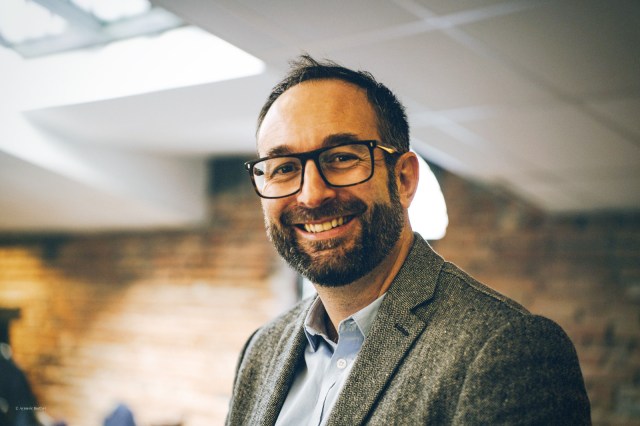 Naïo’s Matthias Carrière
Should you bring Oz onto your farm? The profile, in numbers
Out of the crate, the number that matters most is the one nobody advertises: what kind of farm the machine assumes you have.
| What you are really buying | Oz, as specified | Why it matters |
|---|---|---|
| Farm size fit | Vegetable farmers and seed producers, usually on farms of 1–20 hectares | Small plots make boundary mapping tractable; big open fields do not |
| Mass | about 150 kg | Sets stopping distance and the injury math of any encounter |
| Travel speed | below 2 km/h | Slow motion buys time that sensors and bumpers cannot |
| Day rate | roughly half a hectare a day | Compare this with your crew, not with a demo video |
| Guidance | GPS with real-time kinematic positioning; Naïo’s product page also lists GNSS RTK, up to 8 hours per charge and a five-year warranty | Centimetre guidance is what lets a tool pass within inches of a crop |
| Jobs beyond weeding | Originally built for weeding; also supports sowing, planting and transporting harvested produce | Multi-task use is where the payback actually comes from |
The protection story is old-fashioned, and I mean that as a compliment. A sensitive contact bumper stops the machine when it meets an obstruction. “A very light bump is enough, and it stops on contact,” Carrière said, and he ties that choice to Naïo’s assessment of the robot’s mass, speed and intended operating conditions.
What you do not get is a perception spectacle. “Our robots don’t use AI,” Carrière said. “We prioritize affordability and straightforward operation.”
That candor is worth testing, though, because a bumper is a post-contact device. Whether it is adequate depends on the full risk assessment — movement, task, bystanders — and low speed alone does not prove every possible encounter is harmless.
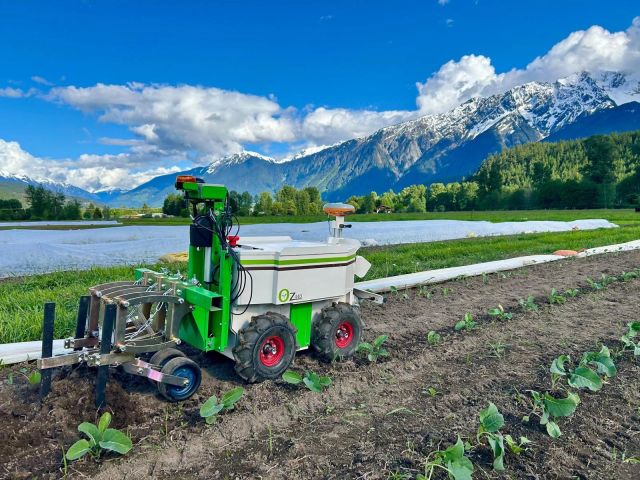 Oz in British Columbia, Canada
Where does a big tractor and a small robot diverge on risk?
Conclusion up front: identical software does not mean identical safety, and the machine’s weight and speed set the conversation.
Salah Issa, associate professor in the Department of Agricultural and Biological Engineering at the University of Illinois Urbana–Champaign, researches agricultural safety, and the corn and soybean production of the U.S. Midwest shapes much of his view. He sees autonomy helping growers expand capacity or improve schedules, but he also points out that a large tractor carries different safety demands from a small robot weeding vegetables or carrying produce beside workers.
“It’s more of the same operation, either doing it with a better life balance or over more acres to expand operations,” Issa said.
In fruit and vegetable systems, a different opening appears: tasks that still depend heavily on manual labour can be automated, which reshapes how people and machines share the workflow. Issa describes produce-carrying robots walking alongside workers and autonomous sprayers moving through orchards.
 University of Illinois Urbana–Champaign’s Salah Issa
The required stopping distance and protective measures for a small robot crawling between vegetable rows are not the ones for a large tractor. Issa says ISO 18497 gives a broad framework while more detailed, machine-specific standards are still needed; the latest version nudges manufacturers toward additional obstacle-detection guidance and leaves live questions — how far from a person should a machine stop? — to application-level rules. The standard has been moving in that direction: the ISO 18497 family was expanded in 2024 into parts covering machine design principles and vocabulary, obstacle protection systems (Part 2), autonomous operating zones (Part 3) and verification and validation methods (Part 4), as listed in a University of California, Davis overview of agricultural robot safety standards published by California’s Division of Occupational Safety and Health.
Which failure modes should you budget for before the first unattended run?
Five, and none of them are exotic.
- The test object is not a person. Obstacle detection is commonly assessed with a two-cylinder test object standing in for a human. Issa notes that other researchers probed how well that translates. “They studied machines trained using the cylinders as stand-ins,” he said. “They found that when the machine operates with real humans, the level of accuracy drops.”
- Fields are hostile to sensors. “Vision systems get dusty. You’re dealing with vibrations, which impact the effectiveness and the longevity of sensors.” Issa therefore favors combining sensor types rather than trusting one technology.
- Nuisance stops invite defeat. Repeated false alarms create a hard engineering problem: protection that obstructs useful work tempts users to disable it. Issa recalled a demonstration in which a manufacturer taped over sensors so a machine could run with people nearby, and worries that frustrated operators do the same.
- Warnings go unheard. People habituate to alerts and stop noticing them, so asking a human to intervene whenever the machine is unsure has a practical ceiling.
- Boundaries are not routing. Following a route accurately and enforcing an approved operating limit are separate jobs. “You must always isolate the loops,” Carrière said, describing a boundary-safety loop mapped independently of everyday guidance.
Naïo tries to design for foreseeable misuse. The robots will not start if required safety devices have been disabled, and even supervised operation makes circumvention awkward: the operator must interact with the remote control every six minutes, confirming somebody remains near the machine. Carrière’s view is that a farmer who deliberately rigs around such a system crosses a line the manufacturer has already anticipated.
What does the robot do when the farm fights back?
Ted is the clearest example of protection interrupting productivity. Vegetation growing beside a vine can trigger its mechanical safeguards, and no software fix is available: someone must investigate and clear the obstruction before unattended work resumes. For context on how the other end of the range is rated, Naïo’s product page puts Ted at up to 6.5 hectares a day with 600 kg of lifting capacity — headline throughput you should discount for the walking-out-and-clearing time.
Before approving unsupervised operation, Naïo also assesses individual parcels. Physical barriers simplify containment, virtual boundaries are used elsewhere, and shared access routes or nearby activity complicate the call.
“You can have all the AI and all the technology in the world,” Carrière said. “If the structure of a farm is not compatible with using a machine, and the farm is not ready to make structural changes, it won’t work.”
That is the sentence I would tape above my desk, because it is the same wall every robot category hits: the gap between a working prototype and an ordinary product people live with. I have watched it play out in consumer robotics — Amazon’s home robot story is the household mirror of a vineyard robot that needs a person to clear a branch.
Who signs when nobody is watching?
Responsibility is written down, not implied. If Naïo decides a robot can operate with no one observing it, Carrière says the company owns that judgment: “It’s Naïo’s management that signs a document saying that, on this parcel, the robot can operate alone; on that parcel, it cannot—it must be supervised. That is how we assume responsibility.”
The assessment leans on what the farmer supplies, including whether an adjoining route is public or private. Users must respect the stated operating conditions; Carrière describes obligations on both sides, with the manufacturer standing behind its assessment and safety systems rather than absorbing every possible liability.
Unknowns still appear once machines are in the field, which is why Issa pushes for learning from near-misses while deployment remains limited. Waiting for a serious accident delivers feedback far too late; unexpected encounters, confusing behavior and moments that make users uneasy expose weaknesses earlier.
“We’re now assuming the machines will respond to our interactions,” Issa said. “Then we change the way we interact based on how we assume the machine does.”
Is the economics argument real, or just a demo?
It is real, but it is a labor-supply story before it is a robotics story. USDA’s Farm Labor Survey released on November 20, 2024 reported that farm operators paid hired workers an average gross wage of $19.11 per hour in the October 2024 reference week, and USDA’s Economic Research Service puts average hourly pay for hired agricultural managers at $30.70 in 2024, up 6.6 percent from the year before. Independent safety research pushes the other way: a 2024 safety risk assessment of an autonomous agricultural machine, indexed in PubMed, concluded that the guidelines in ISO 18497 are not sufficient on their own to guarantee safe operation.
Read together, that pair of facts explains the design philosophy I keep coming back to. You are buying hours of scarce, expensive supervision, and the buyer should demand evidence that the safeguards hold when real people are in the field, not just when foam cylinders are.
What are the common misconceptions?
- “Autonomous means I never go near it again.” It means no one watches while approved conditions hold — approval that is tied to a specific parcel and its access routes.
- “Slow robot, therefore harmless.” Low speed is one input in a risk assessment that also covers mass, task and who might be nearby.
- “More AI means safer.” Detection accuracy degrades with real humans and dusty, vibrating hardware, and Naïo’s answer is deliberately the opposite: fewer moving parts in the software, isolation of the safety loop.
- “The brochure’s daily acreage is my daily acreage.” Clearing a false trip, walking to the field and restarting is real time that no spec sheet counts.
How should a first-time buyer actually approach this?
- Walk your parcels and mark every shared or public access route before you talk to a vendor.
- Ask which parcels the manufacturer would approve for unattended work — and get the signed assessment in writing.
- Request the obstacle-detection evidence: what test object was used, and what happened with real people nearby.
- Count the sensor types, and ask how each is cleaned, re-calibrated and replaced.
- Time one supervised day yourself: how many stops, how many minutes to clear each one.
- Confirm the dead-man logic, including the six-minute remote interaction requirement.
- Price the tasks beyond weeding — sowing, planting, hauling — because that is where utilization climbs.
- Compare the day rate against your crew’s wage and availability, not against a highlight video.
Is it worth buying now?
My honest verdict: if you farm specialty crops in rows — vegetables, seeds, vines — on a bounded parcel where you can describe every public route, yes, a low-speed platform is worth pricing this season, precisely because it is boring. Bumper stops, isolated boundary loops and no AI stack are easier to verify, insure and repair. If you farm broad-acre corn or soybeans in the Midwest and the pitch is a large machine working beside your crew, buy the supervised mode first and treat unattended operation as a later negotiation, not a feature you already own.
What I would not do is pay for sophistication I cannot test. Working alone requires safeguards suited to the application, plus evidence that they keep working once people put the machine to use. As Carrière puts it, “We’re not going to add innovation for innovation’s sake,” and that restraint is exactly the difference between AI everywhere and AI that works.
FAQ
Can an agricultural robot legally work with nobody on the field?
Only where the manufacturer has assessed that specific parcel and signed off on it. Physical or virtual boundaries, public access routes and nearby activity decide the answer, and supervision is mandatory where approval is not granted.
How is obstacle detection tested?
Commonly with a two-cylinder test object as a stand-in for a person. Researchers have found that machines trained on cylinders lose accuracy when real humans are involved, which is why Issa argues for combined sensor types rather than a single technology.
What standard governs these machines?
ISO 18497 provides the broad framework for partially automated, semi-autonomous and highly automated agricultural machinery. Its 2024 expansion into parts covering obstacle protection, autonomous operating zones and verification methods reflects how much application-level detail was still missing.
How fast does a small field robot move?
Oz travels below 2 km/h and weighs about 150 kg, covering roughly half a hectare a day on farms of 1–20 hectares. Speed and mass, not intelligence, are what make that duty class tolerable.
What is the biggest risk for early adopters?
Behavioural, not mechanical: frequent nuisance stops push users toward workarounds such as blocking sensors, and alert fatigue quietly removes the human from the loop.
Sources
- University of Illinois Urbana–Champaign, Department of Agricultural and Biological Engineering — safety research perspective on farm autonomy
- Naïo Technologies, official product pages for Oz and Ted (GNSS RTK navigation, run time, throughput and warranty figures)
- USDA Economic Research Service, Farm Labor topic page — ers.usda.gov/topics/farm-economy/farm-labor
- USDA NASS Farm Labor release, November 20, 2024 — fmla1124.pdf
- California Division of Occupational Safety and Health briefing on agricultural robot safety standards, including the ISO 18497 parts — dir.ca.gov
- Safety risk assessment of an autonomous agricultural machine (2024) — pubmed.ncbi.nlm.nih.gov/40080010