
ChatGPT Pro Account Deactivated Without Warning: A $200 User Recovery Checklist
Recently, when a ChatGPT Pro account suddenly shows account_deactivated, paying users should not guess at a mass ban. First check the deactivation email, use OpenAI's official appeal route, secure payment and API credentials, and export available data. As of publication, reports from November 7 do not prove a single coordinated enforcement wave, and OpenAI has not provided a unified reason.
What happened to the ChatGPT Pro accounts?
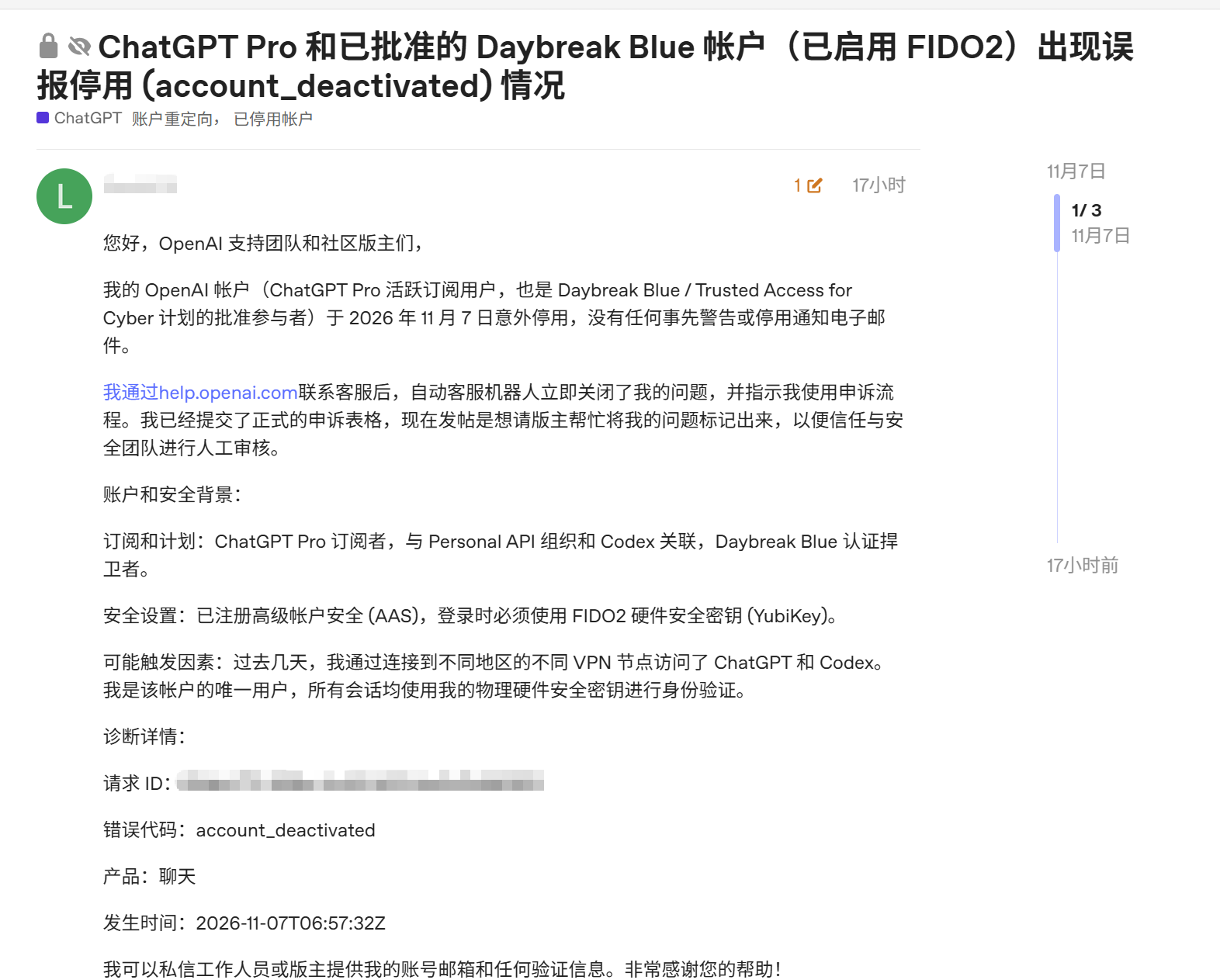
The confirmed details are still case-level, not platform-level. On November 7, a user posted in the OpenAI official developer community that their ChatGPT Pro account had been deactivated that day. The screen showed the error code account_deactivated, but the account did not receive a warning or deactivation email. The user said their monthly subscription cost was $200 and that they had also joined OpenAI's cybersecurity-related access program, with a high-security setting that required a physical security key. They suspected the issue might be linked to their recent use of VPN nodes in different regions to access ChatGPT and Codex; the report made clear that this was only personal speculation.
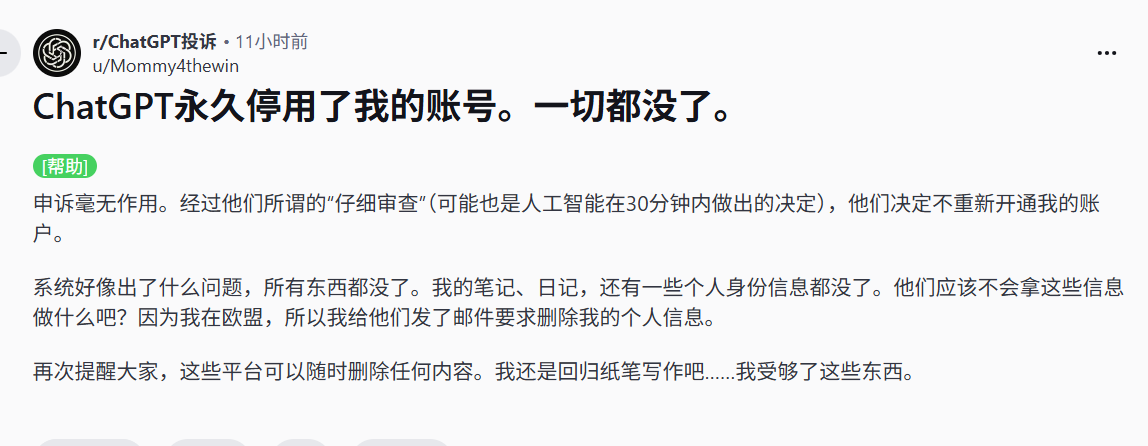
Reddit later carried similar complaints. Another ChatGPT Pro user said the stated reason was suspected association with another account previously closed. That user denied owning or using a second account and said an appeal received a rejection reply about one hour after submission. Another user said a permanent deactivation left an appeal unsuccessful and made notes, diary entries and work material stored inside ChatGPT unavailable. Previously, Reddit had also seen posts collecting recent account-ban examples around different usage-policy disputes.
OpenAI Support account responded in the community thread with a clear but narrow instruction: because specific account information is involved, the issue cannot be handled in public community forums. The reply told users to appeal through the link in the deactivation notification email; if they did not receive email, they should use the official appeal form or the help center. It did not explain the precise reason for the affected account.
Why might a $200 Pro account still be deactivated?
Because paid access does not equal account-level exemption. The OpenAI official Help Center lists categories that can lead to account action, including violating usage policies, bypassing security or access restrictions, improper sharing of account or API keys, account-security anomalies, and incomplete identity verification. The OpenAI official Help Center page on account closures and safety suspensions also frames deactivation as a policy or safety response rather than a billing decision.
Region-related risk is the other line readers should understand without overreading it. A separate OpenAI official Help Center page on unsupported countries and territories says accessing ChatGPT or the OpenAI API from an unsupported country may result in blocking or suspension. However, using VPN nodes from different regions does not automatically prove that a user violated the region rule, and current public reports do not confirm that this was the decisive cause.
Linked-account flags add another layer. If a system identifies a relationship between the current account and another closed account, the affected user may need to prove that the connection is false, outdated, or unrelated to policy abuse. This is difficult when the enforcement explanation is short and the channel is private. Currently, the existing cases do not prove one coordinated mass ban; they show a pattern of user-reported account actions with limited public explanation.
What should a ChatGPT Pro user do immediately after seeing account_deactivated?
- Check the registered inbox, spam folder, and transaction email first. If OpenAI sent a deactivation notice, use the appeal link in that email. If no notice arrived, go to the official appeal form or the help center instead of arguing in a public thread.
- Do not expose private identifiers publicly. Avoid posting the full account email, API keys, organization identifiers, payment details, or screenshots of private chats in Reddit or community forums. OpenAI's public reply says specific account information must be handled through private support channels.
- Start a data-escape plan while the appeal is open. The OpenAI official Help Center article on exporting ChatGPT history and data describes requests for eligible account data. If the normal export path is unavailable after deactivation, include a data-access request in the official support route and keep a written record of what content may be lost. For long-term resilience, keep important notes outside ChatGPT and review fallback paths such as local, open-source multi-agent workflows.
- Audit the four linkage signals: device, payment, sharing, and API keys. Check whether multiple people used the same account, whether the same card or device appears on another profile, whether an API key was reused in bots, relays, or third-party frontends, and whether any security-key enrollment or identity step was incomplete.
- Build one concise appeal file. Attach subscription proof for the $200 monthly plan, account creation or tenure information, security settings such as physical security-key verification, membership in OpenAI's cybersecurity-related access program if relevant, a list of supported-country access attempts, and a statement about shared devices or payment cards. The goal is to reduce ambiguity, not to overload support.
- Avoid workaround behavior during appeal. Creating a new account linked to the same payment method, device, phone number, or organization can make the enforcement pattern harder to separate, even if the original deactivation was a false positive.
Which user groups should be most careful?
| Situation | Why it matters | Practical action |
|---|---|---|
| $200 Pro subscriber | Paid status may prove commercial value, but does not prevent policy or security enforcement. | Document subscription, security keys, and support timeline before appealing. |
| VPN or regional-access user | OpenAI may block or suspend access from unsupported countries, but a VPN node alone is not a confirmed violation. | Check the supported-country guidance and explain travel, work-network, or relay use clearly. |
| Shared seat or household account | Shared credentials can map to improper sharing or account-security anomalies. | Separate payment, device, and API-key use before submitting the appeal. |
| API-key user | Keys can leak into proxies, relays, or resale routes outside the original owner's control. | Rotate keys, review billing usage, and disclose any legitimate integration with Codex or other tools. |
| High-history user | ChatGPT can contain work notes, diary material, project context, and saved conversations. | Export eligible data now, keep manual copies, and request privacy access if login is blocked. |
What are the most common mistakes in deactivation disputes?
- Assuming a Pro subscription guarantees a human review. The public response shows that case-specific account decisions are handled through the appeal route, not community comments.
- Posting the whole account history for sympathy. Private chats and credentials can create additional privacy or security risk and rarely add appeal value.
- Treating every VPN node as a smoking gun. The region rule is real, but the reported VPN cases do not prove that VPN use caused these account actions.
- Ignoring the appeal channel. Users who did not receive email still have the official appeal form or help center path; waiting in public forums delays recovery.
- Leaving no backup outside ChatGPT. If access fails before the appeal succeeds, long-running notes and work context can disappear at the moment they are most needed.
Does this mean OpenAI launched a confirmed mass ban?
No. As of publication, OpenAI has not published a unified explanation for the recent reports and has not disclosed the total number of affected accounts. The available cases cannot prove that all reported deactivations belong to one coordinated enforcement action, and the possibility of false positives still requires further confirmation. The safer interpretation is narrower: at least some users, including a $200 monthly Pro subscriber, saw abrupt account_deactivated errors with limited public explanation, while Reddit and the OpenAI official developer community continued to carry similar reports.
FAQ: what to ask before you appeal
Can a ChatGPT Pro account be deactivated even with a $200 monthly plan?
Yes. User reports from November 7 describe paid Pro accounts deactivated despite the $200 monthly subscription. The public facts do not show a policy that paid users are exempt from security, policy, or identity enforcement.
What does the account_deactivated error code mean?
It is a generic deactivation signal, not a full reason. In the reported cases, it appeared without warning email or with only a brief explanation. The official support channel remains the place to determine whether the account was blocked for policy violation, security concern, sharing, identity verification, region access, or another issue.
How long does an appeal usually take?
There is no public fixed service level in these reports. One Pro user said a rejection came about one hour after submission, while another faced a permanent deactivation and unsuccessful appeal. Timeframes may vary by case and available evidence.
Can users recover saved ChatGPT notes, chats, or work material?
Sometimes, but not guaranteed. The OpenAI official Help Center provides export or privacy-request paths for eligible account data. If the account is deactivated and login is blocked, users should ask through the official support or appeal channel and document the data they need.
Should a user create a new ChatGPT account right away?
Not as a first step. A new account tied to the same payment method, device, organization, or known identity may make the appeal harder to interpret. Complete the official appeal and data-access route first.
For readers using ChatGPT in daily work, the lesson is not to avoid paid AI tools, but to treat them as critical infrastructure: export regularly, isolate credentials, keep evidence of compliance, and build a fallback plan. If your experience differs from the reports above, send an anonymized account-security tip to MyTechDailyNews at hello@techdaily.com.