
MyTechDailyNews General Review: Qwen4-Max vs Qwen3.8-Max — Is the 58% Cheaper Flagship the Right Pick?
Short answer: for long, tool-heavy agent jobs, Qwen4-Max is the better buy — Alibaba reports 48.5 points on Terminal-Bench 4.0 while using 151K tokens per attempt instead of 289K, and 58% less cost per task than Qwen3.8-Max. For quick chat or a spot at the very top of coding leaderboards, the upgrade is less compelling. Here is how I would decide.
Alibaba released the new flagship foundation model in mid-November 2026, positioning it as a cheaper, more efficient engine for real work rather than a chat demo. My angle here is practical: what actually changes for someone already paying an API bill, and where the numbers still look thin.
What is Qwen4-Max, in plain terms?
Conclusion: it is Alibaba's top-end foundation model — 2.4T total parameters, native visual understanding, and a million-token context window (1M context) — built to call tools and carry long, multi-step jobs.
Under the hood it runs a new Mixture-of-Experts (MoE) architecture based on Qwen Sparse Attention (QSA). Only 71B of the 2.4T parameters activate per token, which Alibaba says is 25% fewer activated parameters per token than the previous generation. That is the main reason a bigger model can cost less to run: you are not paying to wake up every parameter on every token.
Is it really cheaper? The numbers side by side
Conclusion: on Alibaba's own measurements, yes — the savings come mostly from using fewer tokens, not only from a lower sticker price.
| Measure | Qwen3.8-Max | Qwen4-Max | Change |
|---|---|---|---|
| Average tokens per attempt, Terminal-Bench 4.0 at Xhigh | 289K | 151K | nearly 50% fewer |
| Score, Terminal-Bench 4.0 at Xhigh | 38.9 points | 48.5 points | nearly 25% higher |
| Activated parameters per token | — | 71B of 2.4T | 25% fewer than prior generation |
| Cost per Task, per Alibaba's evaluation | baseline | — | 58% lower |
| Cache-hit price per million Tokens | — | 0.5 yuan (¥0.5) | new low for the series |
Alibaba's own Qwen blog puts one slice of this plainly: "In our Work360 evaluation, the average cost per task drops from $4.43 to $1.67" — a 62% reduction on an internal work benchmark. Separately, the launch summary says the average spend to finish a single task fell 60% versus the previous generation. Three similar figures, three different scopes: the Work360 result, the 60% general claim, and the 58% Cost per Task drop measured on Terminal-Bench 4.0. I would not blend them into one headline.
On cache hits, the price is as low as 0.5 yuan (¥0.5) per million Tokens (1M tokens) on the Qwen AI platform. For context, Google's Gemini 4 Carbon lists $2 per million input tokens and $10 per million output tokens, with cache reads around $0.10 per million, according to Google AI Studio pricing and OpenRouter. Different currencies and different workloads, so treat that as context rather than a verdict. For a fuller breakdown of that rival, our Gemini 4 Carbon general availability and pricing review goes deeper.
Where does it win, and where does it still fall short?
Conclusion: it is strongest on long-horizon agent work and on cost, but it is not a clean sweep against frontier rivals.
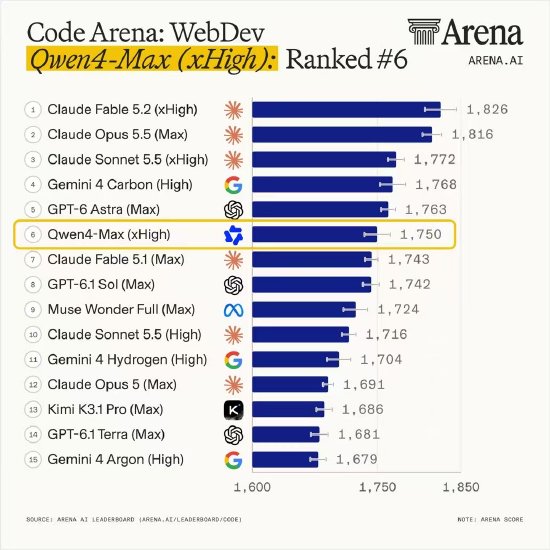
In the global front-end coding blind test CodeArena, Qwen4 ranked sixth. On Agents' Last Exam (ALE) and Vals Index — tests built around agent behavior and specialist tasks — Alibaba places Qwen4 in the leading tier. The company says the series was tuned for real work in automotive manufacturing, game development, financial research and scientific research.
Independent trackers add nuance. Vals.ai currently lists Qwen4-Max at #14 of 42 models with 63.20% on its index, and records a November 15, 2026 release date. VentureBeat framed the launch as an "uneven challenge to frontier rivals." A widely circulated comparison chart, reported by Sina, puts Qwen4-Max at 48.5 on Terminal-Bench 4.0 against Kimi K3.1's 67.2, and at 31.5 on ProgramBench against Claude Opus 5.5's 65. Those are not the numbers Alibaba leads with — which is exactly why I am including them.
Who should switch, and who should stay put?
Conclusion: switch if your bill is driven by long agent runs; wait if you need top-of-board coding scores or local weights today.
- Switch now: teams running multi-step, tool-calling jobs where 289K tokens become 151K and Cost per Task drops 58%. That is a direct margin improvement, not a demo stat.
- Test side by side: if you use Qwen3.8-Max for mixed work, run one real task on each and compare both output quality and spend. The 38.9 to 48.5 points gain is meaningful, but your workload may not match Terminal-Bench 4.0.
- Wait: if you need the top coding slot or self-hosted weights today. Alibaba says smaller and mid-size versions of the Qwen4 family will be open-sourced later, not on day one.
You can reach the model today on the Qwen AI platform and through its API; it is also included in Alibaba Token Plan and available inside Qwen Office, Qoder and the Qwen App. That open-source roadmap matters in a market where 89% of US open-model spend now flows to Chinese models — but if you need weights on your own hardware now, it is still a wait.
What are the common misconceptions?
- "Cheaper means weaker." The measured score went up, not down: 38.9 points to 48.5 points at the same Xhigh setting.
- "Sixth on CodeArena means it is behind everywhere." One leaderboard is one slice; Alibaba places Qwen4 in the leading tier on ALE and Vals Index, while other charts show gaps.
- "0.5 yuan is the price of every token." It is the cache-hit price per million Tokens on the Qwen AI platform, and cache hits depend on your request pattern.
- "One efficiency number settles it." The 62% Work360 result, the 60% general claim and the 58% Cost per Task figure describe different tests.
FAQ
Is Qwen4-Max open source?
Not at launch. Alibaba says smaller and mid-size Qwen4 versions will be open-sourced later; the 2.4T flagship is served through the Qwen AI platform and API.
How much does Qwen4-Max cost per million Tokens?
Cache hits are as low as 0.5 yuan (¥0.5) per million Tokens. Alibaba reports the average cost of a single task fell 60% versus the previous generation, with a 58% Cost per Task drop in its Terminal-Bench 4.0 comparison.
Is Qwen4-Max better than Qwen3.8-Max for coding?
On Terminal-Bench 4.0 at Xhigh, yes: 48.5 points versus 38.9 points using 151K rather than 289K tokens per attempt. On CodeArena, Qwen4 ranked sixth, and other vendors still lead some coding charts.
Where can I try it today?
On the Qwen AI platform and via API, through Alibaba Token Plan, or inside Qwen Office, Qoder and the Qwen App.
What should you do next?
- Log your last month's agent spend and token volume before changing anything.
- Run one real long-horizon task on Qwen4-Max and your current model, and compare both output quality and cost.
- Check what share of your requests hit cache — that decides whether ¥0.5 per million Tokens is realistic for you.
- Re-run the comparison after the smaller open-source Qwen4 versions ship, if local deployment matters.
Reference sources
- Qwen official blog — "Qwen4-Max: Your New Teammate Has Arrived" (November 16, 2026)
- VentureBeat — Alibaba's Qwen4-Max cuts AI task costs, but benchmarks show an uneven challenge
- Vals.ai — Qwen4-Max model index entry
- Google AI Studio — Gemini API pricing and OpenRouter — Gemini 4 Carbon rates
- Sina — report on Alibaba's 16-benchmark Qwen4-Max comparison chart