
Kimi, DeepSeek or Meta Llama: What 89% of US Open-Model Spend Means for Your 2027 AI Budget
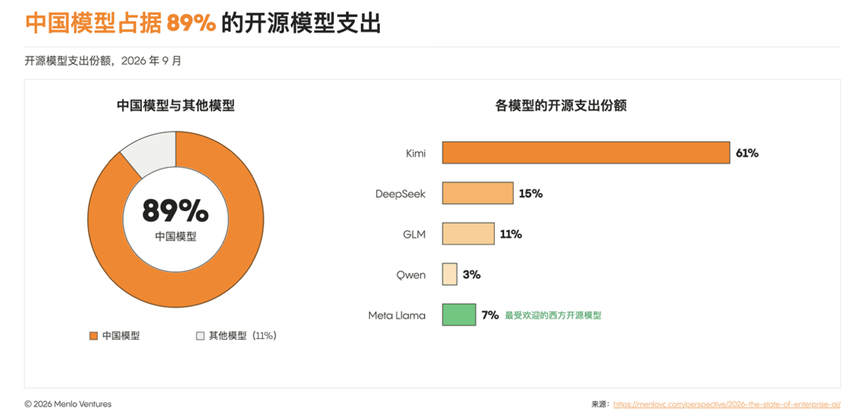
Short answer: if a US company paid for open-source large model calls in 2026, there is roughly a nine in ten chance that money went to a Chinese model. Menlo Ventures' "2026: The State of Enterprise AI", released recently, estimates that 89% of US enterprise open-source model spend went to Chinese models, with Moonshot AI's Kimi alone at 61%. Yet those same models carry 19% of platform tokens while accounting for just 4% of model spending: used everywhere, paid for almost nowhere.
I own model routing for a SaaS product, so I have spent the last month arguing with my own cost dashboard instead of with the headline. My first reaction was arithmetic, not ideology: 89% of a small slice is still a small slice, so who actually needs to change a budget line? Below is my buyer's read — what the survey measures, how the models face off, where the fine print bites, and what I would move.
What did Menlo Ventures actually measure?
Conclusion first: this is a share-of-open-source-spend number, not a scorecard for enterprise AI as a whole.
The Silicon Valley venture firm surveyed nearly 400 US enterprise AI decision-makers whose controlled AI budgets add up to more than $4 billion, then reconciled those answers with a bottom-up market model; the token-share figures draw on OpenRouter volume data plus Menlo's own estimates of model mix. The report is credited to Tim Tully, Joff Redfern, Deedy Das and Derek Xiao, and its framing is unusually direct: as Chinese models define the open-source frontier, they take 89% of open-source spend.
Context matters, because this is not an obscure blog post. Menlo Ventures has been investing for 50 years — it marked its 50th anniversary in June 2026 — and its portfolio includes Anthropic and Uber, which is why one sentence from this report moves procurement conversations.
How do the best-known open models face off?
Conclusion first: the top three are Chinese models, and the strongest Western open option sits behind all of them. Kimi holds 61%, while Meta Llama, the most-used Western open model, reaches only 7%.
The split below adds DeepSeek at 15% and Zhipu's GLM at 11%, figures reported alongside the Menlo release. The final column is my own workload judgement, not survey data.
| Open model | Developer | Share of US enterprise open-source model spend | Where I would route it |
|---|---|---|---|
| Kimi | Moonshot AI | 61% | long-context agents, chat, bulk summarisation |
| DeepSeek | DeepSeek | 15% | reasoning-heavy and coding tasks on a budget |
| GLM | Zhipu | 11% | Chinese-language enterprise work and localised tooling |
| Meta Llama | Meta | 7% | default Western choice, strongest US-side tooling story |
| All other open models | mixed | about 4%, derived from the published shares | specialty jobs and in-house fine-tunes |
Read as a product buyer, that table says something uncomfortable: US teams are not adopting Chinese models out of curiosity. They adopt them because routing is a price-and-quality decision, and the price has collapsed.
Why are US enterprises switching on purpose?
Conclusion first: price fell while capability rose, and both moved in the same year.
In the past year, the average price of open-source model tokens dropped by two-thirds, from $0.45 per million tokens to $0.13, while usage grew 22.5x to 2,900 trillion tokens a month — that is 2.9 quadrillion tokens, every month. Multiply those two numbers and the entire open-source category is worth a few hundred million dollars a month, which explains how it can look enormous in volume yet stay at 4% of spend.
Two structural drivers sit behind the switch, both named in the report. Teams download weights and adapt them to their own tasks instead of training from scratch, which saves time, compute and cash. And once weights are open, companies can keep training on their own data and reduce dependence on a handful of closed model vendors.
Where the 89% headline breaks down
Conclusion first: the money is still elsewhere. The same report sizes total US enterprise AI spending in 2026 at roughly $176.8 billion, with AI applications at $77.3 billion, coding tools at $34 billion and enterprise chat assistants at $25 billion. Against that, open models at 4% of model spend are a loud rounding error.
- Sample risk: nearly 400 self-reported budgets is a strong directional signal, not a census of the US market.
- Share is not quality: winning tokens means winning the cheap, repetitive jobs first, not the ones that decide a deal.
- Vendor sustainability: at $0.13 per million tokens nobody is earning much, and thin margins are exactly where enterprise support, SLAs and long model-retention promises quietly disappear.
The fine print: licences and governance nobody budgeted for
Conclusion first: an open licence is not a free pass. Kimi K2 ships under a modified MIT licence — commercial use is permitted, but if the software or any derivative powers a product with more than 100 million monthly active users or more than $20 million in monthly revenue, the deployer must display the words "Kimi K2" prominently in the user interface. That is a branding clause hiding inside a cost-savings decision, and legal should see it before engineering ships it.
Two more costs never show up in the per-token quote. If you self-host, spending does not vanish; it moves from a variable line to a fixed one — GPUs, inference engineers, monitoring — and a price that fell two-thirds in twelve months keeps moving the break-even point. And whoever hosts the weights owns the risk, so I map those duties against the NIST AI Risk Management Framework before rollout. Scrutiny runs both ways, too: on the other side of the Pacific, Apple's AI features cleared China's filing step for iPad and Mac in early November 2026. Treat model provenance as a paperwork question, not a political one.
Four misconceptions worth killing
- "89% of enterprise AI budgets now go to China." No: 89% of open-source model spend, and open models are 4% of model spend.
- "Open-source means free." The weights are free; GPUs, engineers, evaluation harnesses and licence conditions are not.
- "Cheap must mean weak." Menlo's own wording is that Chinese models define the open-source frontier, and demand grew 22.5x even as prices fell.
- "Pick one model for the company." The data describe a mixed stack: open models soak up token volume, paid flagship models still absorb the budget.
Which model belongs where: my selection checklist
- Bulk extraction, classification, log triage, summarisation: route it to the cheapest open model that clears your quality bar — this is where $0.13 per million tokens actually changes a P&L.
- Long-context agents and multi-file coding: run Kimi and DeepSeek head to head on your own tasks for a week before anything is locked in.
- Regulated or sensitive data: prefer self-hosted weights with your own guardrails, and write the control mapping down before the audit, using NIST framework language.
- Consumer product UI at scale: read the attribution clauses first, because a licence term can override the entire cost case.
- Novel, high-stakes reasoning where someone has to be accountable: keep a paid flagship in the mix.
- Re-run the price math every quarter: a decision made twelve months ago is already stale.
FAQ: the questions I get asked most
Does the 89% figure mean US companies are running on Chinese AI?
Only for the open-source slice of model spending. Closed-model spend, application spend and infrastructure spend are far larger lines in the same report.
Can we use these weights commercially?
Usually yes, with conditions, and the conditions differ model by model. Kimi K2's modified MIT licence, for example, adds an attribution duty above 100 million monthly actives or $20 million monthly revenue.
Is self-hosting always cheaper than calling an API?
No. At an average of $0.13 per million tokens, the break-even volume is high. My rule of thumb: self-host when a workload is steady, large and privacy-bound, not when one month's invoice merely looks ugly.
Will this share hold in 2027?
The report makes no forecast and neither will I. Three things decide it: procurement scrutiny of model provenance, licence terms, and whether Western open models close the price-per-quality gap that currently reads 89% versus 7%.
My verdict: switch the volume, not the crown jewels
Yes, adopt Chinese open models — for the boring, high-volume calls, where price fell two-thirds and quality is good enough that nearly 400 enterprise owners have already voted with their invoices. No, do not consolidate your whole stack on a licence nobody has read. If I were doing this with a clear calendar: audit routing costs this week; run a Kimi versus DeepSeek versus Meta Llama bake-off on real traffic next week; freeze any high-visibility consumer rollout until legal has signed the licence review. The 89% number is not a warning or a victory lap. It is a procurement memo, and you are the one holding the pen.
Sources and further reading
- Menlo Ventures reports page, including "2026: The State of Enterprise AI": https://menlovc.com/reports/
- Kimi K2 licence text (modified MIT), Moonshot AI on GitHub: https://github.com/moonshotai/Kimi-K2/blob/main/LICENSE
- Kimi 61%, DeepSeek 15%, GLM 11% and the total spend estimate, as reported by Cailianshe: https://m.cls.cn/detail/2527402
- Report methodology, author list and Menlo Ventures background as republished by NetEase: https://m.163.com/news/article/LB1NRJ5E0552C3W2.html
- NIST AI Risk Management Framework: https://www.nist.gov/itl/ai-risk-management-framework