
Agents Inside the IDE: How Far TI Took CCStudio, and Whether Your Firmware Team Should Follow
Quick verdict before the details: if your team burns working days every time firmware moves from one microcontroller family to another, the agentic layer Texas Instruments just added to CCStudio deserves a controlled pilot this quarter. If your firmware ships into safety-assessed equipment where every change needs a human signature, treat it as a fast junior engineer, not a release owner. The update was announced on Nov. 10, 2026 and is live now, so the practical question is no longer "is it real" but "what does my team do with it first".
What actually changed in CCStudio
The change is less about a new model and more about context. TI pairs industry-standard AI agents and models with its own resource library, so the assistant stops guessing about hardware it has never seen. Concretely, the company describes five moving parts:
- Device-specific knowledge, including software development kits (SDKs), pin configurations and peripheral data, is injected into the workflow through Model Context Protocol (MCP) servers. TI's stated payoff is higher accuracy, fewer hallucinations, and output that is close to implementation-ready.
- CCStudio IDE opens its core capabilities to those agents, so one tool call chain can generate code, configure peripherals, build the application, flash it to the device, and debug it.
- Code migration is split into specialized subagents that analyze the source project, configure peripherals, update code and API calls, then iterate through build errors to resolution.
- The same workflow runs in either CCStudio IDE or CCStudio for VS Code, so developers are not forced into a new editor to keep context.
- Coverage today spans general-purpose and real-time MCUs, wireless connectivity devices, and radar system-on-chips (SoCs), and the toolchain itself remains a free download from TI.
Amichai Ron, senior VP for embedded processing and DLP products at Texas Instruments, frames the problem plainly: embedded software development has been an incredibly manual and time-consuming process, and agentic AI has shifted that over the last few years. His point is that device migration, system configuration, and debugging are now wired into AI built around embedded expertise rather than general coding.
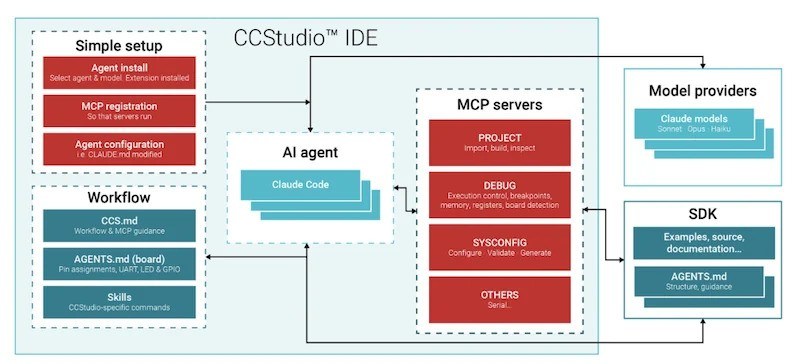
Agentic AI capabilities in CCStudio are aimed at streamlining embedded software work across TI's MCU families. Image source: Texas Instruments
Why this is more than faster autocomplete
For the past two years, design engineers have used generative AI tools to write code faster, then hit a wall on complex embedded tasks because the model had no hardware-specific context. Autocomplete does not know that your pin mux conflicts with the timer you just enabled. An agentic framework that receives SDK and peripheral data from the IDE does, which is why TI positions the shift as moving from code assistance toward autonomous development.
The headline number is TI's own: a purpose-built migration skill is said to cut software migration time from months to days. Two caveats worth holding onto. First, that is a vendor estimate measured on TI-designed workloads, not a benchmark published for third-party projects, so treat "days" as your pilot's target, not your guarantee. Second, this is not a bolt-on from yesterday: TI's application note on AI code assistants documents MCP server support starting with CCStudio IDE 20.5.x, which tells you the plumbing has been building up across releases. TI also describes an AI Configuration Wizard that lets a developer pick an agent and start coding within a minute of launching CCStudio, according to coverage by All About Circuits.
CCStudio IDE or CCStudio for VS Code: which surface should you install?
Both expose the agentic workflow, so the decision is about your existing toolchain rather than about AI features. Here is how I would lay it out for a team choosing tonight.
| Dimension | CCStudio IDE | CCStudio for VS Code |
|---|---|---|
| Best fit | Teams already living in TI's full toolchain, mixing DSP, C2000-class control, and multi-protocol debug work | Teams standardized on VS Code with shared extensions, snippets, and keyboard muscle memory |
| Agentic workflow | Full loop: generate code, configure peripherals, build, flash, debug | Full loop, inside the editor the developer already uses |
| Tool switching | One environment for device tools plus AI | No rebuild of context for VS Code users |
| IT rollout effort | Desktop or cloud install; heavier footprint, deeper TI tool coverage | Marketplace-style extension path; lighter diff for orgs already running VS Code |
| Try it when | Your project depends on TI-specific analyzers and legacy device support | Your bottleneck is onboarding and editor consistency, not toolchain access |
How TI's approach lines up against ST, NXP, ADI and Arm
If you build on more than one silicon vendor's parts, the agentic IDE race is already multi-player, and the vendors are not selling the same thing.
| Vendor / tool | What the agent touches | Maturity signal |
|---|---|---|
| Texas Instruments CCStudio | Device context, peripherals, build, flash, debug, migration subagents across MCUs, wireless, radar SoCs | Available now, no extra license for the IDE |
| STMicroelectronics STM32Cube for Agentic AI | Verified, optimized ST reference examples handed to the agent | Shipping as beta; ST's own docs note that "response quality depends on the selected AI agent and its underlying model" |
| NXP agentic AI development | NXP devices and workflows through MCUXpresso for VS Code and S32 Design Studio | Tool-specific rollout rather than one umbrella ecosystem |
| Analog Devices CodeFusion Studio | Agentic debugging that reasons against live silicon to chase multicore faults | Debug-first positioning |
| Arm with GitHub | AI coding agents that edit, build, test and debug inside one Arm development environment | Announced in late October 2026, ahead of this news cycle |
The pattern: TI and NXP are betting on context injection tied to their own SDKs, ST is leaning on curated reference code, and ADI is starting from the debug side. If your roadmap is single-vendor, TI's pitch is the broadest workflow loop of the group; if you are multi-vendor, you will be juggling several agents and several permission models.
A 30-minute pilot that will not embarrass you
- Update to a CCStudio build that exposes the AI hooks. TI's application note puts MCP server support at CCStudio IDE 20.5.x and later, names Claude Code as the recommended, officially supported AI code assistant for that line, and points to the AI Assistant Configurator as the way to wire it up.
- Pick one throwaway target: a board you already own, a small peripheral change, no production branch.
- Run the migration path on a low-risk module, not your bootloader, and ask the agent to explain which SDK example it used as the source of truth.
- Diff everything the agent wrote against the datasheet's pin and clock tables. Peripheral configuration is where a confident wrong answer costs you hardware time.
- Time it. Record hours saved versus hours spent reviewing. That number is the one your manager will care about, and TI's months-to-days claim only holds if review overhead stays small.
Where the real risk sits: permissions and provenance
An agent that can build and flash has write access to your hardware and your toolchain, not just to a text buffer. That is the same boundary question we ran into when we looked at whether a computer-use agent needs its own permission map: the value shows up the moment automation reaches real systems, and the arguments start when nobody wrote down what it was allowed to touch. Treat device flashing as a permission you grant per project, keep the migration agent off release branches, and require a second human on generated register writes. Everything in this paragraph is editorial guidance rather than a documented TI limitation.
Two other items belong on the checklist. Code provenance: an agent stitches together SDK examples, so confirm your license review covers generated combinations. And model dependency: the IDE is free, but the agents are third-party products with their own accounts and billing, so a team-wide rollout is a procurement conversation, not only an install.
Most organizations land in the same comfortable split we saw when we assessed what to turn on today, what to pilot, and what to wait for in another industry's AI layer: enable context and code generation for prototypes, pilot migration assistance on a named engineer's schedule, and wait on unattended flash-and-debug loops in regulated code.
Three misconceptions I expect to see in forums this month
- "Agentic AI in the IDE means no code review." TI's own framing is that the agent produces implementation-ready output, which is a starting point, not a sign-off.
- "You need the CCStudio desktop app to use agents." The workflow also runs in CCStudio for VS Code.
- "Months to days applies to my 400,000-line legacy project." The claim targets migration tasks the framework handles end to end, and long-tail legacy code with undocumented hardware behavior is exactly the case where context injection helps least.
FAQ: the questions engineers ask first
Is the agentic CCStudio capability paid?
TI says the agentic capabilities are available today across its general-purpose and real-time MCUs, wireless connectivity devices, and radar SoCs, and the CCStudio ecosystem itself is distributed as a free download. The AI agent and model you drive it with carry their own vendor terms.
Does it replace a senior embedded engineer?
No, and TI does not claim it does. The framework offloads repetitive migration and configuration tasks so developers can spend time on system-level design; judging whether a generated peripheral setup is correct remains a human skill.
What happens when the SDK updates?
TI describes a modular architecture built on task-specific skills, MCP server integrations and context injection, designed to keep expanding support for new devices, updated SDKs, and emerging edge AI workflows. In practice, expect release notes to matter more than usual.
Where can I watch it run end to end?
At electronica 2026 in Munich, Nov. 10-13, 2026, TI is demonstrating agentic AI workflows in CCStudio IDE and CCStudio for VS Code in Hall C4, covering system configuration through debugging.
What to watch next
Watch the device list more closely than the demos. The interesting signal for 2026 is whether TI keeps widening the supported device and SDK surface after launch, because a modular agentic layer is worth little on the day it covers only the flagship parts. Also watch whether multi-vendor teams start standardizing review gates for flashed code; that is where the months-to-days math either holds or quietly fails.
The question I would leave you with is not how fast the agent migrated the code. It is who takes responsibility for the one register value it changed at 2 a.m., and whether your diff review is built to catch it.
Sources
- Texas Instruments press release, Nov. 10, 2026, syndicated via PR Newswire: Nasdaq
- TI application note, "Using AI Code Assistants with Code Composer Studio": software-dl.ti.com
- All About Circuits on the AI Configuration Wizard and electronica dates: allaboutcircuits.com
- STMicroelectronics on STM32Cube for Agentic AI: newsroom.st.com and ST developer docs: dev.st.com
- NXP agentic AI development page: nxp.com; Analog Devices CodeFusion Studio: developer.analog.com; Arm and GitHub: newsroom.arm.com
- TI electronica event page (dates and Hall C4 booth): ti.com