
MyTechDailyNews Software Guide: vLLM 0.31 Constrained Decoding for Kimi K2.6 and DeepSeek Tool-Call Schema Accuracy
When a software workflow depends on an open-weight model to run tools, the first sign of trouble is often a malformed handoff rather than a plainly wrong answer. A bad JSON payload can force retries, add confusing messages to the session, and make the assistant look less capable than the model actually is. For teams serving Kimi and DeepSeek, the important software question is whether the inference engine will prevent invalid tool calls. vLLM 0.31 exposes constrained decoding as a server-side flag, and enabling it can raise schema accuracy from the reported 92% under vLLM 0.28 to 100%.
Why this matters for current software work
The reported serving case shows that provider claims and model names are not enough. When Kimi K2.6 was served with vLLM 0.28, the expected tool call schema appeared only 92% of the time. That is 2 failures in every 25 attempts, and it is especially painful in multi-turn agent sessions where each failed call can leave unusable text in context.
In practical terms, a developer assistant, automation chain, or internal knowledge application may need an extra recovery turn whenever syntax breaks. The user sees repeated corrections, higher token use, and slower task completion. The fix is not simply “try again”; the deployment needs a way to make invalid tool calls less likely at the moment the model is generating them.
Two building blocks: tool declaration and schema accuracy
A tool-capable system needs two moves. First, the application tells the model which external functions exist. Second, it requires structured output so the engine can parse the chosen tool and its arguments.
The reported example uses OpenCode as the harness. When OpenCode connects to Kimi, it sends a JSON array of available tools. One sample tool is webfetch, which retrieves Web page content. That array is not just a list of names: it includes parameters, their types, and required fields. It references https://json-schema.org/draft/2020-12/schema, permits text, markdown, or html formats, defaults to markdown, and sets max 120 seconds for an optional timeout.
Before the model sees the schema, the inference engine wraps it in model-specific tokens so the prompt matches the format used during training. For Kimi, that can appear as system tool-declaration tokens around the array. Later, if the model emits a structured invocation such as functions.webfetch:0 with a JSON argument object, the server parses it into an assistant object with tool_calls. The harness, such as OpenCode, runs the tool and feeds the result back.
Why “most of the time” is not enough for software users
Letting a model generate tool calls and trusting its training is the simplest design. It works most of the time because modern models are good at structured patterns. But a small failure rate is not a benchmark trivia point in production software.
Failing calls add error text to the session, push the next response away from the user’s goal, and create retry cost. To make that risk measurable, Moonshot AI published the K2VV ToolCall benchmark. Providers can use it to check whether a serving path preserves the original quality, including syntactically valid tool calls.
The benchmark workload contains 2000 requests. It measures trigger similarity, comparing when the service emits a call with how Moonshot AI’s own service behaves, and schema accuracy, the share of generated calls that follow the schema and can be invoked successfully. If tool-call accuracy is 50%, half of the generated calls are malformed, a result that would be disruptive in almost any tool workflow.
Probabilistic token selection is the underlying reason. The model does not run a compiler; it picks likely tokens. That can bring in names or shapes learned elsewhere, such as search_web instead of web_search, or city_name instead of location, when the current harness expects different conventions.
Constrained decoding: what the flag actually changes
Constrained decoding changes the sampling environment. The engine still lets the model choose among allowed tokens, but it blocks tokens that would make the tool call syntactically invalid. The allowed set is derived from the supplied schema, so generation is guided step by step rather than validated after the fact.
vLLM implements this behavior with structural tags from XGrammar. The relevant structure marks the boundaries of a valid call: where the tool call begins, where the name appears, where the index appears, where arguments begin, and where schema-constrained JSON must be produced.
Under that model, a valid path is Begin tool call → Tool name → Tool call index → Begin arguments → Schema-constrained JSON → End tool call. Invalid paths are prevented while tokens are generated. During the tool-call index phase, for example, integer tokens are permitted while incompatible tokens are masked. The figure below, reproduced from XGrammar’s article, visualizes that masking.
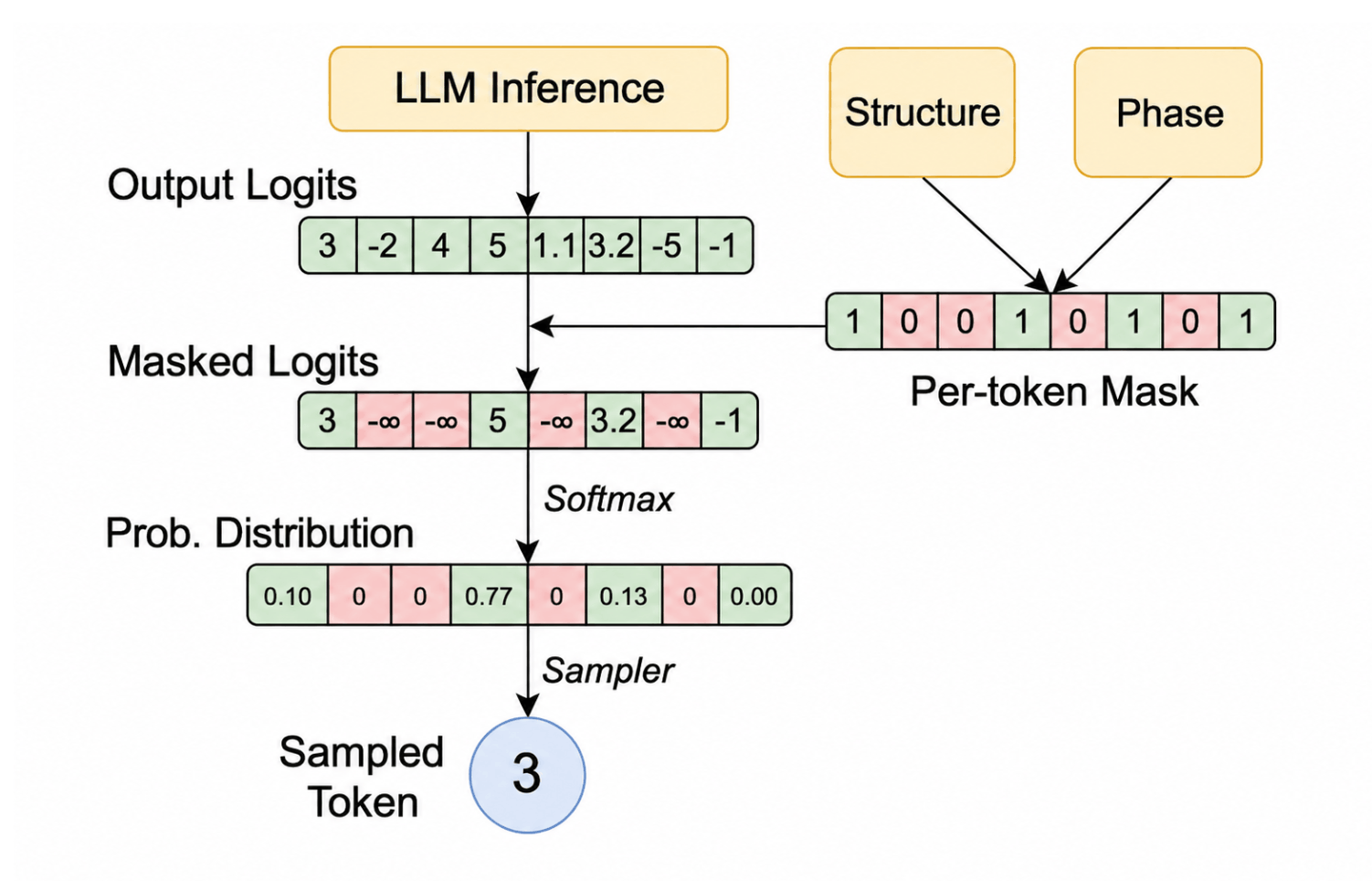
Image source: Dong, Yixin et al., XGrammar: Flexible and efficient structured generation engine for large language models., Proceedings of Machine Learning and Systems 7 (2025).
The result is a runtime guarantee for schema validity, not a claim that every answer is semantically better. The reported implementation also says the overhead is negligible because token masks are precomputed and applied efficiently on the GPU during generation.
Comparison table: free generation and schema-constrained serving
| Dimension | Free generation | Constrained decoding |
|---|---|---|
| Goal | Generate likely tokens, then hope the tool parser accepts them. | Limit token choices to paths that can form a syntactically valid tool call. |
| Reported schema accuracy | Kimi K2.6 on vLLM 0.28: 92%, equal to 2 failures in every 25 attempts. | Can reach 100% for newer Kimi and DeepSeek models when enabled and verified. |
| User impact | Retries, context pollution, slower agent sessions. | More predictable handoffs for the harness. |
| Compatibility risk | Less direct risk for unsupported models. | Defaults and model-specific grammar work matter; some models need validation. |
Defaults, forks, and three failure families
Moonshot AI recommends turning constrained decoding on, and its own API behaves that way. The reported deployment history adds a caution: the feature was first added in a vLLM fork. After vLLM added the feature in v0.25, the team moved to the upstream implementation for Kimi and DeepSeek. Soon after, tool-call accuracy dropped back to 91%.
The investigation concluded that the upstream constrained-decoding implementation itself remained correct. The regression came from default behavior for requests that did not explicitly enable constrained decoding. Because vLLM is a model-agnostic serving engine, enabling this feature per model is not trivial, and the reported problems fall into three groups:
- General model issues: some models behave so far from the schema or calling format that forced token selection can derail output. The report names gpt-oss-20b, Qwen 3.6, and GLM 5.1 as examples where users saw problems after the feature was enabled by default.
- Grammar translation bugs: a mismatch in translating a model’s tool schema or calling format into its grammar may create invalid calls, failed requests, silently dropped constrained decoding, or lower accuracy.
- Feature interaction bugs: constrained decoding can clash with other engine features. One example given is speculative decoding, where speculative tokens can be rejected incorrectly by the grammar and cause failing requests.
These issues explain why vLLM maintainers reported seeing problems with several models after constrained decoding was enabled and why leaving it disabled by default was the safer choice for a general-purpose engine. Later, vLLM added the --tool-strict-level flag so users can choose tool-call strictness for a deployment.
Ubicloud’s priority differs from a broad model-agnostic serving engine. The report says it focuses on serving Kimi and DeepSeek models with quality users expect from first-party providers. After enabling constrained decoding and re-running the K2VV ToolCall benchmark, it verified 100% tool-call schema accuracy across all served model versions, including Kimi K2.6 and DeepSeek V4 Flash, and deployed the change to production.
Step tutorial: how a software team can evaluate the flag
- Record the serving stack: model, engine, version, harness, and whether tools are defined per request. In this case, compare vLLM 0.28, vLLM 0.31, and any fork path.
- Run a schema baseline before changing anything. The reported Kimi K2.6 baseline under vLLM 0.28 is 92% schema accuracy; a practical reading is 2 failures in every 25 attempted calls.
- Measure trigger behavior and syntax, not only answer quality. The K2VV ToolCall benchmark uses 2000 requests and separates trigger similarity from schema accuracy.
- If the engine supports flags, test with constrained decoding enabled and disabled for the same request set. The reported 91% regression came from requests not explicitly enabling the feature after moving to the upstream path after v0.25.
- Check for model-family issues before making the behavior global. The three reported failure families affect different models, so multi-model gateways should validate per model.
- Promote only after measured validation. The report’s deployment gate was verified 100% tool-call schema accuracy across all served model versions before production.
Selection checklist
- Use when: your application has repeated tool calls in multi-turn sessions and malformed handoffs cost user time.
- Test before: switching defaults across all served models, especially if the gateway is model-agnostic.
- Watch: version notes, the --tool-strict-level flag, and any explicit per-request enabling of constrained decoding.
- Cite: the XGrammar structural approach and the Moonshot AI benchmark used to report schema accuracy.
FAQ: permissions, compatibility, performance, and user value
Q: Does constrained decoding give the model new permissions?
A: No. The reported mechanism guides token sampling so a tool call matches the schema. The external tool still executes only what the harness runs.
Q: Does it make the model understand better?
A: It does not replace model reasoning. It reduces syntactically invalid tool calls, which can otherwise make the assistant look worse than it is.
Q: Why did vLLM not leave it enabled for everyone?
A: Because the feature is model-specific and the reported problems include general model issues, grammar translation bugs, and feature interaction bugs. vLLM maintainers treated the safer default as disabled.
Q: What did the reported 92% to 100% change buy users?
A: Fewer malformed calls and less context pollution, assuming the served models pass validation. For software teams, the main benefit is predictable tool execution, not a different claim about model intelligence.
Common misconceptions in software selection
- The model alone controls tool-call quality. Observed quality depends on the serving stack too; the same model can behave differently across engines and settings.
- A high benchmark score means tool calls are always valid. The reported failure categories show that defaults, grammar translation, and feature interactions can break behavior even when the core method is sound.
- Strict decoding is automatically worth the cost. The report says performance overhead can be negligible, but validation is still needed for model-specific serving.
Action recommendations
- For Kimi K2.6 deployments on vLLM 0.28, treat 92% schema accuracy as an operational issue, not a minor metric: 2 failures in every 25 attempts can break agentic software flows.
- For teams on newer vLLM builds, identify the server-side constrained-decoding flag, including 0.31 and the --tool-strict-level mechanism, and validate explicit request behavior.
- For mixed-model stacks, avoid one global default until each model family is tested against the three reported failure categories.
- For Kimi and DeepSeek serving that must match provider-quality tool calls, enable the feature only after benchmarking trigger similarity and schema accuracy; the reported target was 100% before production.