
MyTechDailyNews Software: A guide to the eight Build Reasoning Model (From Scratch) videos in Python and PyTorch
For MyTechDailyNews Software readers who track developer-focused AI education, Ahead of AI has collected a hands-on learning track: eight videos totaling 11 hours, implemented in Python and PyTorch. The Build Reasoning Model (From Scratch) sequence responds to a broader shift over the last two years, when reasoning-model techniques became central enough that many current-generation large language models now ship with reasoning modes or effort controls.
Readers should approach it as an implementation guide rather than a product announcement. It evaluates a pre-trained model, then improves it through inference scaling, reinforcement learning, and distillation. The material also works as a companion to Coding LLMs from the Ground Up last year, but it is designed so that the earlier course is not required.
Key facts for the series
| Field | Detail |
|---|---|
| Creator | Ahead of AI |
| Recording window | Recorded in the last few months |
| Count and runtime | eight videos, 11 hours |
| Programming stack | Python, PyTorch, uv |
| Starting model | Qwen3 0.6B |
| Companion reading | Build a Large Language Model (From Scratch), Build A Reasoning Model (From Scratch), and the Components of a Coding Agent article on Substack |
| Commercial book locations | Manning and Amazon |
| Optional short course | AI Reasoning Models on LinkedIn Learning, about 90 minutes; the linked route should be free for 24h and should not require LinkedIn Premium |
| Author status | Additional LLM research roundups return next month |
Who should watch
This is useful for software users, developers, IT-support practitioners, and buyers comparing AI tooling. It rewards readers who can follow tensor shapes, inspect logits, and run evaluation loops. If your goal is conceptual background, the 90 minutes overview may be enough. If your goal is working code, use the implementation path below.
How conventional LLMs, reasoning models, and agent harnesses relate
The source post frames the relationship with an engine analogy: the model is the engine. A conventional LLM becomes more capable through additional post-training, especially reinforcement learning with verifiable rewards, and through optional inference-scaling techniques. A reasoning model can then be used inside an agent harness, which supplies context management, tool access, and orchestration for bigger coding, booking, and assistant tasks.
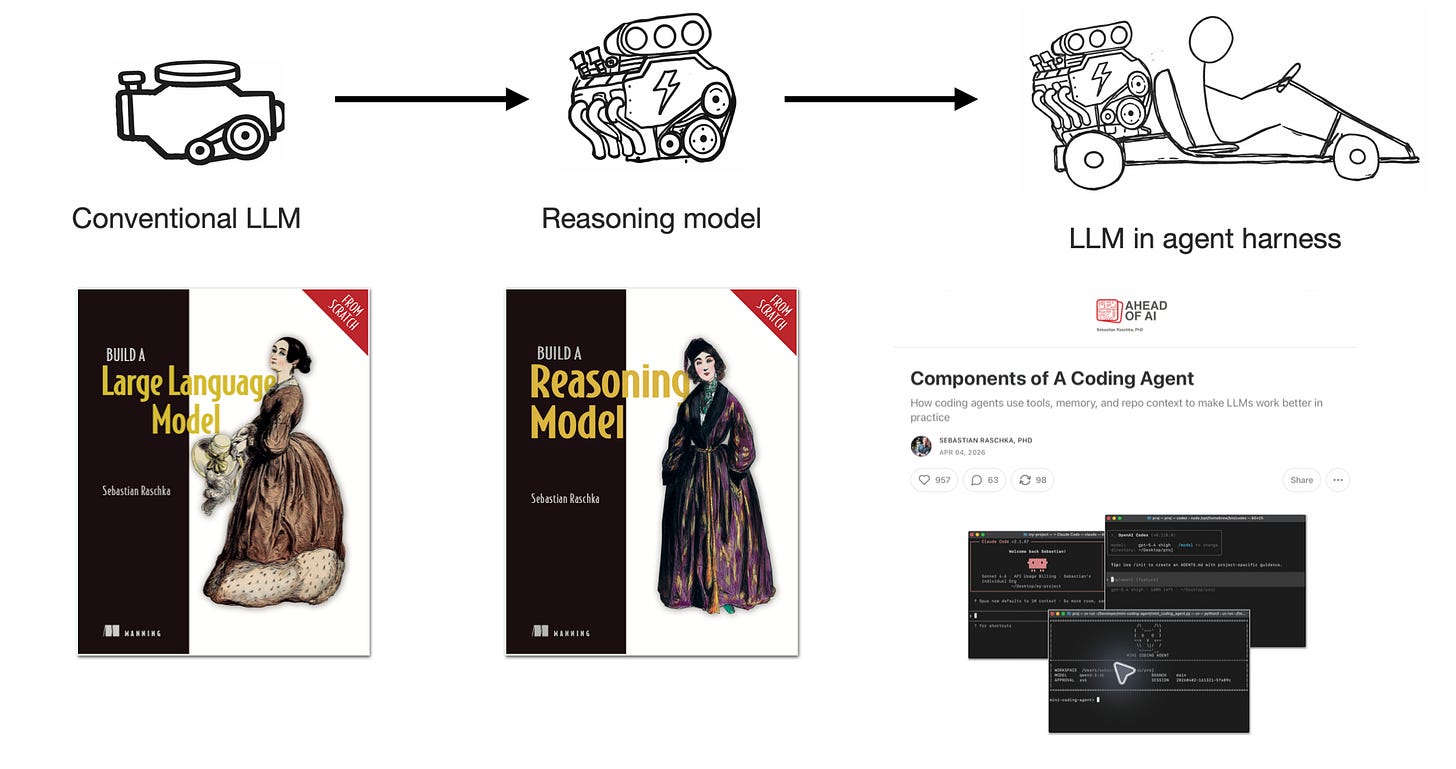
Figure: engine analogy for conventional models, reasoning models, and agent harnesses.
Agents can use either conventional or reasoning models, but reasoning models are the more typical choice because they handle harder problems. The post also notes that current-generation systems commonly expose variable reasoning effort settings.
Scope, compute, and setup expectations
The work starts from a pre-trained Qwen3 0.6B model rather than training a base LLM from scratch. That choice keeps attention on evaluation, inference-time scaling, reinforcement learning, and distillation. The Build a Large Language Model (From Scratch) course may help, but the reasoning sequence is not dependent on it.
Hardware is split by stage. Early text generation and evaluation can run on CPU. Later training experiments become much more practical with a GPU. The first lecture covers environment setup, and the companion repository includes hardware and environment recommendations.
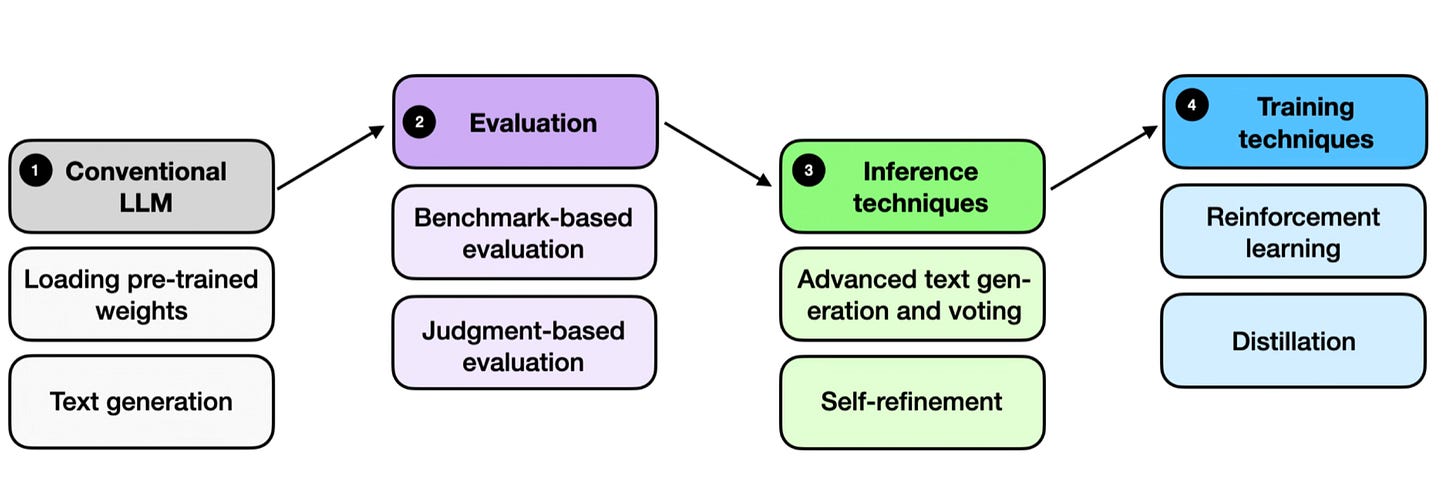
Figure: topic map for the series.
Companion book workflow
The videos are supported by Build A Reasoning Model (From Scratch), offered through Manning and Amazon. The print edition is in color. For a slower, more durable path, read one chapter, run the corresponding code with the matching lecture, then complete the exercises.
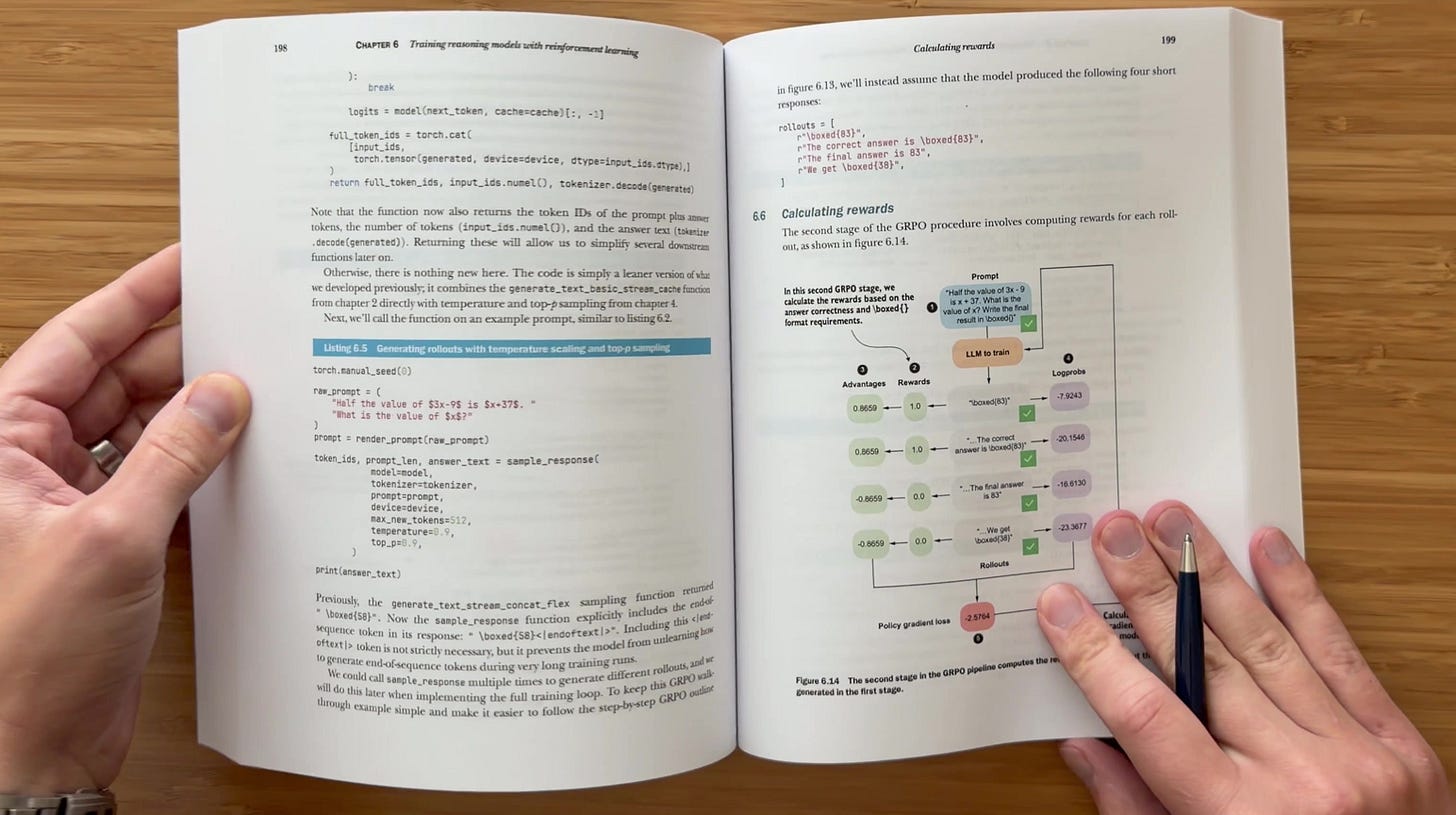
Figure: excerpt from the print edition.
Step tutorial: the eight-lecture implementation path
Use the following sequence to understand what each lecture adds. It preserves the order because each step builds on the previous artifact: environment, model generation, verifier, inference scaling, scoring, RL training, monitoring, and distillation.
- Set up motivation and environment. Map conventional LLMs, reasoning models, and agent harnesses; explain why code-based learning helps; install dependencies with uv; choose hardware; check CUDA or Apple Silicon support; and test remote-GPU workflows in VS Code.
- Load the base model and build text generation. Download Qwen3 weights, place the model on the chosen device, inspect tensor shapes, logits, and next-token predictions, then implement greedy decoding, streaming generation, end-of-sequence handling, speed measurement, KV caching, and torch.compile compilation.
- Build a verifier. Extract final answers, normalize them, check mathematical equivalence, and run an evaluation loop on MATH-500. The same verifier becomes the reward signal for later RLVR training.
- Scale inference with sampling and self-consistency. Use temperature scaling, multinomial sampling, and top-p filtering to create diverse candidates, a common pattern in proprietary chatbots such as ChatGPT. Combine candidates through majority voting and evaluate the MATH-500 accuracy gain against the extra inference compute.
- Scale inference with scoring and self-refinement. Compute token and sequence log probabilities, implement a heuristic scorer, improve numerical stability, break self-consistency ties, and create a critique-and-revise loop. Evaluate the loop on MATH-500.
- Implement GRPO for RLVR. Generate reasoning traces, compare RLHF and RLVR, turn verifier scores into rewards and relative advantages, compute sequence log probabilities and a simplified GRPO loss, assemble logging and checkpoint saving, then evaluate training stability and memory needs.
- Add tracking, clipping, and KL terms. Track entropy and advantage, inspect longer training logs, add clipped policy ratios, assess KL loss terms and reward-hacking concerns, condition format rewards on answer correctness, and compare checkpoints on MATH-500.
- Distill a reasoning model. Collect teacher answers from DeepSeek R1 for the MATH dataset, prepare tokenized train/validation/test splits, compute answer-token log probabilities and cross-entropy loss, run supervised training, track validation loss, and evaluate the distilled model on MATH-500.
Method comparison
| Method | What it changes | Cost | Practical fit |
|---|---|---|---|
| Sampling plus self-consistency | Decoding and answer selection with frozen weights | More candidates per query | Quick experimental improvement |
| Scoring and self-refinement | Model feedback loop and tie-breaking | Additional passes | When answer quality matters more than latency |
| RLVR with GRPO | Weight updates from verifier-derived rewards | Training compute, logging, memory | When you need persistent reasoning behavior |
| Distillation | Supervised learning from teacher answers | Teacher dataset creation and tokenization | Alternative path without RLVR |
Common misconceptions
- Need the prior course first? No. Coding LLMs from the Ground Up last year provides context, but the reasoning materials are standalone.
- Need a GPU for everything? No. CPU is viable for early generation and evaluation examples; GPU becomes much more practical for later training.
- Reasoning models are agents? No. The reasoning model supplies the engine; the agent harness supplies tools, context, and task orchestration.
FAQ
Should I start with the short course or the coding videos?
Use the AI Reasoning Models option on LinkedIn Learning if you want the core concepts in about 90 minutes, including inference-time scaling, reinforcement learning, and distillation. Use the coding videos if you need to implement the methods yourself.
Is the free access route reliable for the short course?
The source note says the linked route should be free for 24h and should not require LinkedIn Premium.
What evaluation is used most?
MATH-500 appears throughout: verifier evaluation, inference scaling, self-refinement, RL checkpoints, and distillation comparison.
Where do teacher answers come from?
For distillation, the course uses answers generated by DeepSeek R1 on the MATH dataset.
What environment details should I expect in the first lecture?
Expect dependency installation with uv, hardware guidance, CUDA and Apple Silicon checks, remote-GPU use with VS Code, and troubleshooting notes.
Action advice
- Pick a lane: concepts or implementation. For MyTechDailyNews Software readers, the implementation lane is more valuable if you manage tooling, evaluate models, or build workflows.
- Before running code, confirm whether your machine can use CUDA or Apple Silicon; otherwise, keep expectations to CPU-friendly early examples.
- Start with video 1 and video 2: dependencies, model loading, streaming generation, KV cache, and torch.compile are the foundation.
- Build the verifier early because it is both evaluation and reward infrastructure.
- Try inference scaling before training: sampling, self-consistency, scoring, and refinement often provide clearer return without changing weights.
- If you need lasting capability, move to GRPO RLVR, then evaluate checkpoints on MATH-500.
- Compare RLVR with distillation before committing to one path.
Takeaway for MyTechDailyNews Software
The most useful reading is that reasoning models remain a core software capability, not just a model-label detail. The eight videos, 11 hours, and Python and PyTorch code path make the mechanism concrete: a base Qwen3 0.6B model can be evaluated, scaled at inference time, improved through verifiable rewards, or distilled from a stronger teacher. The engine analogy keeps the architecture clear while showing where tool access and context management sit. For teams choosing or maintaining AI-assisted workflows, the practical conclusion is simple: start with the smallest reproducible loop, use the verifier as the measurement backbone, and only add training or distillation after inference-time options have been compared.

A closing visual from the source post accompanies the invitation to keep watching, experimenting, and tinkering.