
Software Deep Dive: How BMS DAM Consolidates Multi-Cloud Digital Assets, Cuts Editing to a Few Minutes and Syncs Every Channel
Open a browser tab, type in a product name and count how many copies of the same poster, manual or hero image you can find. For most growing companies the result is uncomfortable: marketing is still hunting for the current manual, the storefront keeps serving last season's product image, and design, legal and sales hand files back and forth. Nothing is broken on its own — the assets are simply stored in too many places at once. That makes this a software-layer problem, solved with workflow, access rights and versioning rather than with new hardware, and it is exactly the kind of change this column follows. Below we unpack BMS DAM, the Digital Asset Manager module inside the Bravo Marketing Suite: what it alters in a day-to-day content workflow, which steps it compresses to a few minutes, how version synchronization behaves across channels, and what your team should validate before committing.
The problem statement: distributed storage, duplicated effort, mismatched versions
Digital operations tend to expand faster than the folder structure holding them together. Product manuals, installation guides, promotional videos and campaign posters have become the main carrier of external communication and market development, yet as headcount, regions and cloud accounts multiply, the same asset quietly ends up in several drives at once. The consequences are operational: the newest manual cannot be located reliably, an expired product image stays live on the e-commerce side, and every cross-department hand-off creates another copy. Version inconsistency and slowed collaboration then delay product promotion and weaken brand consistency.
Where BMS DAM sits in the software stack
Longfu Information Technology (Shanghai) Co., Ltd. introduced Digital Asset Manager (DAM) inside its Longfu Marketing Suite — Bravo Marketing Suite (BMS) — which is itself part of the BMS Digital Experience Platform. Read from a tool-selection angle, the module is positioned as an operating layer over storage you already own rather than as a new repository: it covers the full asset chain — storage, editing, distribution, intelligent processing and cross-region collaboration — with the stated aim of releasing the operating value of digital assets.
Multi-cloud consolidation: one interface instead of several logins
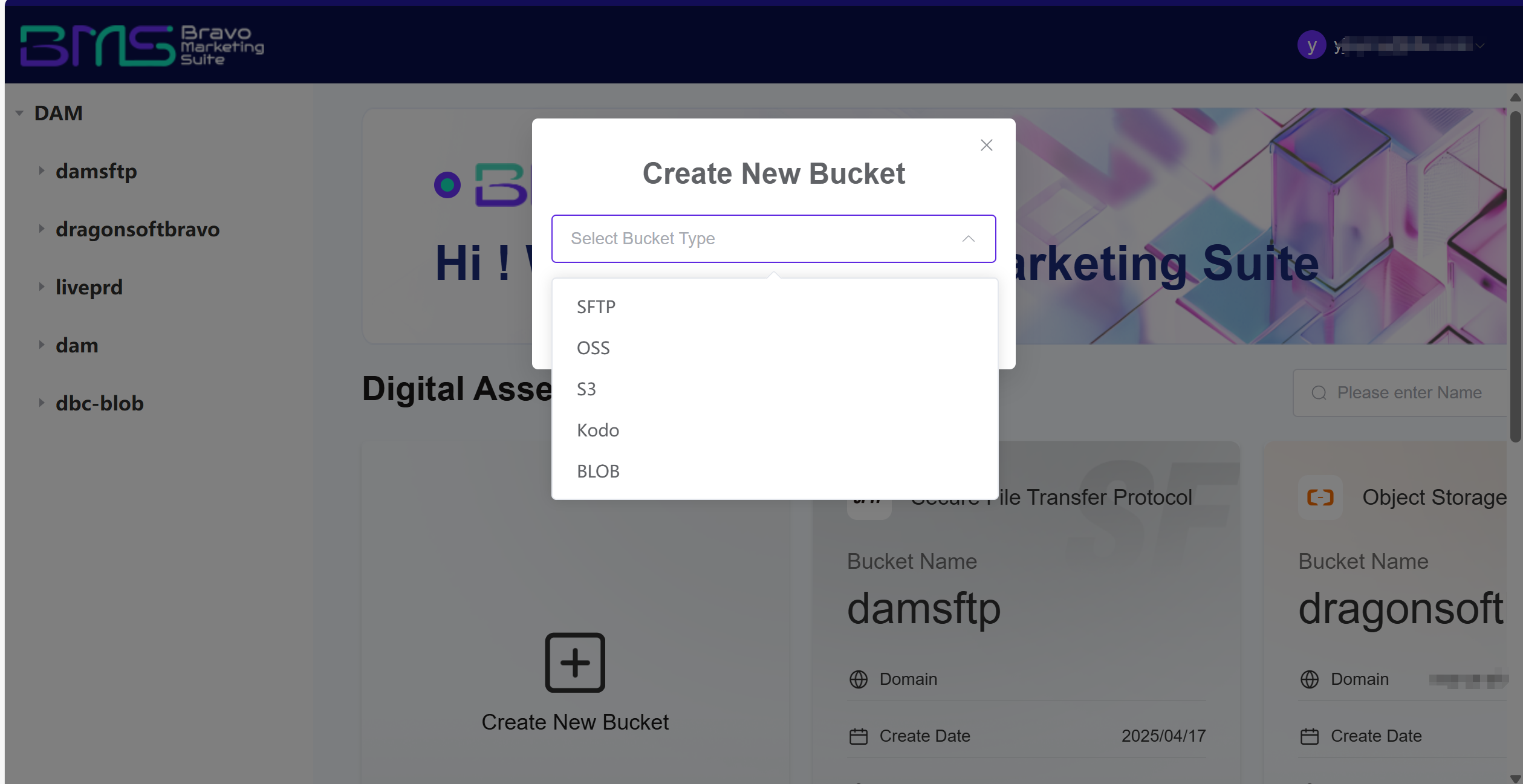
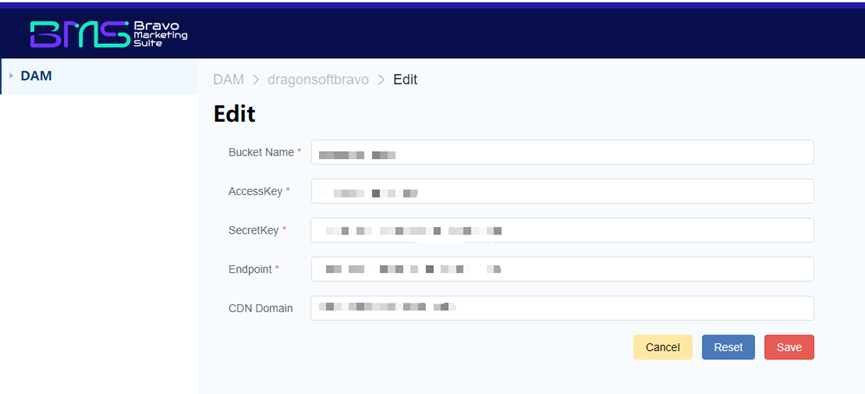
Assets live wherever your teams put them: on Alibaba Cloud or Tencent Cloud, on AWS or Azure. The platform pulls those locations into a single management interface, so a marketer no longer signs into multiple drives to trace one manual. Central access and central administration of all materials is what removes repeated operations and wasted resources, and it is usually the first efficiency gain an IT support desk can actually observe.
Browser-based editing: no Photoshop round-trip while a campaign waits
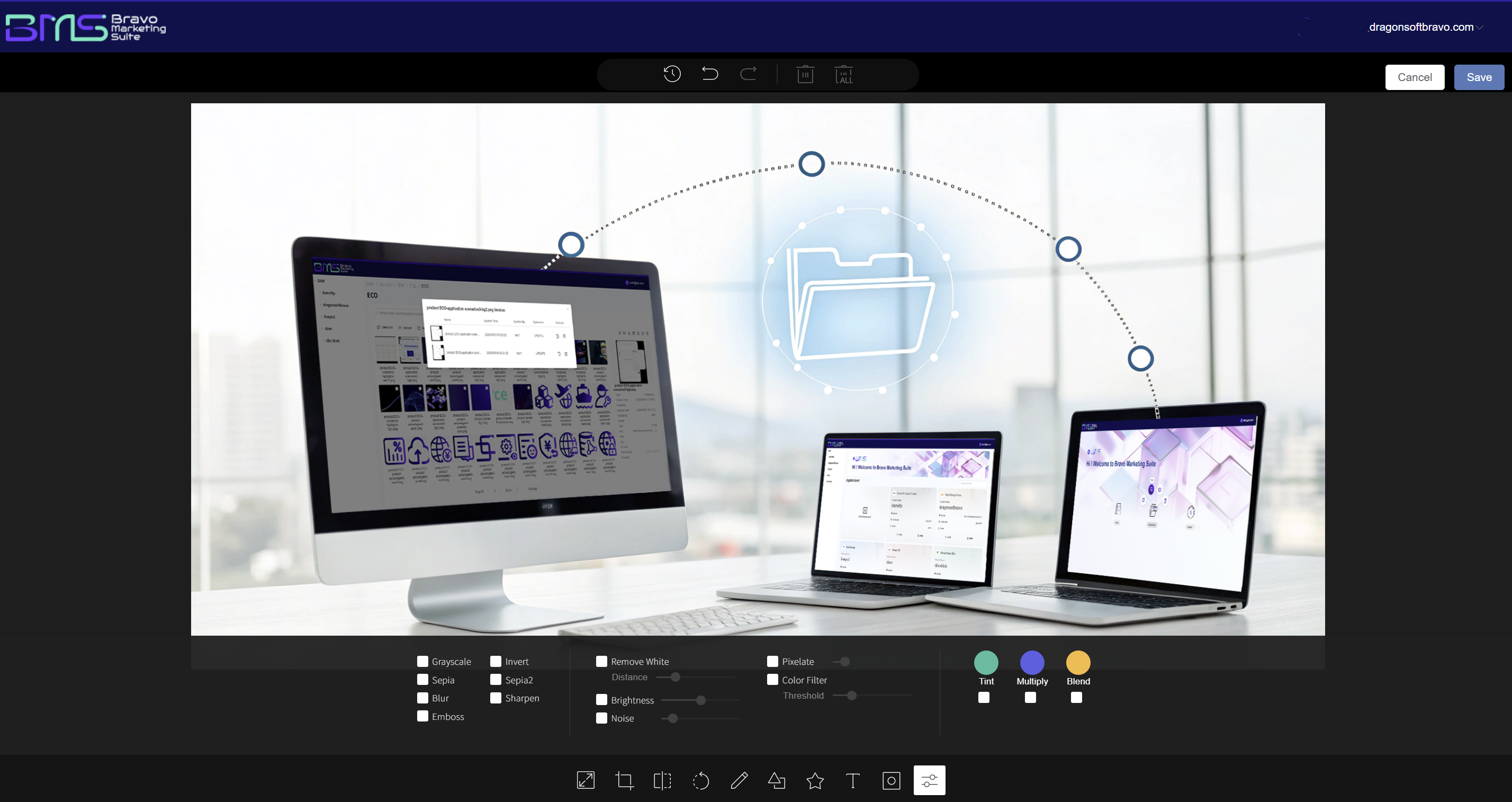
In the creation and publishing step, editing becomes lighter. Users do not need to depend on professional software such as Photoshop; cropping, resizing, watermarking and text adjustments are completed in the browser. In a temporary promotion, for example, a marketing colleague can adjust poster copy and ratio in a few minutes and produce the several versions required by the official website, the e-commerce platform and social media, instead of losing the window while waiting for design rework. The same pattern runs from online advertising to the global website, and from e-commerce events to offline collateral: one image spawns multiple versions in minutes while the brand image stays uniform.
Version control: "one update, synchronized across all channels"
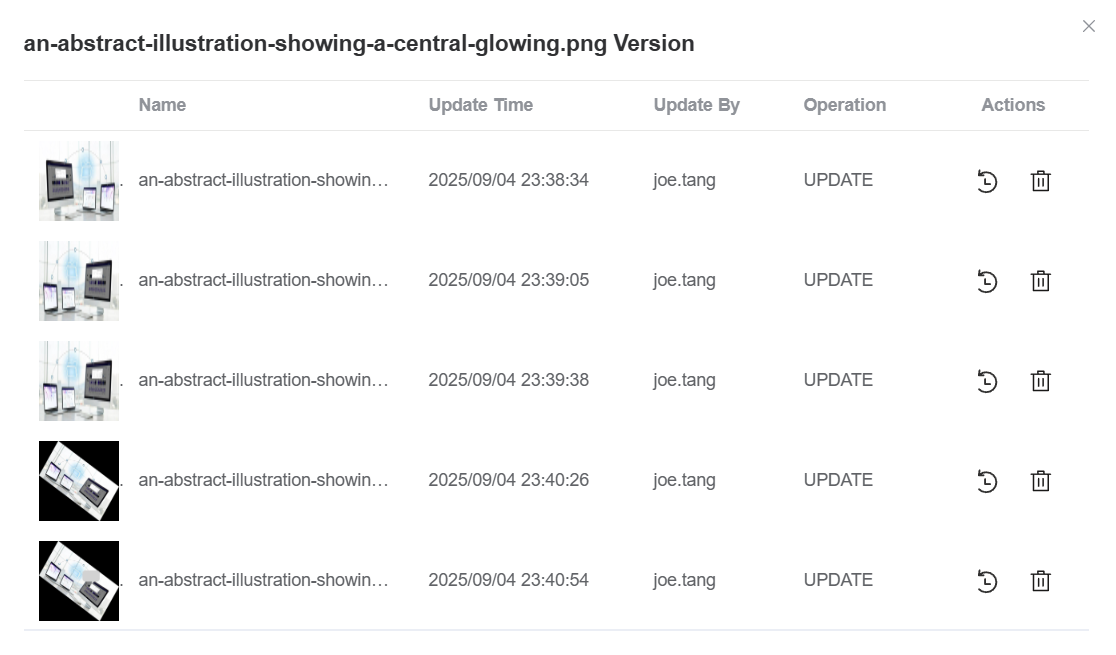
Version handling is where the workflow change is most visible. The platform implements a "one update, synchronized across all channels" model: once an asset is modified inside it, every page that references that asset automatically displays the latest version, while the superseded file is archived automatically and can be rolled back at any time. Update a product manual and the official website, the store and the dealer channels refresh together, with no manual one-by-one replacement — saving time and keeping the information consistent.
Global delivery: built-in CDN networks as the acceleration engine
Once teams are distributed, access speed becomes part of the software decision. The platform has multiple CDN networks built in, enabling fast distribution and loading of content worldwide. Whether the visitor is in North America, Europe or Southeast Asia, images and video on the corporate site or marketplace load immediately, so overseas customers receive the same smooth experience as local ones.
The AI layer: automatic tagging, multimodal search and derivative assets
The intelligence features move asset handling beyond manual filing. The system automatically recognizes the content of images and videos and applies precise tags, which lets an organization sort and classify material quickly. Smart image recognition, automatic cropping and generation are already available, so a marketing team can obtain the version it needs for a given scenario without starting from scratch; AI can also recommend related content based on existing assets and usage scenarios, and produce derivative versions — for instance, an e-commerce image with a watermark added or the background replaced — so more marketing material comes out in a short time. Multimodal retrieval is described as the next step: instead of keyword search alone, a user would upload an image or a video as a reference and let the system match similar material instantly, raising find efficiency further.
Step-by-step: turning one master file into channel-ready versions
The following sequence reflects the workflow the platform describes and is a practical script for a pilot run.
- Connect the storage locations your content already occupies — Alibaba Cloud, Tencent Cloud, AWS, Azure — so the asset list appears in one interface.
- Locate the master file once, instead of signing into each drive separately.
- Open it in the browser and apply the lightweight edits the channel demands: crop, resize, add a watermark, adjust the copy.
- Export the aspect-ratio variants for the official website, the e-commerce listing and social media in one pass.
- Publish from the platform and confirm that every page referencing the asset switches to the new version automatically.
- Check that the previous file has been archived, and test a rollback once before you rely on it.
- For a regional campaign, let the local team make its localization changes directly in the platform and deliver through the CDN layer rather than sending files back to a central designer.
Cloud drive versus enterprise DAM: what actually differs
| Dimension | Ordinary cloud drive | BMS DAM |
|---|---|---|
| Core question answered | Where a file is kept — essentially the storage problem | How an asset is produced, governed, delivered and reused |
| Scope of control | Folders and permissions per drive | Covers storage, editing, distribution, intelligent processing and cross-region collaboration |
| Editing | Download, edit in professional software, re-upload | Crop, resize, watermark and text handled in the browser |
| Versions | Coexisting copies, one "final_v3" per channel | One update propagates to all referencing pages; old files archived and restorable |
| Delivery | Speed depends on the drive the visitor hits | Multiple built-in CDN networks serve North America, Europe and Southeast Asia |
| Organization | Manual naming and folder discipline | AI recognition, automatic tags, recommendations and derivative generation |
| Collaboration | Files forwarded between design, legal, sales and marketing | Design, marketing, sales and legal work on the same latest file |
| Intended user | Everyone, for storage | Enterprise content operations |
Business scenarios where the payoff shows up
- New product launch: material is stored centrally and distributed to global teams immediately, cutting duplicated work.
- Global marketing: local teams make their localization edits directly in the platform instead of returning files to a designer, then publish with CDN acceleration.
- Multi-channel operation: several channel-appropriate versions are generated in one pass, keeping the brand image consistent.
- Cross-team collaboration: design, marketing, sales and even legal view and use the latest file on the same platform, while automatic tags and AI recommendations make the collaboration more efficient and transparent.
Claims worth pinning down with your own numbers
What this module publishes are directional figures rather than benchmarks, so treat them as test cases during a pilot:
- Editing turnaround: poster variants produced "in a few minutes", measured against your current design-rework queue.
- Propagation model: "one update, synchronized across all channels", measured by how many pages switch without manual replacement.
- Clouds explicitly integrated: four named environments — Alibaba Cloud, Tencent Cloud, AWS, Azure.
- Regions explicitly covered for accelerated access: three — North America, Europe, Southeast Asia.
- AI functions listed today: intelligent recognition, automatic tagging and classification, cropping, generation and recommendations; multimodal retrieval is positioned as upcoming.
- Recovery behavior: superseded files archived automatically, with rollback available at any time.
Common misconceptions about this category
- "Consolidation means moving everything into one new repository." The described model integrates assets where they already sit across Alibaba Cloud, Tencent Cloud, AWS and Azure, rather than forcing a single storage vendor.
- "Version control means old files disappear." Older files are archived and can be rolled back, which is what makes channel-wide synchronization safe to enable.
- "You need a designer on the keyboard." Browser editing exists precisely so marketing and operations staff can crop, resize, watermark and add text without waiting for design rework.
- "AI features are limited to auto-tagging." The listed scope also covers recognition, cropping, generation, related-content recommendations and derivative versions.
- "Cross-border speed is a hardware project." On the software side, delivery is handled by the multiple CDN networks already connected to the platform.
- "It is only for marketing teams." The same synchronization and archive behavior matters to IT support and legal, since it is what guarantees that nobody publishes an outdated file.
Who should adopt it — and an action checklist for the pilot
Industrial manufacturing, automotive equipment, cross-border e-commerce and digital marketing teams all fit the profile: any organization with multi-channel, multi-region, multi-team content needs is in scope. Run the pilot with the following checklist:
- Inventory the drives and clouds where assets currently live before you scope the rollout, and note which of them hold restricted material.
- Decide roles up front — who may edit and publish, who only consumes the latest version — and review the access rights carried over from each connected cloud, so consolidated visibility does not silently widen exposure.
- Pick one high-churn asset class, typically a product manual or a campaign poster, and time the few-minutes editing claim on a real request.
- Verify archive and rollback end to end before go-live, and confirm that referencing pages update without manual replacement.
- Test loading behaviour from your actual target markets, including North America, Europe and Southeast Asia.
- Separate the AI capabilities you enable now from those still on the roadmap, such as multimodal retrieval, so users do not judge the platform on unreleased features.
- Set one measurable outcome for the pilot: fewer duplicate assets, faster campaign turnaround, or fewer stale files found in audit.
FAQ
- Q1: How is this different from a normal cloud drive?
A1: A drive mainly answers the storage problem. Beyond centralized storage, BMS DAM adds editing, version management, global acceleration and AI intelligence, which makes it a platform for enterprise-level content operations. - Q2: Do we need professional design staff to operate it?
A2: No. In-browser editing lets marketing and operations users complete cropping, resizing, watermarks and text quickly, which lowers the entry threshold considerably. - Q3: Will cross-region access be slow?
A3: No. Multiple CDN networks are already connected, so content is accelerated worldwide and users in North America, Europe or Southeast Asia can reach assets fast. - Q4: What can the AI do today?
A4: Intelligent tagging and classification, image recognition and cropping, content generation, plus recommendations of related or derivative material — all aimed at higher asset reuse and production speed; multimodal retrieval is described as the next capability. - Q5: Which companies benefit?
A5: Industrial manufacturing, automotive equipment, cross-border e-commerce and digital marketing teams alike — anyone with multi-channel, multi-region and multi-team content management needs can gain from BMS DAM.
Bottom line for software buyers
The decision is less about storage capacity and more about whether your content layer can keep a promise: that the file someone sees today is the file marketing approved today. As business maps widen, centralized asset management, cross-region accelerated delivery and intelligent operations directly shape brand consistency and market response speed. BMS DAM addresses the traditional pain points of scattered material, lagging updates and inefficient collaboration through unified multi-cloud storage, lightweight editing, real-time version management, global CDN acceleration and AI empowerment — moving digital assets from passive storage toward actively driving growth, and lifting efficiency and quality across the whole digital operation chain.