
MyTechDailyNews Software: How BMS DAM Turns AI Asset Management into a Workflow
Published on 2025-09-25 and written by Sarah Chen for MyTechDailyNews Software, this guide looks at how the Digital Asset Manager (DAM) module inside the BMS Digital Experience Platform changes daily work for software teams that manage images and video. The change is not just “a bigger archive.” The module is positioned as an operations layer: it can recognize assets, search by reference, recommend usable materials, and generate channel-ready versions. Longfu Information Technology (Shanghai) Co., Ltd. describes the module as part of the Longfu marketing suite—Bravo Marketing Suite (BMS)—so BMS DAM can be evaluated through a software-buyer lens: version behavior, permissions, compatibility, and time saved.
Why This Matters for Software-First Marketing Teams
Forrester Research reports more than 80% of enterprises are actively exploring AI to optimize their content supply chain; the over 80% trend explains why many DAM selections now ask for automation rather than storage alone. For readers who maintain campaign folders, update storefront banners, or publish across WeChat, Douyin, official websites, and offline displays, the useful question is simple: can a tool reduce repetitive editing and repeated shooting while keeping version control and brand rules manageable? BMS DAM addresses that with AI-assisted labeling, multimodal search, and derivative generation.
- Efficiency signal: fewer manual keyword passes and fewer one-by-one resizes.
- Brand-control signal: checks for logo, font, color, and channel format consistency.
- Reuse signal: finds prior materials before teams commission new assets.
Core Capabilities Users Notice in Daily Operations
Automatic Recognition and Bulk Preparation
In many traditional asset libraries, descriptions and keywords are typed by hand, which slows ingestion and creates inconsistent labels. The BMS DAM approach shifts that work to AI. The platform can detect objects, people, scenes, and text inside images and videos, then produce detailed labels that include industry-specific vocabulary. Assets can also be routed into predefined directories based on detected content features.
On the editing side, the system can perform automatic cropping, background replacement, and resizing. That lets one original file become versions suited for e-commerce product pages, social channels, or event screens. Because many assets can be standardized in one pass, marketing teams spend less time on mechanical formatting.
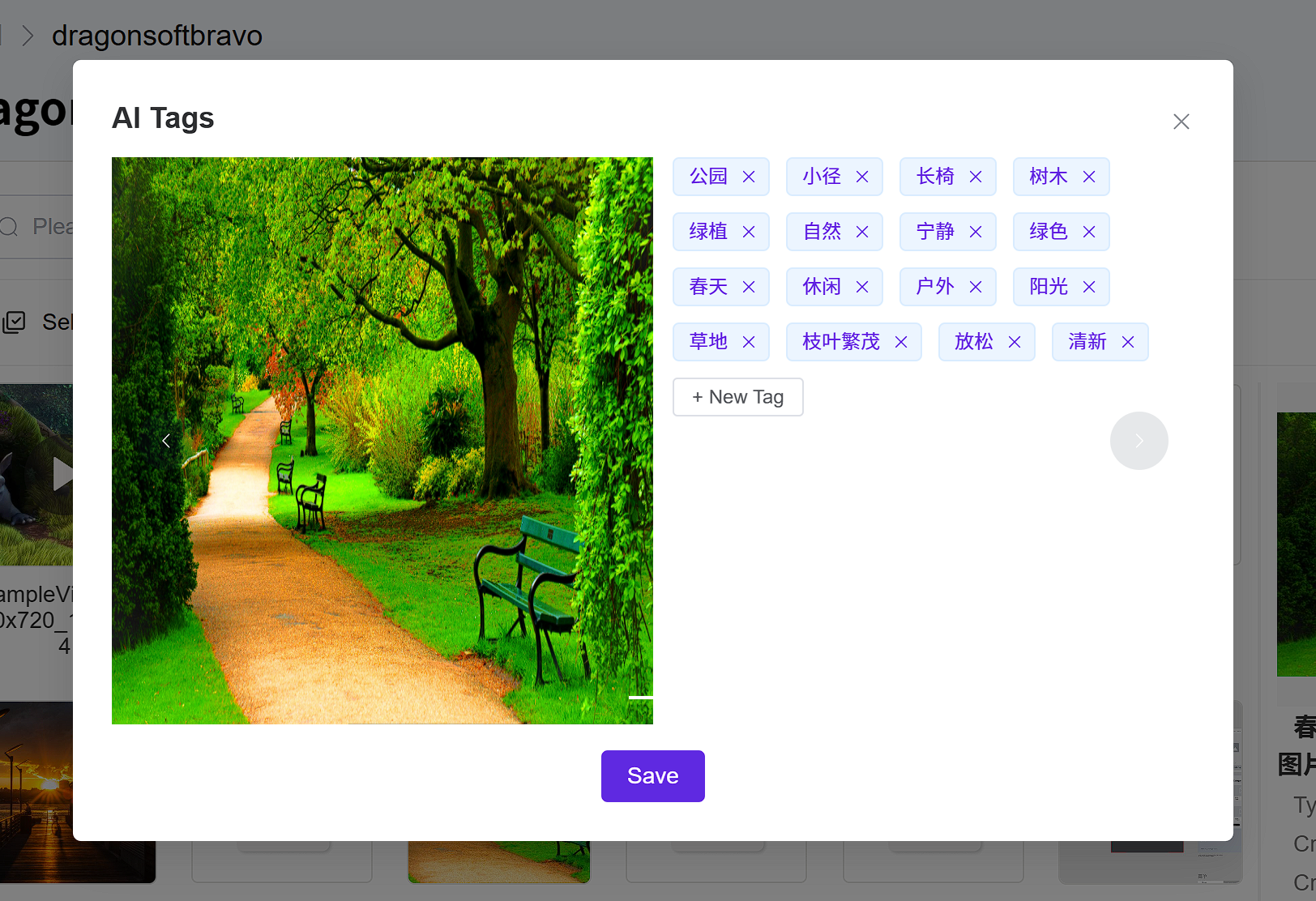
Multimodal Search for Faster Material Discovery
Search is one area where software evaluation matters. A user does not have to depend only on text keywords: they can upload a reference image or video and ask the system to match similar assets. The platform also supports cross-format similarity, so an image query may locate visually related video material, and a video query may surface still images. The practical result described for BMS DAM is that needed materials can be located within hours, while asset discovery and reuse rise.
Smart Recommendations and Derived Content
Recommendation features help teams move from “find the file” to “use the file.” The system can suggest assets that fit the current project and prior usage patterns, surface related materials for combination, and create new variations from existing assets. For design and marketing staff, the value is not only faster production; it is also more consistent use of approved material and more options during brainstorming.
Three Breakthroughs Claimed by the Platform
The platform groups its value into three breakthroughs: production efficiency, brand consistency, and creative reuse. The following sections translate those terms into user-facing outcomes.
Breakthrough 1: Higher Content Production Throughput
Automated labeling, classification, and generation compress the distance between asset creation and asset usage. Teams can focus more on messaging and creative direction instead of manual cleanup. In time-sensitive campaigns such as e-commerce promotions or trend-driven marketing, the ability to quickly retrieve, generate, and launch assets supports faster response. Replacing repetitive operations also lowers labor effort and the number of simple editing mistakes.
Breakthrough 2: Controlled Brand Output Across Channels
Multi-channel publishing creates a real risk: the same campaign may look different on WeChat, Douyin, a brand website, or an offline display. BMS DAM is designed to manage brand assets centrally and then use AI to check whether materials follow guidelines for logo use, fonts, and colors. Adaptive generation can produce channel-appropriate versions, helping keep tone and visual rules aligned even when formats differ.
Breakthrough 3: More Creative Coverage from Existing Assets
Recommendation and generation features can reopen assets that would otherwise be ignored. Search by similarity, combined with related-asset suggestions, gives designers and marketers more material to compare. In scenarios such as e-commerce, the platform can generate localized variants for different regions or audience groups, enabling large-scale customized content output without treating every request as a fresh production job.
Scenario Comparison Table: What Changes in Real Work
| Scenario | Manual workflow pain | How BMS DAM responds | Reported outcome |
|---|---|---|---|
| E-commerce promotion prep | Designers manually crop, resize, add logos, and swap backgrounds across many files; work is slow and error-prone. | Upload original assets once, then generate required sizes and styles for each platform and apply brand elements automatically. | Preparation time drops from several days to a few hours, labor cost falls sharply, and versions stay consistent. |
| Cross-channel publishing | One asset must be reshaped for WeChat, Douyin, official websites, or offline use; manual adjustments create omissions. | Define channel templates first; AI reads content and creates compliant versions for synchronization to the relevant platforms. | Publishing cycles are shortened by more than 50%; format and size errors decrease, and brand output can target 0 errors. |
| Asset search and reuse | Keyword search is imprecise, historical assets are buried, and teams pay again to recreate similar visuals. | Search across text, image, and video, receive AI-suggested related assets, and generate new variants from existing material. | Retrieval efficiency is increased by 80%, historical asset utilization rises by 40%, and production cost is reduced. |
| Global marketing localization | Each region requires separate adaptation, creating a long and repetitive review chain. | Derive multilingual and multi-region versions from the master asset, with recommended visual adjustments based on local preferences. | Localization cycles are cut by 70% while global brand tone remains aligned and local market needs are considered. |
Step-by-Step Tutorial: Piloting BMS DAM in a Software Team
The following sequence is based on the capabilities described above and is intended as a practical evaluation path, not as a new product claim.
- Inventory the content types your team handles most: images, short videos, product banners, brand guides, and historical campaign folders.
- Confirm permission boundaries before upload: who can edit, delete, approve, and publish; who can access sensitive assets; and how external partners are restricted.
- Run an automatic recognition pass on a representative batch and review whether labels, scenes, text, and industry terms are usable.
- Create channel templates for the destinations your team actually uses, including WeChat, Douyin, official websites, and offline event formats.
- Use reference-based search instead of keyword-only search during a live request; upload a sample visual and assess how well similar assets return.
- Generate variants and route them through a brand check for logo, font, and color compliance.
- Measure the pilot: time to locate assets, number of manual edits avoided, reuse rate, and whether localization cycles become shorter.
Common Misconceptions to Avoid When Evaluating DAM Software
- “It is only a cloud folder.” The differentiator is operational AI: recognition, similarity search, recommendation, and derivative generation, not just file hosting.
- “Automation removes governance.” Teams still need naming conventions, approval rules, and permission checks; automation is most useful when policy is defined first.
- “Multi-channel output means copying files to each platform.” The value is template-driven adaptation from a single master asset with consistent branding.
- “If search is AI-based, keywords no longer matter.” Text labels and human review remain useful; multimodal search complements, rather than replaces, organized metadata.
FAQ
Q1: What is the main difference between intelligent asset management and older DAM practices?
Older practices rely heavily on human filing and manual lookup. Intelligent asset management uses AI to identify content, assign tags, recommend assets, and generate new versions, so the workflow becomes faster and less dependent on personal memory.
Q2: Which tasks can AI actually perform inside BMS DAM?
The described tasks include recognizing objects, people, scenes, and text; producing labels; finding visually similar images or videos; and creating resized or restyled derivatives for campaigns.
Q3: Does this affect team collaboration?
Yes. Assets can be organized by project, related materials can be suggested automatically, and multiple users can work with the same library more smoothly, provided access controls are set correctly.
Q4: Which organizations are most likely to benefit?
Teams with high volumes of visual content are the natural fit: e-commerce, advertising, media, education, and similar groups. Size matters less than content volume and channel diversity.
Q5: Can it connect with existing systems?
The platform supports API integration with common design tools, marketing platforms, and existing enterprise systems, so data can move between systems without replacing every workflow at once.
Action Advice: What to Decide Before Publishing This Software Review
MyTechDailyNews readers should treat BMS DAM as a workflow decision, not a branding claim. If the main problem is scattered files, test recognition and tagging first. If the main problem is repeated cross-channel formatting, test templates and brand checks. If the team is already drowning in duplicate shoots, test multimodal search and variant generation. Use a limited pilot, then compare whether material can be found within hours, whether e-commerce prep falls from several days to a few hours, whether publishing cycles are shortened by more than 50%, whether retrieval efficiency is increased by 80%, whether historical utilization rises by 40%, and whether localization cycles are cut by 70%.
Bottom Line for Software Buyers
For a daily technology-news audience, the strongest take on BMS Digital Experience Platform is that its DAM module shifts digital asset management from passive storage toward active content operations. Longfu Information Technology (Shanghai) Co., Ltd. and its Longfu marketing suite—Bravo Marketing Suite (BMS)—present BMS DAM as a tool that can understand visuals, surface them faster, adapt them for channels, and support compliant reuse. Buyers should still evaluate permissions, integration scope, and real campaign volume before adopting it, because the practical payoff appears when the software becomes embedded in the team’s publishing rhythm.