
FreeBSD AI Policy and EU CRA Compliance: A Practical Rollout Guide | MyTechDailyNews Policy and Regulation
FreeBSD AI policy and EU CRA compliance are no longer abstract news items; they are becoming operating instructions for open-source teams. Recently, the FreeBSD project published its 2026 Q3 progress report, and my practical takeaway is simple: draft an AI-use disclosure rule now, map your SBOM fields to Cyber Resilience Act reporting, and treat Bhyve, Bhyvemgr and Sylve as audit-friendly management layers rather than convenience tools.
What does the report actually change?
It changes the governance layer before it changes anything you can feel in a release. The FreeBSD project used the third quarter of 2026 to show that its priorities now include AI contribution policy, EU-facing compliance support, virtualization tooling, desktop usability and kernel work. The first item is the most actionable because it gives outside teams a usable template.
The FreeBSD community survey results are unusually clear: 88% of respondents said FreeBSD should have a formal AI policy; 35% wanted developers to disclose whether they used AI assistance; 22% wanted AI-written code reviewed like any other code; 16% opposed accepting AI-generated code; and 65% supported AI-generated documentation after human review.
I read those numbers as a warning against a binary debate. The community is not asking whether AI is good or bad. It is asking where AI is allowed, who must disclose it, and what human review has to catch.
Which AI policy steps can teams copy?
Start with provenance, then permission. A practical first rule should cover ChatGPT, Claude and similar tools used to generate code, tests, documentation, commit messages or architecture notes. The FreeBSD approach suggests that disclosure and review are the safest default, while a total ban is likely too blunt for a large open-source project.
- Ask contributors to record whether AI assistance shaped a patch, test or document.
- Require human review for AI-generated documentation, consistent with the 65% survey result.
- Keep review criteria for AI-written code close to normal criteria, as 22% of respondents preferred, while still making disclosure visible because 35% favored that path.
FreeBSD's artificial intelligence working group is drafting the project's internal AI use policy and plans to submit a final report in the fourth quarter of 2026. That report will not bind every enterprise user, but it will be useful for teams that need to justify a governance decision to auditors, open-source counsel or product reviewers.
Another practical signal comes from the FreeBSD Foundation. Its AI-assisted Vulnerability Discovery Project is described as a six-month effort funded by the Alpha Omega project, with the goal of reducing exploitable vulnerabilities in FreeBSD source code. That is a useful counterpoint to alarmist debate: AI may be safest when framed as a security aid, not as a substitute for accountable engineering.
Why EU CRA timing makes SBOM work more urgent
Because the EU Cyber Resilience Act has moved from policy discussion to dated obligations. On 13 August 2026, ETSI opened a public enquiry on 17 final-draft CRA product standards. From 11 September 2026, manufacturers must use the ENISA Single Reporting Platform for actively exploited vulnerabilities and severe incidents. The European Commission's CRA timeline says the main obligations apply from 11 December 2027.
Against that backdrop, FreeBSD's SBOM support is more than a technical chore. The EU CRA asks for software security, vulnerability handling and supply-chain transparency. A software bill of materials records components, dependencies and versions, so teams can identify risky parts and trace security exposure through a product's software chain. FreeBSD is improving SBOM-related support to meet future compliance expectations.
Virtualization and web management: where is the audit value?
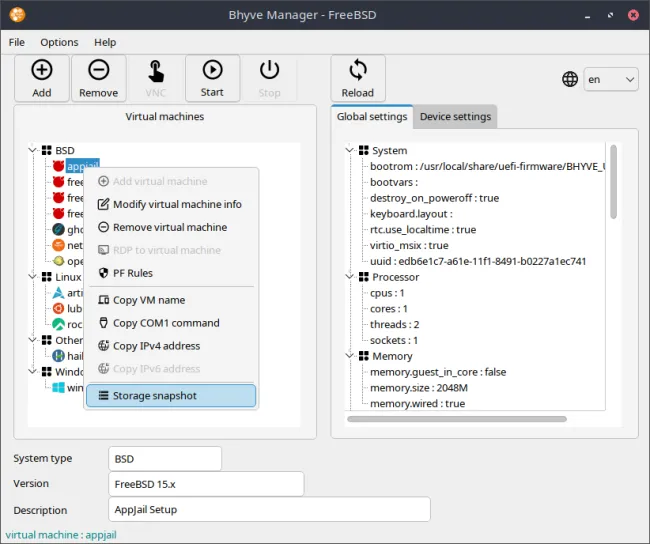
Bhyve is FreeBSD's built-in hypervisor, and this quarter developers are building Bhyvemgr, a graphical management interface written with FreePascal and the Lazarus environment. The goal is to let users create, manage and maintain Bhyve virtual machines through a graphical interface, reducing the need to rely only on command-line operations.
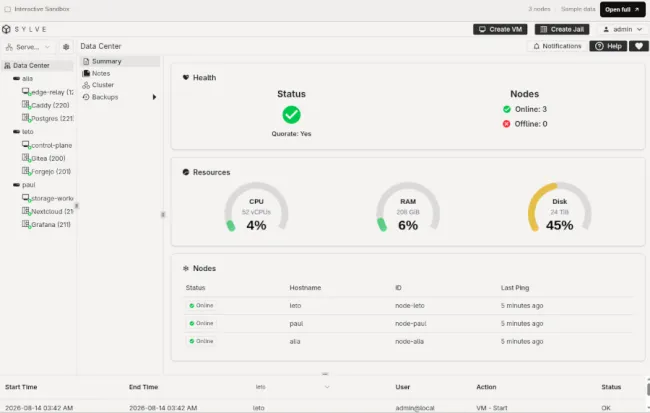
Sylve is also moving in a management-friendly direction. The browser-based FreeBSD system management platform tries to bring server administration, storage configuration and cluster management into one web interface. New work includes additional storage management options plus data-center and cluster management features. Compared with pure command-line routines, these tools can make operations easier to observe, document and delegate, although they do not remove the need for disciplined change control.
Desktop and kernel work: the less visible signal
FreeBSD's desktop work may look consumer-oriented, but it has a compliance side: fewer ad hoc recovery habits, better power behavior and less ambiguity when a machine sleeps, resumes or loses audio support. Developers are improving desktop installation and daily usability, including suspend and resume behavior and audio-system optimization. Those are exactly the details that determine whether a workstation can be trusted in a small team or field-support setting.
Under the hood, the project continued work on Zoned Storage support, debugging tools, kernel scheduler optimization and boot loader improvements. None of these will trend on their own, but they matter to reliability in servers, storage appliances and specialist environments where unattended failures become audit findings.
The volume of work is concrete: the FreeBSD Foundation reported that, for the third quarter, sponsored development produced 530 src commits, 82 ports commits and 19 doc commits. Those categories cover the operating-system core, software packages and official documentation. I care less about the raw totals than about the mix: the project is investing in governance, compliance-adjacent materials and user-facing tooling, not only kernel plumbing.
Quick comparison: what each FreeBSD signal means for your team
| FreeBSD signal | Why it matters | Your first step |
|---|---|---|
| 88% support AI policy | Community projects are moving from informal AI use to documented expectations. | Write one disclosure line for pull requests and documentation. |
| 35%, 22%, 16% and 65% views | Developers want transparency, normal review and human check, not blanket acceptance. | Separate AI-assisted code, AI docs and manual review in your checklist. |
| EU CRA and SBOM work | Component visibility is becoming a regulatory expectation in the EU. | Generate one SBOM for a high-risk FreeBSD-based build and test reporting assumptions. |
| Bhyvemgr and Sylve | Graphical and web management reduce manual drift but can hide audit complexity. | Map who can create, edit and destroy VMs or storage clusters. |
| 530 src, 82 ports, 19 doc commits | Compliance is partly a documentation problem, not only code. | Update release notes, dependency policy and operator instructions. |
Practical rollout guide: steps, checklist and common traps
Use a 30-day pilot rather than a committee cycle. The objective is to prove that your team can answer three questions: who used AI, what components are in the build, and who can change a running system.
- Inventory AI tooling: note whether ChatGPT, Claude or similar tools are used for code, tests, docs or incident notes.
- Draft a one-page AI policy: require disclosure, preserve human review, and explain what happens if a contributor refuses to disclose.
- Build one SBOM sample: pick a FreeBSD-based package or system image, record dependencies, and store the artifact with version and generation date.
- Map CRA ownership: name who monitors exploit reports, who validates vendor claims, and who prepares customer-facing incident language.
- Review Bhyve and Sylve access: identify VM lifecycle owners, storage administration roles and recovery paths before graphical tools become the default workflow.
- Test the desktop assumption: if your developers run FreeBSD on laptops or desktops, verify suspend, resume, audio and update behavior before moving sensitive workloads.
EU compliance deadlines are only useful when mapped to owners, so teams that need a worked example of deadline mapping can compare the logic used in our Playbook on Binance's European account wind-down. The subject is different, but the method is similar: date, duty, owner, evidence.
Common traps
- Treating an SBOM as a filing cabinet rather than a live vulnerability map.
- Copying FreeBSD's survey numbers as if they were law. They are community signals, not binding rules.
- Adding Bhyvemgr or Sylve and assuming access controls will appear automatically.
- Waiting until the fourth quarter of 2026 to read the artificial intelligence working group report, then discovering your contracts, contribution guides and review tools need edits.
FAQ
Is FreeBSD's AI survey a legal requirement?
No. It is an internal community signal. The important point is that 88% of surveyed respondents supported a formal AI policy, and the artificial intelligence working group is preparing a final report for the fourth quarter of 2026.
Do teams using FreeBSD need CRA compliance?
FreeBSD itself is not the same thing as a commercial product sold into the EU. But if your organization ships software with digital elements, maintains a FreeBSD-derived appliance or depends on packages that can be exploited, the EU CRA obligations around reporting, security handling and transparency become relevant.
What is the most useful takeaway from Bhyvemgr and Sylve?
They show that operations tooling is becoming part of compliance. A web interface can make systems easier to manage, but it also needs change logs, role separation and documented failure recovery.
My practical recommendation is not to wait for a finished AI rule or the full CRA application date. Start with disclosure, SBOM evidence and management access maps. If your team can complete those three checks in a month, the FreeBSD report becomes a useful early signal instead of background news.
Reference sources
- FreeBSD project 2026 third-quarter progress report, FreeBSD status reporting archive: freebsd.org/status
- ETSI launch of public enquiry for 17 CRA supporting standards: etsi.org
- ENISA CRA Single Reporting Platform launch: enisa.europa.eu
- European Commission Cyber Resilience Act policy page: digital-strategy.ec.europa.eu
- FreeBSD Foundation AI-assisted Vulnerability Discovery Project: freebsdfoundation.org