
MyTechDailyNews Policy Read: Anthropic Feedback Governance for Claude for Work, the Anthropic API, and Claude Gov
MyTechDailyNews readers covering data governance for workplace AI will find the most useful signal in this source is a split between routine commercial use and feedback capture. The published practice says that, for Claude for Work, the Anthropic API, and Claude Gov, inputs and outputs are not used to train models by default. A separate path opens when a user deliberately sends feedback—such as thumbs up/down—or otherwise grants permission, because chats and coding sessions may then be used for training. Consumer-side references, including Claude Free, Pro, Max, and Claude Code users on those plans, are outside the commercial focus of this article.
For product owners, administrators, and legal reviewers, the distinction matters less as a marketing statement than as a control boundary. The default setting reduces the ordinary path by which ordinary prompts may become training data, while the feedback mechanism is a separate, explicit channel that can expand that boundary.
Scope of the commercial feedback practice
The guidance covers commercial products and deployments including Claude for Work and the Anthropic API. It also names Claude Gov in the same default rule. It does not replace the consumer-facing plan guidance: Claude Free, Pro, Max, and Claude Code usage under those plans are treated as a different reference path.
Because the document references Trust Center and Commercial Terms for broader commercial offering information and privacy-related contact guidance, readers should treat those destinations as the formal entry points for detailed policy verification.
Data citation and comparison
The central quantitative anchor is the retention rule: when a user submits feedback through the thumbs up/down button, Anthropic stores the entire related conversation in secured back-end for up to 5 years. The conversation may include content, custom styles, conversation preferences, or model settings. The source also states that this stored feedback data does not include raw content from connectors such as Google Drive, including remote and local MCP servers, although data may be included if it is directly copied into your conversation with Claude.
| Control point | What the source says | Practical significance for compliance reviews |
|---|---|---|
| Default training use | Inputs and outputs from commercial products such as Claude for Work, the Anthropic API, and Claude Gov are not used to train models by default. | Administrators can separate routine commercial use from feedback-driven exceptions. |
| Feedback exception | Explicit feedback, such as thumbs up/down reports, or other permitted data use may cause chats and coding sessions to be used for training. | Feedback behavior becomes a data-governance variable, not merely a support signal. |
| Retention | Related feedback conversations are stored for up to 5 years. | Reviewers should note the maximum storage horizon and its relationship to internal record schedules. |
| Connector data | Feedback data does not include raw content from connectors such as Google Drive, including remote and local MCP servers. | Copied conversation content needs separate attention. |
| Identity handling | Feedback is de-linked from user and customer IDs before Anthropic uses it. | Identity separation is part of the stated handling sequence. |
| Admin control | Primary Owner or Owner on Team or Enterprise plans can disable member feedback submission through the Rate chats setting under Organization settings > Data and Privacy. | Plan-level controls exist for organizations that want to restrict feedback creation. |
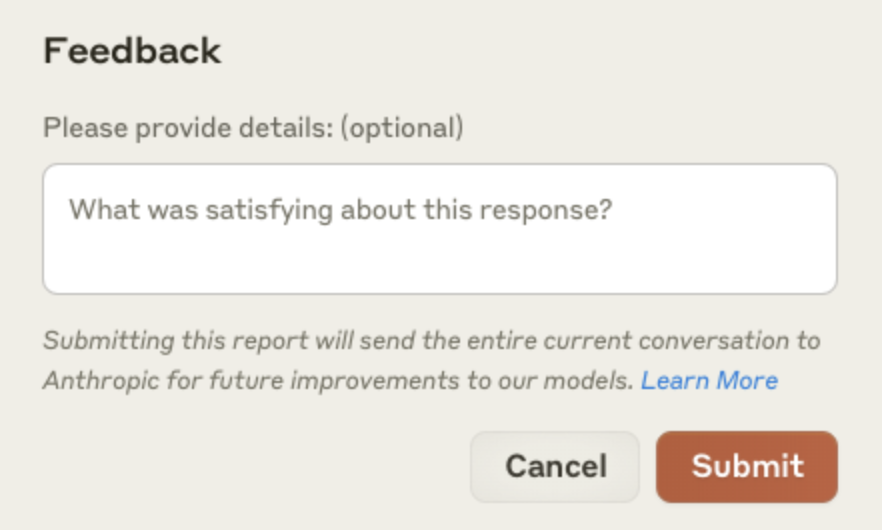
Feedback interface example
On claude.ai, the feedback report interface associated with the thumbs up/down action is illustrated below:
FAQ: Feedback, retention, and model-training boundaries
Does a thumbs down on claude.ai create training data?
If you report feedback through thumbs up/down, the source states Anthropic stores the entire related conversation in secured back-end for up to 5 years. Before feedback is used, it is de-linked from user and customer IDs, and feedback may be used to analyze the effectiveness of services, conduct research, study user behavior, and train AI models as permitted under applicable laws. It is not combined with your other conversations with Claude.
Does connector content automatically come with feedback?
No. Feedback data does not include raw content from connectors such as Google Drive, including remote and local MCP servers. However, the source notes data may be included if it is directly copied into your conversation with Claude.
Can a Team or Enterprise admin stop member feedback submission?
Yes. A Primary Owner or Owner on a Team or Enterprise plan can disable the ability for members of the organization to submit feedback to Anthropic through the thumbs up/down button by using the Rate chats setting under Organization settings > Data and Privacy.
Action recommendations for administrators
- Confirm which plans in your organization are commercial products such as Claude for Work, the Anthropic API, or Claude Gov, and which are consumer plans such as Claude Free, Pro, Max, or plans where accounts use Claude Code.
- Review the Rate chats setting under Organization settings > Data and Privacy if you operate a Team or Enterprise plan.
- Document how users may submit feedback through the thumbs up/down interface on claude.ai and remember the up to 5 years storage rule.
- Train users not to paste material obtained through Google Drive or remote and local MCP servers into a Claude conversation if they want that material to stay outside feedback-related data handling.
- Check Trust Center and Commercial Terms for wider guidance before making final deployment decisions.
Organizational control path
For Team and Enterprise plans, the path to manage member feedback submission is shown in the settings interface below:

For MyTechDailyNews, the takeaway is not that Anthropic's commercial tools expose every enterprise prompt to model training. The source presents a layered model: a default no-training position for Claude for Work, the Anthropic API, and Claude Gov, plus a feedback channel that can be stored, de-linked, analyzed, and used as permitted. The remaining administrative lever is clear: Team and Enterprise owners can turn off member feedback through the Rate chats setting, while all users should understand that copied content from Google Drive or other connectors can enter the conversation and therefore may travel with it.