
Hardware Bench: Reading Cable-Shield Specs When Copper Braid Stops Scaling
By Sarah Chen, MyTechDailyNews Hardware desk
Datasheets tend to reduce a cable shield to one line: a construction code, a metal, sometimes a coverage figure. That framing breaks down the moment an assembly moves into dense RF territory, because the shield then has to be judged on four separate axes at once — added mass, routed volume, termination yield, and attenuation at the frequencies the design actually runs. The analysis below pulls those axes apart for the conventional metal braid and for a coated-textile substitute, so the decision rests on measurable properties instead of inherited habit.
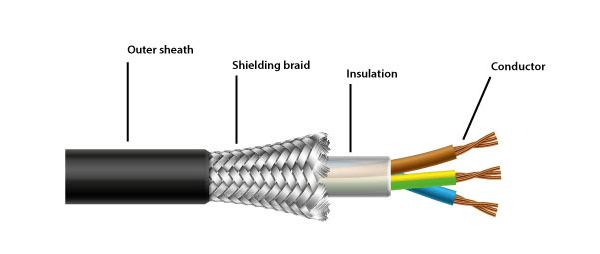
Figure 1 Conventional braided shielding and the RF barrier it forms around the conductors. The schematic shows multiple basic-wire conductors, but the same construction logic applies to coaxial cable and twisted-pair cabling. Source: Stecker Express
The job the braid does — and the tax it levies
For decades, the woven all-metal braid has carried two complementary EMI roles inside one part: it suppresses electromagnetic emissions escaping from the cable while simultaneously keeping interfering energy out of it. It appears on harnesses carrying everything from DC through gigahertz signals, and it is fitted to coaxial cable, twisted pairs and multiconductor cable assemblies alike. It stays in the bill of materials because it is easy to obtain, modest in cost and functional — within limits.
Hardware teams meet those limits in three places. Copper braid (sometimes other metals such as aluminum) is relatively heavy and bulky, so every metre adds mass, volume and cost to the end product. It restricts movement and can be awkward to handle and install. And termination keeps producing the “horror stories” every hands-on engineer can repeat: cleanly marrying the shield to a connector by hand, without the right tools or jigs, plus the tiny cut shards that “fall” off during trimming and then short the cable or the nearby circuit board, turning diagnostics into a scavenger hunt.
Two pressures that scale in the wrong direction
The first is relative bulk. As the protected core shrinks, the shielding’s share of total weight and volume grows. On gigahertz cables that now run down to millimetre-level diameters, the shield — not the conductor — becomes the line item that has to be defended in a design review.
The second is electrical performance at the top of the band. As frequencies reach the multi-gigahertz range, the braid’s shielding performance decreases, because the tiny voids in the weave become “open windows” to short-wavelength RF energy. A tighter weave recovers part of that loss, but it exacts its own price in materials, flex, weight and other factors. The mechanical behaviour compounds the problem: braid resists movement and its “shape memory” makes both initial routing and later rerouting harder, which is exactly what a tightly packed enclosure punishes.
The usual escalation is a solid foil first-layer shield covered by a braided shield. That stack improves RF shielding to nearly 100%, while further increasing cost and weight and adding to termination complexity — the wrong trade for the very designs that motivated it.
The alternative architecture: a coated aramid textile
Micro-Coax, a division of Amphenol, builds its ARACON shielding system on a different premise: form the RF cage around the signal-carrying conductors without woven metal. The substrate is lightweight, ultrathin and extremely strong DuPont Kevlar fiber worked into a textile-like material, then coated with either nickel or silver, the silver option being selected for solderability. The conducting coating adheres to the fabric-like fibers and creates a “wrapper” against electromagnetic energy. Mechanically, the result is a thin braid-equivalent that slips onto the cable core like a thin, open-ended, super-flexible sock, and it can be used with coaxial cable, twisted pair and even wire bundles.
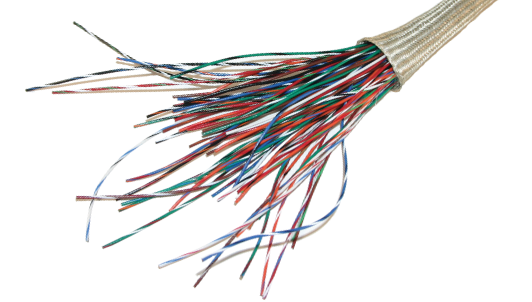
Figure 2 A thin but super-tough fabric sleeve from the ARACON shielding system slips over the conductor or wire bundle to be shielded. Source: Micro-Coax
Side-by-side: the specification data that supports the swap
Because the load-bearing fiber is aramid rather than copper, density is the cleanest apples-to-apples comparison available, and it makes the bulk difference legible at a glance.
| Parameter | Conventional copper braid path | ARACON coated-aramid path |
|---|---|---|
| Core material density | Copper: 8.9 g/cc | Aramid fibers: 1.44 grams per cubic centimeter (g/cc) |
| Coated-fiber composite density | Solid metal wire throughout | Coated fibers: 3 g/cc to 5 g/cc |
| Weight at equivalent shielding function | Baseline | up to 80% lighter than copper |
| Core tensile strength | 35 Ksi to 95 Ksi | 350 kilopounds per square inch (Ksi) |
| RF attenuation reference | Industry standard AA59569 copper braid, baseline | approximately 20 dB greater attenuation than copper braid |
| Flex endurance | Shape memory resists routing and rerouting | Tested to over 50,000 flex cycles over a 180-degree arc |
| Termination | Established hand and tool practice, shard risk when trimming | Techniques similar to wire-braided shields; crimping, banding, soldering if silver plated |
Read in the same units, the aramid core’s tensile strength is 3 to 10 times higher than that of traditional or high-strength copper cores. The unusual part of that pairing is its direction: the shield becomes dramatically lighter while becoming far stronger in tension, two attributes that normally trade against one another.
Data note: the density, tensile, weight and attenuation figures above come from the vendor’s own published characterization of ARACON (Micro-Coax), with the shielding comparison plotted against copper braid built to industry standard AA59569. Treat them as vendor-supplied benchmarks to be verified on your own harness, not as independent laboratory results.
Handling, durability and qualification: a buyer’s checklist
- Tested to withstand over 50,000 flex cycles over a 180-degree arc — the number that matters for harnesses that move in service.
- Installs easily, since it cuts like fabric with standard tools, which shortens the trimming step that generates conductive debris.
- Offers corrosion resistance, important in many real-world settings.
- Meets or exceeds many stringent mil/aero and space-related electrical, mechanical and outgassing performance standards for shielding.
- Wire and cable vendors can braid and fabricate it using standard metal-wire equipment, so no exotic supply-chain step is introduced.
- Supports crimping or banding, as well as soldering if the silver-plated version is specified.
Attenuation evidence on the curve
A high surface-to-volume ratio in the ARACON fibers is what underwrites the shielding claim, supporting effective RF EMI shielding that exceeds the performance of conventional shielding despite the reduced mass.
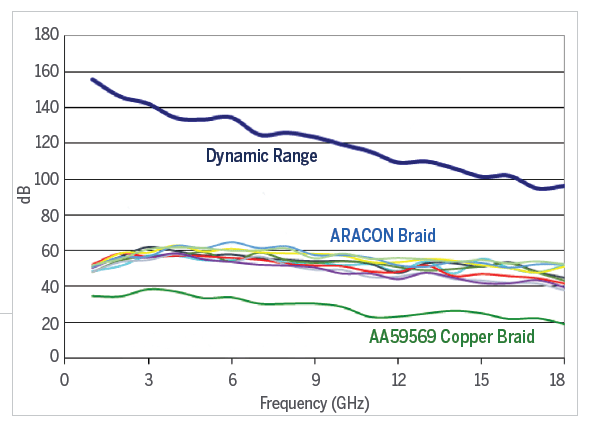
Figure 3 Even with reduced bulk and weight, the ARACON approach offers approximately 20 dB greater attenuation compared with conventional copper braid, here the industry standard AA59569. Source: Micro-Coax
Fit by scenario
Strong fit. Mass-per-dB-dominated platforms: this is not a lab development but a construction that has been in use for over 10 years and has been proven “in the field” in aircraft, space vehicles and more. Dense multi-gigahertz enclosures with millimetre-diameter runs, where shielding bulk is now the constraint. Harnesses that are flexed or repeatedly rerouted during service life. Programs with vacuum exposure, where outgassing performance is a qualification requirement. Silver-plated stock is the variant to specify when solder termination is mandatory.
Weak fit. Cost-led assemblies with generous routing volume and low-frequency links, where proven metal braid remains the cheaper and simpler answer and the shield’s share of total mass is not yet a design problem.
Common misconceptions before you change a shield spec
- “More coverage always fixes performance.” Tighter weaves help, but at a cost in materials, flex and weight; and the foil-plus-braid stack that reaches nearly 100% shielding simultaneously worsens weight and assembly.
- “The shield is a fixed overhead.” Its proportion of total weight and bulk grows as the shielded core shrinks, which is why a solution that looked irrelevant at cable sizes of the past becomes central at today’s diameters.
- “Textile shielding is unproven.” The approach has been in service for over 10 years and validated in the field on aircraft and space vehicles.
- “Termination will become a new headache.” Termination techniques are similar to those already used for wire-braided shields.
- “Lighter must mean weaker.” The coated-aramid core reports 350 kilopounds per square inch (Ksi) against copper cores in the 35 Ksi to 95 Ksi range.
- “The swap will save money.” Comparative pricing was not obtainable, and direct one-to-one comparisons are difficult; the reasonable expectation is a cost premium over conventional metal-braided shielding, justified only where lower weight and bulk, performance and flexibility outrank unit cost.
Action advice for spec writers and purchasers
- Record the actual operating band and the attenuation margin you need, then decide whether braid voids are already leaking at multi-gigahertz wavelengths.
- Calculate the shield’s share of assembly mass and volume at your smallest cable diameter; that ratio, not the absolute grams, is what signals a shielding rethink.
- Audit termination yield: time per connector, available tooling and jigs, and how often trimmed shards have caused shorts on the cable or adjacent board.
- Score flexing and rerouting requirements explicitly — flex-cycle life and shape-memory behaviour, not just static bend radius.
- Match the coating to the process: nickel or silver, with silver required if the build solders the shield.
- Ask the vendor to confirm braiding and fabrication on standard metal-wire equipment, plus crimp, band and solder capability, and to supply the applicable mil/aero and space standards including outgassing.
- Prototype both constructions on your own harness and verify weight and attenuation before committing; use the vendor curve for AA59569 comparison as a starting point, not a sign-off.
- Only after those measurements, price the trade: if mass, volume and dB win the argument, the premium is defensible; if unit cost wins, braid remains the rational choice.
Bottom line
Nothing in the data says metal braid has failed; the design envelope moved out from under it. Saying, as the industry’s long-time shield users might, “we’ve been a team all these years, but things have changed” feels awkward, yet when cable size, weight and multi-gigahertz attenuation are the deciding terms, a coated aramid textile moves from curiosity to a credible specification alternative. If your harness has already outgrown woven metal — or you have measurements comparing a textile shield against copper braid on your own build, the Hardware desk wants to see them: hello@techdaily.com.