
Vox Power EIRE600 Spec Breakdown: 600 W of Open-Frame Power, three Cooling Options and the Derating Limits That Shape the Buy Decision
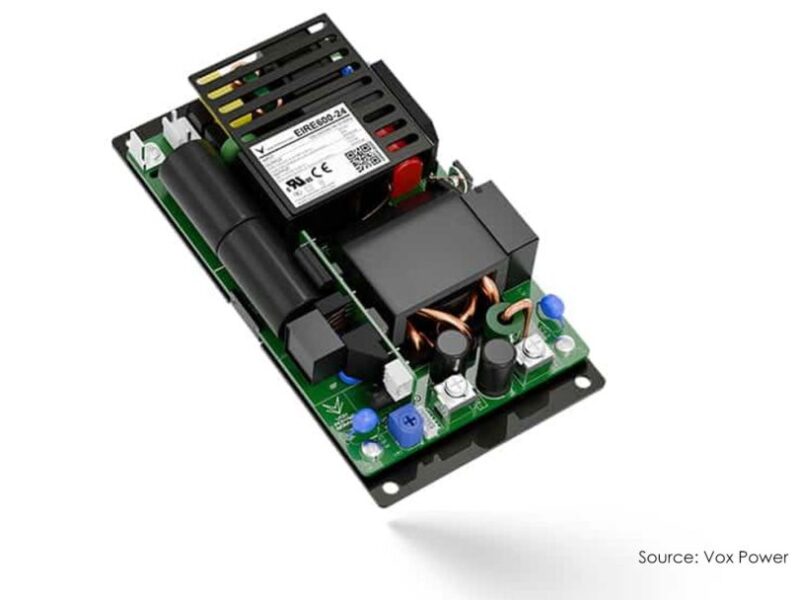
Board-level supplies are rarely bought on a single number, and the open-frame module now sitting at the top of the EIRE line shows exactly why: one nominal rating splinters into four or five different figures once you decide how heat leaves the case and what the mains can look like at their worst. That is the lens this Hardware desk piece uses on the Vox Power EIRE600 — launch commentary stripped back, and the specification sheet read instead as a set of constraints for a designer or a purchasing engineer. Which figure survives inside your enclosure? How much capability does a fanless layout surrender? What does the 750 W burst actually license a load profile to do? The published parameters answer all three, and they do not all point the same way.
Where the new module sits in the family
Vox Power, the Irish manufacturer behind the range, has widened the EIRE series with the EIRE600, a single-output open-frame AC/DC unit. The more compact EIRE300 was the model eeNews Europe reported on in 2024; the newcomer keeps the same board-mounted philosophy at 127 × 76.2 × 27.9 mm (5 × 3 × 1.1 in) and roughly 390 g, aimed at industrial and medical equipment that needs one of three cooling choices without a sealed brick. For an integrator weighing it against the family's smaller member, the trade reduces to board area versus capability: the EIRE600 is the option only when the chassis can absorb the larger footprint, and it makes sense to specify it only once the load is measured against the cooling method you can genuinely deliver.
Cooling path treated as a power budget
Two of the three cooling options unlock the headline rating at a 115 V input. With forced air, or with heat conducted into a chassis or cooling plate, the EIRE600 delivers 600 W continuously. Move to natural convection — no airflow at all — and the continuous figure becomes up to 450 W at the same input voltage: a 150 W penalty paid for silence and a sealed enclosure. Conduction deserves a specific caveat here, because it moves heat into whatever metalwork you provide rather than into a dedicated fan, so the 600 W claim is only as real as the mounting surface, interface and surrounding airflow in your own build.
| Condition as specified | Power on tap | What it changes in your design |
|---|---|---|
| 115 V AC with forced air | 600 W continuous | A fan exists in the product; the 12 V/0.5 A auxiliary rail is there to feed it |
| 115 V AC with conduction cooling | 600 W continuous | Heat leaves through a chassis or cooling plate; thermal performance depends on the installation |
| 115 V AC with natural convection | up to 450 W continuous | Silent and fanless, but 150 W of rated capability is given up |
| Bottom of the 85–264 V input window | 420 W continuous | Output is derated from 600 W at 115 V; low-line conditions, not the label, set the budget |
| Brief transient demand | 750 W for up to 3 s | Capped at a 25% duty cycle, with average power never above the continuous rating |
| Conversion loss indicator | approximately 96% efficiency | Losses are low, but the remainder still has to exit through one of the three paths |
The wattage ladder, and how far you may climb it
Ordered as a ladder, the ratings read: 420 W at the bottom of the input range, 450 W in still air at 115 V, 600 W at 115 V once a fan or a conduction surface does the work, and 750 W if the demand is genuinely momentary. The top rung is the one most often over-read. The manufacturer's datasheet limits peak operation to a 25% duty cycle and requires average power to stay inside the continuous rating, so a 3 s pulse at 750 W only fits a window in which the surrounding time is light enough to drag the mean back down. Worked through, each 3 s of peak needs at least 9 s of lower load around it, and the ceiling to average against is the lowest of 600 W, 450 W and 420 W that your cooling choice and line conditions imply together. Approximately 96% efficiency takes some of the pressure off, because at this power class every point of conversion loss becomes heat that still needs a path out of the board area.
All of these figures are the vendor's own published numbers, cross-checked against the series context established when eeNews Europe covered the EIRE300 in 2024 — useful provenance when the module has to be defended in a design review or a compliance file.
Outputs, signalling and standby draw
Four nominal output voltages are offered — 12, 24, 36 and 48 V — which means the rail is selected to suit the load rather than the other way round. A 5 V/2 A bias output supports control and logic stages, while a 12 V/0.5 A auxiliary supply exists specifically for a fan, an easy feature to overlook in a layout that is intended to run convection-cooled in its first revision. On the control side the module provides remote sensing, an AC_OK status signal and an inhibit input: the first protects regulation accuracy at the load point, the second feeds interlocks and sequencing logic, the third lets host firmware place the output into a low-draw state.
Standby behaviour splits along that inhibit line. Typical consumption is 0.2 W with the main output inhibited, against 0.6 W with the output enabled at no load — a 0.4 W gap that matters when units are plugged in permanently, when a no-load target is tight, or when thousands of installed devices are involved.
Isolation, safety standards and the operating envelope
The insulation architecture is the clearest signal of the module's dual-market intent: 2 MOPP input-to-output isolation and a BF-rated output, with provision for both Class I and Class II equipment. In plain terms, MOPP counts the layers of protection standing between the mains and anything connected to a patient, so a 2 MOPP figure is the higher, patient-connected tier; BF (body floating) describes an output that is isolated from earth for patient-contact applications. Safety compliance is therefore declared twice over — IEC/UL 60601-1 for medical safety and IEC/UL 62368-1 for industrial and ICT equipment — together with Class B conducted and radiated emissions performance.
Environmentally, the unit is rated for −40 to +85 °C operation subject to derating, and for altitudes up to 5,000 m, with overvoltage, overcurrent, short-circuit and overtemperature protection built in. Mechanical and commercial terms are unremarkable but worth recording: about 390 g, a three-year warranty, and availability through Vox Power's distribution and representative network.
Specification summary at a glance
| Parameter | Published value |
|---|---|
| Product / family | Vox Power EIRE600, member of the EIRE series |
| Type | Open-frame, single main output, AC/DC |
| Envelope / mass | 127 × 76.2 × 27.9 mm (5 × 3 × 1.1 in); about 390 g |
| AC input | 85–264 V |
| Continuous output | 600 W at 115 V with forced air or conduction; up to 450 W natural convection; 420 W at minimum input |
| Peak output | 750 W for up to 3 s, 25% duty cycle, average within the continuous rating |
| Efficiency | Approximately 96% |
| Nominal rails | Four choices: 12, 24, 36 and 48 V |
| Auxiliary outputs | 5 V/2 A bias; 12 V/0.5 A fan supply |
| Control and monitoring | Remote sensing, AC_OK status signal, inhibit input |
| Standby draw | 0.2 W typical with main output inhibited; 0.6 W enabled at no load |
| Isolation | 2 MOPP input-to-output, BF-rated output, Class I and Class II provision |
| Safety standards | IEC/UL 60601-1; IEC/UL 62368-1 |
| EMC | Class B conducted and radiated emissions performance |
| Environment | −40 to +85 °C (subject to derating); altitude to 5,000 m |
| Protections | Overvoltage, overcurrent, short circuit, overtemperature |
| Warranty / channel | three-year; Vox Power distribution and representative network |
Common misreadings of these datasheet lines
- 750 W treated as standing headroom. It is a 3 s allowance bounded by a 25% duty cycle and an average-power cap; a load that never falls below its continuous limit simply does not qualify.
- Fanless read as free. Natural convection trims 600 W to 450 W at 115 V, so if the last 150 W is ever needed, an airflow path and the 12 V/0.5 A auxiliary rail belong in the first layout, not a revision.
- Wide input mistaken for uniform output. 85–264 V describes where the module may be plugged in; at the bottom of that window the continuous figure is 420 W.
- Conduction cooling treated as a drop-in. Because heat moves into the chassis or cooling plate, the rating only holds for the metalwork actually built; the same board in a thin enclosure will not behave identically.
- Standby numbers filed as trivia. The 0.2 W versus 0.6 W split is a real 0.4 W per permanently connected unit, and it accumulates across a fleet.
- Component certification mistaken for device certification. The module declares IEC/UL 60601-1 and IEC/UL 62368-1 compliance with 2 MOPP isolation and Class B emissions, but enclosure, wiring, leakage paths and installed EMI behaviour remain system-level work that you must verify.
Pre-spec action list
- Fix the worst-case line first. If the deployment grid can sit at the bottom of 85–264 V, the budget is 420 W rather than the box figure.
- Decide the thermal path before the layout. Forced air or conduction unlocks the full 600 W at 115 V; convection is only defensible when 450 W covers the measured load.
- Choose the rail from the load. Four nominal voltages are on offer — 12, 24, 36 and 48 V — so pick on distribution loss and load compatibility, and reserve the 5 V/2 A bias for control stages.
- Wire the control set properly. Sense at the load point, take AC_OK into your interlock logic, and use inhibit for power-state management instead of a hard supply disconnect.
- Model the transient honestly. Apply the 3 s and 25% limits to your real current profile, then average the result against the cooling-limited continuous rating.
- Check environmental margins. −40 to +85 °C comes with derating and 5,000 m is the rated altitude, so sealed boxes and high-altitude sites need a thermal review, not a spreadsheet copy.
- Plan the mechanics early. At about 390 g inside 127 × 76.2 × 27.9 mm, mounting hardware, clearance access and cleaning routes in a medical or industrial chassis should be settled before the design is frozen.
- Log the commercial terms. A three-year warranty applies and the EIRE600 ships through Vox Power's distribution and representative network; confirm channel and lead time before a prototype schedule depends on it.
- Compare inside the family. If the load never approaches 600 W, the smaller EIRE300 of the EIRE series may suit the enclosure better — the eeNews Europe coverage in 2024 is a reasonable starting point for that comparison.
Verdict for the hardware shelf
Taken as a purchasing decision, this is a cooling-dependent 600 W rather than a flat one, and the honest way to specify it is to start from the enclosure and the grid, then read down the ladder to the number that actually applies. The case for the Vox Power EIRE600 is strongest where one platform must serve both a fan-cooled industrial instrument and a sealed, quietly running medical device, with four rails, an auxiliary fan supply and a monitoring set that already assumes remote sensing and status signalling. Corrections, additional measured data or tip requests for this coverage can be sent to the Tech Daily editorial desk at hello@techdaily.com; this spec breakdown ran on MyTechDailyNews Hardware and was written by Sarah Chen.