
MyTechDailyNews Hardware Signals: System Check Survey Data for Industrial RF Direction, AI Questions and FPGA Hands-On Readiness
This Hardware-side review of the latest System Check from Elektor begins with an editorial split. One section is still open-ended: it asks the community to consider the next phase of industrial RF engineering. The other section is already numeric: it reports prior FPGA answers covering exposure, confidence, and blockers. For board, radio, toolchain, and team-readiness reviews, that distinction is the most practical frame.
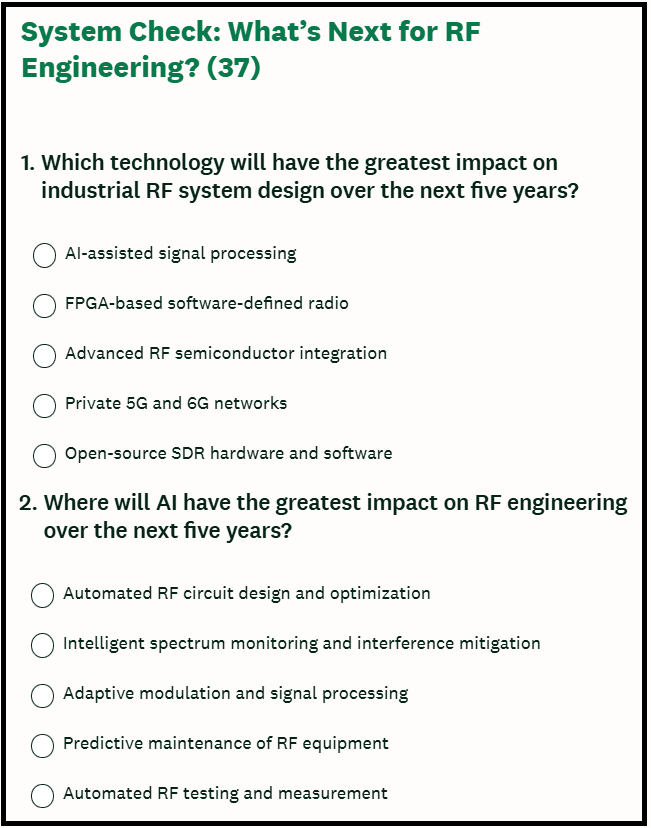
Industrial RF: A Forward-Looking Question Set
The newest Elektor System Check directs respondents toward the future of industrial RF engineering. The report places the topic within automation, wireless communications, and connected systems, then asks which technologies may shape what comes next and where AI could become most consequential.
Because this rewrite presents no future-facing RF percentages, the RF portion should be read as a survey prompt rather than a ranking. It still gives Hardware readers a useful checklist: radio design needs to be evaluated together with automation duties, wireless communication demands, and connected-system integration load.
What an RF-focused hardware team should extract
- Industrial RF should not be treated as an isolated radio-only issue.
- AI relevance is framed at system level, not merely as a component spec.
- Survey planning should separate open RF/AI direction from completed FPGA numbers.
Earlier FPGA Results: Measured Exposure and Confidence
In the earlier part of the series, respondents reported their practical FPGA experience. The answer pattern shows interest plus real exposure, but uneven depth. For hardware buying and skills planning, the difference between regular use, multi-project use, experiments, and non-use is more useful than a single average.
Hands-on experience
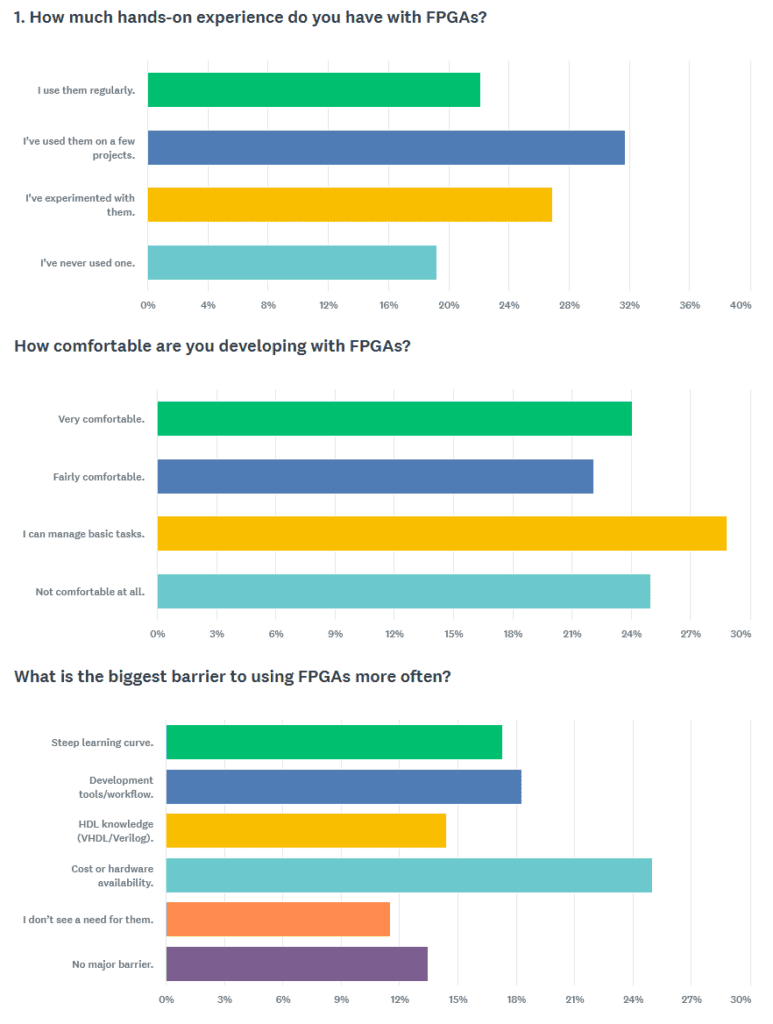
About 22% of respondents use FPGAs regularly. Another 32% have used them in several projects. A further 27% have experimented with FPGAs, and 19% have never used one. Read as one set, these shares show broad familiarity, while routine use remains a minority behavior.
Development confidence
Self-reported confidence is distributed, not binary. Roughly 24% consider themselves very comfortable, while 22% feel fairly comfortable. About 29% can manage basic tasks, and 25% are uncomfortable. For tool and board selection, the 29% basic-task group is especially important: basic capability often needs additional examples, templates, or workflow support before it becomes deeper productive use.
Main barriers
Cost and hardware availability top the barrier list at around 25%. Tooling and workflow issues receive 18%. Learning-curve pressure accounts for 17%. HDL knowledge is cited by 14%. A smaller group, 11%, sees no need for FPGAs, while 13% report no major barrier.
What could broaden adoption
The same responses point to three accelerators: affordable hardware, approachable development environments, and practical learning opportunities. In hardware procurement terms, those reduce entry risk, clarify workflows, and make first projects easier to justify.
Comparison Table: FPGA Survey Shares at a Glance
| Survey dimension | Reported value | Hardware-read note |
|---|---|---|
| Regular FPGA use | 22% | Core practice is present but not universal. |
| Several FPGA projects | 32% | Project exposure is broader than regular use. |
| FPGA experimentation | 27% | Many respondents have touched the technology. |
| Never used FPGA | 19% | A notable share remains outside practical use. |
| Very comfortable | 24% | Advanced confidence is a minority position. |
| Fairly comfortable | 22% | Comfort is split rather than concentrated. |
| Can manage basic tasks | 29% | The largest confidence band is basic rather than deep. |
| Uncomfortable | 25% | A quarter report discomfort with development. |
| Cost/hardware availability barrier | around 25% | Physical and budget constraints lead the blocker list. |
| Tooling/workflow barrier | 18% | Toolchain friction is material but secondary. |
| Learning-curve barrier | 17% | Educational effort is a real adoption drag. |
| HDL knowledge barrier | 14% | Language and skill gaps remain relevant. |
| No perceived need | 11% | Some respondents question relevance. |
| No major barrier | 13% | A minority sees no blocking issue. |
Interpretation notes
- Regular use at 22% is lower than the combined exposure categories, showing familiarity without daily practice.
- Confidence at basic-task level, 29%, exceeds very comfortable at 24%, suggesting a plateau after entry.
- Cost/hardware availability, around 25%, is only one barrier among several; tooling/workflow 18%, learning curve 17%, and HDL 14% are also material.
Common Misreadings of the System Check Data
- Reading 22% as a statement that most people are unfamiliar with FPGAs would be too simple. The report also lists 32% project use, 27% experimentation, and 19% never used.
- Reading confidence as binary would ignore the 29% who can handle basic tasks, alongside 24% very comfortable, 22% fairly comfortable, and 25% uncomfortable.
- Reading barriers as purely budget-related would overlook 18% for tooling and workflow, 17% for the learning curve, and 14% for HDL knowledge.
Action Checklist for Hardware Readers
For makers and design engineers
- Before choosing a development path, identify the dominant blocker: affordability and availability, tool workflow, learning curve, or HDL knowledge.
- If the goal is practical use rather than novelty, favor approachable development environments and hands-on learning opportunities.
- Use the confidence pattern as a reminder that basic-task capability may need more support than a first-board setup provides.
For IT operations and procurement teams
- Map team exposure against the four experience bands: 22% regular, 32% several projects, 27% experimenters, 19% never.
- Include tool and workflow support in the evaluation, because 18% cite those as barriers.
- Treat cost and hardware availability as a primary procurement risk, with around 25% of respondents identifying them.
For RF and AI decision reviews
- Record that the current Elektor System Check is still asking, not answering, the future-facing industrial RF question.
- Frame AI relevance as part of automation, wireless communications, and connected-system impact, exactly as the survey scope suggests.
- Use the completed FPGA dataset as the current evidence layer, rather than mixing it with unreported RF forecast figures.
This is the core Hardware conclusion: the Elektor System Check now combines an open industrial RF and AI question with a hard numeric record of FPGA experience. The data shows broad interest, uneven hands-on maturity, confidence gaps, and adoption friction. The reported way to widen use is straightforward: more affordable hardware, more approachable development environments, and more practical learning opportunities.