
MyTechDailyNews Hardware Guide: Synaptics Astra SR200 xMCU and Coralboard SR/SL Benchmarks, Specs, and Buying Advice
MyTechDailyNews Hardware reviewed the latest edge silicon briefing from Synaptics Inc. presented during its annual tech day, focusing on what matters to board designers, procurement leads, and firmware teams. The headline is the Astra SR200 series xMCU platform, a microcontroller class aimed at multimodal sensing that combines heterogeneous compute, on-package memory headroom, and an NPU stack tuned for low-latency local inference. In practical terms, the design promises to run voice, vision, audio, motion, and contextual sensing without pushing every workload through a separate high-power memory subsystem.
Two product families need to be read together. The chip side, called the xMCU series, supplies the compute tiers, while the Coralboard family gives engineering teams a development route. The platform's most important architectural claim is memory scalability: up to 8 MB of SRAM can be paired with custom high-bandwidth DRAM that grows to hundreds of megabytes. For always-on battery devices, the stated efficiency target is one-third the power of typical system DRAM, a number worth checking against your own inference duty cycle before selecting an external memory option.
Which xMCU tier fits your product?
The Astra SR200 xMCU line is supplied in three versions. The variants are pin-compatible, share a common hardware base, and use the same SDK, so software migration is mainly a performance and cost decision rather than a board-level rewrite.
| xMCU variant | NPU throughput | Best-fit product type | Why it matters |
|---|---|---|---|
| SR210 | 200 GOPS | low-power wake word, voice, and basic sensor nodes | Best when the priority is battery life and always-on operation. |
| SR230 | 300 GOPS | mainstream camera, display, and mixed audio devices | Gives a balanced path for one vision stream plus a UI or audio pipeline. |
| SR250 | 400 GOPS | premium dual-vision or display-heavy edge designs | Suitable for products needing two camera paths and more simultaneous model load. |
The SR200 Series uses the Synaptics Torq AI engine and the Coral NPU from Google Research. On the CPU side, Synaptics describes the industry’s first pairing of Arm Cortex-M85 and Cortex-M52. The faster core runs at up to 800 MHz and handles control, multimedia, and burst compute; the smaller core remains active for sensor fusion, connectivity, and low-power inference. A Cadence Tensilica HiFi 5 DSP is available when acoustic machine learning is a core workload, while an always-on domain can manage voice activity detection, timekeeping, and wake-up tasks.
Memory and model growth are the reason to look past raw clock speed. The architecture is built for transformer-friendly inference and includes an MLIR/IREE compiler path for standard frameworks. That combination matters when you are estimating whether a quantized vision or language model can live on-device without adding power-hungry memory. The company also highlights security as a silicon-level requirement: a multi-layered security engine combines hardware isolation, cryptographic acceleration, anti-tamper detection, device lifecycle management, and secure boot. The stated certification targets are PSA Level 3 and CC EAL4+.
Connectivity and peripheral checklist
For hardware selection, peripherals often decide feasibility. The platform lists high-speed octal SPI, SDIO, and eMMC storage paths, along with UART, SPI, I2C, I3C, PWM, USB 2.0, and low-power GPIOs. Industrial versions add 1Gb Ethernet with IEEE 1588 TSN support and two CAN-FD interfaces, which makes deterministic control and time-sensitive networking easier to evaluate for robotics, physical AI, and plant equipment. The software story includes an open-source Torq NPU compiler plus Zephyr RTOS support, useful for teams standardizing firmware across sensor products.
Development hardware is where the launch becomes testable. Synaptics introduced the Coralboard SR development board, built around the Astra SR250 Series and co-developed with Google Research. The Coralboard family exposes the MLIR-based Synaptics Torq compiler and runtime, giving makers and professional teams an open path from evaluation to prototype. It is positioned for wearables, hearables, smart home appliances, automation hubs, industrial control systems, and robotics.
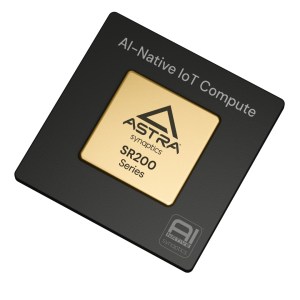 Image: Astra SR200 xMCU (Source: Synaptics Inc.)
Coralboard SR: what the board adds
The Torq open-source toolchain is the board's software anchor. Synaptics says it supports popular ML frameworks and is designed for day-0 enablement of edge AI model families such as Google Gemma3 270M, LiquidAI LFM2.5, and Ultralytics YOLO26. For the compact language model, the cited throughput is up to 12-16 tokens/second using INT8 and 4-bit quantization respectively. If your product roadmap depends on running small language, vision, or sensor models locally, these are the first parameters to verify on the actual board, not just on paper.
The Coralboard SR hardware list includes an 800-MHz Arm Cortex M85, Cortex M52, 400 GOPS Torq/Coral NPU, NOR flash memory, a microSD card slot, integrated SRAM up to 8 MB, and high-bandwidth custom DRAM up to 256 MB. Connectivity includes Wi-Fi/Bluetooth, QWICC and mikroBUS connectors, and multi-camera and display support via CSI/DSI and USB. Dual ISP and digital mic support further broaden the sensor mix that can be attached to one board.
Key advantages:
- Prototype speed: the board maps directly to the SR250 tier, so camera, display, and audio experiments start from the same SDK.
- Memory headroom: custom DRAM expansion is useful for multimodal workloads that would otherwise require a larger external memory subsystem.
- Model flexibility: MLIR/IREE compiler and Torq open-source toolchain lower the risk of framework lock-in.
Trade-offs to watch:
- Power modeling: “one-third” is a design target, not a universal product result; measure your inference pattern under real ambient light, audio load, and wake frequency.
- Model accuracy: quantized models can behave differently on-device; compare INT8 and 4-bit outputs before committing.
- Peripheral bandwidth: dual-camera designs need early validation of CSI/DSI paths, USB traffic, and flash or microSD storage.
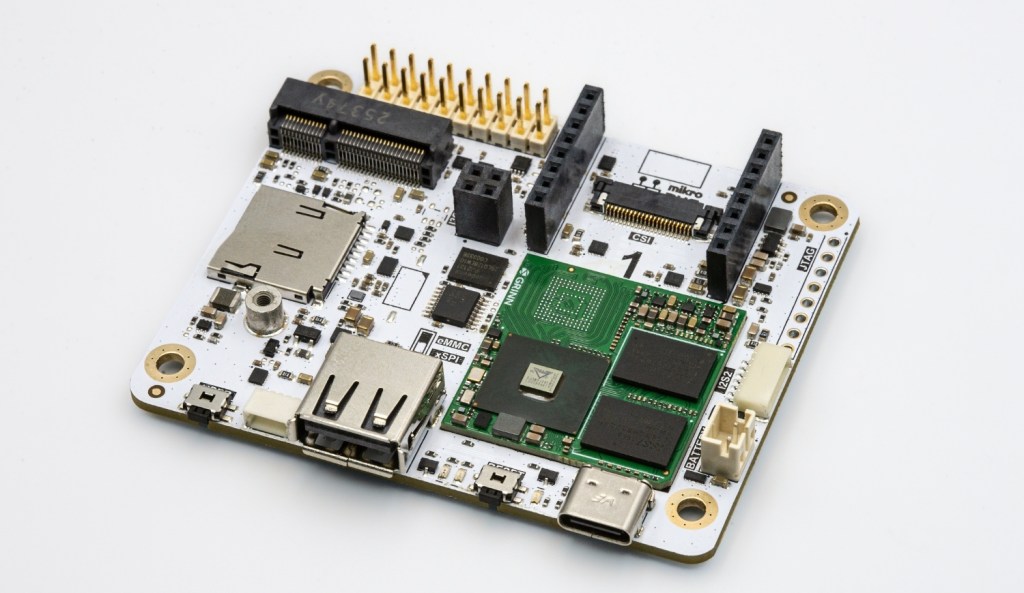 Image: Coralboard development board (Source: Synaptics Inc.)
Coralboard SL and purchase window
The lower-cost route is the Coralboard SL, which Synaptics announced as generally available through DigiKey. This board is powered by the Astra SL2619, integrating the 1-TOPS Synaptics Torq NPU and noted as the first implementation of the Coral NPU. In board specification terms, it includes 2× 2-GHz Arm Cortex A55 cores, a Cortex M52 core, 2-GB DDR4 memory, NOR flash, and add-on HATs for HDMI display, power, camera, and digital mics. Like the SR board, it includes Wi-Fi/Bluetooth, QWICC and mikroBUS connectors, and multi-camera and display support via CSI/DSI and USB, plus dual ISPs and digital mics.
For buyers, the practical question is which developer entry point matches the final target. The Coralboard SL gives an accessible way to evaluate the Torq NPU ecosystem and Coral NPU direction, while the Coralboard SR development board is closer to the premium SR250 chip configuration. The Synaptics Coralboard is available to order from DigiKey starting October 20, 2026.
MyTechDailyNews Hardware action plan
- Start with the workload table: choose SR210, SR230, or SR250 based on required GOPS and number of camera or display paths.
- Model memory growth early: if your vision or voice stack is approaching the limits of on-chip SRAM, validate custom DRAM scaling to hundreds of megabytes.
- Verify security targets: confirm whether PSA Level 3 and CC EAL4+ map to your product certification plan, especially for consumer and industrial deployments.
- Prototype the board, not only the datasheet: use Coralboard SR for dual-camera and display tests, and Coralboard SL for broader ecosystem and model evaluation.
- Log real power: test one-third of typical system DRAM claim against your actual always-on duty cycle and peak compute bursts.
Common misconceptions to avoid
- More GOPS alone means a better device: memory bandwidth, sleep power, and DSP use can matter more than a single accelerator figure.
- All xMCU series parts need different software: the three versions are pin-compatible and use a common SDK, so the migration cost is lower than the top-line speed difference suggests.
- One board fits every tier: Coralboard SR is built around the higher-end SR250 profile, while Coralboard SL is the entry ecosystem route with a different CPU and NPU configuration.
Spec reference data
| Item | Reference value | Editorial note |
|---|---|---|
| SRAM | up to 8 MB | Useful for small context and low-latency buffers. |
| Custom DRAM scaling | hundreds of megabytes | Relevant for larger multimodal models. |
| Power claim | one-third | Verify on your product's duty cycle. |
| Top CPU speed | 800 MHz | Burst compute and control core figure. |
| Board DRAM | up to 256 MB | Coralboard SR expansion capacity. |
| SL NPU | 1-TOPS | Coralboard SL ecosystem entry point. |
| Order date | October 20, 2026 | DigiKey availability window. |
MyTechDailyNews Hardware sees the strongest value proposition in how the SR200 Series separates always-on efficiency from burst performance while keeping one development path open across three versions. For procurement and engineering teams, the next step is simple: define the sensor count, decide whether local LLM or vision inference is mandatory, then test the matching Coralboard before the design locks into memory, radio, or industrial interface choices.