
Hardware Review Lens: Synaptics Astra SR200 series xMCUs Bring Multimodal AI to Embedded Designs
For MyTechDailyNews Hardware readers, the relevant question is not whether on-device AI is fashionable. The question is whether an embedded processor can keep a multimodal workload near the sensor without turning the design into a power, cost, or board-space problem. The Synaptics Astra SR200 series is positioned as that kind of platform: a family of xMCUs that combines heterogeneous, AI-native compute and acceleration with integrated high-bandwidth custom DRAM. The stated goal is to run multimodal AI workloads beyond the memory and compute limits imposed by conventional MCUs, so larger AI models and richer multimodal workloads can remain entirely on-device.
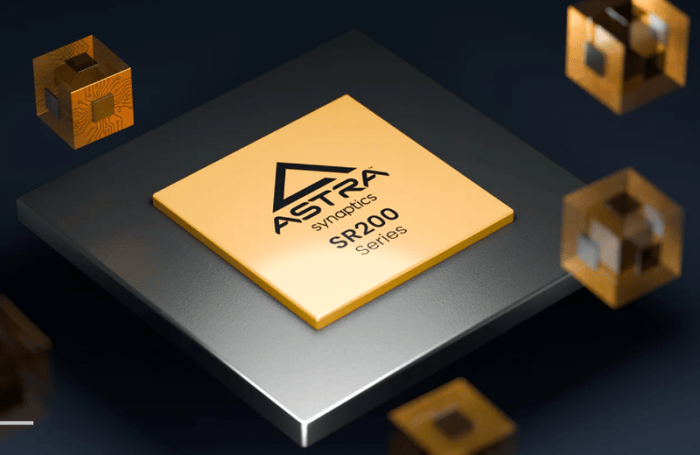
The architecture in plain engineering terms
Embedded AI designs often fail at the memory interface before they fail at math. A neural accelerator can have enough operations per second, but a model still needs to reach parameters, activations, audio buffers, image buffers, and display data. In the Astra SR200 series description, the compute path is deliberately split. The Torq AI engine uses Google Research's transformer-capable Coral NPU to provide up to 400 GOPS of AI inference. Arm Cortex-M85 and Cortex-M52 cores carry the real-time control side. The platform also includes integrated vision and audio capabilities and hardware-rooted security.
Memory is handled in tiers. The source states that up to 8 Mbytes of SRAM is paired with extensible, high-bandwidth, high-capacity custom DRAM. That custom DRAM scales to hundreds of Mbytes. According to Synaptics, the arrangement runs workloads at one-third the power of typical system DRAM. For a hardware evaluation, those points matter more than abstract AI language: inference throughput, local memory hierarchy, and relative DRAM power.
Product tiers: the practical difference between SR210, SR230, and SR250
The Astra SR200 series comprises three pin-compatible product lines that share a common hardware foundation and SDK. The tiers are differentiated by AI performance and the workloads they are aimed at. This makes the family easier to evaluate as a procurement map rather than as a single chip announcement.
| Model | Stated AI compute | Target workload | Hardware focus |
|---|---|---|---|
| SR210 | 200 GOPS | Always-on voice and sensing | Lower-tier compute for sensing-centric devices |
| SR230 | 300 GOPS | Vision, display, and optional audio | Adds vision and display support for richer interfaces |
| SR250 | 400 GOPS | Demanding edge applications | Provides dual vision and display paths |
Why the memory tier matters more than raw AI numbers
In a multimodal system, the bottleneck is rarely only the neural engine. A voice-driven design may need to keep small models resident, while a vision-and-display design may need to move larger buffers between sensor, display, and processing logic. That is where the tiered memory claim becomes important: up to 8 Mbytes of SRAM gives the system fast local working storage, and extensible custom DRAM scaling to hundreds of Mbytes gives designers a path for larger on-device model footprints. If the power claim of one-third versus typical system DRAM holds in a board-level test, the value is not simply more memory capacity; it is a different trade-off between local AI feasibility and system power.
Specification reference from the source material
- AI compute reference: up to 400 GOPS at the top of the Astra SR200 series family.
- Accelerator stack reference: Torq AI engine built around Google Research Coral NPU, described as transformer-capable.
- Processor reference: Arm Cortex-M85 and Cortex-M52 cores for embedded control and real-time tasks.
- Memory reference: up to 8 Mbytes of SRAM paired with high-bandwidth custom DRAM scalable to hundreds of Mbytes.
- Power reference: according to Synaptics, the custom DRAM arrangement runs workloads at one-third the power of typical system DRAM.
- Family reference: three pin-compatible product lines, common hardware foundation, and common SDK.
Buyer and integrator checklist
- Map the product to the correct tier before judging model size. A sensing or always-on voice device may be evaluated against SR210 and 200 GOPS. A vision-and-display device should start with SR230 and 300 GOPS. A dual-path vision/display application belongs with SR250 and 400 GOPS.
- Estimate on-device model residency against the memory tiers. If the workload cannot live within up to 8 Mbytes of SRAM, verify whether the custom DRAM path is appropriate for the board layout, thermal envelope, and bill of materials.
- Validate the memory power assumption early. The one-third figure is relative to typical system DRAM; a product team should confirm whether that ratio moves its actual power budget.
- Leverage the common foundation for portability. Because the three lines are pin-compatible and share a common hardware foundation and SDK, a prototype may be sized up or down more cleanly than in a platform split.
- Confirm security requirements. Hardware-rooted security is listed as part of the family, so procurement can evaluate it alongside integrated vision and audio capabilities rather than treating it as a separate software bolt-on.
Common misconceptions
- More GOPS is not automatically smoother multimodal AI. Inference throughput is only one input; memory bandwidth, model placement, and software efficiency still decide real-time behavior.
- On-device AI does not require every application to use the same chip tier. The platform is presented as a family, with 200 GOPS, 300 GOPS, and 400 GOPS levels mapped to different workload envelopes.
- A large local memory pool is not a standalone advantage. The relevant claim is integrated high-bandwidth custom DRAM, because capacity without an efficient data path does not help embedded AI.
- A custom DRAM claim is not a generic marketing statement. It directly supports the architecture's goal of keeping larger AI models and richer multimodal workloads entirely on-device.
Prototype evaluation sequence
- Start with one workload representative: voice and sensing for SR210, single vision plus display for SR230, or dual vision plus display for SR250.
- Measure memory occupancy in two layers: working set in SRAM and larger model or buffer residency in extensible custom DRAM.
- Compare AI utilization across the Torq AI engine and the Arm cores. The goal is not to prove that one engine can do everything, but to see whether the heterogeneous architecture keeps the workload on-device.
- Track system-level power against the stated one-third DRAM reference, then map the result to battery life, thermal headroom, or wall-power constraints.
- Only after those checks, test model expansion toward hundreds of Mbytes of custom DRAM. That is where the architecture claims to change the design envelope.
Hardware decision conclusion
For MyTechDailyNews Hardware, the most useful takeaway is that Synaptics is not framing the Astra SR200 series as a single MCU upgrade. It is framing it as a scalable on-device AI platform built from concrete variables: up to 400 GOPS from the Torq AI engine, Google Research Coral NPU acceleration, Arm Cortex-M85 and Cortex-M52 cores, hardware-rooted security, up to 8 Mbytes of SRAM, and custom DRAM scalable to hundreds of Mbytes. The family's 200 GOPS, 300 GOPS, and 400 GOPS tiers make the product choice clearer for designers, while the common hardware foundation and SDK reduce the risk of locking an application too early to one tier.
The decisive evaluation question is practical: will a given multimodal workload remain local without unacceptable heat, power, or memory trade-offs? Synaptics gives a concrete hardware answer by combining heterogeneous, AI-native compute and acceleration with integrated high-bandwidth custom DRAM. For teams selecting between voice sensing, vision and display, or demanding edge AI, the SR210, SR230, and SR250 tiers are best read as a staged decision ladder, not as interchangeable parts with only a speed label.