
Hardware Buyer’s Breakdown: Synaptics Astra SR200 Series, Tiered Memory and the Race to Hundreds of Megabytes
By Sarah Chen, MyTechDailyNews Hardware desk · Feedback and corrections: hello@techdaily.com
Most microcontroller shortlists are still built the same way: count the cores, check the clock, then compare a headline accelerator number. That routine made sense when firmware footprints lived in kilobytes. Applied to the current wave of edge AI silicon, it measures the wrong bottleneck — in real designs the constraint that surfaces first is usually the memory subsystem, not the arithmetic engine. The vendor briefing behind the Astra SR200 Series is worth reading specifically because it puts that subsystem ahead of the compute story.
What Synaptics actually announced, in spec terms
The launch covered here took place at Synaptics Tech Day, held in San Jose on Oct. 20, 2026. Two framing statements from that event set the parameters for any hardware evaluation. Chief executive Rahul Patel described SR200 as an xMCU because it offers multiple compute dimensions on a single piece of silicon, and he also characterized Synaptics as a processor company at the edge — a positioning claim that matters when you are deciding whether to treat these parts as MCUs or as small application processors.
John Weil, VP and GM for IoT and Edge AI Processor Business at Synaptics, called the family a new class of microcontrollers and identified three fundamental tenets behind the design transition. “Synaptics went down this path to enable edge AI-capable devices with always-on low-power modes and a greater compute envelope found in entry-level microprocessor units,” he said.
- Compute: heterogeneous, AI-native compute and acceleration, rather than a single general-purpose core.
- Memory: integrated high-bandwidth custom DRAM scalable to hundreds of megabytes, with an in-package interface.
- Workload envelope: larger AI models and richer multimodal tasks executed entirely on the device, with no round trip to a data centre.
The core pairing and the accelerator stack
Read against a datasheet checklist, the headline block is the industry’s first pairing of the Arm Cortex-M85 and the Cortex-M52 cores, combined with up to 400 GOPS of AI acceleration, 256 MB of custom DRAM, vision and audio capabilities, and hardware-rooted security. On the inference side, the edge AI MCU uses Synaptics’s Torq NPU and Google Research’s Coral NPU to run CNN and transformer workloads.
That accelerator split is the practical reason the family spans so much ground: CNN-centric vision pipelines and transformer-based audio or keyword models do not place identical demands on a memory controller, and an MCU that addresses both lets a product team keep one platform across a model refresh.
“Synaptics brings a variety of Arm cores from an ultra-low-power domain to a high-performance domain,” Weil said. “This allows engineers to pick exactly the compute level they want.” He tied that flexibility directly to multimodal behaviour: combining modalities such as voice, vision, audio, motion and contextual sensing — and responding to them in real time — is where the core spread plus the tiered memory architecture earn their keep.
Why the memory ladder is the number to quote in a review
Memory architectures were traditionally designed to feed the CPUs and NPUs. Weil’s point, and the one a buyer should take to a design review, is that many AI applications are not primarily straining the compute element at all — they are straining the memory interface hard. That pattern is also visible in the much larger memory volumes being placed into cloud infrastructure.
Plot the MCU memory ladder and the shift becomes obvious: hundreds of kilobytes was the baseline for traditional microcontrollers, then megabytes became common, and now the discussion reaches hundreds of megabytes of memory. Around an on-chip memory architecture, SR200’s tiered memory architecture builds high-performance compute and adds a custom DRAM interface with in-package memory, bringing HBM-like high-performance memory into a microcontroller.
Assessed against its own memory ladder, the tiered architecture addresses two problems. Conventional silicon answers only the first.
| Constraint | Traditional MCU | Astra SR200 Series |
|---|---|---|
| Feeding compute cores efficiently | Limited by on-chip memory and compute | Tiered memory feeds CPUs and NPUs |
| Sizing memory for ultra-low-power, always-on AI | Not separately addressed | Custom-designed memory tier handles always-on listening and responds simultaneously |
| Capacity ceiling | hundreds of kilobytes to megabytes | Scalable to hundreds of megabytes |
“In this memory-constrained world that we live in right now, it offers design engineers the potential to build really differentiated edge AI devices,” Weil said. “No one else is talking about MCUs having this level of tiered memory architecture and going into the hundreds of megabytes of capacity.”
Power behaviour: the second half of the trade-off
Battery-powered edge hardware rarely fails on peak throughput; it fails on the always-on floor. Weil stated the company’s position on both ends: “We have put a lot of time and effort into bringing high-performance and efficient compute to a low price point and low power point,” he said, adding, “But we also invested heavily in memory architectures that were designed to feed CPUs and NPUs more efficiently.”
The implication for power budgeting is indirect but real: the tiered memory architecture plays a key role in enabling ultra-low-power operation, and feeding the neural processors more efficiently can reduce the device’s power consumption — which is why higher accelerator throughput does not automatically mean a larger cell or a thermal problem.
Tier selection: three pin-compatible tiers, side by side
Because the parts are pin-compatible, tier selection is a performance and power decision rather than a board redesign, and the table below is the shortlist filter.
| Model | AI acceleration | Target use | What to check before you commit |
|---|---|---|---|
| SR210 | 200 GOPS | power-optimized, always-on voice and sensing | Whether the workload is dominated by continuous listening rather than vision throughput |
| SR230 | 300 GOPS | mainstream multimodal devices with vision, display, and optional audio | Whether one vision path plus a display path covers the product definition |
| SR250 | 400 GOPS | demanding edge applications with dual vision and display paths | Whether simultaneous sensor streams justify the top compute envelope |
Where the platform is landing first
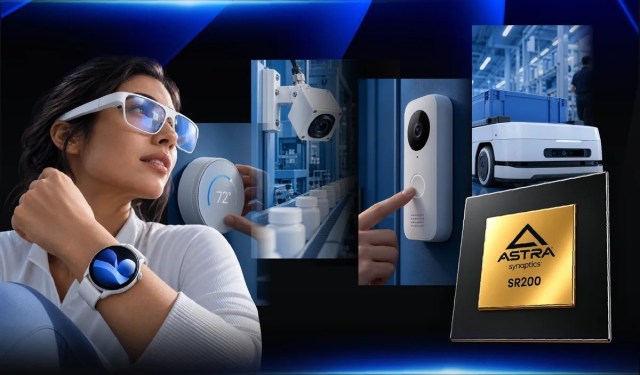
Target categories announced for these MCUs are the next generation of AI wearables, battery-powered sensing devices, connected cameras and streamers, plus industrial vision and voice systems. Weil said the strongest traction so far has come from body-worn electronics — which is consistent with a spec built around an always-on memory tier plus a burst compute tier.
Common misconceptions to retire before you draw a schematic
- “Accelerator throughput is the ranking metric.” The stated workload profile is memory-interface-bound; a higher GOPS part paired with an inadequate memory subsystem will not deliver the model you sized for.
- “On-chip memory is the only ceiling that matters.” The tiered architecture deliberately extends past on-chip capacity with in-package custom DRAM, which is what moves the envelope to hundreds of megabytes.
- “Multimodal means the cloud stays in the loop.” Larger AI models and richer multimodal workloads are positioned to operate entirely on the device.
- “Every performance step up costs a redesign.” Three pin-compatible tiers exist precisely so compute can be scaled without changing the footprint.
- “More AI compute automatically means worse battery life.” Efficiently feeding the neural processors can reduce the device’s power consumption, which cuts against that assumption.
Action recommendations for evaluation and procurement
- List every modality the product must handle — voice, vision, audio, motion, contextual sensing — and note which ones must run at the same time.
- Size the model footprint against 256 MB of custom DRAM before choosing a tier, not after.
- Map your model types to the two accelerator paths: CNN workloads and transformer workloads on Torq NPU and Coral NPU.
- Set an always-on power floor from your battery spec; if continuous listening dominates, start at SR210.
- Confirm security requirements can be met by hardware-rooted security rather than a software layer.
- Prototype at one tier and plan an upgrade path across the pin-compatible family instead of re-spinning the PCB.
- Treat every figure quoted here as vendor-reported data from Synaptics Tech Day; validate throughput, capacity and power against production datasheets and evaluation kits before sign-off.
Bottom line for hardware buyers
The useful takeaway from this launch is not a single performance number — it is a change in what you should be comparing. When an MCU family carries an in-package DRAM interface, an always-on memory tier and a spread of Arm cores from ultra-low-power to high-performance, the selection exercise stops being “which chip is fastest” and becomes “which memory and power envelope fits the modalities we ship.” Evaluate SR200 on that basis, and the tier table above is enough to narrow a shortlist in one pass.