
Hardware Alert: Snapdragon X2 Elite Loses Up to 87% in Premiere Pro and Local LLM Runs on Adreno 32.0.181.0
For once, the specification that decides whether a Windows on Arm laptop is actually usable is not a core count, a boost clock or a TOPS figure — it is a driver build. Qualcomm has rolled out Adreno 32.0.181.0 to systems powered by Snapdragon X and Snapdragon X2 series processors, and the release was aimed at game stability and application compatibility. Measurements now circulating in the community attach a very different cost to that same build: on Snapdragon X2 Elite hardware, owners report losses reaching 87% in Adobe Premiere Pro rendering and in local large language model (LLM) inference. The discussion started on Reddit has, in practical terms, converted a version number into a purchasing and maintenance decision.
The Fault Line Runs Through the GPU, Not Through the Silicon
Two workload families dominate the reports: Adobe Premiere Pro video rendering, and local LLM inference that leans on the graphics side of the chip. Everything else about the platform appears, in these accounts, to be holding steady — which is exactly why the regression is easy to misread as a processor problem when it is a software-stack problem.
The clearest creator-facing number comes from an ASUS Zenbook A16 built around a Snapdragon X2 Elite processor. After that machine moved to the 32.0.181.0 driver, a roughly 7-minute 1080p sequence that had previously exported in 1 minute 40 seconds reportedly took about 10 minutes — a slowdown approaching 6x. The user's conclusion is blunt: creative software efficiency is measurably damaged, and this particular build should be skipped for now rather than adopted on faith.
Token-by-Token: llama.cpp and OpenCL Numbers on the Surface Laptop
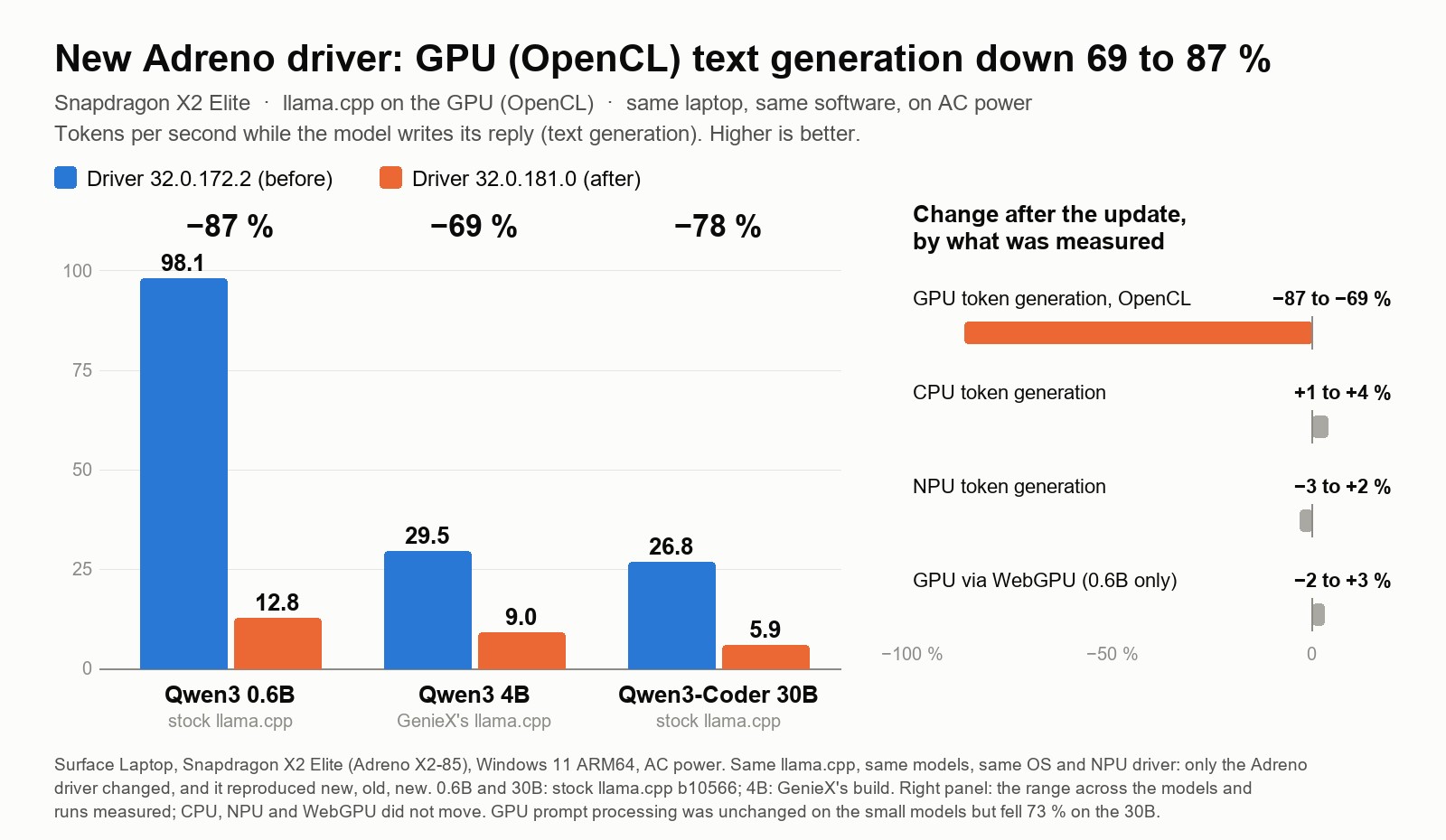
The second report is the more systematic one, and the more useful if you evaluate hardware by tokens per second rather than by render minutes. It was run on the eighth-generation Microsoft Surface Laptop with a Snapdragon X2 Elite platform and an Adreno X2-85 GPU, using llama.cpp with the OpenCL backend across several Qwen3 series models. The same model files were measured on the previous 32.0.172.2 driver and then again on 32.0.181.0, and text-generation speed fell across the board.
| Model measured (llama.cpp + OpenCL) | Driver 32.0.172.2 (previously) | Driver 32.0.181.0 | Position in the reported set |
|---|---|---|---|
| Qwen3-0.6B | 98.1 tokens per second | 12.8 tokens per second | Sharpest single-model loss reported |
| Qwen3-4B | 29.5 tokens per second | 9.0 tokens per second | Smallest of the three drops, still severe |
| Qwen3-Coder-30B-A3B-Instruct | 26.8 tokens per second | 5.9 tokens per second | Between the two extremes |
Depending on the model and the workload, the aggregate figure quoted from these tests is a peak decline of 87%. Note what that spread also tells you: this is not a flat, uniform penalty. Small, fast models — the ones people use to judge whether a machine feels responsive in a local assistant workflow — lose the most, which is why the same driver can feel fine in one task and unusable in another.
How the Test Was Controlled: Roll Back, Restore, Repeat
What makes this evidence more than anecdote is the repetition. To locate the cause, the tester uninstalled 32.0.181.0 and restored the older driver, at which point performance immediately returned to normal; reinstalling the newer package brought the slowdown straight back. Hardware configuration, operating system version, software environment and model files were held identical throughout, and the laptop stayed plugged into AC power the entire time, ruling out a power-policy surprise as the confounder.
Read as a troubleshooting template, that sequence isolates a single variable — the driver — and is the same method IT admins use when a fleet update behaves inconsistently.
Scope: Which Subsystems Do and Do Not Show Regression
- Where losses appear: workloads that depend on Adreno GPU acceleration — video rendering and export in Adobe Premiere Pro, and GPU-compute AI inference such as llama.cpp over OpenCL.
- Where losses do not appear: the Snapdragon X2 Elite CPU side and the NPU side, which are described as not being visibly affected in the same user reports.
- Most likely technical area: OpenCL or GPU-compute optimisations introduced or changed inside 32.0.181.0, rather than a performance defect in the processor itself.
- Vendor status: as of now Qualcomm has published no official statement on the user reports, and no driver defect has been confirmed.
Four Readings to Watch Out For
- "The chip got slower." It did not. On the same hardware, the same OS build and the same model files, the regression disappears the moment the older driver is restored and returns the moment 32.0.181.0 is reinstalled.
- "If the CPU and NPU are down too, this is a platform-wide collapse." The reports point specifically at GPU-dependent tasks; CPU and NPU performance are described as not noticeably impacted.
- "The release notes promise better stability, so professional apps are covered." The build's stated goals were game stability and application compatibility; GPU-compute paths such as OpenCL inference and video export are a different code path, and that is where the measured damage sits.
- "Qualcomm has acknowledged the flaw and a fix is dated." There is no official explanation and no confirmed defect as of now, so anyone quoting a patch timeline is filling in a gap that has not been filled.
Decision Checklist Before You Install or Deploy 32.0.181.0
- Name your real workload first. If a machine only browses and streams, the reports do not touch you; if it exports Premiere Pro timelines or runs local models on the Adreno GPU, treat this as a held update.
- Baseline before you flash anything: record one fixed short-sequence export time and one fixed llama.cpp token-per-second run so "slower" becomes a number instead of a feeling.
- Confirm the currently installed Adreno build and keep 32.0.172.2 — or whatever known-good package you validated on your own hardware — reachable as a rollback target.
- If performance has already dropped, uninstall 32.0.181.0, reinstall the previous driver, then re-run the exact same baseline tests to confirm recovery.
- Run every comparison on AC power with identical OS builds, model files and project media, mirroring the controlled method used in the Surface Laptop tests.
- For mixed fleets of Snapdragon X and Snapdragon X2 series systems, stage the update on one device that does GPU-compute work before pushing it widely.
Data Reference: What These Numbers Are, and What They Are Not
Every figure above traces to user-published testing discussed on Reddit, not to Qualcomm lab validation: one ASUS Zenbook A16 export comparison (about 7 minutes of 1080p media, 1 minute 40 seconds moving to roughly 10 minutes, a slowdown approaching 6x) and one eighth-generation Microsoft Surface Laptop run on an Adreno X2-85 GPU using llama.cpp with an OpenCL backend across three Qwen3 series models (98.1 tokens per second falling to 12.8; 29.5 to 9.0; 26.8 to 5.9), with the reported worst case at 87%. Single-machine community results are directionally valuable and operationally insufficient — they tell you to hold off, not that every unit in your inventory will behave identically.
The Bigger Picture for Buyers and Operators
Set the individual percentages aside for a moment and the pattern still matters. As Snapdragon X2 Elite pushes deeper into creator and AI-developer territory, the platform's competitive position is increasingly decided at the driver layer rather than at the silicon layer: the same notebook can be a fast export machine on Monday and a sluggish one on Tuesday purely because of a graphics package version. For anyone whose upgrade cycle, software stack or fleet policy depends on GPU-accelerated local AI and video work, driver stability and rollback support are now a line item in the evaluation sheet, not an afterthought — and until Qualcomm addresses these reports publicly, staying on the earlier build is the defensible choice.