
MyTechDailyNews Hardware Bench: Testing the 3 W Sixfab AI HAT+ Edge NPU on Raspberry Pi 5
By Sarah Chen, MyTechDailyNews Hardware Desk. Published by Tech Daily, editorial contact: hello@techdaily.com.
MyTechDailyNews evaluates this accessory from a hardware-procurement standpoint: the platform already reaches millions of engineers, students and makers, while the useful target is a continuously running vision-and-language loop. In that setting, a three-watt budget can decide whether a compact camera, robot or sensor can stay local without oversized cooling or a cloud dependency.
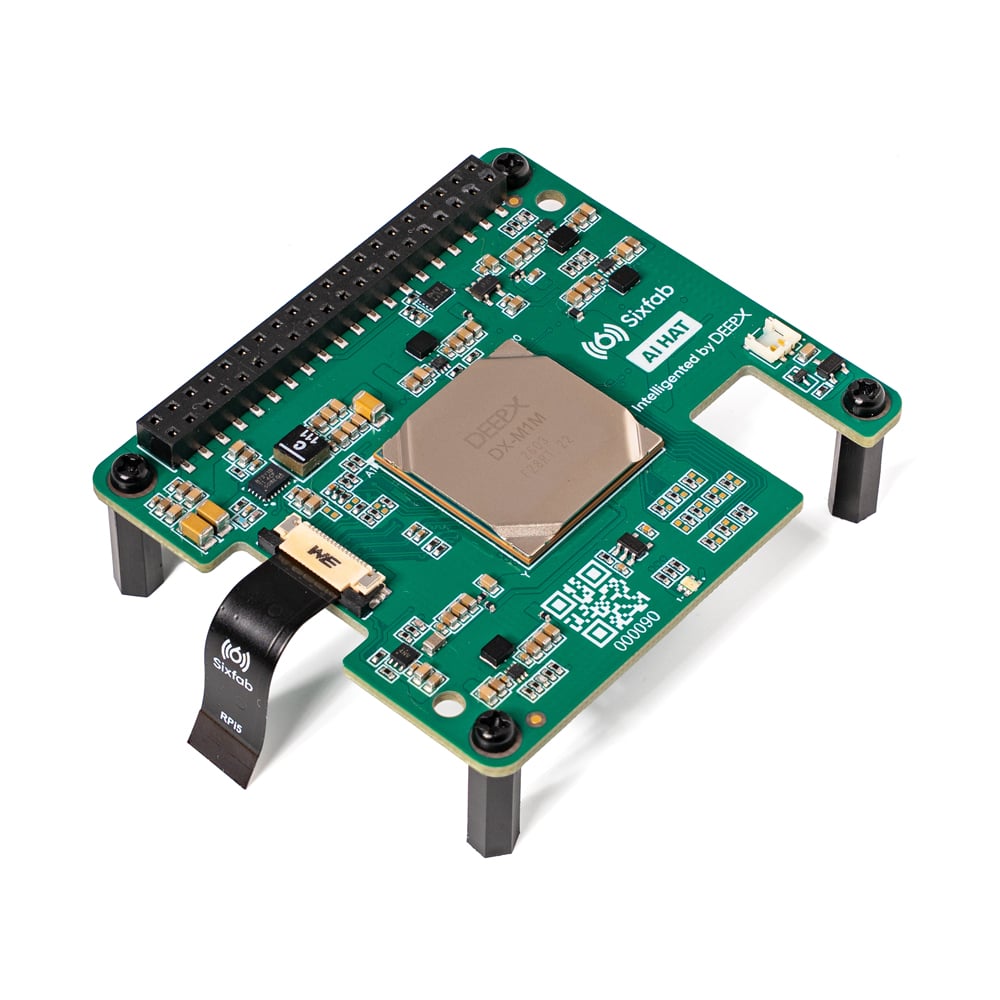
Why three watts matter when the spec sheet says 25 TOPS
Around DEEPX DX-M1M, the Sixfab AI HAT+ for Raspberry Pi 5 contributes 25 TOPS of dedicated acceleration while the NPU typically holds near 3 W under sustained inference. The host Raspberry Pi CPU stays responsible for camera acquisition, application logic, connectivity and device control. For buyers comparing AI HAT+ and HAT+ 2 options, that separation is the practical benefit.
Bench note: ~3 W describes typical sustained NPU power for the 25 TOPS DX-M1M configuration, not total wall consumption. Measure the final Raspberry Pi build with the actual camera, storage, workload and cooling before choosing a power supply.
One NPU powering three classes of edge intelligence
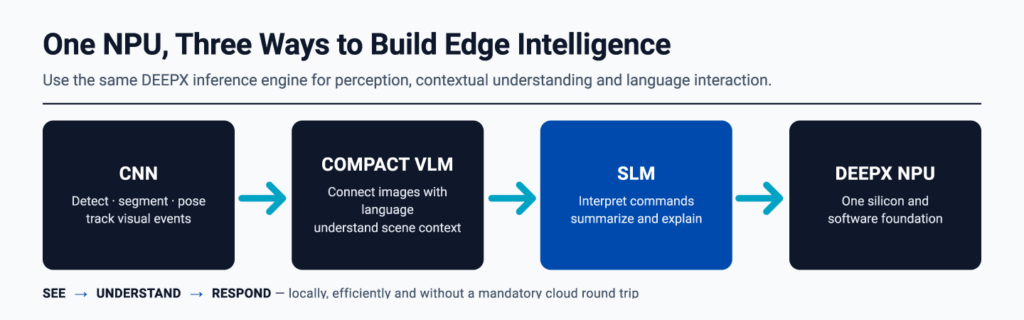
A typical product starts with perception. CNNs can detect objects, segment regions, estimate pose or flag unusual activity. Later requirements ask the system to understand context and communicate findings. The DX-M1M targets that full progression with one toolchain: visual model execution, compact vision-language interpretation and small-language interaction.
CNN perception workloads
Object detection, classification, segmentation, pose estimation, depth and image enhancement turn camera pixels into structured events. Examples in the DEEPX ModelZoo include YOLO-family detectors, segmentation and pose models, and DX-Stream can assemble those stages into GStreamer-based camera pipelines.
Compact VLM context workloads
A compact vision-language model can describe a scene, answer a focused question about an image or interpret an event in natural language locally, without sending data away from the device.
SLM command-handling workloads
A small language model can interpret a user command, summarise local events or produce a concise explanation. That gives cameras, robots and machines a more natural interface while avoiding a cloud round trip for every exchange.
Memory headroom for VLM and SLM selection
Language workloads at the edge begin with a hard constraint: how much memory is available and how large a model will fit. The DX-M1M module carries 2 GB of dedicated on-module LPDDR4x, giving headroom for VLM and SLM tasks alongside vision models.
Accuracy-first INT8 evaluation
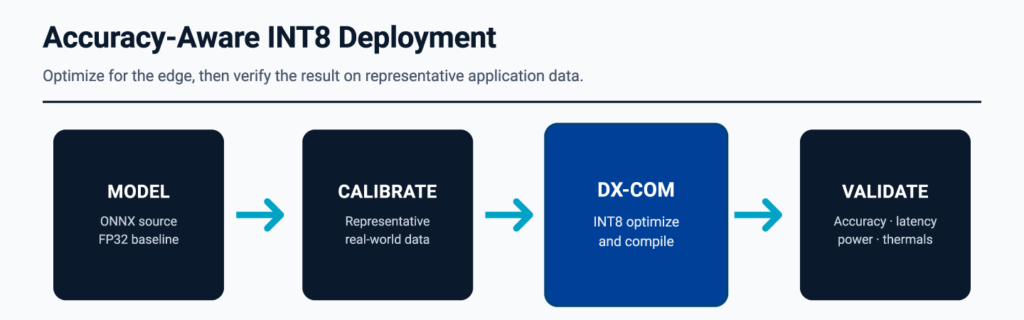
Performance is only meaningful if accuracy survives the deployment path. DEEPX approaches INT8 optimisation as an accuracy-aware engineering process rather than a single conversion step:
- Record a known FP32 accuracy baseline and define the application metric.
- Calibrate with representative data from the target environment, not only clean sample images.
- Compile and optimise with DX-COM into a portable .dxnn deployment artifact.
- Compare accuracy, latency, power and thermal behaviour on the final Raspberry Pi system.
That matters under low light, glare, motion blur, occlusion and unusual angles. A credible benchmark pair shows both efficiency gain and retained application accuracy.
Measured throughput on Raspberry Pi 5
The table reports measured runs on a Raspberry Pi 5 (8 GB) using the shipping Sixfab software release, comparing the DX-M1M and DX-M1 NPUs.
| Workload | DX-M1M (NPU) | DX-M1 (NPU) |
|---|---|---|
| mobilenet_v2, 240×240 | 2361 FPS | 3223 FPS |
| deeplabv3plus, 512×512 | 155 FPS | 231 FPS |
| Qwen3-1.7B, 96 prefill tokens | TTFT: 599.04 ms TPS: 4.64 tok/s | TTFT: 544.58 ms TPS: 11.60 tok/s |
* The DX-M1 uses LPDDR5, while the DX-M1M uses LPDDR4x; the performance difference results from their memory bandwidths.
First boot to first inference: bench checklist
Install and validate the stack under Raspberry Pi OS:
sudo apt update && sudo apt install apt-repo-sixfabsudo apt update && sudo apt install sixfab-dxdxrt-cli -sconfirms device and software status.run_hello_worldruns a packaged example.dxtopobserves the NPU in real time.
Next, select an optimised ModelZoo workload or convert a supported ONNX model with DX-COM. The resulting .dxnn file runs through DX-RT C++ or Python APIs, while the Raspberry Pi application keeps handling cameras, business logic, user interfaces, networking and control.
Software stack overview
| Component | What it does for you |
|---|---|
| DX-COM | Optimises and compiles supported ONNX models into DEEPX .dxnn artifacts. |
| DX-RT | Runs .dxnn models through C++ or Python APIs on the target device. |
| DX-Stream | Builds GStreamer-based capture, inference and post-processing pipelines. |
| ModelZoo | Pre-optimised examples across detection, classification, segmentation, pose and more. |
| dxrt-cli / dxtop | Device status, utilisation, temperature, clocks and memory at a glance. |
Deployment scenarios and procurement fit
At a bench or home scale, a workbench camera can flag a failed 3D print and send a snapshot with a one-line description. A front-door camera can separate a courier, a neighbour's cat and a lingering figure, then summarise the day locally. A garden or pet monitor can notify only about events worth seeing. The loop is consistent: a CNN detects the event, a compact VLM adds context, an SLM explains it or interprets the next command, and the Raspberry Pi application decides and acts.
The same loop can support production use: always-on detection in smart cameras with reduced cloud dependence; low-power visual quality and safety monitoring beside a production line; robot perception and compact multimodal intelligence while the Raspberry Pi runs ROS 2 and control logic; and privacy-aware occupancy and behaviour analytics in retail or smart spaces.
In such deployments, privacy, latency, offline operation and a single-digit-watt power budget are the requirements that decide the design.
Common misconceptions about three-watt edge NPU boards
- "Peak TOPS equals usable system performance." No; the ~3 W figure is typical sustained NPU power, not complete system wall power.
- "INT8 conversion proves deployment quality." No; it needs a FP32 baseline, representative-data calibration and final-board testing.
- "A compact edge accelerator can replace cloud inference." No; broad world knowledge, very long conversational context and continuous learning require more compute and memory.
- "On-module memory is a minor detail." No; VLM and SLM model fit depends on the 2 GB of dedicated LPDDR4x.
Limits, availability and next steps
The AI HAT+ is not designed to compete with cloud inference. Its strongest fit is tightly scoped, always-on intelligence next to a camera or sensor, where privacy, latency, offline operation and a single-digit-watt power budget matter.
The 25 TOPS Sixfab AI HAT+ for Raspberry Pi 5 is available now from Sixfab, with the 13 TOPS version expected to launch toward the end of 2026. DX-AllSuite and the ModelZoo are on GitHub, and the DEEPX Developer Portal hosts documentation, guides and support channels. The Sixfab AI HAT+ Quickstart and DEEPX DX-M1 product information provide further detail.
Action checklist for evaluators
- Measure whole-system power and heat after attaching the actual camera, storage and workload.
- Validate INT8 results against an FP32 baseline using representative deployment images.
- Use the DX-M1M versus DX-M1 benchmark table, remembering LPDDR5 and LPDDR4x bandwidth differences.
- Confirm first inference with the Raspberry Pi OS commands: apt-repo-sixfab, sixfab-dx, dxrt-cli, run_hello_world and dxtop.
- Read the Sixfab AI HAT+ Quickstart and DEEPX DX-M1 product information before procurement.