
NVIDIA Vera Rubin Spec Sheet Decoded: What the 19.2 TB/s HBM4 Bandwidth and 6 TB/s NVLink Changes Mean for Your Next GPU Build
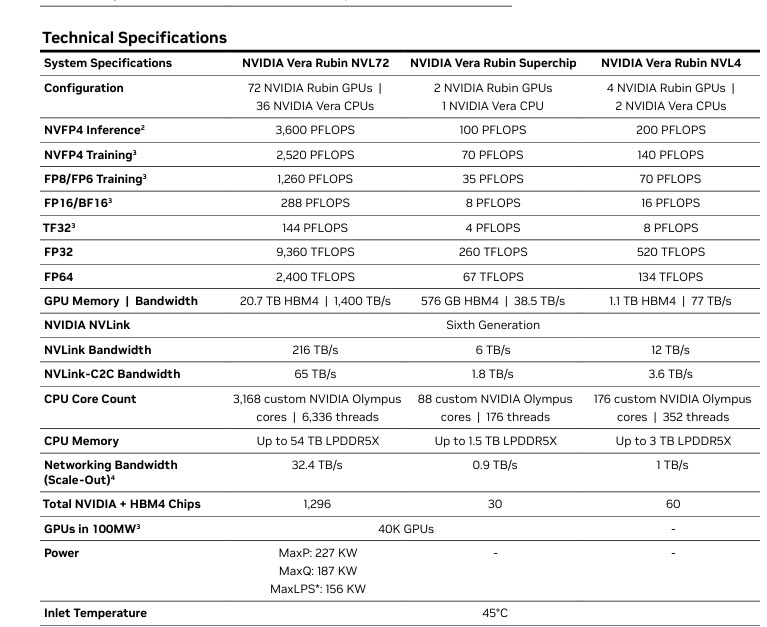
NVIDIA's latest published documentation for the Vera Rubin platform reveals two numbers that every hardware buyer and data-center engineer should scrutinize: the Rubin GPU now carries 288 GB of HBM4 memory at a measured 19.2 TB/s bandwidth, and the Vera Rubin superchip's NVLink interconnect has been re-rated to 6 TB/s. Neither figure matches the earlier "up to" marketing targets that appeared in pre-launch technical briefings. For anyone evaluating this platform against competing accelerators, the question is no longer whether specs shifted — it is what those shifts signal about supply-chain maturity, system-level bottlenecks, and the real-world performance envelope of the upcoming Vera Rubin NVL72 rack.
Spec Comparison: Current Published Values vs. Earlier Targets
| Component / Metric | Earlier Target | Current Published Spec | Change |
|---|---|---|---|
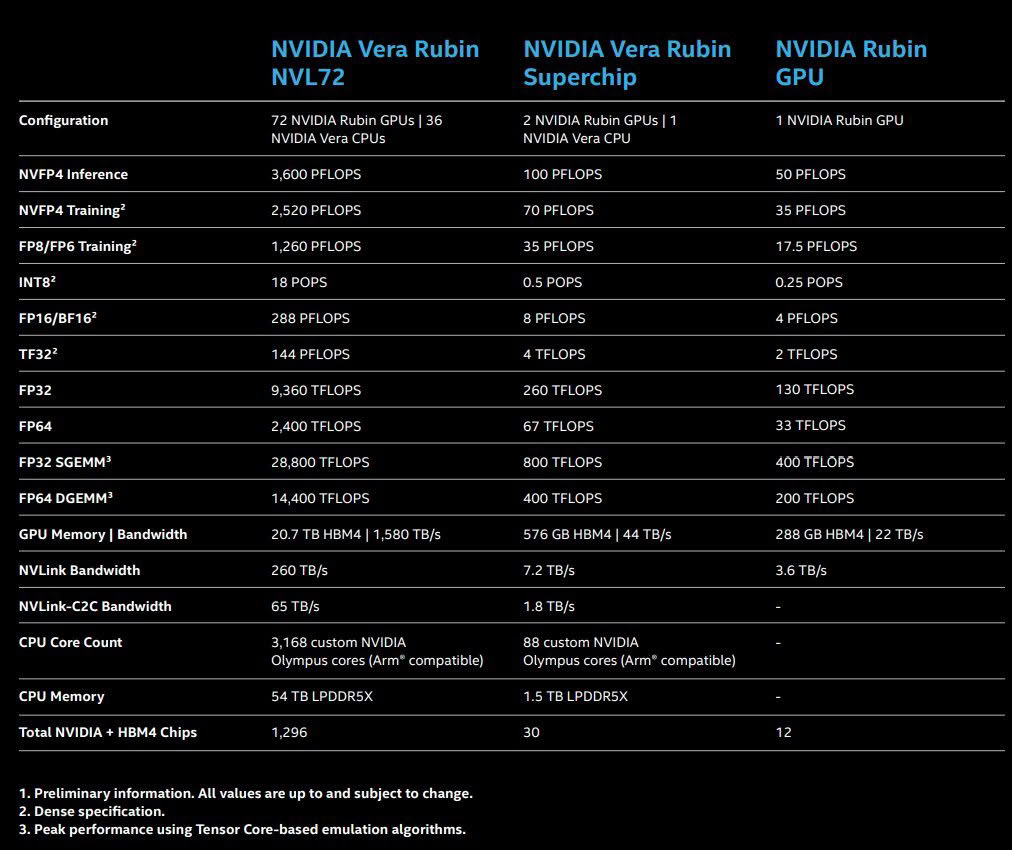
| Rubin GPU – HBM4 Memory Bandwidth | Up to 22 TB/s | 19.2 TB/s | ≈ 12.7 % lower |
| Rubin GPU – HBM4 Capacity | 288 GB | 288 GB | Unchanged |
| Vera Rubin Superchip – NVLink Bandwidth | 7.2 TB/s | 6 TB/s | ≈ 16.7 % lower |
| Vera Rubin Superchip – Scale-Out Network Bandwidth | 0.8 TB/s | 0.9 TB/s | ≈ 12.5 % higher |
| Vera Rubin NVL72 – GPU Count per Rack | 72 Rubin GPUs | 72 Rubin GPUs | Unchanged |
| NVLink Generation | Sixth-generation | Sixth-generation NVLink | Unchanged |
HBM4 Bandwidth: Reading the 19.2 TB/s Figure in Context
HBM4 is the first generation of stacked high-bandwidth memory to adopt a significantly wider interface than its predecessors, and it is the memory subsystem feeding every Rubin GPU. NVIDIA's original technical materials used the phrase "up to 22 TB/s" — a ceiling, not a floor. The current published spec of 19.2 TB/s sits roughly 12.7 % below that ceiling. Because the earlier number was an aspirational maximum, the revision does not automatically mean every shipped Rubin GPU will underperform by the same margin relative to expectations set by other vendors' current-generation products.
What the bandwidth figure does tell a hardware evaluator is how much of the compute pipeline can actually be fed. As large language models and multi-modal inference workloads grow, parameter fetch and intermediate-data traffic dominate memory access patterns. A GPU with a very high theoretical FLOPS rating but insufficient sustained bandwidth will stall while waiting for data. The 288 GB capacity of the Rubin GPU mitigates some of this risk by keeping more parameters resident locally, reducing the number of round-trips required during inference on very large models.
From a supply-chain perspective, relaxing the bandwidth requirement from "up to 22 TB/s" to a confirmed 19.2 TB/s can widen the pool of qualifying HBM4 dies. Memory manufacturers must simultaneously satisfy power, thermal, signal-integrity, and long-term reliability targets at speed; a slightly lower speed threshold may improve yield without requiring a full redesign. This does not confirm a shortage — it is a plausible engineering and manufacturing trade-off.
NVLink and Scale-Out Network: The One-Down, One-Up Pattern
Beyond the GPU die itself, NVIDIA revised two interconnect metrics on the Vera Rubin superchip. NVLink bandwidth dropped from 7.2 TB/s to 6 TB/s — a roughly 16.7 % reduction. NVLink governs GPU-to-GPU data exchange within a single system or rack; it is critical for model-parallel training, expert-routing traffic in mixture-of-experts architectures, and multi-GPU inference tasks that demand low-latency parameter synchronization.
Simultaneously, the scale-out network bandwidth connecting the superchip to other nodes in the cluster rose from 0.8 TB/s to 0.9 TB/s. This network stitches individual compute nodes into a unified cluster spanning multiple servers and racks.
The practical implication for a data-center architect is a shift in where the bottleneck sits. If intra-rack GPU communication (NVLink) is trimmed while inter-node fabric (scale-out) is boosted, NVIDIA appears to be rebalancing the performance budget to reflect workloads that increasingly distribute computation across server boundaries rather than concentrating it within a single 72-GPU enclosure like the Vera Rubin NVL72. The sixth-generation NVLink still connects multiple GPUs inside that rack, but the throughput available per link is now specified lower.
Common Misconceptions to Avoid
- "A 12.7 % bandwidth cut means 12.7 % less compute." End-to-end training throughput depends on the mix of compute-bound and memory-bound operations, software scheduling, and model architecture. The bandwidth delta is one input among many.
- "Lower NVLink speed means multi-GPU scaling is broken." The sixth-generation NVLink topology in the Vera Rubin NVL72 rack still provides all-to-all connectivity across 72 Rubin GPUs; a 6 TB/s rating changes the per-link ceiling, not the architectural pattern.
- "The spec revision proves an HBM4 shortage." A relaxed speed target can improve yield and expand the qualifying supplier base, but it does not on its own confirm a supply constraint.
- "Earlier 'up to' numbers are broken promises." Marketing ceilings and production-floor specs serve different purposes; 19.2 TB/s is a sustained, published operating figure that procurement teams can benchmark against.
Procurement and Deployment Action Items
- Benchmark against the published 19.2 TB/s, not the retired 22 TB/s. When comparing the Rubin GPU to competing accelerators, use only confirmed sustained numbers from official NVIDIA documentation.
- Model your inter-node traffic profile. If your workloads are strongly communication-bound across servers (e.g., pipeline parallelism at large batch sizes), the 0.9 TB/s scale-out figure is now as important as the 6 TB/s NVLink rating. Plan your fabric topology accordingly.
- Validate memory-bound inference assumptions. 288 GB of HBM4 per Rubin GPU is generous for inference, but confirm whether your specific model sizes actually fit within that capacity or still require multi-GPU parameter sharding, which re-introduces the NVLink dependency.
- Track vendor HBM4 qualification lists. If NVIDIA's relaxed bandwidth spec widens the qualified-supplier pool, downstream board partners may see improved component availability and potentially more stable pricing.
- Request actual measurement data before committing to multi-rack orders. The Vera Rubin NVL72 is a 72-GPU system; at that scale, aggregate NVLink throughput and scale-out network latency compound. Insist on real-world training and inference benchmarks, not isolated die-level specs.
Platform-Level Outlook
Performance in a system like the Vera Rubin platform is not a function of any single interconnect or memory metric. GPU compute capability, 288 GB of HBM4 capacity per Rubin GPU, the sixth-generation NVLink mesh, the updated scale-out fabric, and NVIDIA's software stack all interact. Even if certain headline bandwidth numbers land below the original ceiling targets, the overall architecture — especially in a Vera Rubin NVL72 configuration with 72 GPUs — retains substantial headroom for large-scale training and inference workloads.
The open question that matters most to hardware buyers is timing: can NVIDIA ramp shipments at the revised, more achievable spec levels and deliver measurable performance that matches customer expectations? Until third-party benchmark data surfaces, the spec sheet tells you where the platform is headed, not exactly where it will land in your data center.