
nRF71 series vs nRF70 series: a hardware buyer's guide to Nordic's low-power Wi-Fi SoCs
Short answer: if a product has to hold a live wireless association from a small cell, the new family is the part worth benching. Nordic Semiconductor rates it at up to 20 times lower standby power consumption than the previous companion-chip generation, and it merges the radio, an application core and a neural engine into one package. Design engineers pick nRF7120 when dual-band connectivity alone clears the spec sheet; they pay the extra band and silicon only when the tri-band option or local inference actually earns its keep.
Announced on 3 November 2026, the launch matters to hardware teams for a second reason beyond the headline current figure: it collapses the two-chip layout — a host MCU plus a radio piggyback — that battery-fed IoT products have accepted as normal since the Wi-Fi 6 companion era began.
What is actually new in the nRF71 series?
Three things move: standby current, level of integration, and on-chip compute for machine learning. Everything else is a consequence of those.
- Standby current. Both SKUs sit at an average connected current of 14 µA at 2.4 GHz and 8 µA at 5 GHz while polling at DTIM 10 — the figure that decides whether a coin-adjacent lithium cell can carry Wi-Fi at all.
- Radio stack in one die. Wi-Fi (Wi-Fi 6 on nRF7120, Wi-Fi 6E on nRF7120E), plus Bluetooth LE, Thread and Matter support, on the same chip rather than split across two parts.
- Application core and memory. The 256-MHz Cortex-M33 runs the product firmware itself, backed by 4 MB of on-chip non-volatile memory and 1 MB of user-accessible RAM.
- Neural acceleration. nRF7120E carries the Axon NPU; Nordic also keeps a software-only route for very small models through Neuton software.
- Peripherals. Trade press coverage of the data briefs reports up to 65 GPIOs and two high-speed MSPI interfaces (CNX-Software, 3 November 2026) — headroom for displays, sensor buses and external flash that the older radio-only parts never offered.
- Toolchain readiness. Zephyr project documentation already carries an nRF7120 Development Kit page listing support for both the nRF7120 and nRF7120E Arm Cortex-M33 parts, along with a 64 MHz high-frequency crystal and a 32.768 kHz low-frequency crystal (docs.zephyrproject.org) — an early signal that drivers land upstream before volume supply.
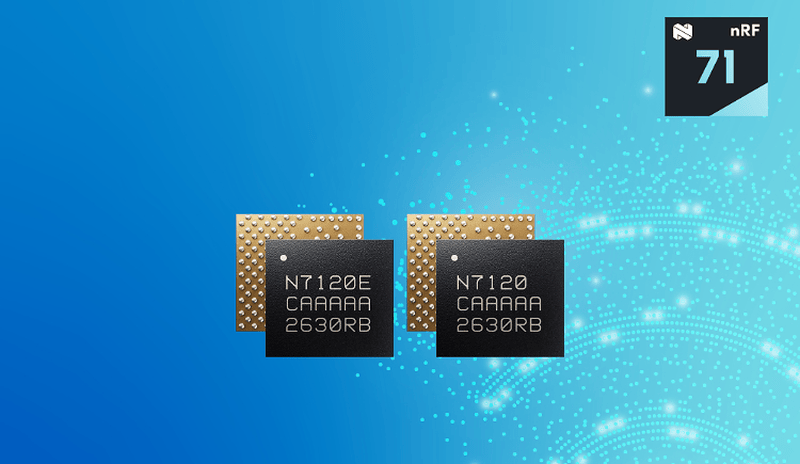
Which SKU should you design around: nRF7120 or nRF7120E?
Verdict first: default to nRF7120, and treat nRF7120E as the inference-and-congestion part. The two SKUs share the silicon memory map and the same 5 GHz standby number, so the decision is really about the 6 GHz band and the NPU.
| Design factor | nRF7120 | nRF7120E |
|---|---|---|
| Wi-Fi bands | dual-band Wi-Fi 6 | tri-band Wi-Fi 6E |
| Average connected current (DTIM 10) | 14 µA at 2.4 GHz, 8 µA at 5 GHz | 14 µA at 2.4 GHz, 8 µA at 5 GHz |
| Accelerated inference | no NPU; models run on Cortex-M33 via Neuton software | Axon NPU; models run 10× to 17× faster than on the 256-MHz Cortex-M33 alone |
| Memory | 4 MB of on-chip non-volatile memory and 1 MB of user-accessible RAM | 4 MB of on-chip non-volatile memory and 1 MB of user-accessible RAM |
| Secondary radios | Bluetooth LE, Thread, Matter | Bluetooth LE, Thread, Matter |
| Buying risk | congested 2.4 GHz homes still have to be survived | 6 GHz allocations and power limits differ by market, so certification scope grows |
Read the table this way: if your product is a sensor or a controller that wakes, posts a payload and sleeps, the NPU is dead weight and the extra band is a certification problem you did not need. If your product has to decide something locally — a sound event, a vibration signature, a thumbnail of an image — the 10× to 17× margin over the plain Cortex-M33 is the difference between classifying in the cloud on every wake and answering inside the chip.
What does 14 µA at DTIM 10 mean for real battery life?
It is a polling-cadence number, and the cadence is set by your access point, not by the chip. A DTIM period counts whole beacon intervals: the client may skip the beacons in between and only wakes for the DTIM beacon that advertises buffered broadcast or multicast traffic (Linux wireless kernel documentation, wireless.docs.kernel.org). With the common 102.4 ms beacon interval, DTIM 10 works out to roughly one useful wake per second — a design assumption you should verify with a packet capture on the actual customer-side routers.
Turning the published figures into calendar time is simple arithmetic, and it is MyTechDailyNews analysis, not a vendor claim:
- 500 mAh cell at 14 µA: about 35,700 hours, roughly 4.1 years of association-only current.
- 500 mAh cell at 8 µA on the 5 GHz band: about 62,500 hours, roughly 7.1 years.
- 100 mAh compact cell at 14 µA: about 7,100 hours, a bit under 10 months.
Those ceilings collide with hardware reality quickly. Transmit bursts, the voltage regulator's quiescent current, a constantly powered sensor, and self-discharge usually dominate the budget, which is why the 5 GHz half of the numbers is only interesting if the network is genuinely steered away from 2.4 GHz. One further note for embedded teams: legacy DTIM power save is not the only lever. Nordic's earlier companion parts already exposed OFDMA and Target Wake Time, letting a client negotiate scheduled listen windows instead of polling (audioXpress, August 2024) — so your lowest measured sleep current may come from TWT scheduling, and you should model both paths during evaluation.
How does the nRF71 series compare with the old companion layout and rival dual-band parts?
Architecture, not band count, is the meaningful axis here.
| Criterion | nRF70 series companion IC (e.g. nRF7002) | nRF71 series | Espressif ESP32-C5 |
|---|---|---|---|
| Role | adds Wi-Fi to a separate host SoC, MPU or MCU | Wi-Fi SoCs with the application core built in | standalone microcontroller with Wi-Fi |
| Application core | external — host MCU decides | 256-MHz Cortex-M33 on die | single RISC-V core up to 240 MHz, plus a 40 MHz low-power core |
| Wi-Fi | dual-band Wi-Fi 6, 2.4 GHz and 5 GHz | dual-band Wi-Fi 6 or tri-band Wi-Fi 6E | dual-band Wi-Fi 6, 2.4 GHz and 5 GHz |
| Low-power reference | no connected-state figure of this class in the pairing | 14 µA at 2.4 GHz and 8 µA at 5 GHz at DTIM 10 | TWT-assisted sleep; vendor lists no equivalent DTIM average |
| Neural engine | none on the radio die | Axon NPU on nRF7120E, Neuton software on Cortex-M33 | no dedicated NPU in the published spec |
| Volatile memory | host-dependent | 1 MB of user-accessible RAM | 384 KB HP SRAM, 320 KB ROM |
| Maturity | shipping, second-source modules available | sampling with selected customers | in volume production since Espressif's 30 April 2025 announcement |
Two trade-offs worth pricing into your BOM. Against Nordic's own companion approach, a single die removes one power domain, one SPI or SDIO link to keep alive, and some board area — but it also means the firmware now runs on the same silicon as the radio, so a busy application task competes with connection maintenance. Against the ESP32-C5, the comparison is asymmetric: the RISC-V part is in volume today and is the safer pick for throughput-hungry, mains-adjacent or cost-driven builds, while the 1 MB of user-accessible RAM plus the Axon NPU is where the newer device pulls ahead for battery products that must think locally (espressif.com product page).
Where the fit is good, and where it is not
Good fit:
- Battery-powered smart home hubs, Matter bridges and Thread border routers. Nordic's own launch framing is that these products can now run Wi-Fi, Thread and Bluetooth LE from a cell-backed design (nordicsemi.com newsroom).
- Wearables and health sensors that need bulk upload without a phone in the loop.
- Local analytics: Nordic cites keyword spotting, anomaly detection and image classification as the practical workloads for the chip.
- Industrial IoT nodes and retrofits where running a cable or replacing a cell monthly is the real cost.
Poor fit:
- Mains-powered devices. Standby current is irrelevant; buy silicon with more RAM or a faster CPU instead.
- Video-rate or large-model inference. An NPU embedded beside a Cortex-M33 is scoped for small models, not vision pipelines.
- Designs that must ship this quarter. A sampling part cannot carry a production ramp.
Four misconceptions to clear before you commit
- "20x lower standby means 20x more runtime." Only if standby dominates. Once your firmware transmits every few seconds, duty cycle and transmit current set the answer.
- "Any chip that hits 8 µA is a 5 GHz product." That figure assumes DTIM 10 on the 5 GHz band, which assumes a network that actually steers the device there — an AP-side condition, not a silicon guarantee.
- "An NPU means I can port any model." The accelerated path is bounded by the memory map: 4 MB of on-chip non-volatile memory and 1 MB of user-accessible RAM.
- "Tri-band is always future-proofing." If the 6 GHz band is restricted to low-power indoor use in your target markets, tri-band buys you congestion relief at best and re-certification effort at worst.
Action checklist for the next hardware cycle
- Capture the beacon interval and DTIM period on the routers your customers actually own; recompute your sleep budget from measured values rather than from the datasheet.
- Model three duty cycles — association only, hourly upload, and continuous inference — and let the worst case pick the SKU.
- Compare measured transmit current against the 14 µA baseline before promising multi-year battery life to marketing.
- Quantify NPU headroom against the 10× to 17× gain over the 256-MHz Cortex-M33; prototype the model with Neuton software first, since that path works on both SKUs.
- Confirm radio coexistence: Bluetooth LE and Thread active simultaneously alongside Wi-Fi adds real current the standby figure does not include.
- Track supply status and the development kit, driver and certification-document maturity before scheduling a production build.
Availability and procurement risk
Nordic Semiconductor states that the nRF71 series is now sampling with selected customers, which is the correct word to take seriously: samples, not stock. For a hardware programme that means evaluation boards, datasheet-revision churn and early errata are the near-term risks, not price. Kjetil Holstad, EVP Wi-Fi and Power Management at Nordic, framed the intent plainly in the launch release — "With the nRF71 Series, Nordic removes that barrier" — and in a launch-day post described the pitch as ultra-low power Wi-Fi, the company's best Bluetooth LE and Thread radio and edge AI on one chip (prnewswire.com; linkedin.com). For the current bill of materials, the companion-IC route still ships today; for the next generation of cell-backed wireless products, the new Wi-Fi SoCs belong on your evaluation shortlist now, with a design win gated on volume qualification.
Frequently asked questions
Is nRF7120E the same chip with Wi-Fi 6E switched on?
No. nRF7120 is the dual-band Wi-Fi 6 part; nRF7120E adds the third band and the Axon NPU. Radios, core, memory and the 5 GHz standby figure are otherwise common to the family.
Why does the 5 GHz number look better than the 2.4 GHz one?
Band switching in the low-power association path costs current, and 2.4 GHz is where most legacy beacons, coexistence work and retransmissions live. Treat 14 µA at 2.4 GHz and 8 µA at 5 GHz as two operating profiles, not as one average.
Can the chip do edge AI without the NPU?
Yes, at a smaller scale. Ultra-small models trained on a developer's own data can run directly on the Cortex-M33 through Neuton software; the NPU is what delivers 10× to 17× headroom.
Should I migrate an existing nRF70-based design?
Only if standby current is your limiting factor. If the design is mains-powered, throughput-bound, or already certified, the migration cost in layout, software and re-testing rarely pays for itself.
Reference sources
- Nordic Semiconductor launch release, "Nordic brings edge AI to battery-powered Wi-Fi devices" — https://www.nordicsemi.com/Nordic-news/2026/11/Nordic-brings-edge-AI-to-battery-powered-WiFi-devices-20-times-lower-standby-power-with-nRF71-Series
- PR Newswire, 3 November 2026 — https://www.prnewswire.com/news-releases/nordic-brings-edge-ai-to-battery-powered-wi-fi-devices-achieving-twenty-times-lower-standby-power-with-new-nrf71-series-302926830.html
- CNX-Software, "Nordic Semi nRF71 wireless chips to deliver 20 times lower standby power" — https://www.cnx-software.com/2026/11/03/nordic-semi-nrf71-wireless-chips-to-deliver-20-times-lower-standby-power-for-battery-operated-wifi-devices/
- Zephyr project board documentation, nRF7120 DK — https://docs.zephyrproject.org/latest/boards/nordic/nrf7120dk/doc/index.html
- Linux wireless kernel documentation, IEEE-802.11 power savings and DTIM — https://wireless.docs.kernel.org/en/latest/en/developers/documentation/ieee80211/power-savings.html
- Espressif Systems ESP32-C5 product page — https://www.espressif.com/en/products/socs/esp32-c5
- audioXpress on nRF7002 OFDMA and Target Wake Time — https://audioxpress.com/news/nordic-semiconductor-introduces-smaller-nrf7002-wi-fi-6-companion-ic-for-compact-designs