
LEO Timing Hardware Explained: Microchip Technology's LX-820 Radiation-Tolerant Quartz Oscillator Joins the L-Series
On a satellite board the reference oscillator is the least visible line item, and the one that keeps communications, navigation, Earth observation and mapping links coherent. Microchip Technology has just widened that section of the bill of materials with the LX-820 Radiation-Tolerant Quartz Oscillator, the newest addition to its L-Series family of timing devices, aimed at Low Earth Orbit (LEO) and other space applications. For a hardware evaluation the useful question is not whether a part carries a space label, but how frequency stability, phase noise, power, size and lead time line up with the mission profile you are flying. On that basis the headline numbers are CMOS outputs up to 135 MHz, LVDS outputs up to 250 MHz, and operation from -55°C to 125°C.
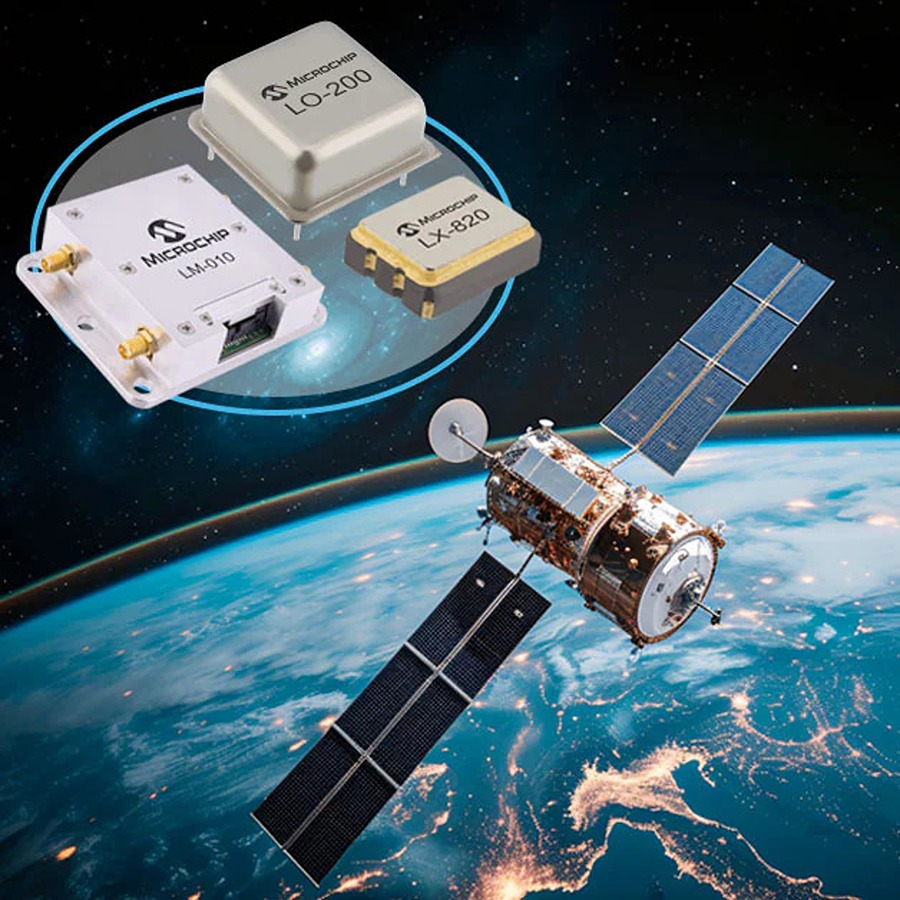
Spec sheet at a glance
| Item | Published figure | Design or procurement note |
|---|---|---|
| Device | LX-820 Radiation-Tolerant Quartz Oscillator, part of the L-Series portfolio | Timing reference for LEO and other space applications |
| CMOS output range | 1.25 MHz to 135 MHz (CMOS outputs up to 135 MHz) | Board reference clocks on the lower-frequency side |
| LVDS output range | 100 MHz to 250 MHz (LVDS outputs up to 250 MHz) | Extends the reference beyond the CMOS ceiling |
| Operating temperature | -55°C to 125°C | Thermal window to check against your own board budget |
| Performance level | MIL-PRF-55310 Level B with ±100 ppm | Stability target quoted for the ruggedized device |
| Package | Compact 3.2 mm × 2.5 mm surface-mount | Footprint for dense timing regions |
| Total Ionizing Dose (TID) | Radiation tolerance up to 50 krad | Device-level testing reported across the L-Series |
| Single-Event Latchup (SEL) | SEL testing to 40 MeV·cm²/mg | Latchup margin figure quoted for the series |
| Crystal selection | Most L-Series products use swept quartz | Reduces radiation-induced frequency drift |
| Mechanical build | Ruggedized construction and four-point crystal mounts in L-Series OCXOs | Designed to survive launch and the intended mission profile |
| Lead time | Many configurations from stock, or less than 20 weeks | Supply comparison point versus traditional space-grade timing |
Where the L-Series sits on the reliability ladder
Structurally the family occupies a deliberately intermediate position: it sits between commercial off-the-shelf (COTS) oscillators and traditional high-reliability space products, blending commercial- or military-grade components with production inspection, electrical and thermal analysis and hybrid manufacturing. That distinction matters to a buyer, because the qualification story is delivered at device level rather than at raw-component level. As complete, functioning devices, L-Series oscillators have passed Total Ionizing Dose (TID) and Single-Event Latchup (SEL) testing, reaching radiation tolerance up to 50 krad and SEL testing to 40 MeV·cm²/mg. Most L-Series products also use swept quartz, the crystal selection that reduces radiation-induced frequency drift, while ruggedized construction and four-point crystal mounts in the L-Series OCXOs are designed to survive launch and the intended mission profile.
The two procurement problems the family is built around
Read as a purchasing case rather than a datasheet, the L-Series addresses two persistent challenges for satellite developers: supply chain constraints and budget pressure. Space-qualified timing solutions often carry extended lead times and significant procurement costs, which is exactly where schedule risk accumulates on a constellation program.
- Availability: the series is designed as a more accessible alternative, with many configurations available from stock or with lead times of less than 20 weeks.
- Program cost: overall program cost may be lowered by reducing the need for component pedigree, documentation requirements and inspection overhead typically associated with traditional high-reliability space-grade timing products.
Matching the architecture to the mission block
Highly accurate timing references support communications, navigation, Earth observation, mapping and emerging lunar missions, and each portfolio member offers a different combination of frequency stability, phase noise, power and size to meet different mission requirements. Because those requirements do not overlap, the L-Series spans four device classes rather than one universal part:
- XO (crystal oscillator): choose the compact option when size and broad frequency coverage are the priorities.
- TCXO (temperature-compensated crystal oscillator): choose it when tighter temperature stability and lower power are needed.
- OCXO (oven-controlled crystal oscillator): choose it for more demanding stability and phase-noise requirements, and note this is the class where four-point crystal mounts appear.
- PPS disciplined oscillator: choose a pulse-per-second disciplined design when PPS synchronization and holdovers are required.
Common misconceptions worth clearing up
- "Radiation tolerance must mean a full high-reliability documentation trail." The stated intent of the L-Series is the opposite: it reduces the need for component pedigree, documentation requirements and inspection overhead typical of traditional space-grade timing.
- "Space timing always means long lead times." Many configurations are available from stock, or with lead times of less than 20 weeks.
- "Any oscillator that hits the frequency is interchangeable." Frequency stability, phase noise, power and size all differ across the family, which is why XOs, TCXOs, OCXOs and the pulse-per-second disciplined oscillator coexist in one portfolio.
- "Swept quartz is a marketing footnote." It is the material choice credited with reducing radiation-induced frequency drift in most L-Series products.
- "A small package must be a fragile package." The new device ships in a 3.2 mm × 2.5 mm surface-mount outline, and mechanical survivability across the series is handled through ruggedized construction and four-point crystal mounts in the OCXO class.
Selection checklist before you raise a quote request
- Fix the output standard first: CMOS if your clock tree needs 1.25 MHz to 135 MHz, LVDS if it needs 100 MHz to 250 MHz.
- Confirm the thermal envelope of -55°C to 125°C against the board-level temperature profile rather than the datasheet alone.
- Check the stability requirement: the LX-820 is engineered to meet MIL-PRF-55310 Level B, with ±100 ppm performance.
- Validate layout against the 3.2 mm × 2.5 mm surface-mount package before committing the timing region.
- Record the radiation figures you must clear: up to 50 krad TID and SEL testing to 40 MeV·cm²/mg.
- Pick the architecture class - XO, TCXO, OCXO or PPS disciplined - based on stability, phase noise, power and size trade-offs.
- If launch vibration survival is the binding constraint, evaluate the L-Series OCXO options with four-point crystal mounts.
- Build the schedule line item from actual availability: stock for many configurations, otherwise less than 20 weeks.
Figures to cite in your design note
- Frequency coverage: CMOS up to 135 MHz, LVDS up to 250 MHz (source: Microchip Technology product specification).
- Temperature range: -55°C to 125°C (source: Microchip Technology product specification).
- Radiation figures: up to 50 krad and 40 MeV·cm²/mg (source: L-Series device-level TID and SEL testing).
- Stability and standard: ±100 ppm, MIL-PRF-55310 Level B (source: Microchip Technology product specification).
- Footprint: 3.2 mm × 2.5 mm surface-mount package.
- Schedule: many configurations from stock or less than 20 weeks.
Portfolio context for a timing architecture decision
For teams standardizing timing across more than one board, the surrounding catalog is unusually broad: from miniature component oscillators and small plug-in timing server cards to atomic clocks and multi-rack time scale systems, Microchip offers an extensive portfolio of clock and timing systems, and describes its solutions as a primary contributor to the world's time. In practical terms that means an evaluation does not have to stop at a single oscillator when the bus contains several different stability domains.
Availability and what to do next
Production quantities are now available for the LX-820 Crystal Oscillator and other L-Series oscillators, so the device can be pulled into an active build rather than a future roadmap slot.
If your current LEO design runs on a COTS reference and qualification paperwork is the bottleneck, the sensible first step is to map the clock tree against the checklist above - output standard, thermal window, ±100 ppm stability target, footprint and dose margins - and then compare the XO, TCXO and OCXO variants of the L-Series on the same axis. The published figures, not the label on the part, are what decide whether it fits the mission.