
Melexis MLX92342: A Hardware Checklist for Automotive Position Sensing
Automotive position-sensing components are usually compared by magnetic span, interface wiring, output behavior, and qualification status. The Melexis MLX92342 is worth reviewing from that hardware angle because it packages a programmable Hall switch, a 2-wire interface, and on-chip diagnostics around remote position detection. In this MyTechDailyNews Hardware guide, the key evaluation question is whether the stated fault signalling, magnetic range, ESD protection, automotive qualification, and availability help replace or improve traditional mechanical microswitches, reed-based switches, or lower-featured magnetic switches in a specific design.
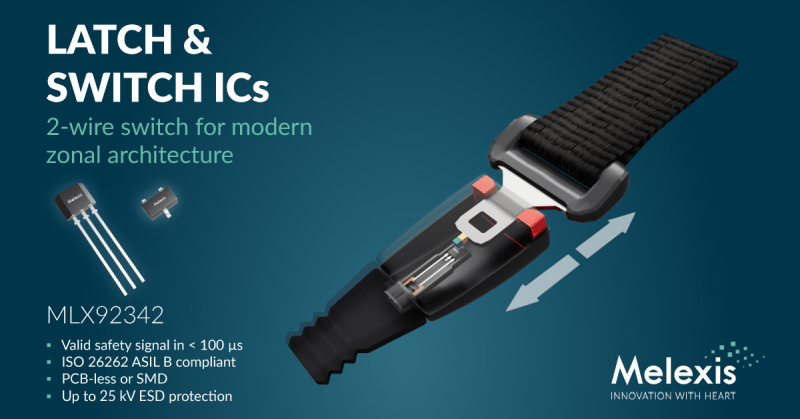
Why the diagnostic signal changes the selection conversation
A sensor output can answer a simple state question: is the mechanism open, closed, latched, or within the monitored magnetic condition? A diagnostic safety signal answers a different question: is the sensor path itself in a fault state? The published description says the MLX92342 supplies a valid output and produces a diagnostic safety signal in less than 100 µs. The timing gives the electronic control unit a way to separate sensor malfunction from a valid reading. In an automotive application such as a seatbelt buckle, that separation is not an optional detail; it affects how an ECU treats the same input line.
Core facts at a glance
- Manufacturer and part: Melexis MLX92342, a programmable Hall switch.
- Interface description: 2-wire, PCB-less sensor IC.
- Fault signalling: diagnostic safety signal in less than 100 µs.
- Magnetic configurations: latch, unipolar, and omnipolar switch modes.
- Magnetic operating range: 0.5 mT to 200 mT.
- Automotive status: qualified to AEC-Q100.
- Functional safety status: certified as an ISO 26262 ASIL B SEooC.
- ESD protection: 8-kV HBM, 15-kV system-level contact discharge, and 25-kV system-level indirect discharge.
- Availability: available now.
- Pre-programmed derivative: locked, pre-programmed MLX92341.
Specification table for hardware comparison
| Parameter | Published value | Hardware decision point |
|---|---|---|
| Device family | Melexis MLX92342 | Programmable path when configuration needs to be selected during development. |
| Interface | 2-wire | Compare against existing microswitch or reed-switch wiring assumptions. |
| Latency for diagnostic signal | less than 100 µs | Check how the ECU handles fault flags and valid outputs. |
| Magnetic range | 0.5 mT to 200 mT | Map magnet strength and geometry to the target sensing distance. |
| Magnetic modes | latch, unipolar, omnipolar | Choose the mode that matches actuator or latch behavior. |
| Automotive qualification | AEC-Q100 | Confirm whether the application requires automotive-grade qualification. |
| Functional safety status | ISO 26262 ASIL B SEooC | Use the status as part of a safety argument, not as a complete system certification. |
| ESD protection | 8-kV HBM, 15-kV system-level contact discharge, 25-kV system-level indirect discharge | Review component-level and system-level ESD paths separately. |
| Procurement | available now | Include in current design candidates if availability timing matters. |
| Variant | MLX92341 | Locked, pre-programmed option when configurability is not desired. |
How to read the magnetic range
The source states a magnetic operating range of 0.5 mT to 200 mT and lists magnetic latch, unipolar switch, and omnipolar switch configurations. For a hardware comparison, the range gives the magnetic field window in which the sensor can operate, while the configuration determines how the output responds to that field. These are two separate variables. A design that previously used a mechanical microswitch may benefit from contactless operation, but the final result still depends on the chosen switch mode and the magnetic field presented to the device.
Protection ratings are not interchangeable
The ESD line includes three conditions: 8-kV HBM, 15-kV system-level contact discharge, and 25-kV system-level indirect discharge. The wording itself separates the figures. For procurement and design review, that means a component-level rating and a system-level rating should not be treated as the same test. The source gives a specific set of ratings; the evaluation task is to confirm whether those ratings match the expected handling, assembly, and board-level protection requirements.
Application breadth beyond one example
The published application examples are seatbelt buckle detection, window lifters, brake fluid level sensors, active air skirts, locks, valves, and actuators. That list shows the product is positioned for several remote position or state-detection roles inside an automotive system. If a design is moving away from mechanical microswitches, reed switches, or less advanced magnetic switches, the claimed additions are programmability, diagnostics, and contactless operation. Each of those three should be checked against the actual circuit and firmware behavior.
Pros and watchpoints
| Pros | Watchpoints |
|---|---|
| Programmable Hall switch with multiple magnetic modes | Mode choice must be matched to the mechanism and magnet field. |
| Diagnostic safety signal in less than 100 µs | ECU firmware must be reviewed to consume the fault indication correctly. |
| Automotive qualification listed as AEC-Q100 | Confirm that the product fits the qualification expectations of the target platform. |
| Functional safety status listed as ISO 26262 ASIL B SEooC | A SEooC status still needs integration evidence at system level. |
| Stated ESD protection with 8-kV HBM and system-level values | Board layout, enclosure, and cabling can change how system-level ESD behaves. |
| Available now, plus MLX92341 locked variant | Decide whether configurability or a fixed pre-programmed option is the better path. |
Common misconceptions
- A fast diagnostic signal does not eliminate the need to validate output polarity, latch behavior, and system response.
- A wide magnetic window does not automatically mean every mechanical assembly will work; the mode selection matters.
- The presence of on-chip diagnostics does not replace safety documentation, validation plans, or fault-handling logic.
- PCB-less and 2-wire are useful integration descriptors, but they do not prove that no firmware or harness review is needed.
- The MLX92341 is not simply an alternative package; the source describes it as a locked, pre-programmed version.
Action recommendations
- Start with the application: if the design needs remote position detection in a seatbelt buckle, window lifter, fluid level sensor, active air skirt, lock, valve, or actuator, check whether the listed modes and range are relevant.
- Record the exact timing requirement: the diagnostic safety signal is stated in less than 100 µs, so compare that with the ECU fault-handling window.
- Choose the configuration path: MLX92342 for programmability, MLX92341 for a locked, pre-programmed version.
- Validate the magnetic budget using 0.5 mT to 200 mT and the selected latch, unipolar, or omnipolar mode.
- Review the ESD figures as separate data points: 8-kV HBM, 15-kV system-level contact discharge, and 25-kV system-level indirect discharge.
- Confirm procurement timing: the article says available now.
Data reference
Every quantitative and qualification item in this checklist comes from the source description: Melexis, MLX92342, 2-wire, less than 100 µs, ISO 26262 ASIL B SEooC, AEC-Q100, 8-kV HBM, 15-kV system-level contact discharge, 25-kV system-level indirect discharge, 0.5 mT to 200 mT, availability now, and the MLX92341 variant. No external benchmark, price, supply chain data, or performance claim has been added beyond those listed facts.