
MyTechDailyNews Hardware Brief: Kioxia E1.L LD4 Series Pushes QLC Density and PCIe 5.0 for 1U Servers
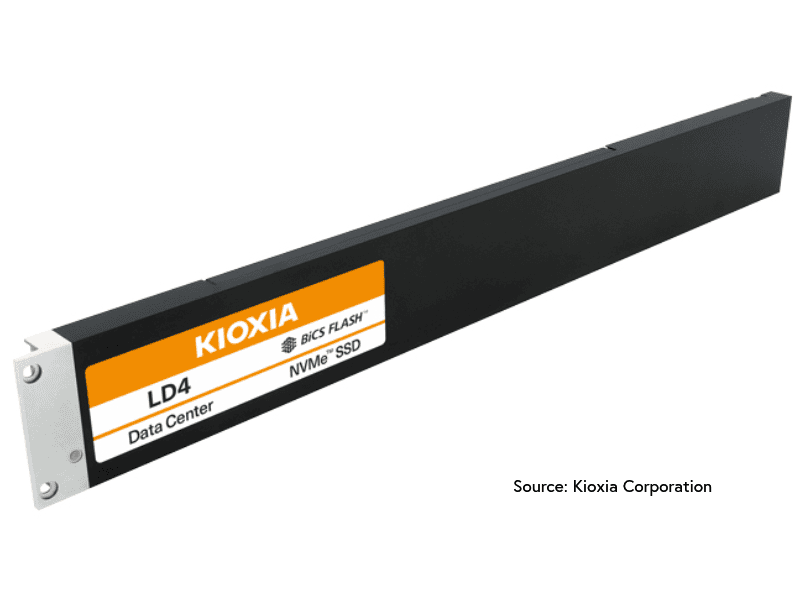
Storage architecture teams now have another high-capacity option for dense server bays: Kioxia has introduced the LD4 Series, an E1.L solid-state drive family using eighth-generation BiCS FLASH QLC NAND. The launch gives platform planners two commercial capacity points, 15.36 TB and 30.72 TB, while the company says its validated path can support up to 122.88 TB. That combination matters for 1U servers, read-heavy pools, and infrastructure evaluations followed on eeNews Europe hardware coverage.
Hardware buyers should treat this as a density-first product decision rather than a general-purpose SSD refresh. The value is in fitting more data into a constrained bay, keeping a PCIe 5.0 server path, and staying aligned with NVMe 2.0e and datacenter specification work. For teams assessing AI and hyperscale storage, the relevant question is whether the QLC read profile matches workload traffic enough to justify the capacity gain.
Why the E1.L and QLC pairing changes density math
The LD4 Series is the first Kioxia SSD family to combine E1.L with eighth-generation BiCS FLASH QLC NAND. Quad-level cell NAND stores four bits per cell, which is why capacity can move higher in a compact physical drive envelope. The initial retail-relevant sizes are 15.36 TB and 30.72 TB, and Kioxia points to an architecture that has been validated for up to 122.88 TB, even though a drive at that size has not been announced.
The physical context also matters. E1.L is useful in 1U servers because chassis depth and tray layout make drive shape part of the capacity plan. A device that delivers more terabytes in an accepted front-access form factor gives platform designers a way to grow storage without rethinking every mechanical detail. Still, the trade-off is real: QLC is commonly connected with lower write endurance, so the LD4 Series should be evaluated mainly against read-dominant workloads.
Interface and protocol summary
| Hardware factor | Launch statement | Planning implication |
|---|---|---|
| Form factor | E1.L drive family for 1U servers | Useful when bay geometry and tray access are primary constraints. |
| Memory technology | eighth-generation BiCS FLASH QLC NAND | Capacity-focused media; read-heavy workload fit is central. |
| Announced capacities | 15.36 TB and 30.72 TB | These are the practical capacity points for current comparison and quotation. |
| Validated upper path | up to 122.88 TB | Architecture signal, not a current purchasable product. |
| Host interface | PCIe 5.0 over a four-lane link, up to 16 GT/s per lane | Requires matching server topology, firmware, thermal, and BIOS validation. |
| Protocol | NVMe 2.0e | Aligns with modern data-center storage management expectations. |
| Datacenter specification | Open Compute Project (OCP) Datacenter NVMe SSD Specification v2.6 | Helps infrastructure teams filter for standardized drive requirements. |
| Availability | Sampling to selected customers; shown at OCP Global Summit 2026 | Early evaluation stage; production assumptions should remain cautious. |
The practical integration sequence is to match the connector path first, then the protocol path. A four-lane PCIe 5.0 interface is not only a speed statement; it affects platform topology, firmware compatibility, thermal behavior, and how predictable the drive appears in server inventory. NVMe 2.0e support adds the management and namespace behavior needed in data-center storage stacks, while Open Compute Project (OCP) Datacenter NVMe SSD Specification v2.6 compliance is another signal that the product is aimed at infrastructure-grade deployment rather than informal storage expansion.
Sampling, public showing, and evaluation limits
Kioxia says selected customers are already sampling the E1.L QLC SSD family, with initial samples focused on functional evaluation. That is an early gate, not a final production release. Teams can use this stage to test host recognition, drive reporting, thermal thresholds, and NVMe control paths, but performance stability and endurance assumptions should still be treated as provisional. The company also notes that specifications may change before mass production.
The LD4 Series was presented at OCP Global Summit 2026, which took place from 12 to 15 October in San Jose, California. The timing and venue are relevant to hardware readers because the product is positioned inside a data-center standards and hyperscale infrastructure discussion, not as a consumer storage release.
Procurement checklist for hardware and IT operations
- Confirm the target server tray, backplane, and cable routing accept E1.L drives before comparing capacity.
- Check that the host can run a PCIe 5.0 four-lane connection without BIOS or firmware compatibility issues.
- Verify NVMe 2.0e behavior in the storage software stack, especially for provisioning, namespace management, and telemetry.
- Test whether 15.36 TB or 30.72 TB improves usable rack density, rebuild window, and spare inventory.
- Record the up to 122.88 TB statement as a future architecture signal, not as a current purchasable capacity.
- Ask for sample version notes and specification change history before making deployment assumptions.
Common misconceptions to avoid
- High capacity is always better. QLC density is attractive, but read-dominant suitability matters because endurance expectations are different.
- PCIe 5.0 guarantees faster application response. Real performance still depends on workload shape, queue depth, thermal conditions, firmware, and host path.
- E1.L fit is universal. The form factor helps in 1U servers, but mechanical access, power delivery, cooling, and serviceability must be checked.
- OCP v2.6 compliance removes validation work. It narrows a specification gap, but it does not replace customer-specific integration testing.
Buyer interpretation for MyTechDailyNews Hardware readers
For hardware and IT operations readers, the LD4 Series is a data-center density candidate with clear signals: E1.L packaging, eighth-generation BiCS FLASH QLC NAND, 15.36 TB and 30.72 TB initial sizes, PCIe 5.0, NVMe 2.0e, and Open Compute Project (OCP) Datacenter NVMe SSD Specification v2.6 alignment. The public presentation at OCP Global Summit 2026 also reinforces its hyperscale and infrastructure focus.
The action advice is simple: move from specification review to sample evaluation only after you know the workload is read-heavy and the server platform supports the interface. Treat mass-production details as pending, and use the up to 122.88 TB validated architecture as roadmap context rather than an immediate procurement assumption.
Final hardware takeaway
Kioxia's LD4 Series is best understood as a capacity-first E1.L SSD line for 1U server storage expansion. The product gives infrastructure teams a concrete 15.36 TB and 30.72 TB choice today, while the stated architecture points toward a much larger capacity ceiling. If your environment values density, standard NVMe control paths, and modern PCIe 5.0 connectivity, the LD4 Series deserves a measured evaluation; if your workloads are write-heavy, the QLC profile should be reviewed carefully first.