
MyTechDailyNews Hardware Buyer's Checklist: Ordering the Kia PV5 Chassis and Cargo L2/H2 in the UK
By Cleo Howard, MyTechDailyNews Hardware
You can now order two more versions of the Kia PV5 in the UK: a bare Chassis that waits for a body, and the taller Cargo L2/H2 with standing room in the load bay. Both share one battery and one grant, but the Chassis price covers an unfinished van, so a usable truck costs more. Here is the spec sheet, the real on-road maths, and the ordering traps to clear before you sign.
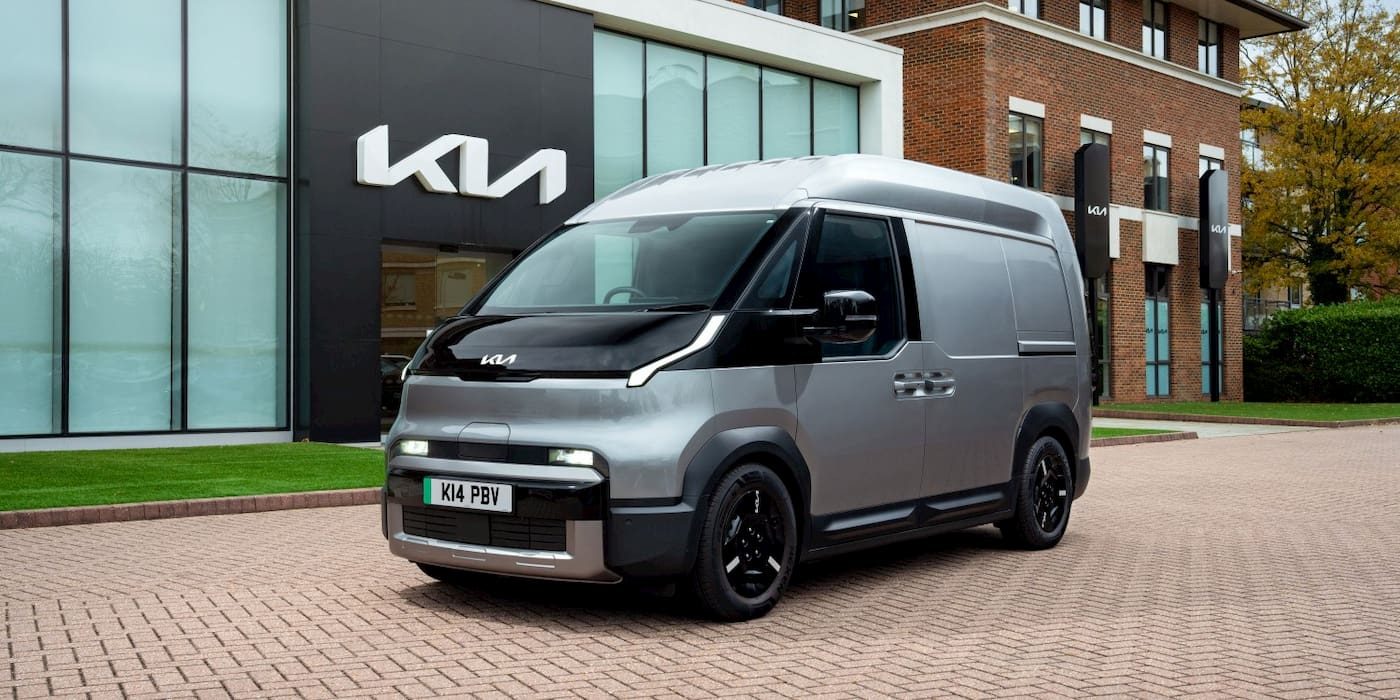
What can you actually order in the UK right now?
Two new body styles on an existing platform: an open-bed Chassis for custom builds and a high-roof Cargo L2/H2 for volume. Under the skin it is the first fully electric van Kia has built on its Platform Beyond Vehicle (PBV) programme, using E-GMP.S — the modular skateboard platform from Hyundai Motor. That architecture is why body styles can be swapped so readily, and why Kia talks about "limitless possibilities."
Until now the PV5 in the UK had mostly been sold as Passenger and Cargo bodies with several variations. The newly added PV5 Chassis is an open-bed model that can be converted into just about anything. For UK conversions, Kia works through TGS Automotive Group, whose options include lightweight tipper, Dropside and Box solutions. Trade publication businessmotoring reported in September 2026 that those conversions would land in Q4 with modular extras such as Chapter 8 liveries and mesh cages (source: businessmotoring.co.uk).
Which battery, range and cab tech come as standard?
One battery only, at least in the UK: both new variants are sold exclusively with the long-range 71.2 kWh pack. Kia quotes a potential WLTP range of up to 258 miles (416 km) for the Chassis, and the PV5 Cargo L2/H1 on the same 71.2 kWh battery also reaches up to 258 miles (416 km). Other markets additionally get a standard-range 51.1 kWh option; UK buyers do not.
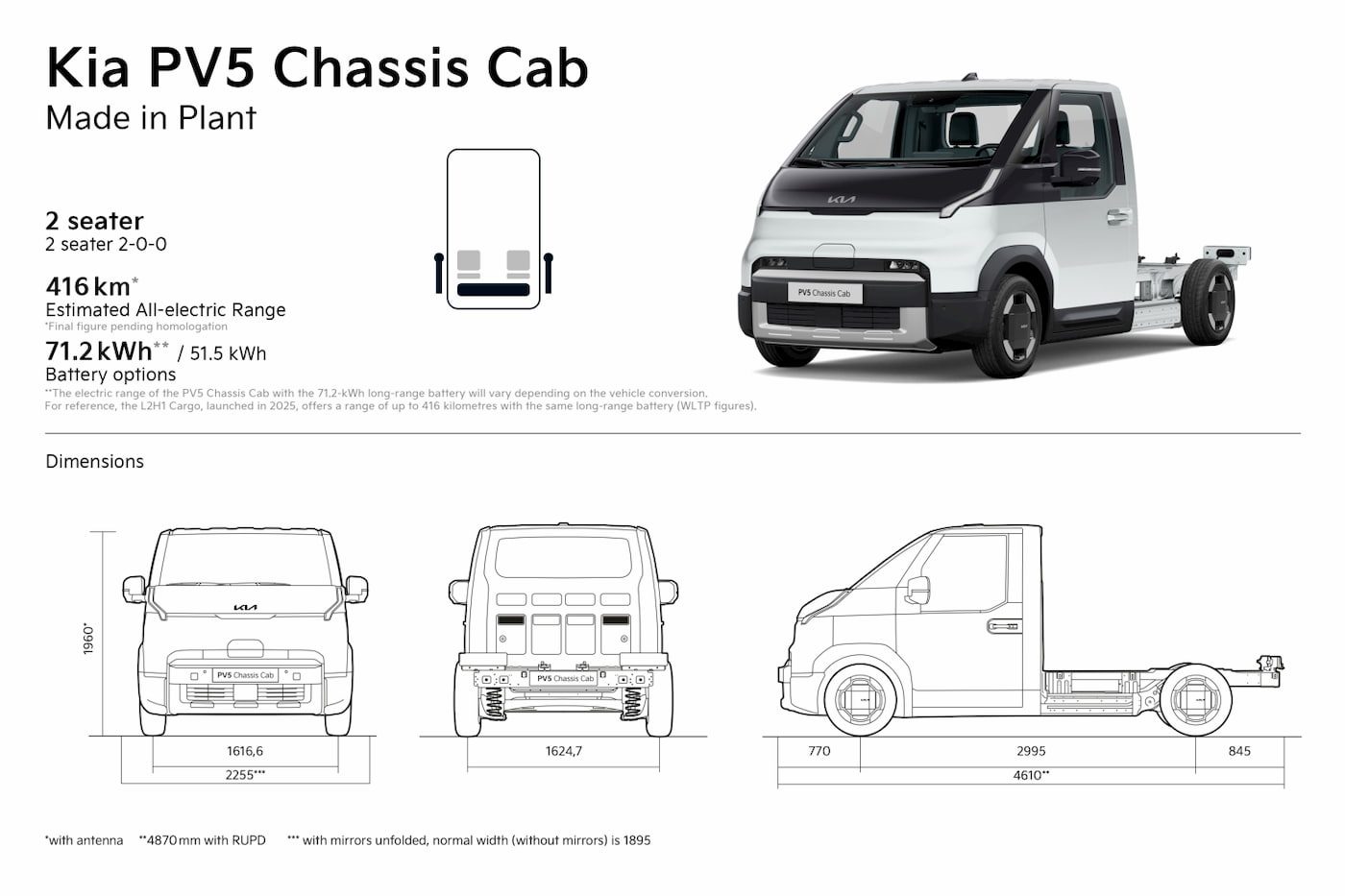 Kia PV5 Chassis Cab (Source: Kia)
Size-wise the Chassis measures 4,610 mm long, 1,895 mm wide and 1,935 mm tall on a 2,995 mm wheelbase. Kia says that compact footprint and a 5.5-meter turning radius make it easy to manoeuvre on city streets, construction sites and other tight work areas.
The cab is a two-seat arrangement. You get the same 12.9″ navigation screen and 7.5″ driver display as the rest of the range, and wireless Apple CarPlay and Android Auto are standard.
How fast does it charge and what can it carry?
Charging peaks at 120 kW DC, which Kia says takes the battery from 10% to 80% in roughly 30 minutes; on an 11 kW AC supply, 10% to 100% takes about 6 hours and 30 minutes. Our analysis: charging speed is only useful if the pack can hold the peak, so treat 120 kW as a best case on a warmed battery at a suitable charger, not a number you will see at every stop.
Payload depends on the finished body rather than the base van: Kia quotes up to 633 kg for the Dropside and 561 kg for the Tipper. In our reading, the lower figure is what the tipping gear costs in carrying capacity.
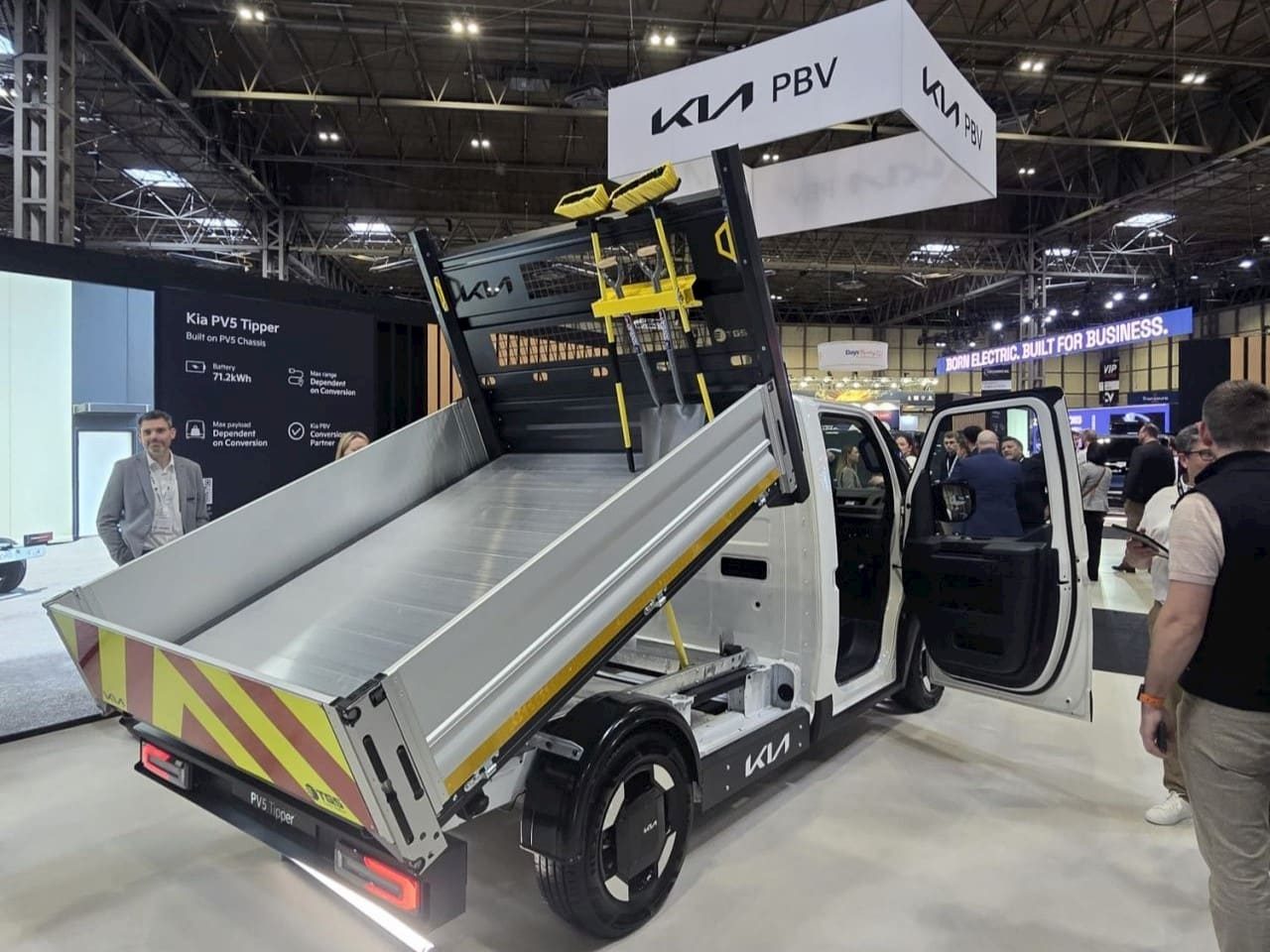 Kia PV5 Chassis Cab Tipper (Source: TGS Automotive Group)
What does the Chassis cost once the grant is applied?
£32,916 on the road for the bare van; £40,110 for a Dropside and £41,310 for a Tipper, all with the grant deducted. The £32,916 ($43,400) starting price for the PV5 Chassis already accounts for the expected £5,000 ($6,700) UK Zero Emission Van Grant. Read the small print, though: Kia calls it an "incomplete vehicle," meaning no body has been fitted yet.
| Variant | Battery | Basic Price (+VAT) | ZEVG | On-the-road (including ZEVG) |
|---|---|---|---|---|
| PV5 Chassis 'Plus' LR | 71.2kWh | £30,605 | £5,000 | £32,916 |
| PV5 Dropside 'Plus' LR (conversion by TGS) | 71.2kWh | £36,600 | £5,000 | £40,110 |
| PV5 Tipper 'Plus' LR (conversion by TGS) | 71.2kWh | £37,600 | £5,000 | £41,310 |
Kia PV5 Chassis prices in the UK by trim
A finished conversion moves the number up: £40,110 ($53,500) on the road for the Dropside and £41,310 ($55,000) for the Tipper, both with ZEVG included.
How much room does the Cargo L2/H2 actually give you?
5.2 cubic meters and a 1,815mm load height — enough to stand in — with payload set by door count. The larger PV5 Cargo L2/H2 is now orderable in the UK too. It runs 4,695mm long, 1,895mm wide and 2,200mm high on a 2,995mm wheelbase; the higher roof lifts internal cargo-area height to 1,815mm, and load capacity is greater than that of the L1/H1 and L2/H2, at 5.2 cubic meters. Kia's press office describes the load bay as 2,255 mm long and 1,565 mm wide, providing "more than five cubic meters" and room for two Euro pallets (source: kiapressoffice.com).
Official Kia UK listings quote a 419 mm low step-in and a 1,343 mm rear opening width — numbers that matter more than total volume if your crew loads by hand several times a day (source: kia.com/uk).
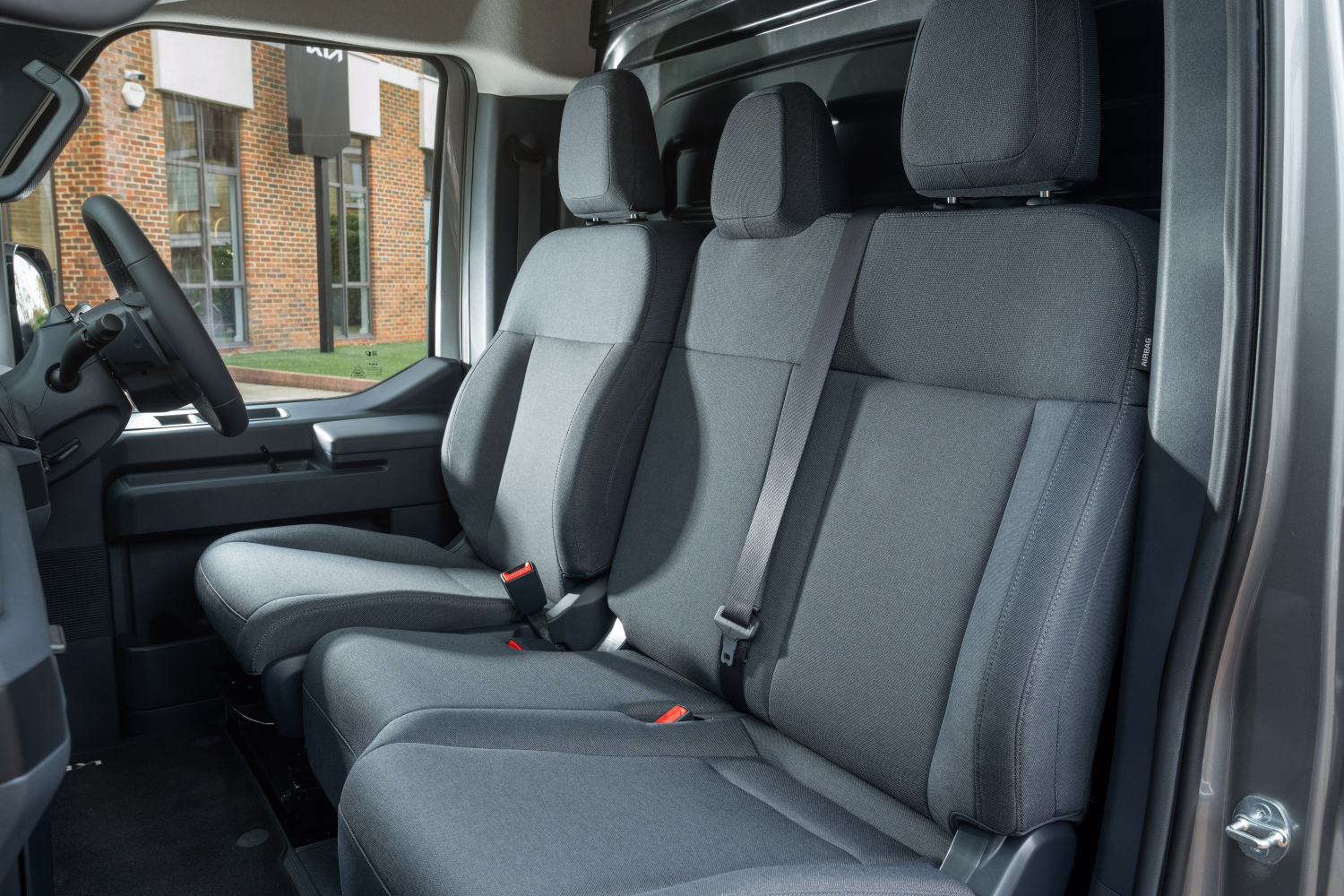
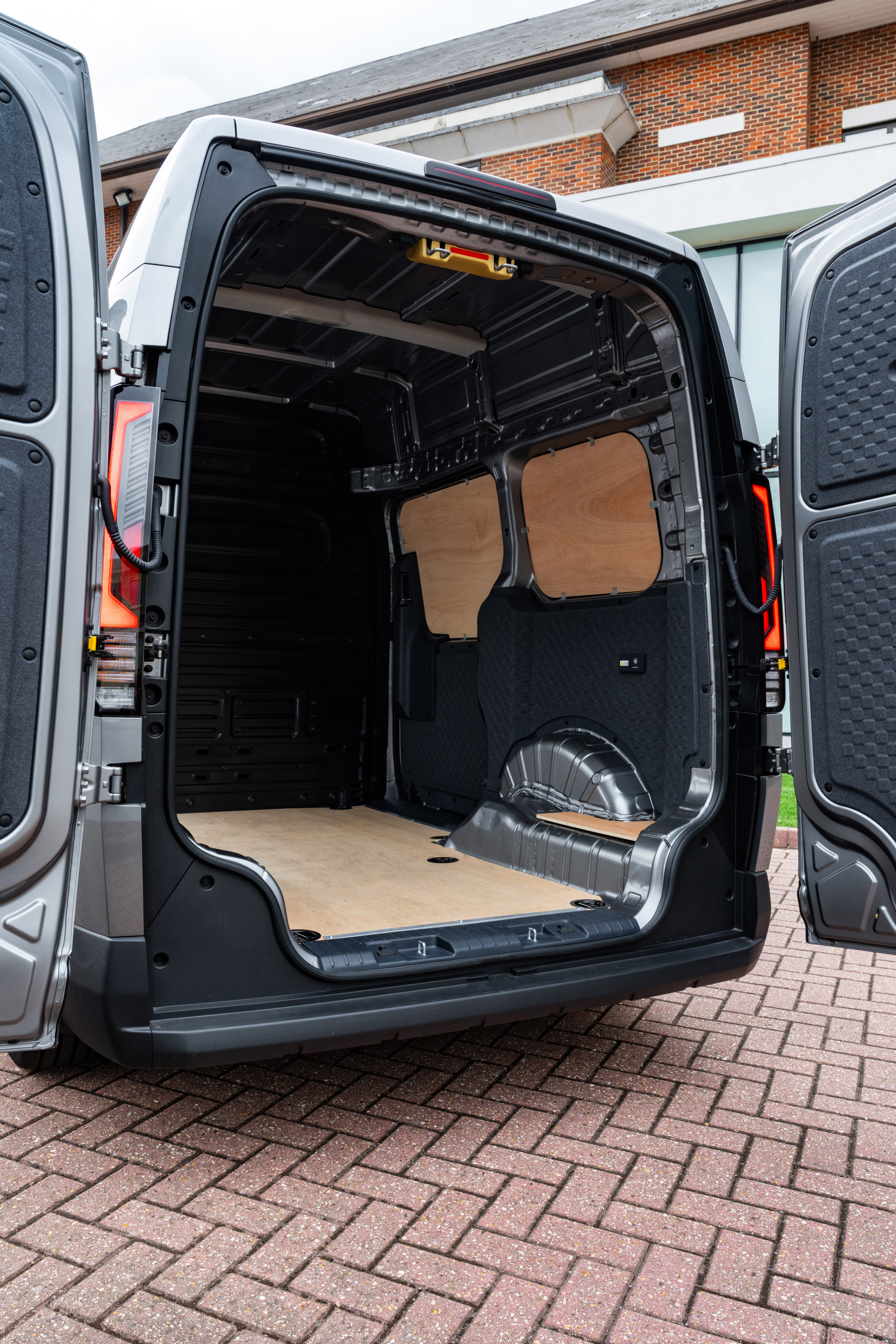
Door count is a real payload decision. Go for three doors with two or three seats and you keep 630 kg; the four-door version adds dual sliding doors but drops the maximum to 600 kg. Towing is 1,500 kg either way.
Warranty is another number worth checking before you commit: Kia's PV5 Cargo material in other markets lists an 8-year/160,000 km warranty, a handy benchmark when you compare running costs with a diesel van (source: kia.com). Confirm the exact UK terms with your dealer before signing.
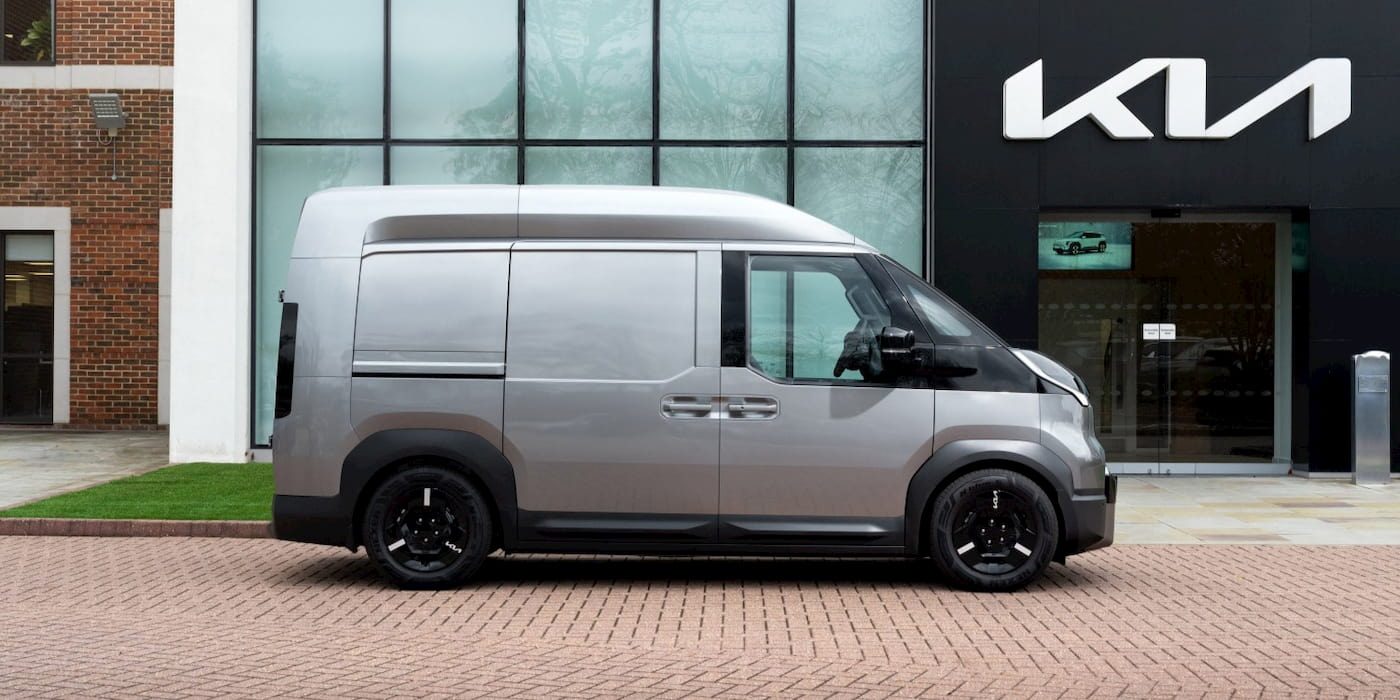 Kia PV5 Cargo L2/H2 (Source: Kia)
What does the Cargo L2/H2 cost on the road?
Entry to this body style is the PV5 Cargo L2/H2 Essential two-seat at £35,016 ($46,700) on the road including ZEVG. The Cargo L2/H2 follows the same UK battery rule: 71.2 kWh only, good for a WLTP range of up to 239 miles. Inside it matches the rest of the PV5 family with a 12.9″ touchscreen navigation screen and a 7.5″ driver display.
| Variant | Battery | Basic Price (+VAT) | ZEVG | On-the-road (including ZEVG) |
|---|---|---|---|---|
| PV5 Cargo L2/H2 'Essential' two-seat LR | 71.2kWh | £32,355 | £5,000 | £35,016 |
| PV5 Cargo L2/H2 'Essential' three-seat LR | 71.2kWh | £32,355 | £5,000 | £35,016 |
| PV5 Cargo L2/H2 'Plus' two-seat LR | 71.2kWh | £33,355 | £5,000 | £36,216 |
| PV5 Cargo L2/H2 'Plus' three-seat LR | 71.2kWh | £33,355 | £5,000 | £36,216 |
| PV5 Cargo L2/H2 'Plus Walk Through' LR | 71.2kWh | £34,425 | £5,000 | £37,500 |
Kia PV5 Cargo L2/H2 prices in the UK by trim
Which one fits your job? A practical pick list
Match the body to the load, not the badge: specialist trades should start with the Chassis, high-volume couriers with the Cargo L2/H2.
- Chassis with Dropside — £40,110: up to 633 kg payload, flat deck, the simplest general-purpose build.
- Chassis with Tipper — £41,310: 561 kg payload; choose it for aggregates and waste where a tip bed earns its keep.
- Cargo L2/H2 Essential two-seat — £35,016: 5.2 cubic meters, 1,815mm internal height and up to 239 miles of range, the volume-per-pound pick.
- Cargo L2/H2 Plus Walk Through — £37,500: the same battery with a through-loading layout for crews that move in and out all day.
Common pitfalls before you place the order
The two biggest traps are assuming the grant is automatic and forgetting that the Chassis arrives without a body. GOV.UK states that an eligible van must weigh between 2,500kg and 4,250kg gross vehicle weight and be an approved model, with at least 60 miles of zero-emission range for a full electric van (source: GOV.UK). For a chassis conversion, guidance adds that the completed vehicle — chassis and bodywork together — must meet the criteria (source: NetZeroGo). Ask the dealer to confirm the grant in writing against your finished body, not the bare cab.
Second, the phrase "incomplete vehicle," is doing a lot of work in the Chassis price. Budget for the TGS conversion and its lead time before you compare it with a ready-to-drive Cargo. Third, payload is not fixed across the range: 633 kg for the Dropside, 561 kg for the Tipper, 630 kg for the three-door Cargo and 600 kg for the four-door. Size the van to the load you actually carry.
What to watch next
The spec sheet is settled; the open question is delivery. With the Chassis still dependent on TGS conversion slots and the grant tied to the completed vehicle, the number that will decide this order is not the £32,916 headline but the date your body is signed off. Worth asking your dealer for both before you put a deposit down.
FAQ
Is the £5,000 grant already in the quoted price?
Yes. Both the £32,916 Chassis and the £35,016 Cargo L2/H2 include the expected £5,000 ZEVG, subject to the government's approved-vehicle criteria.
Can I order a smaller battery in the UK?
No. UK buyers get the 71.2 kWh long-range pack only; the 51.1 kWh option is offered in other markets.
How long does a fast charge take?
Roughly 30 minutes from 10% to 80% at up to 120 kW DC. A 10% to 100% session on 11 kW AC takes about 6 hours and 30 minutes.
Which variant carries the most?
The Chassis Dropside is quoted at 633 kg. The Cargo L2/H2 takes 630 kg with three doors or 600 kg with four, and both can tow 1,500 kg.